sales@wildnetedge.com
 +1 (212) 901 8616
 +1 (437) 225-7733















































































































 ChatGPT Development & Enablement
  Hire AI & ChatGPT Experts
  ChatGPT Apps by Industry
  ChatGPT Blog
  ChatGPT Case study
  AI Development Services
  Industry AI Solutions
  AI Consulting & Research
  Automation & Intelligence





That’s where IT outsourcing services come in. Instead of building everything from scratch internally, you bring in outside experts to handle part or all of your technology needs. It’s become a common move for companies of every size, from small startups to large enterprises worldwide.
Running a business in 2026 means dealing with technology whether you want to or not. Every company needs software that works, systems that stay online, and data that stays safe. The problem is that hiring a full in-house IT team is expensive, and finding the right people takes time most businesses don’t have.
Key Takeaways
- IT outsourcing involves employing an external team to perform tasks such as development, support, security, or infrastructure, rather than setting up an internal team.
- The most common types of outsourcing include offshore, nearshore, onshore, augmentation, project-based, and managed service models.
- It helps you save money, get access to specialists, and free up your internal team to focus on growing the business rather than handling IT problems.
- The pricing model is usually either per hour, per project, or a monthly retainer, depending on the complexity of the task.
- A good outsourcing vendor depends on their experience, communication skills, security measures, and how they explain the contract.
What Is IT Outsourcing?
IT outsourcing means hiring an outside company or individual to handle technology tasks that would otherwise be done by your own staff, including software development, IT support, network management, cybersecurity, and cloud services. Some businesses outsource a single project, like building a new app. Others outsource entire departments, like their help desk or infrastructure management. The scope depends on what your business needs and how much control you want to keep in-house.
What Are the Different Models of IT Outsourcing?
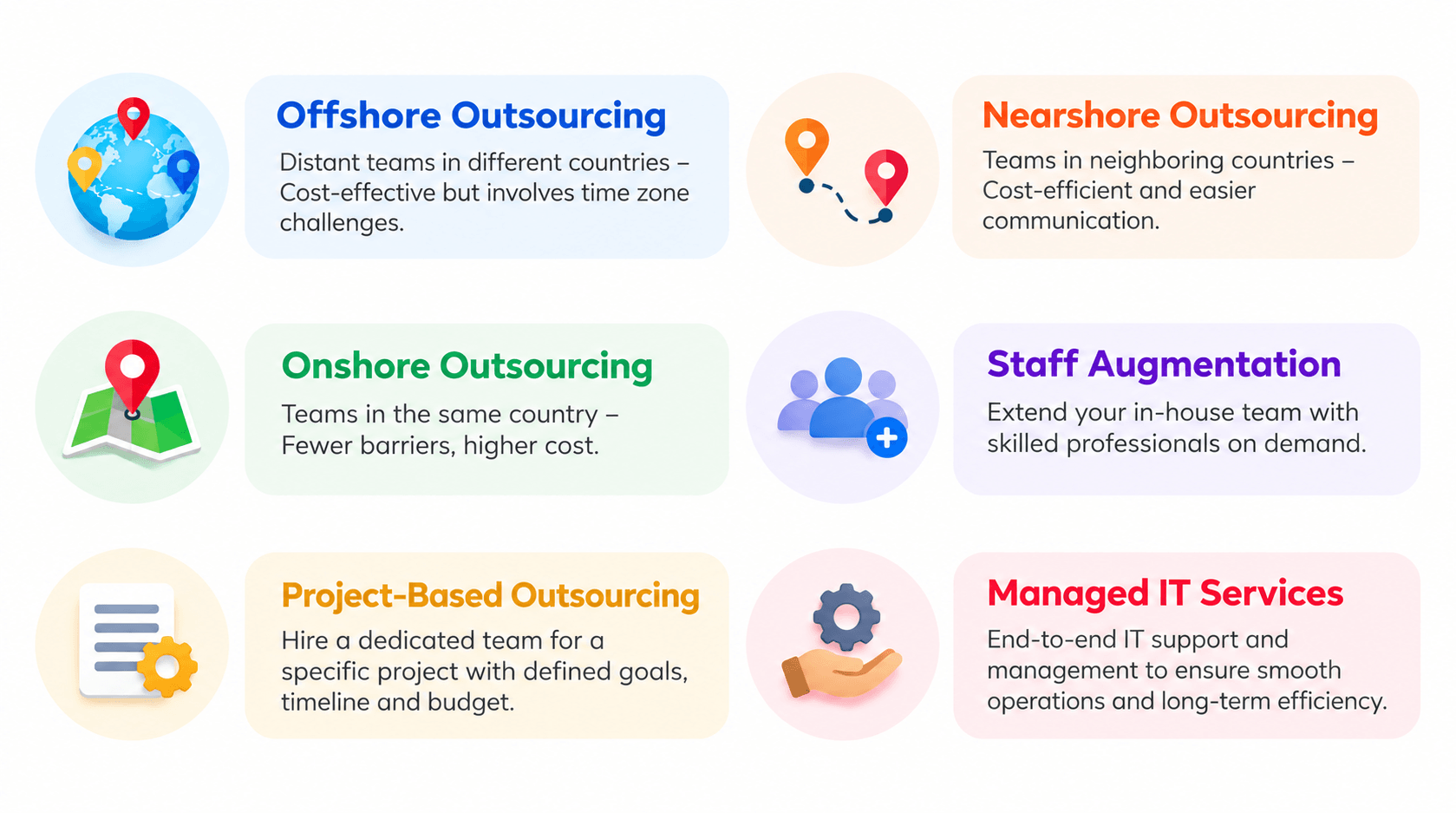
The main models are offshore, nearshore, onshore, staff augmentation, project-based outsourcing, and managed IT services, each offering a different balance of cost, control, and communication ease. Not every business needs the same setup, so here’s a closer look at each one.
| Model | Best For | Cost | Time Zone Fit |
| Offshore Outsourcing | Businesses who care about minimising costs | Lowest | Often not matched |
| Nearshore Outsourcing | Balancing cost and good communication | Moderate | The same or close |
| Onshore Outsourcing | Businesses that want all processes aligned with theirs | Highest | The same |
| Staff Augmentation | Hiring temporary professionals onto your team | Varies per position | Depends on vendor |
| Project-Based Outsourcing | One-time projects with clear scope | Fixed per project | Depends on vendor |
| Managed IT Services | Delegating IT processes to an external partner | Monthly fee | Depends on vendor |
Offshore Outsourcing
Offshore software development means hiring a team based outside your country, usually in a place with a lower cost of living, such as India, the Philippines, or parts of Eastern Europe. It’s usually the cheapest option, although time zone differences can be a challenge.
Nearshore Outsourcing
Nearshore Outsourcing means your partner is based in a neighbouring country, usually in a similar time zone. For a company, this typically means a nearshore partner located in a neighbouring country with a similar time zone.
Onshore Outsourcing
Onshore outsourcing means the work happens inside your own country. You get the benefits of the same time zone, similar work culture, and no language barrier, though you’ll usually pay more for it.
Staff Augmentation
When you need to bring on a temporary professional to join your in-house team, staff augmentation is the approach to use.
Project-Based Outsourcing
The outsourcing partner takes on a specific project from you and completes it. Once the project wraps up, the engagement ends too.
Managed IT Services
This is a long-term arrangement where a provider takes care of your ongoing IT needs, like monitoring your systems, handling support tickets, managing your network, and keeping everything running smoothly. Many businesses choose this model when they want to stop worrying about IT altogether and just have it handled.
What Are the Benefits of IT Outsourcing?
The biggest benefits include lower costs, access to skilled talent, more internal focus time, easier scaling, stronger security, and faster project turnaround. Here’s why each one matters.
Lower Costs
Hiring, training, and retaining an in-house IT team adds up fast when you factor in salaries, benefits, equipment, and office space. Outsourcing lets you pay for what you actually need without carrying all those extra costs.
For businesses comparing outsourcing vs in-house development, these differences in ongoing costs can be an important part of the decision.
Access to Skilled Talent
Good IT talent is hard to find and even harder to keep. When you outsource, you’re not limited to hiring locally. You get access to specialists who already have the experience and certifications needed, without spending months on recruitment.
More Time to Focus on What Matters
When technology issues are handled by someone else, your team can spend their energy on the parts of the business that actually drive growth, like sales, product, and customer relationships, instead of troubleshooting servers.
Scalability
Business needs change. Maybe you need extra support during a busy season, or maybe you’re launching a new product and need a bigger development team for a few months. Outsourcing makes it easy to scale up or down without the hassle of hiring or letting people go.
Stronger Security and Compliance
Cybersecurity threats keep changing, and staying on top of them is a full-time job in itself. Many outsourcing partners specialise in keeping systems secure and helping businesses meet industry regulations, which can be tough to manage alone.
Faster Turnaround
Established outsourcing providers already have the tools, processes, and experience to get projects moving quickly. There’s less time spent figuring things out and more time spent actually building and delivering.
How Expensive Is IT Outsourcing?
The prices on IT outsourcing services depend on the chosen model, the provider’s location, and the nature of work performed. Pricing is usually structured as hourly rates, fixed project prices or monthly retainer prices. Offshore teams often offer cheaper hourly rates than their onshore counterparts, but lower prices don’t necessarily mean better value. Low hourly rates can sometimes mean more time spent on implementation and extra revisions due to communication gaps.
There are three typical pricing models most providers offer:
- Hourly rate is a popular model of pricing small or ongoing projects.
- Fixed project pricing is a common model for those projects that have a well-defined scope.
- Retainer pricing is a model for managed services.
Make sure you understand the cost structure and the scope of included services before signing anything.
How Do You Choose the Right IT Outsourcing Partner?
Choosing the right partner comes down to checking their experience, communication style, process, security practices, client reviews, company size fit, and contract terms. Here’s what actually matters when you’re comparing options.
Consider Their Experience
Request examples of their previous projects, especially ones like your current project. A provider who has handled your kind of project before is likely to handle your project more efficiently than one starting from scratch.
Examine Their Mode of Communication
This company is going to work closely with you, so pay attention to their communication from the first point of contact. Is it clear? Is it timely? Do they ask good questions?
Evaluate Their Process
An efficient outsourcing partner should be able to clearly explain how they manage projects, track progress, and solve problems that come up. If their explanations feel vague, take that as a warning sign.
Ask About Security Practices
Since you may be sharing sensitive data or system access, it’s worth asking directly how they protect information, who has access to what, and what happens if something goes wrong.
Read Reviews and Ask for References
Client feedback tells you things a sales pitch won’t. Reach out to a few past or current clients if possible, and ask them honestly how the partnership has gone.
Make Sure the Size Is Right for You
A huge outsourcing company may not give your small firm much attention, while a tiny team may struggle with a big, complicated project. Choose an outsourcing partner whose size and specialisation actually fit your project.
Ask About Pricing and Contracts
Make sure the contract clarifies what’s covered and what isn’t, how pricing works, and how termination would work if you need to end the agreement. A reputable outsourcing company won’t have a problem discussing these questions openly.
Final Thoughts
Every business has different needs, so what works for one company won’t always work for another. Choosing the right approach means understanding the differences between each model and planning carefully. But when done right, it gives businesses access to skilled talent, cuts costs, and frees up time to focus on growth.
Take the time to compare providers and choose one that treats your business like it’s worth getting right; the payoff shows up in fewer headaches down the road.
FAQs
What is the difference between offshore and nearshore outsourcing?
Offshore outsourcing involves working with an overseas team, usually for cost savings, while nearshore outsourcing means working with a firm in a neighbouring country with a similar time zone.
Is IT outsourcing cheaper than hiring in-house?
In most cases, yes. Outsourcing avoids the ongoing costs of salaries, benefits, equipment, and office space that come with building an in-house team, though the actual savings depend on the model and provider you choose.
What needs to be specified in the IT outsourcing contract?
An effective contract should include the scope of work, pricing, deadlines, security responsibilities, communication expectations, and exit terms in case the relationship doesn’t work out.
How long does it take to onboard an IT outsourcing company?
It varies depending on the provider. An experienced vendor with solid processes can usually onboard within a couple of weeks, while more complex engagements may take longer.

Vidit Kumar is an expert in DevOps and cloud engineering, specializing in building efficient, reliable, and scalable systems for organizations of all sizes. He has deep expertise in automation, cloud infrastructure, and workflow optimization, helping teams streamline operations and improve software delivery processes. Vidit is passionate about mentoring teams and exploring innovative tools that improve software performance and delivery. He believes in blending technical skill with thoughtful problem-solving to create systems that make a real difference. Outside of work, Vidit enjoys experimenting with cloud platforms, learning new technologies, and finding smarter ways to approach engineering challenges.

 based on 1200+ reviews