 sales@wildnetedge.com
 +1 (212) 901 8616
 +1 (437) 225-7733
















































































































 ChatGPT Development & Enablement
  Hire AI & ChatGPT Experts
  ChatGPT Apps by Industry
  ChatGPT Blog
  ChatGPT Case study
  AI Development Services
  Industry AI Solutions
  AI Consulting & Research
  Automation & Intelligence





Key Takeaways
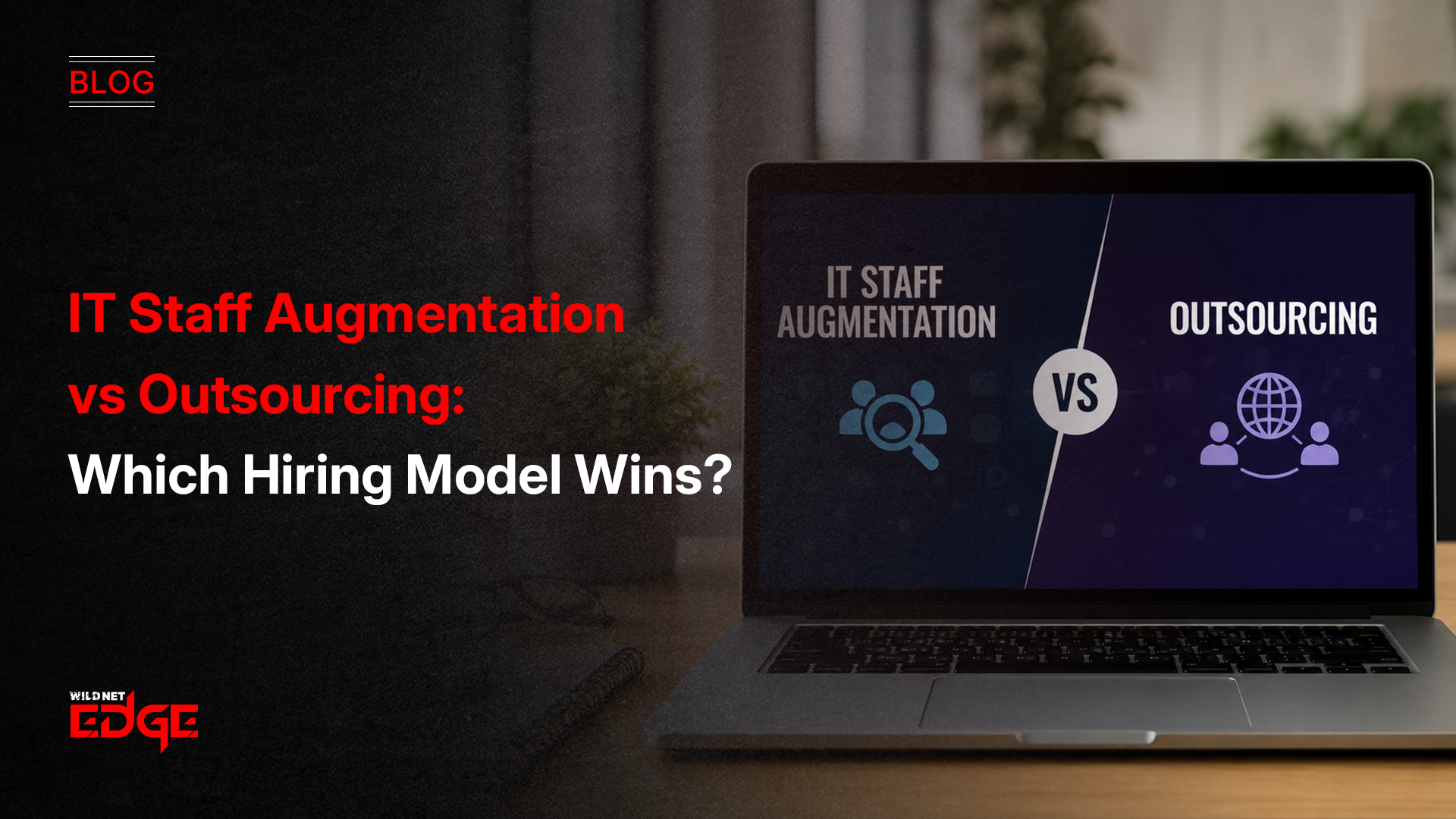
- IT staff augmentation and outsourcing both solve the same problem (external technical capacity) but operate completely differently and suit different project types.
- In staff augmentation, you direct the engineers. In outsourcing, you manage the outcome. That one difference determines cost, IP risk, and long-term knowledge retention.
- Staff augmentation fits ongoing product work, evolving scope, and situations where architectural ownership matters.
- Outsourcing fits well-defined, non-core projects where your team does not have the bandwidth to manage engineers day to day.
- Neither model wins universally. Most companies that scale well use both at different stages of their roadmap.
If you have ever tried to fill a senior engineering role during a product sprint, you already understand the core tension these two models are trying to solve. You need technical capacity now. Permanent hiring takes too long. Freelancers are inconsistent. So you look at the IT staff augmentation vs outsourcing debate and find two options that sound similar on the surface but work very differently in practice.
That difference matters a lot. Choosing the wrong model for your project type is one of the more expensive IT decisions a business can make because the costs of misalignment show up months after the contract is signed, in rework, missed timelines, and technical debt your internal team inherits.
This guide gives you a clear, practical breakdown of how each model works, where each one produces better outcomes, and the specific variables that should drive your decision.
How Each Model Actually Works
Both models bring external technical talent into your business. Everything else about them is different.
- IT staff augmentation adds external engineers directly to your existing team. They work inside your sprint cycles, use your project management tools, follow your technical standards, and report to your internal leads. The augmentation vendor handles their employment contract, payroll, and HR. You handle the direction of their work. They are, in every practical sense, part of your team for the duration of the engagement.
- IT outsourcing assigns a project or function to a third-party vendor who takes delivery responsibility. The vendor or the IT outsourcing company staffs the project with their own team, follows their own internal processes, and reports back to you at defined milestones. You define the requirements and the expected output. They determine how to get there.
The clearest single-sentence distinction: in staff augmentation, you manage the engineers. In outsourcing, you manage the outcome.
Where They Differ in Practice
| Factor | Staff Augmentation | IT Outsourcing |
|---|---|---|
| Who manages daily work | You | The vendor |
| Control over process | Full | Limited |
| IP visibility during build | Continuous | At milestones |
| Knowledge stays in-house | Yes | Depends on handoff |
| Scope flexibility | High | Low without change orders |
| Time to start | 1 to 2 weeks | 2 to 6 weeks (scoping required) |
| Best for | Ongoing product, evolving scope | Fixed deliverable, non-core work |
Control and Day-to-Day Ownership
Staff augmentation keeps every technical decision inside your organization. Your tech lead or engineering manager reviews work, sets priorities, and makes architectural calls. The external engineers operate within that structure. When the engagement ends, the institutional knowledge built during that period stays with your team.
Outsourcing shifts day-to-day control to the vendor. They make the engineering decisions. You see output at checkpoints. That works well when scope is tight and well-documented. It creates problems when requirements shift mid-project, because every change to the scope after the statement of work is signed typically triggers a change order, additional cost, and timeline renegotiation.
IP and Code Visibility
When augmented engineers work inside your codebase, your team reviews every pull request. Your quality standards govern what gets merged. Problems surface during development, when they are cheap to fix.
In outsourcing, the vendor builds in their own environment. You receive the codebase at milestones or final delivery. The code reflects decisions made by engineers you did not supervise, using standards you did not set. With a capable vendor and explicit contract requirements for documentation, this is manageable. Without those protections, businesses frequently inherit codebases they cannot fully understand or maintain without going back to the same vendor.
Both models can produce clean IP ownership with the right contract terms. Staff augmentation gives you visibility into how that IP is being built throughout the engagement, which is a meaningful operational difference.
Knowledge Retention After the Engagement Ends
This is the factor most businesses underestimate when they compare the two models purely on price.
When augmented engineers work alongside your team for several months, knowledge transfers organically. Your engineers see how problems get solved, learn framework-specific approaches, and absorb architectural thinking. That knowledge stays when the engagement closes.
When a project is fully outsourced, the working knowledge of how the system was built lives with the vendor’s team. Knowledge transfer at handoff is contractually required in well-structured engagements but is frequently treated as an afterthought in practice. Businesses that outsource core product components sometimes spend significant time and budget re-learning their own architecture when they need to modify or extend the system later.
IT Staff Augmentation vs Outsourcing: When One Favors The Other
These are the situations where working with an IT staff augmentation company consistently produces better outcomes than outsourcing.
- Your team has a defined skill gap for a defined period. You have solid engineers but need a senior cloud architect or a machine learning specialist for a six-month initiative. Augmentation fills that gap without a permanent hire and without handing over delivery accountability.
- The project scope is likely to change. Most product development involves evolving requirements. Augmented engineers adapt inside your process as priorities shift. Outsourcing contracts price scope changes as separate line items, and renegotiating mid-project is time-consuming and expensive.
- Architectural ownership is important to you. If the product is core to your business, the decisions made during development will affect your team for years. You want those decisions made by people your tech lead can direct and review in real time.
- You are scaling an engineering team quickly. Growing a team from eight engineers to twenty through traditional hiring takes months per role. Augmented engineers can be onboarded in one to two weeks without the long-term headcount commitment.
When IT Outsourcing Services Make More Sense
IT Outsourcing Services are the better fit in a different set of circumstances.
- The scope is tightly defined and unlikely to change. A legacy system migration, a compliance-focused infrastructure rebuild, or a customer portal with documented requirements. When the specification is complete before work starts, outsourcing works efficiently.
- Your team does not have the bandwidth to manage engineers. Staff augmentation requires active management from your side. If your tech leads are already overloaded, adding engineers without effective direction adds headcount without adding output. Outsourcing removes that management requirement.
- The work requires specialized expertise your team does not have and does not need long-term. A cybersecurity audit, a one-time ERP implementation, or a data center migration. A vendor with deep specialization in that domain will deliver more reliably than a generalist augmented team working outside their core experience.
The Costs Neither Quote Tells You About
Both models carry operational costs that do not appear on the proposal.
With staff augmentation, the real overhead is management time. Your tech lead or engineering manager needs to direct the augmented engineers, review their work, and integrate them into team processes. If that bandwidth does not exist internally, the engagement underperforms regardless of how good the engineers are.
With outsourcing, scope change fees are the most common surprise. Contracts are priced on a defined scope. Every requirement that evolves after signing triggers a change order. Communication overhead, particularly with vendors across significant time zones, adds coordination cost that does not show up in hourly rate comparisons. And knowledge transfer at project close, unless explicitly required in the contract with clear deliverables, often does not happen in any useful form.
Total cost of ownership for either model includes these operational realities, not just the invoice.
A Decision Framework That Actually Works
Most businesses overcomplicate this decision. Four questions get you to the right answer in most situations.
- How much do you need to control the day-to-day engineering process? High control needs points to staff augmentation. Low control needs, combined with a capable vendor, makes outsourcing viable.
- How well-defined is the scope going into the engagement? Evolving or ambiguous scope favors augmentation because it adapts inside your process. Fixed, fully documented scope makes outsourcing a reasonable choice.
- Does your team have the bandwidth to manage engineers? If yes, augmentation gives you more control and better knowledge retention. If not, outsourcing is worth the tradeoff.
- Is this work core to your product or peripheral? Core product work almost always favors augmentation for the knowledge retention reason alone. Peripheral or one-time work is a reasonable candidate for outsourcing
Using Both Models Is a Strategy, Not a Compromise
The framing of IT staff augmentation vs outsourcing as a binary choice misrepresents how most well-run technology organizations actually operate. Companies that scale well tend to use both models, applying each where it fits rather than applying one everywhere.
A product team might run augmented engineers for ongoing feature development while outsourcing a compliance infrastructure project to a specialist vendor simultaneously. The models address different needs and do not compete with each other when they are scoped correctly.
What creates problems is making the model decision based on price alone or based on familiarity rather than fit. The cheaper option at contract signing frequently becomes the more expensive option at delivery when the model was wrong for the project type.
Picking the Right Model Means Being Honest About What Your Project Actually Needs
Staff augmentation wins when control, adaptability, and knowledge retention matter. Outsourcing wins when scope is fixed, internal management capacity is limited, and delivery accountability to a vendor is more practical than directing engineers in-house.
The businesses that consistently get this right are the ones that assess each engagement honestly against those variables rather than defaulting to whichever model they used last time.
At Wildnet Edge, we work with businesses at both ends of this decision. If you want to think through which model fits your current project, or whether a hybrid approach makes sense, that is a conversation worth having before you sign anything. Let’s talk.
FAQs
In staff augmentation, external engineers work inside your team under your direction. In outsourcing, a vendor takes responsibility for delivering a defined outcome using their own team and processes. The difference is who manages the engineers and where technical decisions are made.
Staff augmentation gives you continuous control because your team directs the work, reviews code, and makes architectural decisions throughout. Outsourcing gives you control over requirements and acceptance criteria but not over how the work gets done between milestones.
Per-engineer rates in staff augmentation are often higher than outsourced project rates, but the total cost comparison depends on project type. Augmentation avoids scope change fees, rework costs, and knowledge transfer gaps that frequently inflate outsourcing costs on long or evolving projects.
When a vendor builds in their own environment, you receive the codebase at milestones rather than seeing it developed continuously. Without explicit contract terms covering documentation standards, code review rights, and handoff requirements, you can end up owning code you cannot maintain independently.
Yes. Many technology organizations run augmented teams for core product development and outsource specific, well-defined projects to specialist vendors simultaneously. The two models serve different purposes and are not mutually exclusive.

Managing Director (MD) Nitin Agarwal is a veteran in custom software development. He is fascinated by how software can turn ideas into real-world solutions. With extensive experience designing scalable and efficient systems, he focuses on creating software that delivers tangible results. Nitin enjoys exploring emerging technologies, taking on challenging projects, and mentoring teams to bring ideas to life. He believes that good software is not just about code; it’s about understanding problems and creating value for users. For him, great software combines thoughtful design, clever engineering, and a clear understanding of the problems it’s meant to solve.

 based on 1200+ reviews



