 sales@wildnetedge.com
 +1 (212) 901 8616
 +1 (437) 225-7733
















































































































 ChatGPT Development & Enablement
  Hire AI & ChatGPT Experts
  ChatGPT Apps by Industry
  ChatGPT Blog
  ChatGPT Case study
  AI Development Services
  Industry AI Solutions
  AI Consulting & Research
  Automation & Intelligence





Key Takeaways
- In 2026, the Gemini vs ChatGPT debate has shifted from basic chat capabilities to “Context Leadership.” Gemini’s 2M+ token window makes it the superior choice for massive enterprise data analysis.
- Gemini development services are now the primary choice for businesses deeply integrated into the Google Cloud (Vertex AI) ecosystem, offering native multi-modal processing of video and code.
- ChatGPT remains a strong contender for creative iteration and logic-heavy reasoning, but enterprises often seek Gemini alternatives when data residency and massive context are the primary drivers.
- The most effective approach in 2026 is often a hybrid one using ChatGPT for consumer-facing creative content and Gemini development services for complex, data-intensive backend automation.
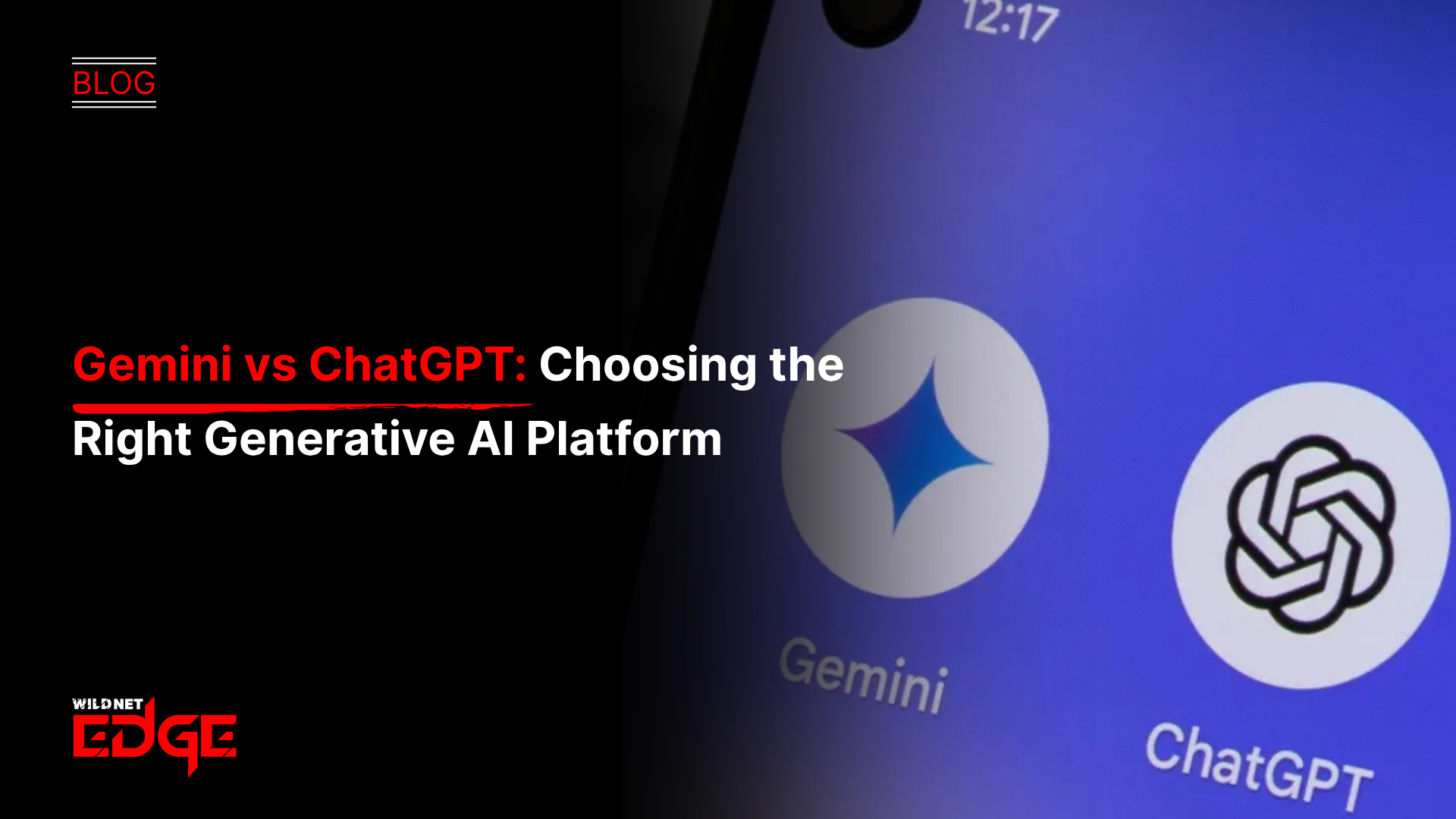
Choosing between Gemini vs ChatGPT is no longer just a choice of “which chatbot is smarter.” It is a strategic decision about which infrastructure will power your company’s intelligence. While ChatGPT revolutionized the market, Google’s Gemini has rapidly evolved into a multi-modal powerhouse integrated into the world’s most popular productivity suite.
Instead of looking for a “winner,” businesses must perform a rigorous AI model comparison to determine:
- Which model handles their specific data volume?
- Which ecosystem (Google vs. OpenAI/Microsoft) fits their existing stack?
- Where can specialized Gemini development services provide a competitive moat?
The goal is to move past the hype and select the platform that solves your specific business friction.
Why Businesses Look for Gemini Alternatives
Companies rarely switch between Gemini and ChatGPT without a technical or financial catalyst. The shift usually follows specific requirements in a generative AI comparison.
1. Context Window and Data Volume
Gemini’s massive context window (allowing for millions of tokens) allows it to “read” entire codebases or legal libraries in one go. For many, this makes ChatGPT feel limited, pushing them toward Gemini AI Integration Services for large-scale document reasoning.
2. Speed of Multi-Modal Execution
While ChatGPT can see and hear, Gemini was built from the ground up as a multi-modal model. In a generative AI comparison, Gemini often performs faster when analyzing live video or high-density technical schematics, making it a favourite for industrial AI.
3. Knowledge Sovereignty and Integration
Businesses already on Google Workspace find Gemini’s native integration into Docs, Sheets, and Gmail more seamless. Reducing the “Toggle Tax” between apps is a major reason enterprises choose Gemini over other Gemini alternatives.
Top Generative AI Platforms Explained
Here is a structured AI model comparison of the two most common enterprise choices in 2026.
1. Google Gemini vs. ChatGPT (OpenAI)
This is the primary evaluation for 90% of enterprises today.
Google Gemini
- Massive Context: Up to 2M+ tokens for heavy data reasoning.
- Google Cloud Native: Deeply integrated into Vertex AI for developers.
- Multi-Modal First: Built to process video, audio, and text simultaneously.
- Best For: Enterprise data analysis and technical automation.
ChatGPT (OpenAI)
- Logic & Reasoning: Often cited as having a slight edge in nuanced creative writing.
- Plugin Ecosystem: Large third-party marketplace for consumer-facing apps.
- Market Familiarity: Highly intuitive UI for non-technical staff.
- Best For: Creative content, customer service bots, and general-purpose assistance.
In the Gemini vs ChatGPT debate, Gemini works best for deep, technical “Intelligence Ops.” ChatGPT remains a leader for “Surface-Level” creative agility.
2. In-House Models (The “Build” Alternative)
Some companies choose to build their own Gemini alternatives using open-source cores like Llama 4 or Mistral.
Advantages:
- Total data privacy.
- No per-token API costs.
Limitations:
- High compute costs (GPU requirements).
- Need for specialized Gemini development services to tune the models.
3. Fractional AI Advisory Model
When a business can’t decide on Gemini vs ChatGPT, they bring in fractional AI architects. They provide vendor-neutral guidance on which generative AI comparison metrics actually matter for the company’s P&L.
4. Hybrid AI Model (Most Common in 2026)
High-performing organizations rarely pick just one side of the Gemini vs ChatGPT line.
They combine:
- Gemini development services for analyzing global supply chain data.
- ChatGPT for generating marketing copy and social media engagement.
- Open-source models for localized, high-security edge processing.
AI Model Comparison: Choosing the Right Engagement Model
Selecting the right platform depends on your primary “Job to be Done.”
| Feature | Google Gemini | ChatGPT (OpenAI) | Llama/Open Source |
| Context Window | 1M – 2M+ Tokens | 128k – 256k Tokens | Variable (Hardware dependent) |
| Cloud Integration | Google Vertex AI | Microsoft Azure / OpenAI | On-Premise / Private Cloud |
| Primary Strength | Multi-modal / Data Volume | Creative Logic / Ecosystem | Privacy / Cost Control |
| Best For | Heavy Engineering / BI | Marketing / Support | Sensitive R&D |
Making the Right Decision for Your Business
Before you commit to Gemini AI Integration Services or an OpenAI contract, evaluate these five drivers:
1. Growth Stage
Early-stage startups often use ChatGPT for speed. Scaling enterprises usually pivot to Gemini vs ChatGPT analysis once they need to process petabytes of private corporate data through an comparison of AI model.
2. Internal Talent Maturity
Does your team know how to manage Google Cloud Vertex AI? If you have a “Google-Shop” workforce, Gemini AI Integration Services will have a much shorter learning curve than external alternatives in Gemini.
3. Risk Tolerance
In the comparison of generative AI, where does your data go? In Gemini vs ChatGPT, if you require strict “Geopatriation,” you may need the enterprise-grade sovereign cloud options offered by Google’s Gemini AI Integration Services.
4. Budget Structure
OpenAI often relies on token-based pricing. Google offers tiered enterprise agreements. Perform a comparison of generative AI to see which matches your predictable operational spend.
5. Speed Requirements
If you need to deploy a chatbot today, ChatGPT is the fastest. In Gemini vs ChatGPT, if you need to build a custom AI-native product that replaces a manual engineering process, Gemini AI Integration Services are the way to go.
Case Studies
Case Study 1: The Multi-Modal Shift (Logistics)
- Problem: A global shipping firm was using ChatGPT to summarize reports, but the model couldn’t handle their 2,000-page manifest files or video logs of cargo loading.
- Solution: We implemented Gemini AI Integration Services, leveraging the 2M context window and multi-modal vision to analyze entire shipping journeys in one pass.
- Result: Manifest processing time dropped by 90%. The company moved away from creative-led AI to data-led AI.
Case Study 2: Hybrid AI Success (E-commerce)
- Problem: A retail giant was overpaying for OpenAI tokens for simple data sorting while missing out on Google’s workspace integrations.
- Solution: They adopted a Hybrid Model: ChatGPT for their customer-facing “Style Assistant” and Gemini AI Integration Services for their backend inventory forecasting.
- Result: Overall AI spend dropped by 30% while forecasting accuracy improved by 15% due to Gemini’s superior data context.
Conclusion
In 2026, the Gemini vs ChatGPT debate isn’t about which model is “better”, it’s about which one fits your architecture. ChatGPT remains the king of creative intuition, while Gemini AI Integration Services dominate the world of high-scale, multi-modal enterprise data.
At Wildnet Edge, we help you choose the right path. We use AI-driven diagnostics to determine your technical needs, helping you decide when to stick with the status quo and when to pivot to specialized Gemini AI Integration Services
FAQs
In 2026, developers often prefer Gemini AI Integration Services for projects requiring large context windows (like code refactoring) and native Google Cloud integration.
It depends on the volume. ChatGPT is often cheaper for low-volume, short-text tasks, while Gemini becomes more efficient for high-scale, document-heavy enterprise workflows.
The top alternatives to Gemini for total privacy are open-source models like Llama 4 or Mistral, hosted on your own private cloud or local hardware.
Yes. Through Google Cloud’s Vertex AI, Gemini AI Integration Services can be configured for HIPAA compliance, making it a preferred choice for healthcare AI.
The “Context Window.” Gemini can process significantly more data in a single request than ChatGPT, which is a game-changer for long-form analysis.
Absolutely. Many businesses use a hybrid approach to get the creative strengths of ChatGPT and the analytical scale of Gemini AI Integration Services.
Because the wrong model can lead to “Technical Debt.” A comparison of AI models ensures you don’t build a product on an infrastructure that can’t scale with your data needs.

Managing Director (MD) Nitin Agarwal is a veteran in custom software development. He is fascinated by how software can turn ideas into real-world solutions. With extensive experience designing scalable and efficient systems, he focuses on creating software that delivers tangible results. Nitin enjoys exploring emerging technologies, taking on challenging projects, and mentoring teams to bring ideas to life. He believes that good software is not just about code; it’s about understanding problems and creating value for users. For him, great software combines thoughtful design, clever engineering, and a clear understanding of the problems it’s meant to solve.

 based on 1200+ reviews



