 sales@wildnetedge.com
 +1 (212) 901 8616
 +1 (437) 225-7733
















































































































 ChatGPT Development & Enablement
  Hire AI & ChatGPT Experts
  ChatGPT Apps by Industry
  ChatGPT Blog
  ChatGPT Case study
  AI Development Services
  Industry AI Solutions
  AI Consulting & Research
  Automation & Intelligence





Key Takeaways
- Inhouse IT VS Outsourcing is not a question with one right answer. It depends on your project type, budget, timeline, and how central software is to your business model.
- In-house developers in the US cost $200,000 to $240,000 per year in total compensation. Outsourcing to Eastern Europe or Latin America typically costs $55,000 to $115,000 for equivalent output.
- 66% of US businesses outsource at least one department, including Google, Apple, Slack, WhatsApp, and IBM.
- Regulated industries including healthcare, finance, and defense have specific compliance obligations that must be contractually passed through to any outsourcing partner.
- Offshore IT outsourcing can reduce development costs by up to 60% compared to Western market rates, but time zone gaps of 8 to 12 hours make real-time collaboration difficult for most product teams.
- The hybrid model, a core in-house team supported by outsourced specialists, is the structure most scaling businesses land on.
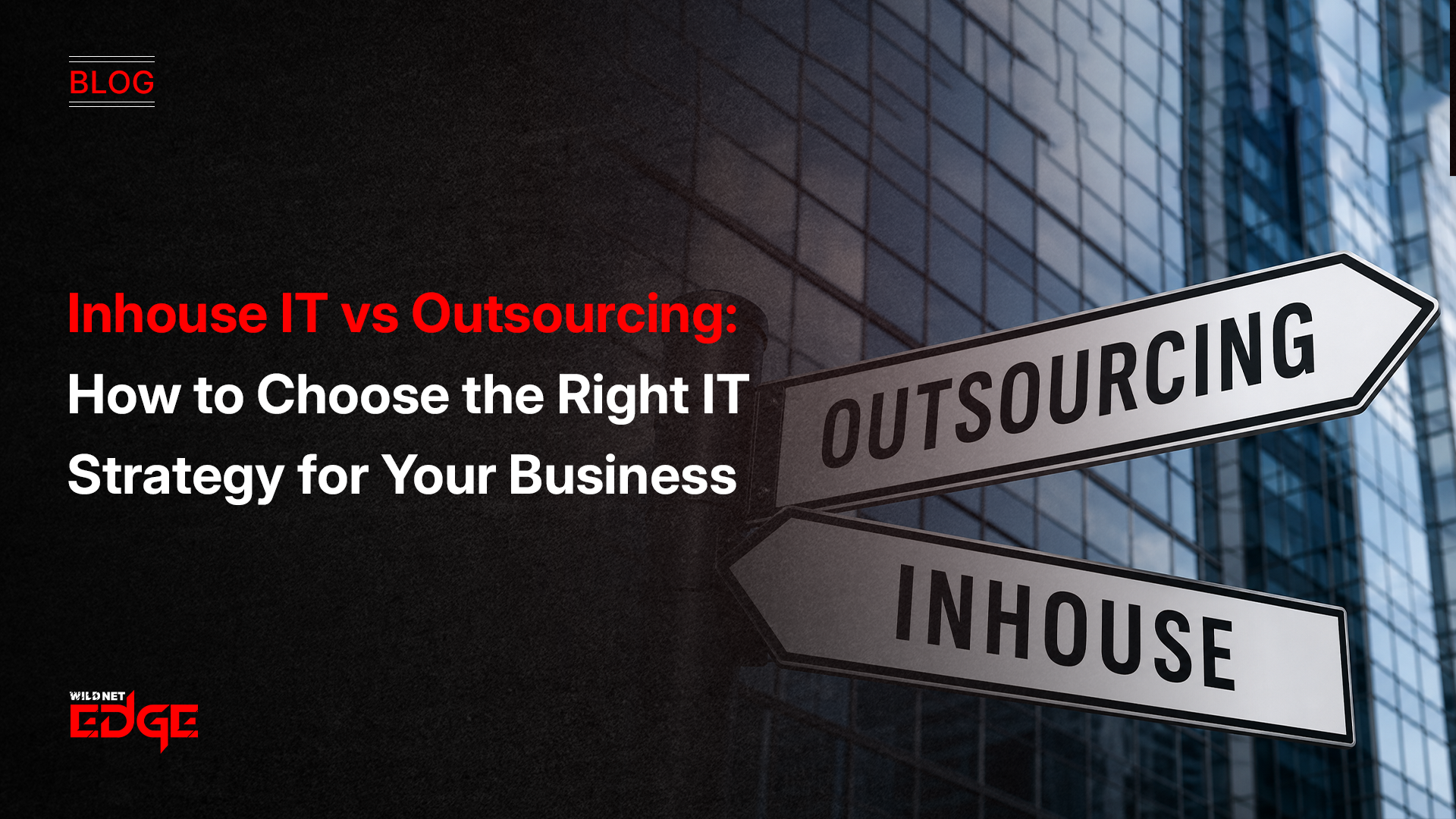
You are three months from a product launch. Your internal team is maxed out. Leadership wants to know whether to hire two senior engineers or bring in an outsourced team to carry the sprint.
This is the decision in its most compressed form. And the wrong call in either direction has real consequences: over-hire for a short sprint and you carry headcount you cannot justify afterward; outsource the wrong workstream and you hand over architectural control you cannot easily get back.
The goal of this blog is to give you the information to make that call accurately, not just directionally. That means real cost numbers, honest tradeoffs, compliance requirements by industry, and a look at what the hybrid approach actually looks like in practice.
What Each Model Actually Means
Before comparing the two, it is worth being precise about what each one involves, because both terms get used loosely.
- In-house development means hiring engineers as full-time employees who work exclusively for your company, sit inside your team structure, and accumulate deep institutional knowledge of your product over time. You own the hiring process, the employment relationship, the salary, the benefits, the tools, and the management overhead. Everything is internal.
- IT outsourcing means contracting external teams, agencies, or individual contractors to handle part or all of your development work. This can take three geographic forms:
- Onshore outsourcing means working with a team in your own country. Communication is clean and cultural alignment is natural, but costs are close to in-house rates.
- Nearshore outsourcing means working with teams in neighboring regions with overlapping time zones. For US companies this typically means Latin America.
- Offshore IT outsourcing means working with teams in geographically distant countries, usually Asia or Eastern Europe. Rates are significantly lower but time zone differences of 8 to 12 hours make synchronous collaboration genuinely difficult.
The key functional difference between the two models: with in-house, you manage the people. With outsourcing, you manage the outcome.
Inhouse IT VS Outsourcing: How They Compare Side by Side
| Factor | In-House Development | IT Outsourcing |
|---|---|---|
| Total annual cost (US, senior) | $200,000–$240,000 per engineer | $55,000–$115,000 equivalent output |
| Time to hire | 42 to 59 days average | 1 to 4 weeks |
| Control over process | Full | Varies by model |
| IP and code ownership | Always internal | Requires clear contract terms |
| Knowledge retention | High, accumulates over time | Depends on documentation |
| Scalability | Slow, limited by hiring cycles | Fast, can scale in weeks |
| Best for | Core product, long-term roadmap | Defined scope, niche skills, speed |
| Management burden | High internally | Lower, shared with vendor |
| Compliance control | Easier to enforce | Must be contracted through |
Benefits of In-House Development
- Deep product knowledge: In-house engineers learn your architecture, your codebase, and your product decisions over time. That accumulated context is hard to replicate and produces better decisions as the product matures.
- Full process control: Your engineering manager sets the standards, the processes, and the pace. Nobody is working to a vendor’s timeline or a different team’s priorities.
- Cultural alignment: Engineers who sit inside your organization understand the business goals, the stakeholder dynamics, and the product vision at a level that external teams rarely match.
- IP stays internal: Every line of code, every architectural decision, every piece of documentation stays within the organization by default.
- Faster internal communication: No coordination overhead, no time zone gaps, no context-switching between your team and an external one.
Benefits of Outsourcing IT Services
- Immediate access to specialized skills. When you need a machine learning engineer or a DevOps specialist for a six-month project, outsourcing lets you bring that expertise in without a permanent hire.
- Lower total cost, particularly offshore. Outsourcing companies report up to 40% cost savings compared to an in-house team, and offshore IT outsourcing to countries like India can reduce development costs by up to 60% compared to Western markets.
- Speed. Finding an outsourcing partner takes one to four weeks, versus 42 to 59 days to fill an engineering role internally through traditional hiring.
- No long-term headcount commitment. You scale up for a project and scale back when it wraps. No severance, no idle headcount, no organizational restructuring required.
- Access to a remote IT team globally. You are not limited by your local talent market. A company in Chicago can access backend specialists in Warsaw, mobile engineers in Medellín, and QA automation teams in Bangalore simultaneously.
In-House Development
| Pros | Cons |
|---|---|
| Full control over process and quality | High total cost per engineer |
| Deep institutional knowledge | 42 to 59 days average time to hire |
| Stronger cultural and brand alignment | Limited talent pool by geography |
| IP retained without contractual complexity | Carries headcount risk during low-demand periods |
| Easier compliance enforcement | Slow to scale up or down |
| Better for complex, evolving products | Training and development overhead |
IT Outsourcing
| Pros | Cons |
|---|---|
| 40 to 60% lower cost than in-house | Less control over day-to-day process |
| Access to global specialized talent | IP risk without clear contract terms |
| Scales up or down in weeks | Communication gaps across time zones |
| No long-term employment commitment | Knowledge walks out when engagement ends |
| Faster project start | Quality varies significantly by vendor |
| No recruitment overhead | Compliance requires explicit contractual coverage |
What IT Services Can Be Outsourced
Here is what businesses most commonly and successfully outsource, and where caution is warranted.
Commonly outsourced successfully:
- Software development (web, mobile, backend, frontend)
- QA and testing automation
- Cloud infrastructure management and DevOps
- Cybersecurity monitoring and managed security services
- IT helpdesk and outsourced IT support services
- Data engineering and analytics pipelines
- UI/UX design
- ERP and CRM implementation
Outsourcing Regulations by Industry
If your business operates in a regulated industry, compliance obligations do not stop at your organization boundary. They extend to every vendor and outsourcing partner that touches your data or systems. These requirements must be contractually passed through.
Healthcare
Any outsourcing partner that handles Protected Health Information (PHI) must sign a Business Associate Agreement (BAA) before any work begins. This is a non-negotiable HIPAA requirement. The BAA defines the partner’s obligations for data protection, breach notification, and permitted uses of PHI. Violations carry civil penalties of up to $1.9 million per violation category per year.
Key outsourcing compliance requirements for healthcare:
- Signed BAA with every vendor touching PHI
- Encryption of PHI at rest and in transit
- Access controls limiting PHI access to authorized personnel only
- Breach notification timelines (60 days for HIPAA)
- Data residency controls if applicable
Financial Services
Financial services outsourcing partners must comply with PCI DSS if they handle cardholder data, SOX controls if they touch financial reporting systems, and GLBA requirements for customer financial information. In the EU, DORA (Digital Operational Resilience Act) now requires financial entities to formally document and monitor all third-party IT providers.
Key outsourcing compliance requirements for financial services:
- Contractual PCI DSS compliance obligation for any partner handling payment data
- Annual vendor risk assessments
- Right-to-audit clauses in outsourcing contracts
- Operational resilience testing requirements under DORA
- Data processing agreements covering GDPR if EU customer data is involved
Government and Defense
US defense contractors using outsourced IT services must comply with CMMC (Cybersecurity Maturity Model Certification) requirements, with Level 2 enforcement active from November 2026. Only 8% of contractors requiring CMMC Level 2 are currently certified. Any outsourcing partner touching Controlled Unclassified Information (CUI) must also meet the relevant CMMC level.
Key outsourcing compliance requirements for defense:
- CMMC level certification verified for any partner touching CUI
- NIST SP 800-171 controls documented and enforced
- No offshore IT outsourcing for CUI without specific government authorization
- Flow-down clauses passing CMMC obligations to subcontractors
Retail and E-commerce
Any outsourcing partner that processes, stores, or transmits cardholder data is subject to PCI DSS. Non-compliance can result in fines, increased transaction fees, and loss of the ability to process payments. If EU customer data is involved, GDPR Data Processing Agreements are required.
Key outsourcing compliance requirements for retail:
- PCI DSS compliance verified for any partner handling payment systems
- GDPR Data Processing Agreements for EU customer data
- CCPA compliance obligations for California consumer data
- Contractual data deletion requirements at engagement end
How Much Do IT Outsourcing Services Cost?
IT outsourcing vs in-house development cost comes down to one key difference: in-house developers in the US cost $200,000 to $240,000 per year in total compensation, while outsourcing to Eastern Europe or Latin America typically costs $55,000 to $115,000 for equivalent output.
Here is the hourly rate breakdown by region for outsourced IT services in 2026:
| Region | Average Hourly Rate | Common Outsourcing Destinations |
|---|---|---|
| North America (Onshore) | $100–$200/hr | USA, Canada |
| Western Europe | $80–$150/hr | UK, Germany, Netherlands |
| Eastern Europe (Nearshore) | $40–$80/hr | Poland, Romania, Ukraine |
| Latin America (Nearshore) | $35–$70/hr | Brazil, Colombia, Mexico |
| South Asia (Offshore) | $20–$50/hr | India, Pakistan, Sri Lanka |
| Southeast Asia (Offshore) | $25–$50/hr | Vietnam, Philippines |
Beyond labor, total cost of outsourcing IT services includes technology and tools licensing, project governance overhead, and communication and coordination infrastructure. More than 70% of global companies use outsourced IT services to lower their infrastructure and human resources expenditure.
One cost that is frequently missed is the management overhead of running an outsourced engagement. An external team still requires internal coordination, specification work, code review, and quality oversight. Businesses that do not budget for this often find that the cost savings are partially eroded by the internal time required to manage the engagement effectively.
Also Read: IT Staff Augmentation Benefits That Help Teams Scale Faster.
Major Companies That Outsource Their IT Services
Outsourcing is not a strategy for resource-constrained businesses that cannot afford in-house teams. According to Demandsage, 66% of US businesses outsource at least one department, and the names leading that list include Google, Apple, Meta, IBM, American Express, Wells Fargo, Microsoft, LinkedIn, Slack, and WhatsApp.
Here is how some of the most recognized technology companies have used outsourcing strategically:
- Slack outsourced its entire UI design to MetaLab, the studio that designed the product interface, logo, and website. The product went on to reach 38 million daily active users. Outsourcing the design function let Slack’s internal team stay focused on the communication infrastructure.
- WhatsApp ran entirely on IBM’s outsourced hosting, data storage, and data center infrastructure before its acquisition by Meta. A product used by over 2 billion people was built on a foundation of strategic outsourcing.
- Skype outsourced its core back-end development to three engineers in Estonia, a decision that helped the product reach global scale. Microsoft later acquired Skype for $8.5 billion, validating the output quality of that outsourced work.
- Google has consistently used outsourcing for non-core functions including AdWords support, data center operations, and content moderation, allowing internal engineering to stay focused on core search and AI infrastructure.
- Alibaba outsourced its initial development to a US-based firm before building out its internal engineering capability, demonstrating that outsourcing can be a starting point for companies that later build substantial in-house teams.
Inhouse IT VS Outsourcing: Things to Consider Before Picking a Production Method
Before committing to either model, work through these questions honestly.
- Is this function core to your competitive differentiation? If the software you are building is your product, or directly powers your competitive advantage, in-house ownership of the architecture matters significantly. If it is a support function, outsourcing carries less strategic risk.
- How stable is your scope? Fixed, well-documented requirements suit outsourcing well. Evolving or ambiguous requirements suit in-house or a staff augmentation model better, because changes inside an outsourcing contract trigger cost and timeline renegotiation.
- What does your compliance environment require? If your industry mandates specific contractual obligations for any third party touching your data, your outsourcing shortlist needs to be filtered by vendor compliance posture before anything else.
- Do you have internal capacity to manage an external team? Outsourcing requires active management from your side. Specification, code review, quality oversight, and communication coordination do not disappear when you bring in an external partner. If your internal leads are already over capacity, adding an outsourced team without management bandwidth produces poor outcomes.
- What is your time horizon? For a six-month sprint, outsourcing is almost always faster to activate and cheaper to run. For a two-year product build, the total cost advantage of outsourcing narrows and the knowledge retention advantage of in-house grows.
The Hybrid Approach Most Scaling Businesses Land On
Many companies evolve from fully internal teams to hybrid models, blending internal knowledge with specialized external expertise.
The hybrid model is not a compromise. It is a deliberate structure that most mature technology organizations operate on, applying each model where it produces the best outcome.
A typical hybrid structure looks like this:
- Core in-house team: Senior engineers, the tech lead, and the product architect who own the long-term codebase and make architectural decisions
- Outsourced specialists: Niche skill sets brought in for specific projects or capabilities the in-house team does not cover, such as AI/ML engineering, security audits, or mobile development
- Remote IT team via staff augmentation: External engineers who work inside your processes and report to your leads, effectively extending the in-house team without a permanent hire
This structure gives you institutional knowledge retention at the core, while keeping the ability to scale specialized capacity up or down without carrying that headcount permanently. For a deeper look at how staff augmentation fits into this structure, the comparison of IT staff augmentation vs outsourcing covers the practical differences in how each model operates day to day.
The Future Is Not Either–Or
The debate around Inhouse IT VS Outsourcing is often framed as an either-or decision, but for most growing businesses, the answer is far more nuanced.
The right model depends on what you’re building, how quickly you need to move, the expertise required, and how critical the work is to your competitive advantage. In-house teams provide long-term ownership, product knowledge, and strategic control. Outsourcing offers flexibility, specialized expertise, and faster access to talent. The businesses that scale most effectively understand where each approach creates the most value and build their operating model accordingly.
That is why many successful organizations ultimately adopt a hybrid strategy: keeping core product ownership in-house while leveraging external specialists to accelerate delivery, fill skill gaps, and support growth initiatives.
At WildnetEdge, we help businesses build that balance. Whether you need a dedicated development team, specialized talent, staff augmentation, or end-to-end product delivery, our experts work alongside your organization to accelerate outcomes while keeping your technology investments aligned with business objectives.
If you’re evaluating your next technology investment and unsure whether to hire, outsource, or adopt a hybrid approach, our team can help you identify the model that delivers the best balance of cost, speed, and long-term business value.
FAQs
In-house development typically costs significantly more due to salaries, benefits, recruitment, tools, and onboarding expenses. Outsourcing can reduce costs by up to 60%, especially when working with teams in regions such as Eastern Europe, Latin America, or South Asia. However, the savings may decrease for long-term projects where deep product knowledge is essential.
Many functions are commonly outsourced, including software development, QA testing, cloud management, DevOps, cybersecurity monitoring, helpdesk support, data engineering, and UI/UX design. Functions that involve strategic architecture, sensitive regulated data, or extensive business context generally require greater caution.
Healthcare, financial services, and defense-related sectors have the most rigorous compliance requirements. Organizations in these industries must ensure outsourcing partners meet relevant standards and contractual obligations before handling regulated data or critical systems.
A hybrid IT model combines an in-house team with outsourced specialists. This approach allows businesses to retain control over core products while gaining access to specialized skills, additional capacity, and faster scaling when needed. It is a common model among growing technology companies.
The decision depends on whether the work is core to your competitive advantage, how stable the project scope is, your compliance requirements, and your ability to manage external teams. Outsourcing is often the better option for short-term, well-defined, non-core projects, while in-house teams are usually more effective for long-term product ownership and strategic initiatives.

Managing Director (MD) Nitin Agarwal is a veteran in custom software development. He is fascinated by how software can turn ideas into real-world solutions. With extensive experience designing scalable and efficient systems, he focuses on creating software that delivers tangible results. Nitin enjoys exploring emerging technologies, taking on challenging projects, and mentoring teams to bring ideas to life. He believes that good software is not just about code; it’s about understanding problems and creating value for users. For him, great software combines thoughtful design, clever engineering, and a clear understanding of the problems it’s meant to solve.


 based on 1200+ reviews



