 sales@wildnetedge.com
 +1 (212) 901 8616
 +1 (437) 225-7733
















































































































 ChatGPT Development & Enablement
  Hire AI & ChatGPT Experts
  ChatGPT Apps by Industry
  ChatGPT Blog
  ChatGPT Case study
  AI Development Services
  Industry AI Solutions
  AI Consulting & Research
  Automation & Intelligence



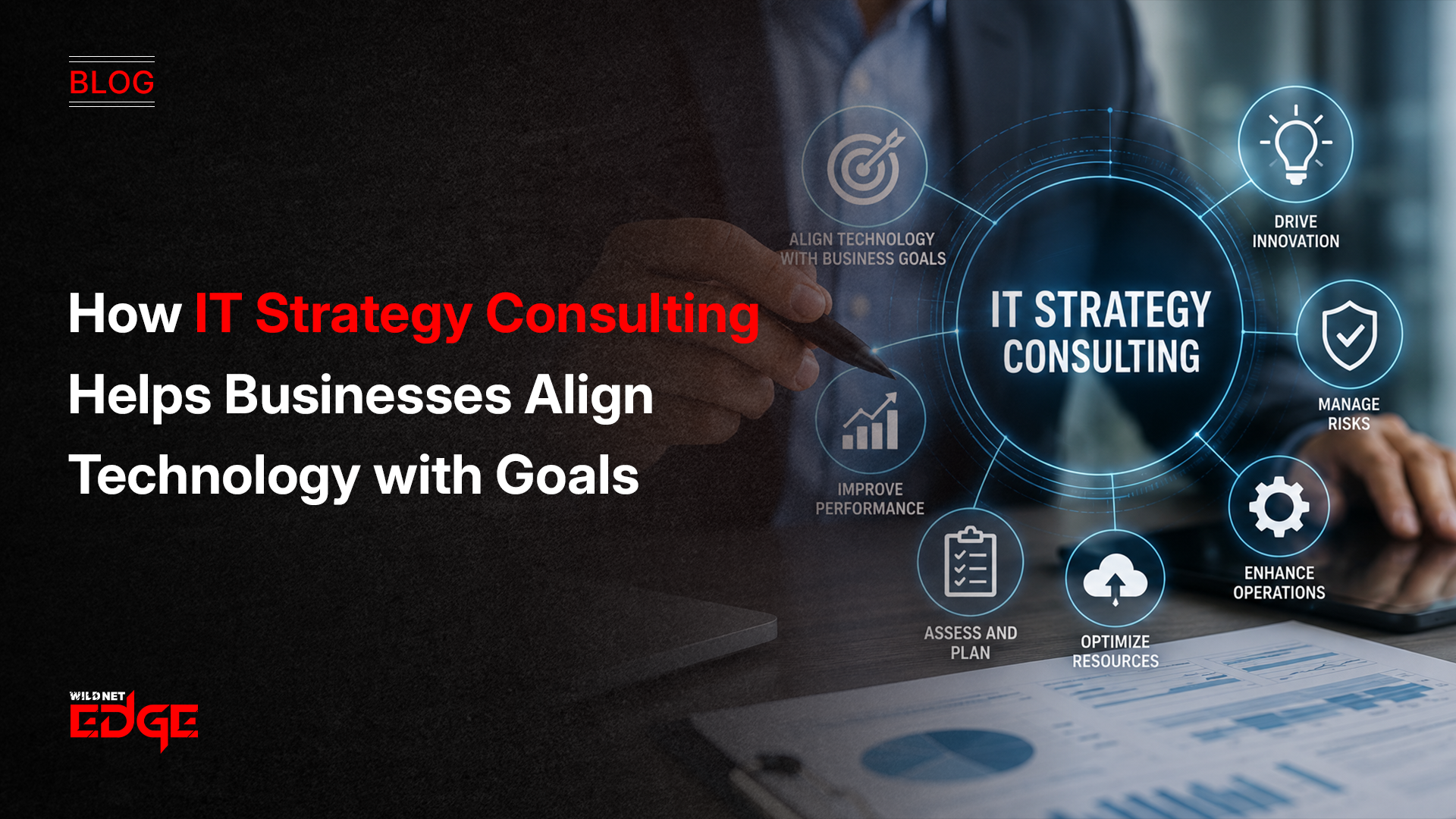


Here is something we hear from business leaders more often than you would expect. They know their technology is not working hard enough for the business. Systems are slow, teams work around them, and the IT plan, if one exists at all, has no clear connection to what the company is actually trying to achieve. Yet no one has made fixing that a priority, because fixing it feels like a long, expensive, uncertain process.
That is exactly the gap that IT strategy consulting services are built to close. Not by throwing new technology at old problems, but by starting with what the business needs and building a technology plan that actually serves it.
The stakes behind this gap are significant. According to a 2026 Gartner survey, 70% of digital transformation initiatives still fail to meet their objectives, with failed efforts costing organizations an estimated $2.3 trillion per year globally. The most consistent reason is not bad technology. It is a strategy that was disconnected from the business goals it was meant to support from the start.
If your technology investments are not producing the results you expected, the problem is almost certainly not the technology.
What IT Strategy Consulting Services Actually Do
Let’s clear up a common misconception. IT strategy consulting is not about recommending software or managing your infrastructure. It is about making sure every technology decision your business makes is connected to a business outcome you actually care about.
In practice, that means working with your leadership team to understand where the business is going, auditing your current technology environment honestly, identifying the gaps between where you are and where you need to be, and then building a prioritized IT planning roadmap that closes those gaps in the right sequence.
The work spans several disciplines. Vendor selection and contract negotiation. Cloud strategy. Security and compliance planning. Digital transformation sequencing. Organizational change management around technology. And ongoing governance to make sure the plan stays connected to business reality as both evolve.
What you get at the end of a well-run IT strategy engagement is not a document. It is clear. Your leadership team knows which technology investments to make, in what order, for what reason, and how to measure whether they are working.
Good IT strategy consulting does not start with technology. It starts with the business. Technology is the answer. The business goal is the question. You need to know the question before the answer means anything.
Why Technology and Business Strategy Keep Drifting Apart
You have probably experienced this. The IT team is busy and capable. Projects get delivered. Systems stay up. But when you ask how this year’s technology spend connects to next year’s growth targets, the conversation gets vague.
This is not a failure of competence. It is a failure of structure. IT teams are evaluated on operational metrics. Uptime. Ticket resolution. Project delivery. None of those metrics asks whether the technology is actually helping the business grow. So IT optimizes for what it is measured on, and the business optimizes for growth, and the two gradually drift apart.
The result shows up in predictable ways. A new product launch was delayed because the infrastructure was not ready. A sales team cannot use a new CRM properly because no one planned the integration with existing systems. A compliance requirement surfaces three months before a major client contract is due to be signed, and suddenly it becomes a crisis.
According to BCG’s analysis of 850 companies, only 35% of digital transformation projects reach their stated goals. The primary cause is not technology failure. It is strategy misalignment, which means leadership invested in technology without first establishing a clear connection between the investment and the business outcome it was meant to produce.
This is the exact problem that a structured IT planning process is designed to prevent. Not by adding more governance or more meetings, but by making business alignment the starting point for every technology decision rather than an afterthought.
How IT Strategy Consulting Services Build Your Tech Roadmap
A tech roadmap is not a list of technology projects. It is a strategic document that connects every technology initiative to a business objective and sequences those initiatives in a way that produces visible, measurable value at each stage. Building one properly takes four inputs.
Discovery
Before you can plan where to go, you need an honest picture of where you are. That means auditing your current technology stack, cataloging your technical debt, mapping vendor relationships and contracts, and identifying where your existing systems are serving the business well and where they are creating friction. Most businesses have never done this systematically, and the findings are often a mix of reassuring and uncomfortable.
This step is not glamorous. But it is the one most IT planning efforts skip, and skipping it is why plans fail. You cannot build a useful roadmap on top of assumptions about your own environment.
Goal Mapping
Once you know where you are, you map where the business is going. What are the 12 to 36-month priorities for growth, market expansion, operational efficiency, or risk reduction? Every item that goes onto the tech roadmap must answer one question: which business objective does this serve?
Cloud migration is not on the roadmap because the cloud is good. It is on the roadmap because it enables the scalability the sales team needs to support projected headcount growth. A security upgrade is prioritized because your largest prospect requires SOC 2 compliance before signing. Technology serves the goal. Always.
Prioritisation
Not everything can happen at once, and not everything should. Good IT strategy consulting helps you sequence your technology investments to produce quick wins early, build the foundations for longer-term capability, and avoid the trap of starting expensive initiatives before the prerequisite infrastructure is in place.
The sequencing question is one of the most valuable things a consultant with cross-industry experience can help you with. Someone who has seen fifty technology roadmaps knows which sequencing decisions cause problems six months down the line. That pattern recognition is genuinely hard to replicate from the inside.
Review Cadence
A roadmap written once and filed is not a strategy. Markets shift. Business priorities change. Technology evolves faster than any plan can anticipate. A well-run IT strategy engagement builds in a regular review cadence, typically quarterly, where the roadmap is reassessed against current business priorities and adjusted where necessary.
This ongoing governance is what separates IT planning that works from IT planning that produces a document and then gathers dust.
The Business Growth Connection
The clearest way to understand the value of a structured IT strategy is to look at how specific technology decisions either enable or constrain business growth. The connection is more direct than most businesses realize.
IT Planning That Enables Market Expansion
When your technology infrastructure is designed with growth in mind, entering a new market or launching a new product line is a planned exercise. Your systems scale. Your data is structured to support new reporting requirements. Your compliance posture is ready for new regulatory environments. When your technology was built reactively, each new initiative requires a round of unplanned work that slows everything down and creates risk.
Operational Efficiency as a Revenue Driver
Automating the right processes does more than reduce cost. It frees your best people to focus on the work that actually requires human judgment. A technology strategy that identifies where manual processes are creating bottlenecks and builds an automation roadmap to address them produces compounding returns over time. The efficiency gain in year one funds better investments in year two.
Technology as a Commercial Differentiator
For a growing number of businesses, your technology capability is part of what you are selling. Enterprise clients want to know that their data is secure, that your systems can integrate with theirs, and that you have the technical maturity to support a long-term partnership. A well-documented, professionally managed IT strategy signals credibility in ways that a good product pitch alone cannot.
What to Look for in an IT Strategy Consulting Partner
Not every firm that offers IT strategy consulting services approaches it the same way. Here is what actually separates the engagements that produce lasting change from the ones that produce a document.
They Start With Your Business, Not Their Framework
A good IT strategy consultant asks more questions about your business in the first meeting than about your technology. Where are you trying to be in three years? What is preventing you from getting there? Which parts of the business are growing fastest, and what do those parts need from technology to keep going? The technology audit comes after you understand the business context, not before.
They Tell You What Is Working, Not Just What Is Wrong
The most useful discovery process surfaces what your existing technology environment is doing well, not just where it is falling short. Recommending that you replace something that is working is a red flag. A consultant who tells you your current ERP is solid and you should build around it rather than replace it is giving you advice that serves your interests. One who recommends a replacement on day three probably arrived with a preferred vendor in mind.
They Deliver a Plan You Can Actually Execute
The output of an IT strategy engagement should be a tech roadmap your team can act on, not a presentation that requires a follow-on engagement to interpret. Initiatives should be sequenced realistically, with clear owners, timelines, and success metrics. If the roadmap requires ten things to happen simultaneously, it is not a roadmap. It is a wish list.
They Build in Governance, Not Just Deliverables
Technology strategy is not a project with an end date. Your environment changes. Your business changes. A consulting partner who builds in a regular review cadence and helps you develop the internal capability to govern your own technology roadmap is giving you something more valuable than a one-time plan. They are helping you build an ongoing capability.
Case Studies
How a Financial Services Firm Used IT Compliance Services to Close Security Gaps Before They Were Exploited
A mid-size financial services firm came to us after its board requested an independent assessment of its IT compliance and security posture ahead of a potential acquisition. They had been operating under the assumption that their annual PCI DSS audit gave them sufficient security coverage. What the assessment found was more complicated.
The firm was PCI DSS compliant on paper. But the compliance program had been run in isolation from the security team. Access control documentation was current. Actual access configurations were not. Several administrative accounts had privileges that had been granted years earlier for a specific project and never revoked. Audit logs were being collected but not monitored. Vendor contracts contained no security requirements and had never been reviewed for data handling obligations.
We built an integrated IT compliance and security remediation plan that addressed each finding in priority order, starting with access controls and moving through logging, vendor management, and incident response. Crucially, we structured the remediation so that every fix served both compliance and security simultaneously.
Results
- Privileged access was fully reviewed and rationalized within six weeks.
- Active log monitoring was implemented and connected to the incident response process.
- All vendor contracts were reviewed and updated with security and data handling requirements.
- The firm entered the acquisition process with a defensible, documented security posture.
The acquirer’s due diligence team noted that the firm’s compliance and security documentation was among the most complete they had reviewed in the sector.
How a Healthcare Organization Reduced Audit Preparation Time While Improving Its Security Posture
A healthcare technology company providing software to NHS Trusts came to us with two separate problems. Their compliance team spent approximately three months per year preparing for DSPT assessments and ISO 27001 audits. Their security team had recently flagged a series of unresolved vulnerabilities that had been deprioritized because resources were consumed by compliance preparation. The two problems were connected, but the two teams had not made that connection.
We restructured their compliance and security program around a single, integrated risk register. Evidence gathered for compliance purposes was tagged and stored in a format that also served the security team’s monitoring and reporting needs. Vulnerability management was sequenced to align with compliance assessment cycles so that remediation work produced audit-ready evidence as a by-product.
We also implemented a data governance framework that mapped all personal data flows, established a formal data classification policy, and connected both to the incident response procedure. Previously, the organization had no structured way to assess the scope of a potential breach quickly, which created significant exposure under GDPR notification timelines.
Results
- Audit preparation time reduced from three months to four weeks.
- All previously deprioritized vulnerabilities were remediated within the first compliance cycle
- The data governance framework reduced breach notification assessment from days to hours.
- The organization achieved ISO 27001 certification at its next assessment with zero major non-conformities
The security team gained continuous visibility into the compliance posture, and the compliance team gained access to real-time security data. Both functions now work from the same evidence base.
Your Technology Should Move With Your Business, Not Behind It
We work with businesses at different stages, and the pattern is consistent. The ones that grow with the least friction are not the ones with the most sophisticated technology. They are the ones who made a deliberate decision to connect their technology strategy to their business strategy and then built the governance to keep those two things aligned as both evolved.
That decision does not require a large internal team or an enterprise budget. It requires clarity about where the business is going, honesty about where the technology is today, and a plan that connects the two in a sequence that the business can actually execute.
IT strategy consulting services are how you build that plan. Not once, but as a continuous capability that makes your technology investments smarter over time.
At Wildnet Edge, we are an AI-first IT strategy consulting partner. We work with leadership teams to build technology roadmaps that are grounded in business reality, sequenced for maximum impact, and governed to stay aligned as the business grows. We combine strategic consulting with deep technical execution, so the strategy does not stop at the slide deck. If your technology and business strategy are still operating on separate tracks, that is the conversation we want to start.
Let’s build a technology strategy your business can actually use.
FAQs
IT strategy consulting services include technology audits, goal mapping, tech roadmaps, vendor evaluation, and governance planning. The goal is to align technology investments with business priorities and long-term growth objectives.
An IT manager handles daily operations and system maintenance. IT strategy consulting focuses on long-term planning, investment prioritization, and aligning technology decisions with business outcomes.
Most engagements take 6–12 weeks for discovery and roadmap creation. Ongoing quarterly reviews are common to refine strategy and adapt to changing business needs.
Common signs include rising IT costs without clear ROI, disconnected technology initiatives, operational bottlenecks, or uncertainty about whether current systems can support growth.
An IT plan focuses on operational maintenance and upgrades. A tech roadmap is strategic, connecting technology initiatives directly to measurable business goals and growth priorities.
Yes. Small and mid-size businesses often see strong ROI because they gain strategic technology guidance without hiring a full-time senior IT leader.
Success is measured through business outcomes such as faster launches, reduced operational costs, improved security, better scalability, and stronger ROI from technology investments.

Managing Director (MD) Nitin Agarwal is a veteran in custom software development. He is fascinated by how software can turn ideas into real-world solutions. With extensive experience designing scalable and efficient systems, he focuses on creating software that delivers tangible results. Nitin enjoys exploring emerging technologies, taking on challenging projects, and mentoring teams to bring ideas to life. He believes that good software is not just about code; it’s about understanding problems and creating value for users. For him, great software combines thoughtful design, clever engineering, and a clear understanding of the problems it’s meant to solve.
 based on 1200+ reviews



