sales@wildnetedge.com
 +1 (212) 901 8616
 +1 (437) 225-7733















































































































 ChatGPT Development & Enablement
  Hire AI & ChatGPT Experts
  ChatGPT Apps by Industry
  ChatGPT Blog
  ChatGPT Case study
  AI Development Services
  Industry AI Solutions
  AI Consulting & Research
  Automation & Intelligence


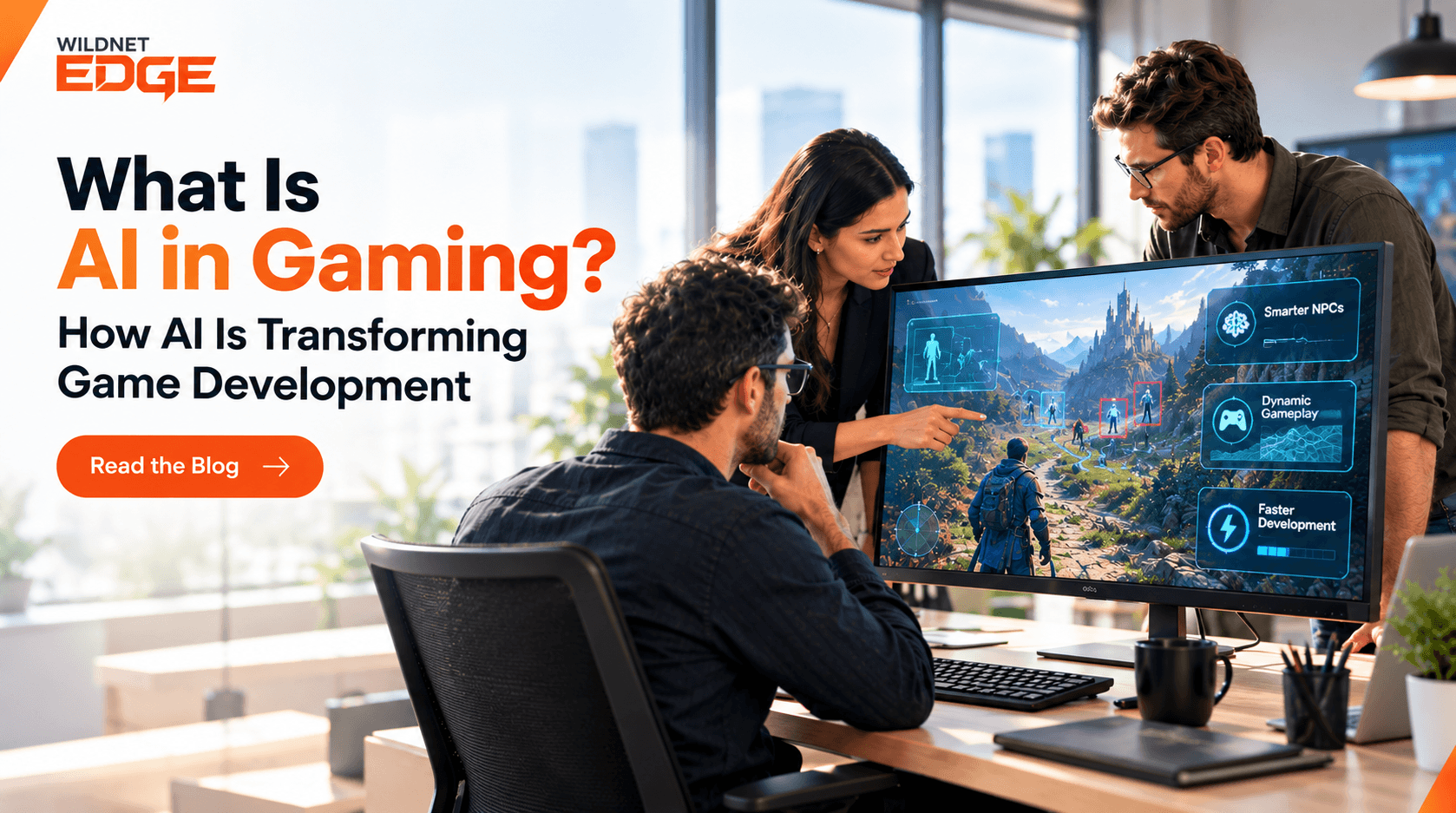


AI in gaming has moved well past being a nice extra that only big studios can afford. It now shapes how enemies behave, how levels get built, and how bugs get caught before launch. If you’re trying to understand how AI in game development actually works and where it could help your own project, this guide breaks it down in plain terms, from its key applications and benefits to the way it can add value to a gaming project.
What is AI in Gaming?
AI in gaming means using artificial intelligence to make games more responsive, interactive, and personalised.
There are really two sides to it:
- In- game AI: what the player sees and experiences, such as NPCs, enemy behaviour, dynamic difficulty, and personalised content.
- AI in the development process: what the team uses behind the scenes for automated testing, content creation, analytics, and other repetitive tasks.
Game AI itself isn’t new. Games have used programmed rules to control enemies and characters for decades. What has changed is that newer AI tools can handle more complex behaviour, generate content, and respond to players in ways that were much harder to build in the past.
How AI is transforming Game Development
Making games involves a huge amount of repetitive work. Artists create assets, designers build levels, developers write and refine systems, and testers repeatedly play the same sections to find problems. AI in game development can now assist with some of these tasks, giving teams more time to focus on the creative side of a project.
For example, AI can help generate variations of game environments instead of requiring developers to create every element manually. It can also make enemies and other characters react more naturally to what players do, creating less predictable gameplay.
Testing is another area where AI can help. AI-powered systems can run through different gameplay situations repeatedly and flag issues such as crashes, broken quests, collision problems, or unusual difficulty spikes.
Player data can also reveal where people struggle, where they stop playing, and which features they use most. Development teams can use these insights to improve gameplay, balance difficulty, and plan future updates.
Key Applications of AI in the Gaming Industry
Here are some of the areas where AI in the gaming industry is making a practical difference.
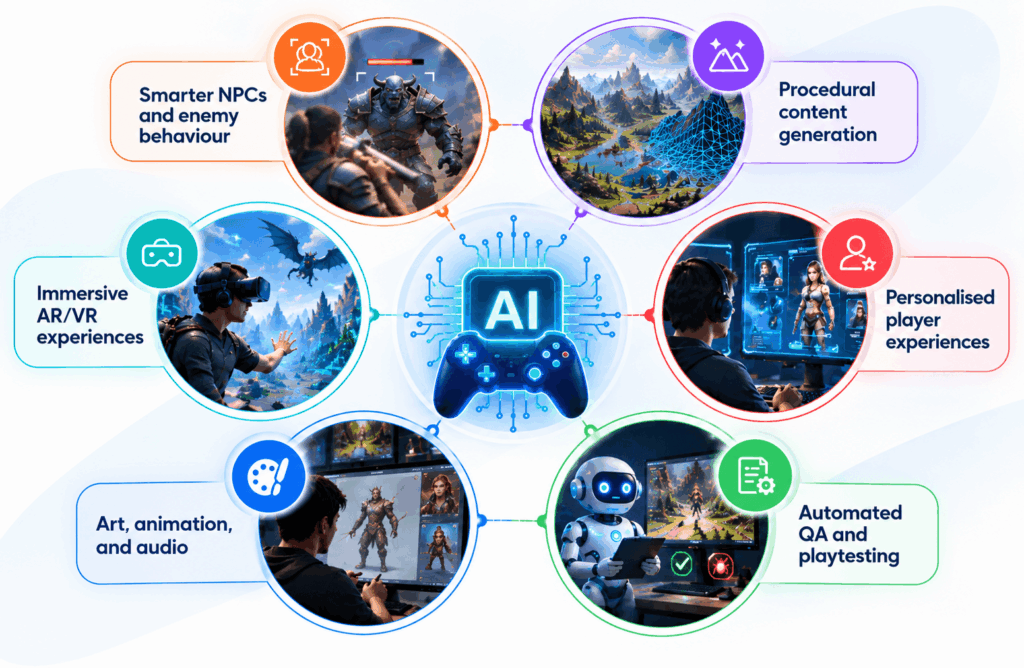
Smarter NPCs and enemy behaviour
AI can give NPCs more flexible behaviour instead of making them follow the same fixed pattern every time. An enemy might change its approach based on what the player does, while a character could respond differently depending on the situation. Some developers are also experimenting with AI-powered characters that can hold more natural conversations instead of relying entirely on pre-written dialogue options.
Procedural content generation
AI can help generate variations of levels, quests, items, environments, and other game content. Roguelike games helped popularise this approach, and developers now use similar methods across different genres to create varied experiences without manually building every element from scratch.
Personalised player experiences
Gaming AI can adjust difficulty, recommend content, and personalise parts of the experience based on how someone plays. A new player who is struggling and an experienced player looking for a challenge can therefore have different experiences within the same game.
Automated QA and playtesting
AI-powered testing systems can explore a game in ways similar to players while also trying situations that human testers may not think to test. They can help flag collision bugs, broken quests, crashes, and other problems earlier, reducing the amount of rework needed later.
Art, animation, and audio
AI tools can speed up early work such as concept art, texture variations, animation cleanup, and sound creation. Teams still control the creative direction, but AI can help them produce and refine early versions much faster.
Immersive AR/VR experiences
Immersive games depend on believable, responsive worlds. AI can support object recognition, spatial mapping, and more natural interactions, making it particularly useful in AR/VR gaming development, where games need to respond to a player’s movements and surroundings.
Benefits of AI in Game Development
There are several practical reasons studios are exploring AI game development today.
Better gameplay: AI can make characters and game systems respond more naturally.
Faster development: Repetitive tasks can be reduced, giving developers more time for creative work.
Personalisation: Players can receive experiences that better match their behaviour and preferences.
More effective testing: AI can help teams test a wider range of gameplay situations.
Dynamic game worlds: AI can make some environments, characters, and challenges feel less repetitive.
Useful player insights: Developers can better understand how players interact with their games.
These insights are particularly useful for live-service and multiplayer games, where the number of players and amount of activity can grow over time. Planning for scalable game app development early can make it easier to support that growth as the game expands,
How to Choose the Best AI for Game Development
There is no single best AI for game development for every project. The right choice depends on the game’s goals, audience, and the problem the development team wants to solve.
Before adding AI, developers should ask:
- What problem are we trying to solve?
- Will AI improve the player’s experience?
- Which part of the game actually needs AI?
- How much time and money will implementation require?
- Can the feature be maintained after launch?
For example, a multiplayer action game may benefit from smarter opponents and automated testing, while a story-driven game may gain more from interactive characters.
Starting with the gameplay goal rather than the technology usually leads to a more useful result.
Where an AI Game Development Company Can Help
Studios without an in-house AI team can work with an AI game development company to plan and build AI-powered features.
An experienced development partner can help identify suitable use cases and integrate AI into an existing or new gaming project.
This can include NPC behaviour, personalisation, content creation, player analytics, and testing, making AI game development services useful for teams looking to add AI capabilities to their projects.
AI and the Future of Gaming
AI is likely to become a bigger part of gaming as developers find more practical ways to use it.
Future games may feature characters that respond more naturally, challenges that change according to the player’s behaviour, and worlds that feel more dynamic.
AI can work alongside AR and VR to create more interactive experiences, particularly when games need to respond to a player’s movements, surroundings, or actions in real time.
At the same time, human creativity will remain central. Strong games still need good storytelling, thoughtful design, memorable characters, and gameplay that keeps people coming back.
Challenges of Using AI in Gaming
AI brings opportunities, but it also needs to be used carefully.
Maintaining Human Creativity
AI can assist with ideas and content, but creative direction still needs to come from the development team.
Keeping Quality Consistent
AI-generated content can vary in quality, so developers need to review and refine it before it reaches players.
Protecting Player Data
When AI systems use player behaviour, developers need to handle that information responsibly and protect player privacy.
Managing Costs
AI features require development and ongoing maintenance, so teams need to consider whether the expected value justifies the investment.
Conclusion
AI in gaming is becoming a practical tool for modern game development. It can make characters more responsive, personalise gameplay, support content creation, improve testing, and help teams understand how players interact with their games.
But AI works best when it solves a clear problem. Simply adding AI does not automatically make a game better. Its value comes from using it where it can improve the player experience or make development more efficient.
For studios planning their next project, the key question is not just, “How can we use AI?” but “Where can AI genuinely improve this game?” Starting with that question can help teams use AI more effectively while keeping creativity at the centre of the gaming experience.
FAQs
What is AI in gaming?
AI in gaming is the use of artificial intelligence to improve game behaviour, personalisation, testing, content creation, and other parts of the gaming experience.
How is AI used in game development?
AI can be used for NPC behaviour, adaptive difficulty, player analysis, content creation, game testing, and personalised gameplay.
Can AI create an entire game?
AI can assist with many parts of game creation, but a polished game still needs human designers, developers, artists, testers, and creative direction.
Is AI useful for mobile gaming?
Yes. AI can support mobile games through personalisation, smarter characters, testing, recommendations, and adaptive gameplay.
Does AI make game development more expensive?
It can, depending on the features involved. The cost depends on the game’s complexity, AI requirements, integration work, and ongoing maintenance.

Vidit Kumar is an expert in DevOps and cloud engineering, specializing in building efficient, reliable, and scalable systems for organizations of all sizes. He has deep expertise in automation, cloud infrastructure, and workflow optimization, helping teams streamline operations and improve software delivery processes. Vidit is passionate about mentoring teams and exploring innovative tools that improve software performance and delivery. He believes in blending technical skill with thoughtful problem-solving to create systems that make a real difference. Outside of work, Vidit enjoys experimenting with cloud platforms, learning new technologies, and finding smarter ways to approach engineering challenges.

 based on 1200+ reviews