 sales@wildnetedge.com
 +1 (212) 901 8616
 +1 (437) 225-7733
















































































































 ChatGPT Development & Enablement
  Hire AI & ChatGPT Experts
  ChatGPT Apps by Industry
  ChatGPT Blog
  ChatGPT Case study
  AI Development Services
  Industry AI Solutions
  AI Consulting & Research
  Automation & Intelligence





Key Takeaways
- In 2026, Tabnine’s manufacturing software development became the gold standard for “Secure Industrial AI,” allowing plants to leverage AI coding assistants without exposing proprietary production logic to public clouds.
- By utilizing specialized industrial software coding tools, engineering teams are reducing the “Legacy Maintenance Tax,” using AI to refactor 30-year-old PLC and SCADA integration code 40% faster.
- Professional Tabnine development services focus on “Contextual Privacy,” ensuring that AI models are fine-tuned to internal industrial protocols without exposing sensitive OT data to external LLMs.
- Manufacturing software automation now includes embedded safety guardrails, where the AI suggests code that complies with ISO 26262 and IEC 61508 standards by default.
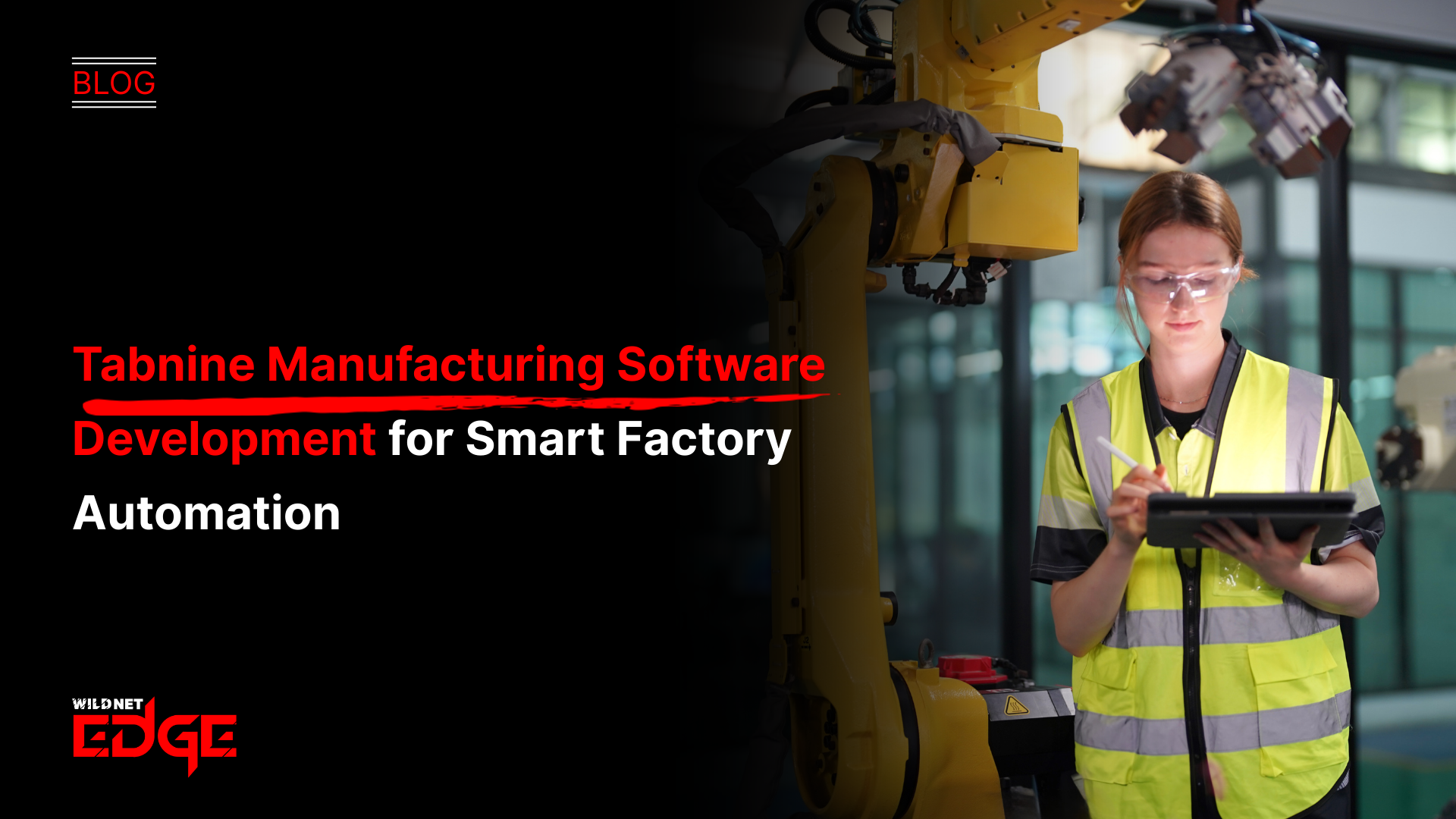
The modern factory floor is no longer just a place of mechanical labor; it is a high-velocity data ecosystem. In 2026, the gap between market leaders and struggling plants is defined by the quality of their digital backbone. While many have sensors, few have the engineering velocity to keep those systems updated.
Specialized Tabnine manufacturing software development steps in where general-purpose AI tools fail. It requires a deep understanding of air-gapped environments, deterministic latency, and the complex logic of global supply chains. Modernization is no longer about adding more hardware; it is about building an intelligent software layer that orchestrates the entire production lifecycle securely.
Why the Manufacturing Industry Needs Specialized Tabnine Development
Generalist software development often fails in an industrial setting because it ignores the unique constraints of the factory floor. Tabnine manufacturing software development ensures that your AI coding assistant is built with domain-specific intelligence.
1. AI Must Move From Pilot to Production
Most manufacturers have experimented with predictive maintenance. However, moving to “Agentic Production” requires deep system integration. AI development tools like Tabnine allow your developers to:
- Write Deterministic Code: Ensuring the AI suggests patterns that respond in milliseconds to prevent equipment damage.
- Maintain Code Privacy: Keeping your most sensitive production algorithms strictly within your Virtual Private Cloud (VPC).
- Accelerate PLC Integration: Using industrial software coding tools to rapidly write the middleware that connects shop floor PLCs to top-floor ERPs.
2. The Labor Gap is Forcing Automation
With a global shortage of skilled engineers, manufacturing software automation acts as a “Force Multiplier.” Tabnine helps codify tribal knowledge into the codebase. When a senior architect writes a custom library for a specific robotic arm, Tabnine learns that pattern and suggests it to junior developers, ensuring consistency from day one.
3. Legacy Core Systems Are the Real Bottleneck
Many factories run on proprietary “Black Box” systems. Tabnine manufacturing software development helps “hollow the core” by allowing developers to rapidly understand legacy dependencies. AI assists in writing the modern microservices needed to wrap around legacy modules, moving critical functions to the cloud while maintaining floor stability.
Industrial Software Development Lifecycle (SDLC)
Building manufacturing software requires a more rigorous approach than standard consumer apps. In the industrial sector, the use of AI development tools follows a “Safety-First” engineering lifecycle.
1. OT/IT Mapping & Architecture Planning
Before a single line of code is written, architects perform a detailed audit of the factory’s protocols. We ensure that Tabnine manufacturing software development strategy aligns with local data sovereignty, ensuring the AI model server resides in the same jurisdiction as the factory floor.
2. Secure Edge-to-Cloud Integration
This is where industrial IT coding tools prove their value. Modern developers often struggle with legacy protocols like Modbus or Profinet. Tabnine acts as a translator:
- Protocol Explanation: Helping developers understand complex industrial messaging formats.
- Secure API Generation: Suggesting secure patterns for Edge-to-Cloud data transmission.
- Hardware Interfacing: Automating the boilerplate code required to talk to industrial IoT gateways.
3. Resilience Testing & Virtual Commissioning
Using manufacturing software automation, we create “Digital Twins” of the codebase. Professional Tabnine development services include setting up automated test suites that simulate industrial stress, ensuring the AI-generated code doesn’t fail during high-speed production runs.
How Tabnine Helps Factories Grow
Modern manufacturing increasingly depends on automation, real-time analytics, and intelligent production systems. Tabnine manufacturing software development helps engineering teams build industrial applications faster by using AI-assisted coding to automate repetitive tasks and improve development efficiency.
With Tabnine manufacturing software development, developers can accelerate the creation of factory automation tools, predictive maintenance systems, and production analytics platforms. This enables manufacturers to modernize legacy systems and scale smart factory solutions more efficiently in the Industry 4.0 era.
- Optimized OEE: Real-time analytics code is written and deployed 30% faster, identifying “Micro-Stops” that drain productivity.
- Zero-Waste Production: AI tools help engineers build automated quality loops with higher precision and fewer bugs.
- Agile Supply Chains: Integration between the floor and the ERP allows for “Demand-Driven Manufacturing,” reducing excess inventory.
- Legacy Debt Reduction: Use Tabnine services to refactor old codebases into cloud-native microservices with significantly lower risk.
What Manufacturing Leaders Look for in an AI Partner
Manufacturing leaders evaluating AI-powered development solutions prioritize reliability, security, and the ability to support complex industrial environments. Tabnine manufacturing software development helps engineering teams improve productivity while maintaining strict control over proprietary code and sensitive industrial processes.
A strong AI partner should also understand machine integrations, automation workflows, and operational reliability. By adopting Tabnine manufacturing software development, factories can enable their teams to build automation platforms, analytics dashboards, and industrial control systems faster while maintaining consistent code quality and secure development practices.
1. OT Fluency: Do They Speak “Machine”?
Leaders evaluate if a partner has successfully deployed Tabnine development services in environments with zero internet connectivity. The partner must understand the difference between a web request and a PLC trigger.
2. Proven Execution in Core Modernization
A strategy deck is not enough. Leaders ask: Have you integrated a cloud ERP with a legacy assembly line? Partners must demonstrate zero-downtime migration frameworks and robust data reconciliation.
3. AI Governance and Safety-First Mindset
Leaders prioritize partners who can build “Responsible AI.” When using manufacturing software automation, it is vital that developers can audit every line of AI-generated code to ensure it meets industrial safety standards.
Case Studies
Case Study 1: Legacy to Cloud-Native ERP
- Problem: An automotive supplier was losing 15% of its margin due to disconnected inventory data.
- Solution: We provided Tabnine manufacturing software development to build a modular middleware that synced production with a cloud-native ERP.
- Result: Inventory accuracy hit 99%, and developer velocity for new features increased by 40%.
Case Study 2: AI Agents in Predictive Maintenance
- Problem: A global electronics maker faced a $100k-per-hour loss during unplanned downtime.
- Solution: We used industrial software coding tools and Tabnine to build a “Context-Aware” assistant that monitored vibration data and scheduled maintenance windows.
- Result: Unplanned downtime dropped by 75%, and the system predicted three major failures before they occurred.
Conclusion
The manufacturing sector stands at a turning point. Success in 2026 requires moving AI from a “chat” curiosity to a core engineering pillar. Specialized Tabnine manufacturing software development bridges the gap between mechanical stability and AI innovation. By using secure, private AI tools, factories can modernize their digital backbone without compromising their most valuable asset: their operational logic.
At Wildnet Edge, we address the industry’s failure rate with our AI-first approach. We help you deploy manufacturing IT automation that is as secure as a vault but as fast as a startup.
FAQs
Yes. Professional Tabnine services enable 100% on-premises or VPC deployment, meaning your industrial code never leaves your local network.
When you use industrial IT coding tools fine-tuned on your private repositories, Tabnine learns your specific implementation of protocols like Modbus, OPC-UA, and Profinet.
Most plants see a 25-45% increase in developer commit volume and a significant reduction in unplanned downtime through faster deployment of predictive tools.
Yes. By training AI tools on your specific logic patterns, Tabnine can help engineers write cleaner, more reliable code for industrial controllers.
By keeping data local and providing an audit trail for generated code, Tabnine services meet the “Transparency” and “Security” requirements of modern industrial regulations.
A private enterprise rollout, including VPC configuration and custom fine-tuning for manufacturing IT automation, typically takes 6 to 10 weeks.
We use an AI-first methodology to automate the initial analysis of your legacy silos, ensuring your industrial IT coding tools have the best possible data to learn from.

Managing Director (MD) Nitin Agarwal is a veteran in custom software development. He is fascinated by how software can turn ideas into real-world solutions. With extensive experience designing scalable and efficient systems, he focuses on creating software that delivers tangible results. Nitin enjoys exploring emerging technologies, taking on challenging projects, and mentoring teams to bring ideas to life. He believes that good software is not just about code; it’s about understanding problems and creating value for users. For him, great software combines thoughtful design, clever engineering, and a clear understanding of the problems it’s meant to solve.

 based on 1200+ reviews



