 sales@wildnetedge.com
 +1 (212) 901 8616
 +1 (437) 225-7733
















































































































 ChatGPT Development & Enablement
  Hire AI & ChatGPT Experts
  ChatGPT Apps by Industry
  ChatGPT Blog
  ChatGPT Case study
  AI Development Services
  Industry AI Solutions
  AI Consulting & Research
  Automation & Intelligence





TL;DR
AI in Food Delivery Apps is now the core engine behind fast, accurate, and profitable deliveries. It improves everything—from route planning and batching orders to predicting demand and personalizing the user’s menu. With the help of automation and smart forecasting, platforms can cut delays, reduce costs, and give both customers and drivers a smoother experience. For restaurants, AI reduces kitchen bottlenecks and improves prep time. For businesses, it boosts margins and helps scale operations without losing control. In short: AI makes delivery apps faster, smarter, and far more reliable.
Today’s food delivery world customers expect their food to arrive even faster. A small delay can lead to a canceled order, a negative review, or a loss of the delivery. That’s why AI in Food Delivery Apps has become so important. It helps delivery companies manage traffic, cooking times, order volume, and driver availability with accuracy that humans simply can’t match.
Instead of guessing what drivers should pick up first or which route will be empty, AI handles every decision behind the scenes. This gives customers hot food, restaurants steady orders, and drivers better earnings, all from the same app. For startups looking to compete, investing in robust food delivery app development is the first step toward building these intelligent dispatch systems.
The Strategic Necessity of Logistics Automation
A delivery app works only when restaurants, drivers, and customers are perfectly in sync. Without automation, this becomes chaotic quickly.
AI in Food Delivery Apps helps coordinate everything by studying live data traffic, weather, order volume, kitchen speed, and more. With this intelligence, the system can:
- Assign the right driver for each order
- Combine multiple deliveries efficiently
- Predict cooking times so drivers don’t wait
- Reduce the chances of late deliveries
This kind of logistics automation improves profit margins and keeps users coming back.
Route Optimization AI: The Engine of Efficiency
Regular GPS apps simply show the shortest path. Route optimization AI shows the best path.
Dynamic Rerouting
AI in Food Delivery Apps continuously recalculates routes based on real-time incidents. If a specific street has a 10% higher probability of congestion on Friday nights, the algorithm routes the driver around it before they even encounter traffic.
Parking Prediction
Finding parking can take longer than the drive itself. AI learns the best drop-off spots by studying past data, reducing the “last 100 feet” problem.
This functionality is often a key differentiator in custom mobile app development for logistics.
Customer Experience AI: Hyper-Personalization
When a user opens the app, AI helps them find what they want quickly.
- If someone usually orders noodles on Friday, the app shows them first.
- If they upload a food photo, visual search can find similar dishes nearby.
- If the weather is cold, the app highlights soups and warm meals.
This level of personalization reduces decision fatigue and increases orders, two things every delivery app needs.
Demand Forecasting and Kitchen Management
AI doesn’t just help drivers it helps restaurants, too. With accurate forecasting, restaurants can prep ingredients ahead of rush hour. This reduces delays, prevents stock shortages, and improves order accuracy. This is a major benefit of food delivery automation, especially during weekends, holidays, or big sporting events.
Case Studies: AI Excellence in Delivery
Case Study 1: DoorDash’s “DeepRed” Dispatch Engine
- The Challenge: DoorDash needed to solve the “dispatch problem” matching thousands of orders to drivers instantly while accounting for complex constraints like hot/cold bag requirements.
- Our Solution: They utilized AI in Food Delivery Apps to build “DeepRed,” a system that combines Machine Learning for prediction (e.g., “how long will this pizza take to bake?”) with Mixed Integer Programming for optimization.
- The Result: The system improved delivery times by reducing “Dasher” wait times at restaurants. The technology allowed them to batch orders more aggressively, increasing driver earnings and platform efficiency.
Case Study 2: Voice AI for Merchant Orders
- The Challenge: A delivery platform was spending millions on call centers to manually phone in orders to restaurants that didn’t have tablets.
- Our Solution: We implemented AI in Food Delivery Apps using voice automation. An AI agent could call the restaurant, place the order in natural language, and handle modifications.
- The Result: The automation reduced order placement costs by 90% and eliminated human error in transcription, proving the versatility of AI in delivery apps.
Tech Stack for Delivery Innovation
We leverage high-performance tools to build these systems.
- Languages: Python, Golang (for high-concurrency dispatch).
- Optimization: Google OR-Tools, Gurobi.
- Maps & Location: Google Maps Platform, Mapbox, Radar.
- Machine Learning: TensorFlow, PyTorch (for ETA prediction).
- Cloud: AWS Lambda, Google Cloud Functions.
Future Trends: Autonomous Delivery
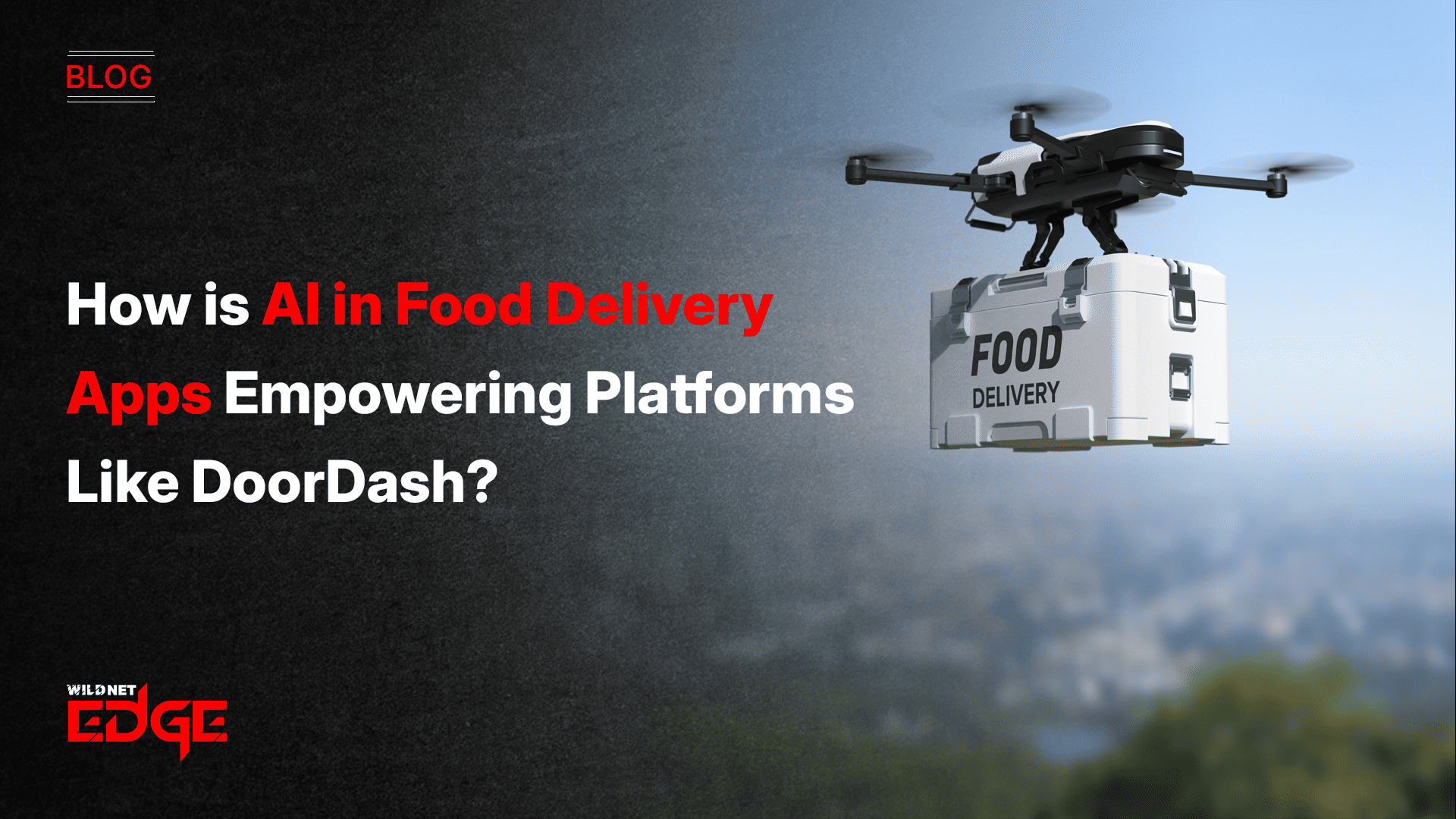
As we look toward 2026, AI in Food Delivery Apps is paving the way for full autonomy. Sidewalk robots and drones are already being integrated into the dispatch logic. The algorithms will soon determine not just who delivers your food, but what delivers it assigning a drone for a rush order of medicine and a scooter for a large pizza order. This multi-modal future relies entirely on the sophistication of the underlying intelligence.
Conclusion
AI in Food Delivery Apps is now the foundation of successful delivery platforms. It speeds up delivery times, personalizes customer experiences, and makes operations more efficient. Whether it’s optimizing routes or predicting what users will order, AI keeps improving with every new data point, creating a system that gets smarter every day.
If you are looking for a company that gives you quick, efficient solutions, you can partner with Wildnet Edge. Our AI-first approach focuses on improving your delivery economics, predicting demand, reducing delays, and helping you build smarter delivery platforms. As a leading AI development company, we are ready to help you build the next generation of delivery infrastructure.
FAQs
It improves quality primarily through speed. By optimizing routes and predicting kitchen prep times, the food spends less time sitting on a counter or in a car, arriving at the customer’s door at the optimal temperature.
Yes. It can optimize “batching” to ensure drivers are constantly moving and earning, rather than waiting for orders. Predictable earnings and efficient routing are key factors in keeping drivers happy and active on the platform.
Computer Vision is used to verify that the correct items are in the bag before the driver leaves. It can analyze photos of the order to detect missing items or packaging errors, reducing refund rates.
While building a custom “DeepRed” engine is costly, many features can be implemented using APIs. For example, using Google’s Route Optimization API is a cost-effective way for startups to get enterprise-grade logistics.
The technology uses dynamic pricing (surge pricing) to balance supply and demand. It predicts a spike in orders (e.g., during a rainstorm) and increases delivery fees to temper demand while simultaneously incentivizing more drivers to log on.
No, if implemented correctly. It relies on anonymized data patterns (e.g., “users in this zip code like pizza”) rather than invasive personal tracking. Secure development practices ensure data compliance.
Yes. Advanced models track your ordering cadence. If you order coffee every morning at 8 AM, the app can preemptively ask “Want your usual?” at 7:55 AM, reducing friction and increasing order frequency.

Managing Director (MD) Nitin Agarwal is a veteran in custom software development. He is fascinated by how software can turn ideas into real-world solutions. With extensive experience designing scalable and efficient systems, he focuses on creating software that delivers tangible results. Nitin enjoys exploring emerging technologies, taking on challenging projects, and mentoring teams to bring ideas to life. He believes that good software is not just about code; it’s about understanding problems and creating value for users. For him, great software combines thoughtful design, clever engineering, and a clear understanding of the problems it’s meant to solve.
 based on 1200+ reviews



