 sales@wildnetedge.com
 +1 (212) 901 8616
 +1 (437) 225-7733
















































































































 ChatGPT Development & Enablement
  Hire AI & ChatGPT Experts
  ChatGPT Apps by Industry
  ChatGPT Blog
  ChatGPT Case study
  AI Development Services
  Industry AI Solutions
  AI Consulting & Research
  Automation & Intelligence





TL;DR
In 2026, the Internet of Things (IoT) is no longer a futuristic concept; it is the operational backbone of modern industry and consumer convenience. This article is your definitive guide to the Best IoT App Development Companies in the USA. We have ranked the top 10 firms that move beyond basic Bluetooth pairing to deliver complex Smart Device App interfaces and robust Connected Solutions. We analyzed these companies based on their technical expertise in MQTT protocols, edge computing, hardware-software integration, and data security.
If you’ve ever tried building a connected device, whether it’s a smart home gadget, an industrial sensor, or a wearable, one thing you surely know: hardware is only half the headache. The real challenge begins when you try to make everything talk to each other smoothly. That’s exactly why people start looking for the Best IoT App Development Companies, because you need someone who can translate your blinking hardware prototype into a real product people can trust.
Maybe you’ve been there: the device works in the lab, but the app keeps losing Bluetooth connection. Or the cloud data refuses to sync. Or your firmware team says the mobile app team is “sending the wrong messages,” and the mobile team says the firmware is “responding weirdly.” Add in the security and real-time data requirements, and suddenly your “simple IoT idea” feels more like running a space mission.
This guide breaks down the companies that actually understand how messy real-world IoT can be and how to build apps and platforms that don’t crumble the moment thousands of devices go live.
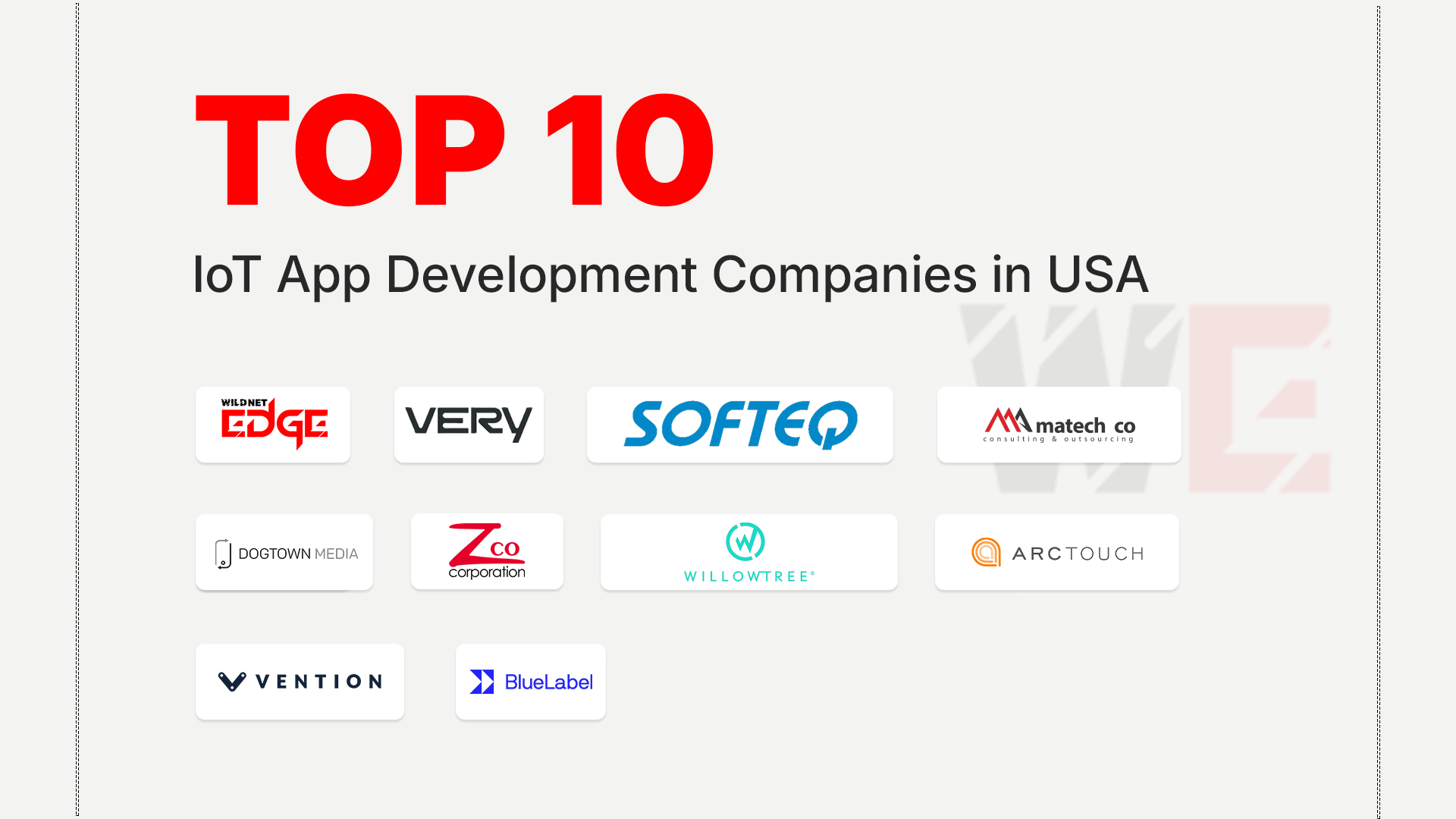
Comparative Matrix: Top 10 IoT App Development Companies
| Company | Core Services | Industries Served |
| Wildnet Edge | Enterprise IoT, Edge AI, Smart Infrastructure | Manufacturing, Healthcare, Energy, Logistics |
| Very, LLC | IoT Engineering, Hardware & Software, Design | Consumer Electronics, Industrial, Energy |
| Softeq | Low-Level Programming, Firmware, Driver Dev | Automotive, Consumer Tech, Industrial |
| Intellectsoft | Digital Transformation, IIoT, Enterprise Mobility | Construction, Healthcare, FinTech |
| Dogtown Media | mHealth, IoT, Mobile App Development | Healthcare, FinTech, Robotics |
| Zco Corporation | Mobile Apps, Enterprise Software, AR/VR | Healthcare, Public Safety, Gaming |
| WillowTree | Digital Product, Voice/Chat, Mobile Strategy | Media, Finance, Retail |
| ArcTouch | Connected Experiences, Mobile & Web Apps | Consumer Goods, Media, Smart Home |
| Vention | Staff Augmentation, IoT Dev, Cloud | FinTech, HealthTech, Automotive |
| Blue Label Labs | Product Strategy, GenAI, Mobile Apps | Finance, Healthcare, Media |
Top 10 IoT App Development Companies in USA for 2026
1. Wildnet Edge
- Best for: Enterprise-scale, AI-driven IoT ecosystems and complex hardware-software integration.
- Key highlights:
- Over 19 years of industry experience (Founded 2005).
- Enterprise-scale team of 350+ certified engineers.
- Proven track record with 8,000+ projects delivered.
- CMMI Level 3 appraised for mature, repeatable processes.
Wildnet Edge takes IoT far beyond basic “build an app and connect a device.” They look at the entire ecosystem: hardware, firmware, cloud, mobile, edge computing, and AI and make sure everything works together smoothly. That’s what makes them stand out. They think about real situations most teams miss, like what happens when Wi-Fi drops, how to recover from a failed firmware update, or how to avoid flooding the cloud with unnecessary data.
Their experience and the AI-first approach show in the way they build systems that don’t fall apart under pressure. With a large engineering team and nearly two decades in the field, they’ve built everything from smart home apps to huge industrial IoT platforms. They also understand how to work with hardware teams, which is rare. They know how to avoid problems like battery drain, unstable connections, and data overload. That’s why Wildnet Edge consistently ranks among the Best IoT App Development Company. They build solutions that survive real-world use, not just perfect test environments.
Clients often say Wildnet Edge “thinks ahead of problems.” If you’ve ever worked on an IoT project, you know how comforting that is. They don’t just build the app; they build guardrails so the entire system survives real-world chaos.
Projects Built (Highlights):
- Smart Factory Digital Twin: Architected a comprehensive Industrial IoT (IIoT) platform for a manufacturing plant. The system aggregates data from PLC controllers and environmental sensors to create a real-time digital twin, improving OEE (Overall Equipment Effectiveness) by 20%.
- Connected Healthcare Wearable Ecosystem: Developed a secure mobile app and cloud backend for a medical wearable. The solution tracks patient vitals in real-time, alerting doctors to irregularities while maintaining full HIPAA compliance.
- Smart City Waste Management: Built an intelligent logistics platform connecting smart trash bins to a central command center. The system uses fill-level sensors to optimize collection routes, reducing fuel consumption and operational costs.
- Pros:
- Enterprise-scale (350+ engineers) for handling complex, multi-device IoT rollouts.
- AI-first approach integrates edge computing and predictive analytics.
- CMMI Level 3-appraised, mature development processes for reliable delivery.
- Full-lifecycle partner for strategy, firmware consulting, app development, and support.
- Cons:
- Their robust, enterprise-grade security protocols might be “over-engineering” for a simple, hobbyist-level smart plug prototype.
- Their focus on deep custom engineering and data integration represents a strategic investment, not a low-cost option for basic Bluetooth connectivity apps.
2. Very, LLC
- Best for: End-to-end IoT engineering, from hardware prototyping to software.
- Key highlights:
- 100% focused on IoT.
- Agile hardware and software development.
- US-based team with a fully distributed model.
Very, LLC is a good fit for teams that need help with both the hardware and the software sides of an IoT product. They work well in situations where the device is still evolving and the app needs to grow alongside it. They’re comfortable jumping into early prototyping, helping refine the hardware, shaping the firmware behavior, and building the companion Smart Device App at the same time.
Their fully remote team works surprisingly smoothly for hardware projects, which isn’t easy to pull off, and they stay organized even when the product is still changing. They’re also honest about trade-offs, something IoT desperately needs.
They help clients understand how decisions affect things like battery life, connection stability, or long-term maintenance. They’re not the cheapest option, and they don’t take simple projects, but if you’re building something technically challenging or still shaping your device, they’re thoughtful partners who ask the right questions early on.
- Pros:
- specialized expertise in both hardware engineering and software development.
- Agile methodology applied effectively to physical product development.
- Cons:
- Their premium, end-to-end model is expensive for software-only projects.
- Highly selective with clients; they look for complex engineering challenges.
- Not a generalist app shop; they only do IoT.
3. Softeq
- Best for: Low-level programming, driver development, and embedded systems.
- Key highlights:
- Founded in 1997 in Houston, TX.
- Deep expertise in C/C++ and firmware.
- Experience with complex driver and kernel-level development.
Softeq is the kind of company people call when the “deep tech” part of an IoT project starts getting tricky. They work very close to the hardware layer, handling things like firmware, drivers, and embedded systems, the stuff most teams don’t touch unless they have to. If your device needs custom logic, low-level programming, or performance tuning directly on the chip, Softeq has the background for it.
They’re comfortable dealing with things like memory limits, timing issues, and sensor noise, which are common in real IoT devices but often ignored until they become a problem. They’ve been around for a long time, so they’ve seen everything from industrial sensors to consumer gadgets. Their work is more engineering-heavy than design-focused, so they may not be the best match if you mainly need a polished mobile app. But if your device needs careful firmware work or custom communication logic, they bring experience that many companies simply don’t have.
- Pros:
- Unmatched expertise in low-level firmware and driver development.
- Capable of handling the full stack from chip design to cloud dashboard.
- Cons:
- Their engineering-heavy culture may lack the polished consumer UI/UX of a creative agency.
- Premium pricing for specialized, hard-to-find low-level talent.
- May be overkill for projects using off-the-shelf smart devices.
4. Intellectsoft
- Best for: Enterprise digital transformation and Industrial IoT (IIoT).
- Key highlights:
- Founded in 2007.
- Large team (250-999 employees).
- Strong focus on enterprise digital transformation.
Intellectsoft is well-known for helping large enterprises modernize their systems, and that includes IoT solutions that need to fit into existing corporate infrastructure. As one of the best IoT app development companies,they understand how complicated it can be to connect new devices to older ERPs, CRMs, or warehouse systems without breaking everything in between.
Their strength is building stable backends that can handle a lot of data coming from sensors or machines, and then turning that data into dashboards that actually make sense for managers. They’re a solid choice for companies that already have big systems in place and need IoT to flow into them smoothly.
While IoT is not their only specialty, their experience with enterprise transformation gives them an advantage in projects that require careful integration and long-term planning. They aren’t the fastest or most flexible option for startups, but when a business needs reliability, rules, and predictable processes, Intellectsoft tends to fit the way big organizations operate.
- Pros:
- Deep expertise in enterprise mobility and legacy integration.
- Strong, long-term partner for comprehensive digital transformation.
- Cons:
- IoT is a component of their service, not their sole specialty.
- Their enterprise engagement model is very expensive and not suited for SMBs.
- Can be less agile than smaller, cloud-native firms.
5. Dogtown Media
- Best for: Mobile-first IoT apps, specifically in MedTech and FinTech.
- Key highlights:
- Boutique agency focused on mobile and emerging tech.
- Strong expertise in Bluetooth (BLE) integration.
- Experience with FDA-regulated mobile medical apps.
Dogtown Media focuses heavily on mobile apps, and they’ve carved out a strong niche in IoT projects that depend on Bluetooth Low Energy (BLE). If your device connects directly to a phone like a wearable, a medical gadget, or a smart home accessory, it knows how to make that experience smooth.
Their work in the healthcare space is especially notable because medical devices require careful handling of data, stable connections, and strict compliance checks. As one of the
Best IoT App Development Companies, they’re a hands-on team, which makes communication easy and the process more collaborative. They’re good at explaining how local connectivity works, why certain devices disconnect, and how to make pairing more reliable, things users often complain about in IoT products.
They may not be the best match for huge industrial platforms or complex cloud dashboards, but for consumer-friendly IoT apps that rely on the phone as the main controller, they bring the right blend of creativity and technical depth.
- Pros:
- Deep niche expertise in mHealth and Bluetooth connectivity.
- Agile, innovative team willing to tackle novel technical challenges.
- Cons:
- Small team size limits ability to scale for large enterprise IT projects.
- Highly specialized focus may not fit general industrial IoT web portals.
- Premium pricing for their specialized mobile/IoT expertise.
6. Zco Corporation
- Best for: Reliable, US-based development for established enterprises.
- Key highlights:
- Founded in 1989, offering decades of stability.
- Large, US-based in-house team.
- Deep expertise in enterprise mobility and backend systems.
Zco Corporation has been around long enough to see the evolution of IoT from simple remote controls to today’s cloud-connected devices. They’re a dependable partner for companies that want a stable, US-based team and predictable delivery. Their focus leans more toward enterprise mobile apps and backend systems, which work well for IoT projects that need solid, secure communication between devices and a central platform. They also understand how to build apps that stay reliable in real-world conditions, something businesses value when devices are used in the field or by non-technical users.
Zco isn’t the company you call for experimental or highly creative concepts, but they’re consistent and structured, which many enterprises appreciate. They handle things like secure data transfer, user permission control, and long-term support with a steady hand. If your priority is a trustworthy team that delivers clean, functional apps without unnecessary flair, Zco tends to be a practical choice.
- Pros:
- Stable, long-term partner with a large US-based team.
- Deep experience with secure, enterprise-grade mobile solutions.
- Cons:
- Their primary focus is broad enterprise software, not exclusively IoT.
- May be less agile and “trendy” than smaller, startup-focused design shops.
- Premium pricing reflects their large, US-based team structure.
7. WillowTree
- Best for: Premium digital product experiences for major consumer brands.
- Key highlights:
- Focus on “Digital Product” strategy and design.
- Large, US-based enterprise team.
- Strong expertise in mobile and web/cloud convergence.
WillowTree is known for designing polished, user-friendly digital products, and that carries over naturally into their IoT work. They’re especially good at projects where the mobile app is the main touchpoint for users like controlling smart appliances, managing smart home devices, or syncing data from a connected consumer gadget. Their focus on user experience means they think carefully about how the setup process should work, how to avoid pairing frustrations, and how to make the app feel simple even when the device itself is complex.
They’re used to working with large brands, which means they’re comfortable managing strict guidelines, tight schedules, and multi-team collaboration. While they may not specialize in the deeper industrial or hardware-heavy side of IoT, they shine when the goal is to make a connected product feel smooth, predictable, and enjoyable for everyday users. If your IoT product lives or dies based on how the app feels, WillowTree is often a safe and thoughtful choice.
- Pros:
- World-class product strategy and user experience design.
- Proven track record with Fortune 500 consumer brands.
- Cons:
- Premium pricing structure is among the highest in the industry.
- Highly selective with their client list and project types.
- Focus is heavily on the consumer experience; less on industrial automation.
8. ArcTouch
- Best for: Connecting brands with customers through smart devices.
- Key highlights:
- “Lovable” app design philosophy.
- Expertise in voice interfaces (Alexa, Google Assistant).
- Strong portfolio of connected home and lifestyle apps.
ArcTouch focuses heavily on creating connected experiences that feel intuitive and friendly, especially in the smart home and lifestyle product space. They’ve done a lot of work with voice assistants like Alexa and Google Assistant, which is useful if you want your device to work hands-free or fit into the growing smart home ecosystem. Being one of the best IoT app development companies, they approach IoT with the mindset that users shouldn’t have to think too hard about how to connect or control a device everything should “just work.” This means they spend time polishing onboarding flows, simplifying device pairing, and testing user journeys to remove confusion.
ArcTouch isn’t trying to be an industrial IoT powerhouse; instead, they make connected consumer products feel approachable. Their work tends to appeal to brands that care as much about user delight as they do about technical reliability. If your device needs personality and a strong user experience, ArcTouch is good at bringing that softness to tech-heavy products.
- Pros:
- Strong expertise in voice and conversational interfaces.
- Focus on creating delightful, consumer-friendly user experiences.
- Cons:
- May lack the deep industrial engineering focus for factory automation.
- Services are priced for established brands and funded startups.
- Less focused on heavy backend data analytics than some competitors.
9. Vention
- Best for: High-growth IoT startups needing to scale engineering teams fast.
- Key highlights:
- Enterprise-scale team (3,000+ employees).
- Strong focus on providing elite, dedicated development teams.
- Deep expertise in AI/ML, data engineering, and cloud platforms.
Vention is often the choice for teams that are growing fast and need skilled developers to join the project quickly. They work as an extension of your own engineering team, which makes them useful for IoT startups that already have a foundation but need more people to speed up development. They’re experienced in cloud platforms, mobile apps, and data engineering, which helps when you’re building dashboards, processing sensor data, or handling device updates. Their model is flexible: you bring them in to fill gaps, not to run the entire project.
This works well when you have internal hardware or product teams and just need more hands on the software side. Because they focus on staff augmentation, the responsibility for architecture and direction usually stays with the client. They’re not the ideal match if you want someone to fully own the IoT product, but they’re great when you want steady, skilled talent to move things forward.
- Pros:
- Access to a large pool of elite, pre-vetted engineering talent.
- Fast onboarding and the ability to scale teams up or down.
- Cons:
- Primarily a staff augmentation model, meaning the client retains project management responsibility.
- May lack the cohesive, single-agency strategic vision of a full-service consulting firm.
- Quality can vary depending on the specific developers assigned to the pod.
10. Blue Label Labs
- Best for: Strategy-led IoT product development and innovation.
- Key highlights:
- Design Sprint methodology.
- Strong focus on user-centric product definition.
- NY-based team with a polished portfolio.
Blue Label Labs takes a strategy-first approach to IoT, which can be helpful if you’re still shaping the idea or figuring out how a user should interact with your device. They like to run Design Sprints to quickly test assumptions before investing in full development. This helps teams avoid building features that users don’t actually care about.
They have a strong background in mobile and connected apps, so they know how to make the software side feel modern and intuitive. They’re especially helpful for early-stage founders or companies launching a new connected product for the first time. Their process is structured and collaborative, but it also requires clients to be involved and ready to make decisions. They’re less about squeezing out quick code and more about building a product with long-term clarity. If you want to validate your IoT concept before going all-in, Blue Label Labs brings a thoughtful, user-driven approach.
- Pros:
- Proven “Design Sprint” process reduces product risk.
- High-quality, US-based engineering and design talent.
- Cons:
- Premium pricing structure.
- Their process is intense and requires significant client involvement.
- Not a “staff augmentation” shop; they own the product process.
IoT Security Best Practices — What Every IoT Mobile App Development Company Must Implement in 2026
IoT security is one of the biggest differentiators between a reliable IoT development company and a vendor that leaves your connected devices vulnerable. With over 18 billion IoT devices projected online by 2026, security is no longer a feature — it is the foundation.
Device authentication & identity management
Every IoT device on your network must have a unique cryptographic identity (X.509 certificates or hardware security modules). Any reputable IoT mobile app development company will provision devices with secure boot and unique credentials — not shared default passwords.
Encrypted communication across all layers
Data in transit must use TLS 1.3 or DTLS for constrained devices. MQTT over TLS is the most widely deployed secure IoT messaging protocol. IoT development companies that still use plain HTTP for device telemetry should be avoided.
Over-the-air (OTA) update capability
Secure OTA firmware updates are critical. Without them, a known vulnerability in device firmware cannot be patched at scale. The best IoT development companies build signed, verified OTA pipelines from day one.
Edge computing to reduce attack surface
Moving computation closer to the device (edge computing using AWS Greengrass, Azure IoT Edge, or NVIDIA Jetson) reduces the amount of raw data sent to the cloud — limiting exposure in case of a breach.
For enterprise-level connected systems, you can also explore enterprise software development company in USA.
Our Selection Criteria: How We Chose the Best IoT App Development Companies
Selecting the Best IoT App Development Companies in the USA for 2026 required a focus on deep technical capability, hardware integration skills, and security expertise. We carefully evaluated each company using a set of key parameters.
If you are planning to modernize systems, you can check top cloud migration companies in USA.
Here’s what we looked at:
- IoT Protocol Expertise: We prioritized firms with verifiable experience in communication protocols like MQTT, CoAP, BLE, Zigbee, and LoRaWAN. This is the language of IoT, and fluency is mandatory.
- Cloud & Edge Capability: We looked for companies that excel at building Connected Solutions on major IoT cloud platforms (AWS IoT Core, Azure IoT Hub) and have experience with edge computing to process data locally.
- Hardware Integration: We evaluated their ability to interface with physical devices. The best firms understand firmware constraints, over-the-air (OTA) updates, and the intricacies of pairing and connectivity.
- Data Security: IoT devices are a prime target for hackers. We assessed their ability to implement end-to-end encryption, secure authentication (PKI), and compliance with standards like GDPR and CCPA.
- Proven Track Record: Experience matters. We considered each firm’s years in business, the complexity of their IoT projects, client portfolios, and verified success stories.
- Scalability: We assessed how each company handles high-volume data streams from thousands or millions of devices and their ability to build systems that scale with device growth.
- Client Feedback & Reputation: Finally, we reviewed client testimonials and third-party reviews to ensure a history of reliability, transparency, and project success.
Conclusion
In 2026, the Internet of Things is weaving intelligence into the fabric of our daily lives. The Best IoT App Development Companies listed above, including industry leaders like Wildnet Edge, provide the critical, specialized engineering expertise to build these complex systems. By selecting a top-tier partner, you are not just hiring developers; you are investing in a secure, scalable, and innovative foundation for your connected business.
FAQs
IoT app development is the process of creating software applications that communicate with and control physical devices connected to the internet. This includes mobile apps for users to interact with devices and cloud dashboards to manage and analyze device data.
A Smart Device App is the user-facing interface for an IoT product. It allows users to set up their device, control settings remotely, receive notifications, and view data collected by the device (e.g., a thermostat app or a fitness tracker app).
AWS IoT Core is the market leader for scale and features. Azure IoT Hub excels for enterprise Microsoft integrations. Google Cloud IoT is strong for ML/AI-driven analytics on sensor data.
The cost is generally higher than a standard mobile app due to hardware integration complexity. A simple companion app might cost $40,000-$60,000. A fully integrated enterprise IoT platform with custom firmware support and analytics from one of the Best IoT App Development Companies can cost $150,000 to over $500,000.
Manufacturing (Industry 4.0), smart buildings, healthcare wearables, agriculture (precision farming), retail (smart shelves), and energy management are the top IoT verticals in 2026.
IoT devices often lack the robust security of computers, making them vulnerable entry points for hackers. Secure app development ensures that the communication channel between the app, the cloud, and the device is encrypted and authenticated to prevent unauthorized control or data theft.
Yes. Most modern IoT apps are built using cross-platform frameworks like React Native or Flutter, or native development for both platforms, to ensure that users can control their devices regardless of the phone they own.

Managing Director (MD) Nitin Agarwal is a veteran in custom software development. He is fascinated by how software can turn ideas into real-world solutions. With extensive experience designing scalable and efficient systems, he focuses on creating software that delivers tangible results. Nitin enjoys exploring emerging technologies, taking on challenging projects, and mentoring teams to bring ideas to life. He believes that good software is not just about code; it’s about understanding problems and creating value for users. For him, great software combines thoughtful design, clever engineering, and a clear understanding of the problems it’s meant to solve.

 based on 1200+ reviews



