 sales@wildnetedge.com
 +1 (212) 901 8616
 +1 (437) 225-7733
















































































































 ChatGPT Development & Enablement
  Hire AI & ChatGPT Experts
  ChatGPT Apps by Industry
  ChatGPT Blog
  ChatGPT Case study
  AI Development Services
  Industry AI Solutions
  AI Consulting & Research
  Automation & Intelligence



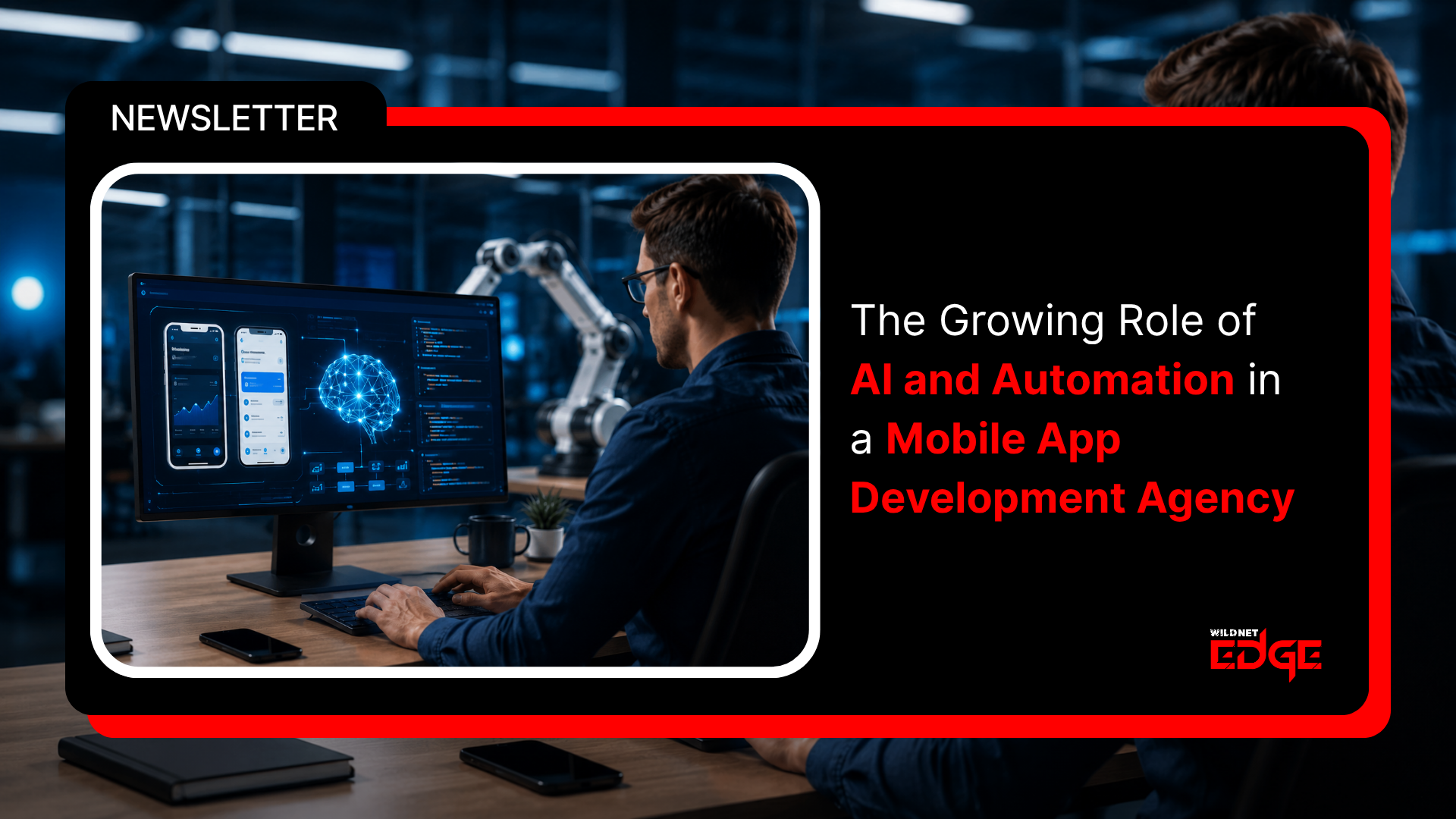


Three years ago, AI in mobile app development meant adding a chatbot or a recommendation engine as a feature. Today, it means something structurally different. 70% of mobile apps now run AI features in production, and 63% of developers have integrated AI directly into their development process. That shift has moved AI from a feature category to a foundational layer that shapes how apps are architected, how they are built, and what clients expect when they hire a mobile app development company.
This is not a story about replacing developers. It is a story about what a capable mobile app development agency looks like now compared to two years ago, and why that difference matters to every business evaluating a development partner.
What Has Actually Changed for a Mobile App Development Agency
Over 60% of developers now incorporate machine learning algorithms into their apps to enhance user experience and functionality. But the more significant shift is happening inside the agencies themselves, not just in the products they ship.
The traditional agency workflow involved manual code reviews, human-written test suites, sequential sprint delivery, and post-launch monitoring that typically ran on scheduled checks rather than continuous analysis. AI has touched every one of those stages.
- AI-assisted code generation tools like GitHub Copilot and Amazon CodeWhisperer now handle routine code scaffolding, boilerplate generation, and API integration patterns. Senior engineers use them to move faster on repetitive tasks and focus attention on architecture decisions and complex business logic. Agencies that have integrated these tools into their workflows report 30 to 40% reductions in time spent on standard development tasks. That translates directly into faster delivery timelines and more competitive project pricing.
- Automated testing has been the bigger operational change. Traditional QA required dedicated engineers writing test cases, running regression cycles, and manually validating UI across device types. AI-driven testing platforms now generate test cases from user behavior data, run parallel regression suites across hundreds of device configurations simultaneously, and flag anomalies before they reach production. For any serious custom mobile app development company, cutting QA cycles by 40 to 60% without reducing coverage is a meaningful competitive advantage.
- Automated deployment and monitoring has changed how agencies handle the post-launch phase. CI/CD pipelines now include AI-powered anomaly detection that catches performance degradation, crash spikes, and API failures in real time rather than waiting for user reports or scheduled checks. This reduces post-launch firefighting and creates a more defensible quality guarantee.
How AI Has Changed What Gets Built
The more visible change for clients is in the product itself. 44% of mobile apps now use AI personalization to deliver tailored content, and AI-powered features have become a baseline expectation rather than a premium add-on in most product categories.
A few specific shifts define what mobile app development services look like in 2026.
- On-device AI is replacing cloud-dependent inference for performance-sensitive features. The on-device AI market was $10.7 billion in 2025, with analysts projecting $75.5 billion by 2033. 68% of enterprises plan edge AI deployment by 2026 to cut cloud compute costs and improve performance. For healthcare and fintech apps handling sensitive data, on-device processing eliminates cloud transmission entirely, which is increasingly a compliance requirement rather than a product preference.
- Predictive UX has moved from experimental to expected in competitive product categories. Apps that surface the next likely action before a user explicitly requests it, pre-load content based on behavioral patterns, or adapt interface layout based on individual usage history now outperform static-interface competitors on retention and session length.
- Agentic AI features represent the next phase. Gartner predicts 40% of enterprise apps will include agentic AI capabilities, where the app can take actions and complete multi-step tasks autonomously on behalf of the user. In e-commerce, that means completing a reorder based on consumption patterns. In field service apps, it means auto-scheduling and route optimization without dispatcher input.
What this means practically is that clients evaluating a mobile app development company in 2026 are asking different questions than they were in 2023. The question is no longer “can you add AI features?” It is “how does your development process handle AI architecture, model integration, and on-device inference from day one?”
The Low-Code and No-Code Layer
AI has also accelerated the rise of low-code development tooling in ways that directly affect how agencies scope and price projects. Gartner projects that by 2026, low-code development tools will account for 75% of new application development, up from 40% in 2021.
This does not mean most apps are being built without engineers. It means that the portion of any app that consists of standard UI patterns, data forms, workflow logic, and integration connectors is increasingly handled by visual tooling rather than hand-written code. Agencies that have integrated low-code layers into appropriate parts of their workflow ship standard features faster and allocate senior engineering time to the complex, differentiated parts of a product.
For clients, this shifts where the value of a mobile app development agency actually sits. Commodity features are fast and affordable. Architectural decisions, AI feature design, platform performance, and security implementation are where agency expertise matters most.
Automation Inside the Development Process
Beyond what gets built, automation has changed how agencies structure their internal operations in ways clients do not always see but always benefit from.
- Automated project estimation tools now analyze historical project data to generate more accurate scope estimates. Agencies that have trained estimation models on past delivery data produce estimates that are 20 to 30% more accurate than human-only estimates, which reduces scope creep and mid-project renegotiation.
- CI/CD automation means code moves from development to staging to production through automated pipelines with defined quality gates. Manual promotion approvals have been replaced by automated checks that validate test coverage, performance benchmarks, and security scans before any build advances. This is standard practice at capable agencies and a meaningful differentiator from teams still running manual deployment processes.
- AI-assisted design-to-code translation tools have shortened the gap between design handoff and development start. Modern tools like Figma-to-code plugins and AI layout interpretation reduce the manual translation work that used to consume significant engineering hours at the beginning of every sprint.
The cumulative effect of these internal automation improvements is meaningful. Agencies operating with mature AI and automation tooling can deliver comparable projects in shorter timeframes, with fewer QA cycles, and with tighter post-launch monitoring than teams operating on traditional workflows.
What This Means When You Are Evaluating a Development Partner
The difference between a mobile app development agency that has genuinely embedded AI into its workflow and one that markets AI without operationalizing it shows up in a few specific places.
- Timeline accuracy. Agencies with AI-assisted estimation and automated testing deliver on stated timelines more consistently than those running on manual processes. Ask prospective partners for their on-time delivery rate on projects comparable to yours.
- QA depth. Ask specifically how testing is handled. Manual QA on a subset of devices is a different product from automated regression suites running across full device matrices. The difference matters for production quality.
- Post-launch monitoring. Ask what happens in the 30 days after launch. Real-time AI monitoring that catches and alerts on anomalies before users report them is meaningfully different from scheduled checks or reactive incident response.
- AI architecture experience. If your product requires AI features, ask for documented examples of similar AI integrations from their portfolio. Agencies that have shipped AI-powered apps in your product category have already solved the model selection, latency, and on-device inference problems your project will hit.
For a closer look at the tools and frameworks that define capable mobile development in 2026, the breakdown of mobile app development tools and technologies covers what a serious technical stack actually looks like.
The Compounding Advantage of Getting This Right Early
The global AI automation market is expected to reach $169.46 billion in 2026, and the trajectory is not slowing. Every month that passes, the gap between AI-native development workflows and traditional ones widens. The apps shipping today with embedded personalization, predictive UX, and automated quality pipelines are setting user experience baselines that future apps in the same category will be compared against.
For businesses evaluating a custom mobile app development company, the question is not whether AI belongs in your product. It is whether your development partner has the process maturity to build it in correctly from the start, or whether AI features will be retrofitted into an architecture that was not designed to support them.
Retrofitting is expensive. Architectural decisions made in the first sprint of a mobile project constrain every sprint that follows. A partner that treats AI integration as a core architectural concern from day one produces a fundamentally more extensible product than one that adds AI features as afterthoughts.
Choose an Agency That Builds for Where Apps Are Headed
Every meaningful shift in mobile over the past decade, from responsive design to push notifications to real-time data to AI, followed the same pattern. Early adopters built for the capability before it became expected. By the time it was standard, they had a year or two of production experience the market was still trying to acquire.
AI in mobile app development is past the early adopter phase. It is in the adoption curve where agencies that are not operationally mature with these tools are already behind. Choosing a development partner that has embedded AI into both their process and their product delivery is not a forward-looking preference. It is a current requirement for building an app that competes.
At Wildnet Edge, AI is built into how we scope, design, build, test, and monitor every mobile product we ship. If you are planning a mobile project and want to understand what that looks like in practice, let’s talk.

Managing Director (MD) Nitin Agarwal is a veteran in custom software development. He is fascinated by how software can turn ideas into real-world solutions. With extensive experience designing scalable and efficient systems, he focuses on creating software that delivers tangible results. Nitin enjoys exploring emerging technologies, taking on challenging projects, and mentoring teams to bring ideas to life. He believes that good software is not just about code; it’s about understanding problems and creating value for users. For him, great software combines thoughtful design, clever engineering, and a clear understanding of the problems it’s meant to solve.


 based on 1200+ reviews



