 sales@wildnetedge.com
 +1 (212) 901 8616
 +1 (437) 225-7733
















































































































 ChatGPT Development & Enablement
  Hire AI & ChatGPT Experts
  ChatGPT Apps by Industry
  ChatGPT Blog
  ChatGPT Case study
  AI Development Services
  Industry AI Solutions
  AI Consulting & Research
  Automation & Intelligence





Key Takeaways
- IT modernization services replace or refactor legacy systems that are actively limiting scalability, security, and operational efficiency.
- Organizations that completed modernization between 2022 and 2025 report 25 to 35 percent reductions in infrastructure costs and 40 to 60 percent faster release cycles.
- Between 60 and 80 percent of enterprise IT budgets currently go toward maintaining legacy systems, leaving very little for innovation or business growth.
- Scalable IT infrastructure built on cloud-native architecture lets businesses handle demand spikes, enter new markets, and absorb acquisitions without multi-year transformation projects.
- Legacy systems are now the primary bottleneck blocking AI adoption, with 75 percent of AI deployment failures attributed to legacy friction.
- Modernization is not a one-time project. It is a continuous evolution that separates businesses that scale from businesses that stall.
Most businesses do not realize their IT infrastructure is holding them back until the evidence becomes impossible to ignore. A product launch that should take three months takes nine. A new market entry gets delayed because the core system cannot support a new data format. An AI initiative gets shelved because the underlying database architecture was designed for overnight batch processing, not real-time inference.
This is what IT modernization services are built to solve, and in 2026, the businesses choosing to modernize are not doing it because it sounds strategic. They are doing it because the cost of not modernizing has become specific, measurable, and painful enough to land in board-level conversations.
Global IT spending is projected to exceed six trillion dollars in 2026, driven heavily by infrastructure modernization, cybersecurity, and AI readiness. The businesses driving that spend are not upgrading for its own sake. They are removing the constraints that prevent them from growing the way their markets demand.
This guide breaks down exactly how IT modernization services reshape scalability, why legacy infrastructure creates a compounding liability over time, and what a practical modernization path looks like for businesses that need to move without breaking what is already working.
The Real Cost of Legacy Systems Before IT Modernization Services Enter the Picture
Industry data consistently shows that enterprises allocate 60 to 80 percent of their IT budgets to maintaining old systems. Deloitte reported, technical debt accounts for 21% to 40% of an organization’s IT spending. When that cost compounds every year a business delays the decision to modernize.
Beyond the direct cost, legacy systems create three specific liabilities that accelerate over time.
- Security exposure: Legacy systems run on unsupported software that no longer receives patches or security updates. In 2026, cyber insurance carriers are now treating legacy infrastructure on end-of-life platforms as unacceptable risk, either denying coverage or raising premiums by 40 to 60 percent for businesses that have not modernized.
- Talent drain: The developers who know how to maintain COBOL, legacy Java frameworks, and aging ERP systems are retiring. Fewer than 2,000 COBOL programmers graduated worldwide in 2024. When the one engineer who understands a critical system leaves, businesses are left with undocumented infrastructure that nobody on the current team knows how to safely modify.
- AI readiness failure: This one is quietly the most significant in 2026. Enterprises investing in AI-powered analytics, customer service automation, and predictive operations are discovering that their legacy architecture is the reason AI projects stall. Seventy-five percent of AI deployment failures trace back to legacy friction including slow integrations, outdated databases, and siloed data that modern AI tools cannot access. Modernization is not just about upgrading old systems. It is the prerequisite for everything businesses want to do next.
What IT Modernization Services Actually Do
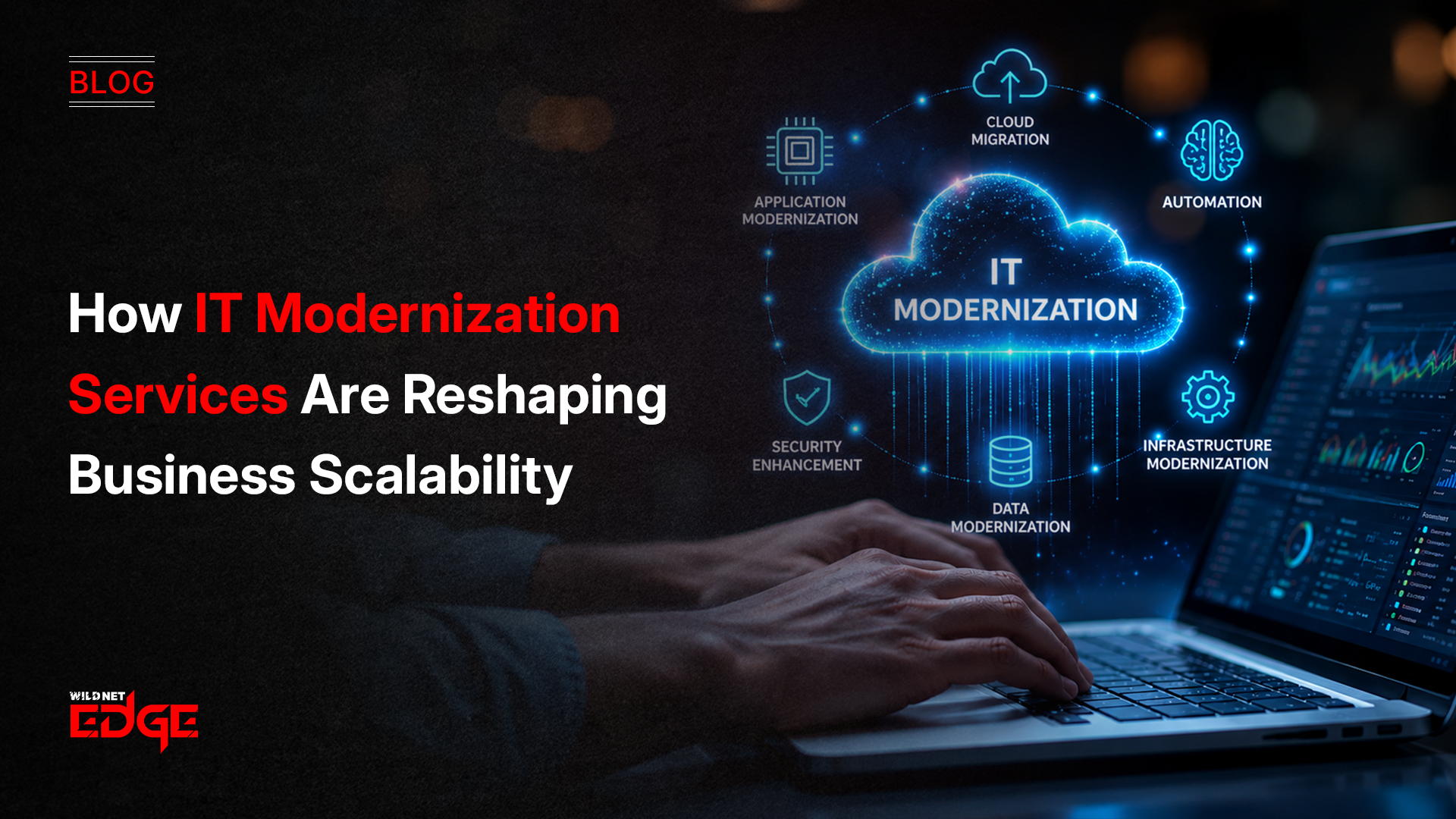
Modernization is not a single action. It is a spectrum of interventions applied based on how outdated a system is, how central it is to business operations, and how much risk the business can absorb during the transition.
- Rehosting moves applications to cloud infrastructure with minimal changes to the code. This is the fastest and lowest-risk approach, often called lift-and-shift. It does not solve underlying architecture problems, but it reduces data center dependency and hardware costs while buying time to plan deeper modernization.
- Replatforming introduces targeted optimizations during the move to cloud, such as switching from a licensed database to an open-source alternative or upgrading an operating system from UNIX to Linux. It improves performance and reduces licensing costs without requiring a full rebuild.
- Refactoring decomposes monolithic applications into microservices, independent modular components that communicate through APIs. This is where the scalability gains become significant. Each microservice can be scaled individually based on real-time demand, which eliminates the all-or-nothing scaling problem of monolithic systems.
- Rebuilding starts from scratch while preserving business logic. This approach carries the highest execution risk and is the right choice in a minority of cases, specifically when the architecture actively prevents what the business needs and the cost of workarounds exceeds the cost of rebuilding.
- Retiring and replacing involves decommissioning systems that no longer serve a function and replacing them with modern SaaS equivalents. Portfolio audits typically find that 15 to 30 percent of applications are legitimate retirement candidates. Removing them first reduces the scope of everything that follows.
Most serious modernization engagements blend these approaches across different parts of the system rather than applying a single strategy universally. The goal is always the same: remove what limits the business, preserve what it has built, and create a foundation that can scale.
How IT Modernization Services Build Scalable IT Infrastructure
This is where the business case for modernization becomes concrete. Here is what changes structurally when modernization is done well.
- Elastic capacity replaces manual provisioning: Legacy systems require capacity planning cycles and hardware procurement timelines measured in weeks or months. Cloud-native infrastructure scales automatically based on demand. When traffic spikes during a product launch or a seasonal peak, the system absorbs it. When demand drops, resource consumption scales back. The business pays for what it uses rather than maintaining excess capacity to handle worst-case scenarios.
- Microservices architecture removes the single-point-of-failure risk: In a monolithic system, a failure in one component can bring down the entire application. When architecture is broken into independent services, a failure in one area is contained. The rest of the system keeps running. This is what enables the uptime guarantees that customer-facing applications require in 2026.
- API-first design enables integration at speed: Modern systems expose functionality through clean APIs, which means adding a new channel, integrating a new tool, or onboarding a new partner becomes a matter of connecting to an existing API rather than undertaking a custom development project. Businesses that run on API-first architecture can respond to market changes in weeks rather than quarters.
- Data becomes accessible in real time: Legacy systems were designed around batch processing. Data moved through them in scheduled overnight jobs. Modern architectures process data continuously, which means the analytics, reporting, and AI tools sitting on top of that data actually work as intended. Real-time inventory, real-time customer behavior analysis, real-time operational monitoring: none of these are possible on legacy infrastructure, and all of them are standard on modern cloud-native platforms.
The Business Growth Connection Most Companies Underestimate
Business growth and IT infrastructure are more directly connected than most leadership teams acknowledge until there is a crisis.
When a company grows faster than its infrastructure can support, the signs are unmistakable. Development cycles slow as engineers spend more time working around system limitations than building new features. New market entries get delayed because onboarding a new geography requires custom integration work with existing systems. Acquisition targets become integration nightmares because the legacy architecture cannot absorb a new business without months of manual data reconciliation.
These are not IT problems. They are business growth problems caused by IT infrastructure that was never designed to scale.
McKinsey’s April 2026 research identified what they called “deliberate modernizers” as the archetype worth studying. These organizations allocate at least one-third of their technology budgets to change rather than maintenance, keep run costs at least 20 percent lower than their peers, and replace legacy systems rather than layering new capabilities on top of them. The businesses in this category consistently outperform their industries on speed to market, operational efficiency, and their ability to respond to competitive disruption.
What a Practical IT Modernization Services Roadmap Looks Like
One of the most common reasons modernization stalls is that businesses treat it as a single project with a defined beginning and end. It is not. It is a structured, ongoing program, and the businesses that execute it well start with a clear framework rather than a technology wish list.
Step 1: Assessment before action
Every successful modernization engagement starts with a thorough assessment of the current environment. Which systems are business-critical? Which are retirement candidates? Where is the technical debt most expensive? What are the dependencies between systems? This assessment maps business processes to system components and establishes baseline metrics for cost, performance, and availability.
- How to do this: Bring in an independent assessment rather than relying on internal teams who may be too close to the existing systems to evaluate them objectively. The output should be a prioritized map of systems ranked by business criticality and modernization complexity, not a list of everything that needs to be updated.
Step 2: Prioritize by impact, not by ease
Not all modernization work delivers equal value. The highest-return engagements target systems where the gap between current capability and business need is largest, and where modernization would directly unblock a specific business growth opportunity.
- How to do this: Work backward from business goals. If the strategic priority is entering a new market, identify which systems currently block that entry and start there. If the priority is deploying AI-powered customer service, identify the data infrastructure that AI requires and modernize that first.
Step 3: Use incremental delivery, not big-bang replacement
Attempting to replace a core system in a single project is one of the highest-risk paths in IT. History is full of large-scale system replacements that ran years over schedule and tens of millions over budget. The Strangler Fig pattern, where legacy components are gradually replaced with cloud-native services while the existing system continues to operate, is now the industry standard for reducing that risk.
- How to do this: Break the modernization program into phases, each with clear milestones and measurable outcomes. Begin with lower-risk, high-impact systems to demonstrate early ROI. Use those wins to build organizational confidence and refine the approach before tackling more complex, mission-critical components.
Step 4: Build for scalability from the start
The point of modernization is not to have newer systems. It is to have systems that can grow with the business without requiring another transformation program in five years. Every architecture decision during modernization should be evaluated against the question of whether it adds or removes future scaling constraints.
- How to do this: Adopt cloud-native, API-first design principles as the default. Choose platforms that scale horizontally, meaning they can add capacity by running more instances rather than by upgrading to larger hardware. Prioritize interoperability so that future tools can be integrated without custom development.
Scalable IT Infrastructure Is Not a Future State. It Is a Current Competitive Advantage.
The businesses scaling fastest right now are not the ones waiting for the right moment to modernize. They are already modernized, and their ability to ship features faster, onboard new customers without friction, respond to market changes in weeks rather than quarters, and actually deploy AI tools that work is the direct result of that infrastructure investment.
Legacy systems do not get easier to modernize over time. Technical debt compounds. The developers who understand those systems retire. Security exposure grows. The gap between what the business needs and what the infrastructure can deliver widens every quarter. At some point that gap becomes existential, and the businesses that reach that point face transformation under duress rather than transformation by design.
The companies that treat IT modernization services as a strategic investment rather than a defensive necessity are the ones building the scalable IT infrastructure that supports durable business growth. That infrastructure is the asset. The systems themselves are just how it gets built.
At Wildnet Edge, we help businesses assess where they are, identify where legacy constraints are limiting growth, and execute modernization in a way that delivers real outcomes without disrupting what is already working. If your systems are slowing your business down, that conversation is worth having sooner than later. Let’s talk.
FAQs
IT modernization services cover the full range of work involved in transforming legacy systems into scalable, secure, and business-aligned infrastructure. This includes cloud migration, application refactoring, microservices adoption, API integration, data architecture modernization, and the retirement of systems that no longer serve a business function.
Scalable IT infrastructure refers to technology architecture that can grow with the business without requiring disruptive rebuilds. Cloud-native systems built on microservices and API-first design scale horizontally, meaning they handle more load by adding capacity automatically rather than by replacing hardware. This is what allows a business to double in size without doubling its IT team.
It depends heavily on the scope and approach. Simple rehosting projects can be completed in a few weeks. Refactoring a core enterprise application to microservices typically takes six to twelve months. Full rebuilds of mission-critical systems can take 12 to 18 months. Most businesses see the best results with phased modernization, which delivers measurable value within the first 60 to 90 days while managing risk incrementally.
Organizations that completed modernization between 2022 and 2025 reported 25 to 35 percent reductions in infrastructure costs, 40 to 60 percent faster release cycles, and total cost of ownership reductions of 20 to 40 percent over three years. The ROI accelerates further when modernization enables AI initiatives that were previously blocked by legacy infrastructure.
Directly. AI tools require real-time data access, clean API surfaces, and continuous data pipelines. Most legacy systems were built on batch processing and siloed databases that cannot support these requirements. Seventy-five percent of AI deployment failures trace back to legacy infrastructure friction. Modernization is the prerequisite for meaningful AI adoption, not an optional complement to it.

Managing Director (MD) Nitin Agarwal is a veteran in custom software development. He is fascinated by how software can turn ideas into real-world solutions. With extensive experience designing scalable and efficient systems, he focuses on creating software that delivers tangible results. Nitin enjoys exploring emerging technologies, taking on challenging projects, and mentoring teams to bring ideas to life. He believes that good software is not just about code; it’s about understanding problems and creating value for users. For him, great software combines thoughtful design, clever engineering, and a clear understanding of the problems it’s meant to solve.



 based on 1200+ reviews



