sales@wildnetedge.com
 +1 (212) 901 8616
 +1 (437) 225-7733













































































































 ChatGPT Development & Enablement
  Hire AI & ChatGPT Experts
  ChatGPT Apps by Industry
  ChatGPT Blog
  ChatGPT Case study
  AI Development Services
  Industry AI Solutions
  AI Consulting & Research
  Automation & Intelligence




TL;DR
In 2026, factories rely on mobile apps to run daily operations. Hybrid app development for Manufacturing Industry helps manufacturers modernize operations without replacing legacy systems. Using one codebase, teams build secure manufacturing hybrid apps that work offline, run on rugged devices, integrate with ERPs and machines, and scale across plants. This guide explains why manufacturers are adopting hybrid apps for operations, key use cases, technical architecture, and how to choose the right hybrid app development company.
Manufacturing loses an estimated $50 billion globally every year due to unplanned downtime. At the same time, factories operate with mixed devices, unstable connectivity, and decades-old machines that cannot be replaced overnight. This is where hybrid app development for Manufacturing Industry becomes practical, not experimental.
Plant managers need real-time visibility. Engineers need data at the machine level. Workers need apps that function even when Wi-Fi drops. Traditional web apps fail here, and native apps take too long to build and maintain.
Hybrid app development for Manufacturing Industry allows manufacturers to deploy industrial mobile app development solutions across tablets, handheld scanners, and rugged devices using one shared codebase without compromising reliability.
Why Manufacturers Are Choosing Hybrid Apps
Manufacturing environments demand resilience, not polish.
1. Offline-First Is Non-Negotiable
Factories have dead zones. Hybrid app development for Manufacturing Industry supports offline-first workflows where data is stored locally and synced later. Workers can complete inspections, audits, or inventory updates without a network and nothing gets lost, often supported by expert hybrid app implementation services to ensure reliable deployment in complex industrial environments.
2. Too Many Devices, One Codebase
Most plants use iPads for supervisors and rugged Android devices for floor workers. Manufacturing hybrid apps run smoothly on both. Instead of managing separate teams, companies maintain one system that works everywhere.
3. Faster IoT and Digital Twin Rollouts
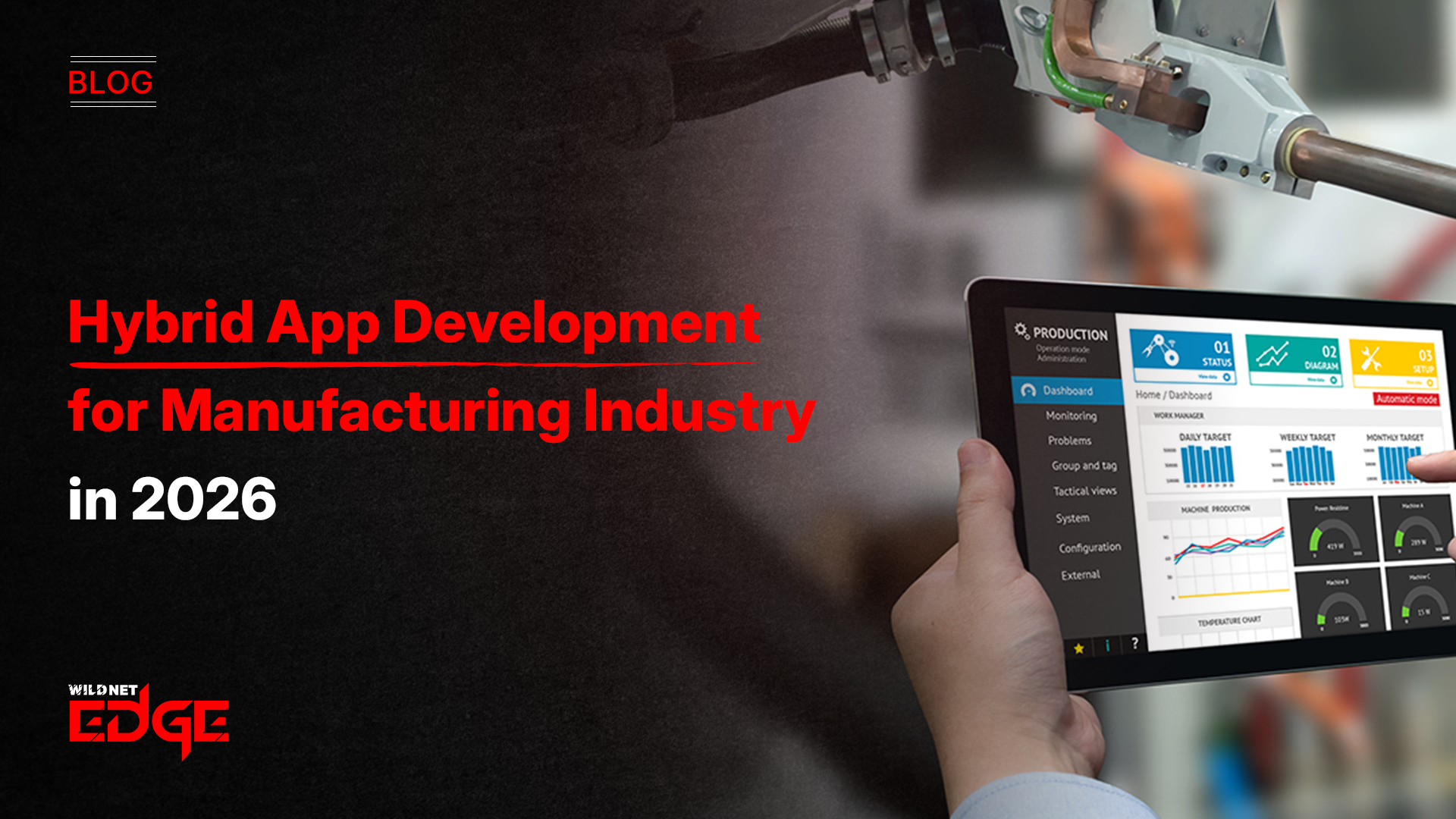
Industrial IoT is growing fast. Hybrid apps for operations help teams visualize machine data, sensor readings, and alerts quickly. Dashboards that once took months now ship in weeks.
High-Impact Use Cases for Hybrid Apps in Manufacturing
1. Predictive Maintenance & Digital Twins
Hybrid apps show live machine health, vibration, and temperature data. Engineers spot issues early and reduce downtime.
2. Inventory & Warehouse Management
Factory management apps built with hybrid frameworks integrate directly with barcode scanners and RFID readers. Updates happen in milliseconds.
3. Worker Safety & Compliance
Manufacturers use geofencing and alerts to prevent accidents. Hybrid apps trigger warnings when workers enter restricted zones and log compliance automatically.
Technical Architecture Behind Manufacturing Hybrid Apps
Building enterprise manufacturing apps requires careful planning.
Legacy System Integration
Most plants still rely on SAP or Oracle. Hybrid app development for Manufacturing Industry includes secure middleware that translates modern APIs into legacy formats.
Edge Computing
Hybrid apps process data locally on devices. This reduces latency and keeps operations running even during network failures.
How to Hire Hybrid App Developers for Manufacturing
Not every mobile developer understands factories. When you hire hybrid app developers, look for:
- Experience with industrial protocols (MQTT, OPC-UA)
- Strong offline sync logic
- Knowledge of shift-based workflows
- Awareness of downtime costs and safety requirements
Manufacturing software has no margin for error.
Why Partner With a Hybrid App Development Company
A specialized hybrid app development company understands industrial risk.
- Security-first architecture aligned with ISA-95
- 24/7 support and SLAs
- Scalable systems that won’t stop production lines
This expertise protects operations and revenue.
Case Studies
Case Study 1: The Automotive Assembly Line
- Challenge: A car manufacturer needed to digitize paper-based quality checks.
- Solution: We implemented hybrid app development for Manufacturing Industry using React Native on rugged tablets.
- Result: QA time was reduced by 30%. The app’s offline capability ensured zero data loss during connectivity drops, proving the value of the hybrid approach.
Case Study 2: The Chemical Plant Safety App
- Challenge: Workers were missing safety protocols during shift changes.
- Solution: A Flutter-based project that used geofencing to push checklists.
- Result: Safety incidents dropped by 45%, and the firm saved $200k in compliance fines thanks to robust hybrid app development for Manufacturing Industry.
Conclusion
Hybrid app development for Manufacturing Industry helps manufacturers modernize without disruption. It connects people, machines, and data securely and reliably.
At WildnetEdge, we build industrial-grade hybrid apps that work where it matters most: on the factory floor. Whether you want to hire hybrid app developers or build full-scale enterprise manufacturing apps, hybrid technology is the foundation for Industry 5.0.
FAQs
Yes. Hybrid app development for Manufacturing Industry prioritizes “Offline-First” architecture. Data is stored locally in encrypted databases and syncs automatically with the ERP once the device reconnects to the network.
An industrial MVP typically ranges from $50,000 to $100,000. Complex enterprise manufacturing apps with AR and IoT integration can exceed $200,000.
Both work well, but Flutter is often preferred in hybrid app development for Manufacturing sector when high-performance rendering (like 3D machine parts or digital twins) is required.
Yes. These apps utilize native plugins to interface seamlessly with external hardware like barcode scanners, RFID readers, and thermal cameras.
General developers lack understanding of industrial workflows. Specialized developers understand safety protocols, shift management, and the cost of downtime inherent in hybrid app development for Manufacturing sector.
It puts real-time data in the hands of every worker. From the loading dock to the assembly line, everyone sees the same inventory status, reducing bottlenecks.
Yes. By implementing role-based access control (RBAC) and data encryption, hybrid app development for Manufacturing sector ensures that sensitive production data remains secure, even on shared devices.

Managing Director (MD) Nitin Agarwal is a veteran in custom software development. He is fascinated by how software can turn ideas into real-world solutions. With extensive experience designing scalable and efficient systems, he focuses on creating software that delivers tangible results. Nitin enjoys exploring emerging technologies, taking on challenging projects, and mentoring teams to bring ideas to life. He believes that good software is not just about code; it’s about understanding problems and creating value for users. For him, great software combines thoughtful design, clever engineering, and a clear understanding of the problems it’s meant to solve.


 based on 1200+ reviews