sales@wildnetedge.com
 +1 (212) 901 8616
 +1 (437) 225-7733











































































































 ChatGPT Development & Enablement
  Hire AI & ChatGPT Experts
  ChatGPT Apps by Industry
  ChatGPT Blog
  ChatGPT Case study
  AI Development Services
  Industry AI Solutions
  AI Consulting & Research
  Automation & Intelligence




Key Takeaways
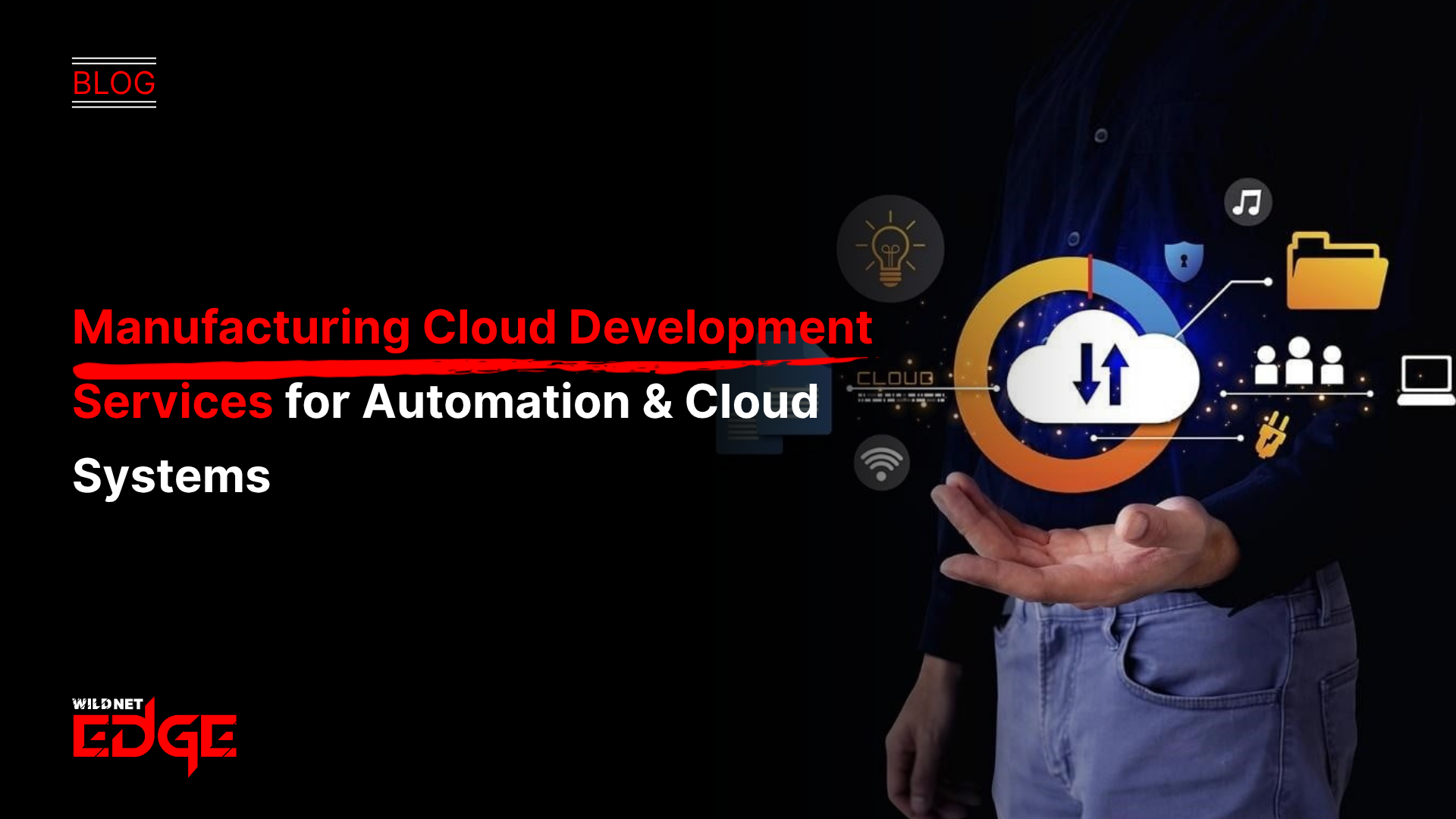
- In 2026, manufacturing cloud development services are bridging the IT/OT divide, enabling real-time data synchronization between shop-floor sensors and enterprise-level analytics.
- Modern industrial cloud platforms leverage “Confidential Computing” to process sensitive intellectual property (blueprints and formulations) in isolated, secure cloud environments.
- Specialized smart factory cloud solutions utilize Edge Computing to provide millisecond-latency responses for critical automation tasks while offloading heavy data processing to the cloud.
- A professional cloud development company for the manufacturing sector ensures that “Sustainability-as-a-Service” is baked into the architecture to track carbon footprints across the production lifecycle.
The modern factory floor is no longer just a place of mechanical labour; it is a high-velocity data ecosystem. In 2026, the gap between market leaders and struggling plants is defined by the quality of their manufacturing cloud development services. While many have sensors and dashboards, few have a truly integrated digital backbone that “thinks” and “scales” globally.
Specialized industrial cloud platforms step in where generic IT fails. It requires a deep understanding of the IT/OT (Information Technology/Operational Technology) divide, deterministic latency requirements, and the complex logic of global supply chains. Modernization is no longer about adding more hardware; it is about building a resilient, intelligent layer through a specialized cloud development company that orchestrates the entire production lifecycle from the cloud to the edge.
Why the Manufacturing Industry Needs Specialized Cloud Development
Generic cloud hosting often fails in an industrial setting because it ignores the unique constraints of the factory floor. Smart factory cloud solutions must be built with domain-specific resilience and multi-protocol connectivity.
1. AI Must Move From Pilot to Production
Most manufacturers have experimented with basic predictive maintenance. However, moving to “Agentic Production”, where the cloud infrastructure autonomously reroutes a production line based on a supply chain delay, requires deep system integration. Manufacturing cloud development services ensure your architecture is:
- Scalable: Managing data from thousands of IoT nodes across global factory sites.
- Secure: Protecting proprietary industrial algorithms within private cloud instances.
- Integrated: Directly connected to both shop floor PLCs and top-floor ERPs via cloud-native bridges.
2. The Labor Gap is Forcing Automation
With a global shortage of skilled technicians, manufacturing cloud software acts as a “Force Multiplier.” Cloud-powered “Expert Assistants” can guide a junior operator through complex engine assembly using AR overlays and real-time voice guidance hosted on high-performance industrial cloud platforms.
3. Legacy Core Systems Are the Real Bottleneck
Many factories run on 20-year-old proprietary systems. The trend for 2026 is “Cognitive Overlays.” Instead of a risky “rip-and-replace,” a specialized cloud development company builds a cloud-native intelligence layer that “reads” legacy data streams and provides production optimization without disrupting existing workflows.
Industrial Cloud Development Lifecycle (SDLC)
Building manufacturing systems requires a more rigorous approach than standard SaaS. The deployment of smart factory cloud solutions follows a “Safety-First” engineering lifecycle.
1. OT/IT Mapping & Architecture Planning
Before a single server is provisioned, architects perform a detailed audit of the factory’s data protocols. We ensure that manufacturing cloud software can bridge Modbus, Profinet, and OPC-UA data into a standardized cloud format.
2. Secure Edge-to-Cloud Integration
This is the most critical phase. Modern industrial cloud platforms must handle high-speed data. We solve this through:
- Edge Gateways: Processing immediate safety-critical actions locally at the machine.
- Unified Namespace (UNS): Creating a single source of truth in the cloud where every machine and app can share data.
- Hybrid Cloud Bridging: Keeping sensitive production data on-site while moving analytics and simulation to the cloud.
3. Resilience Testing & Virtual Commissioning
Using “Digital Twins,” modern manufacturing cloud development services test the system in a virtual factory before live deployment. We simulate failures to ensure that automation logic prevents equipment damage and operational risks.
How Cloud Development Helps Factories Grow
Strategic smart factory cloud solutions enable factories to modernize while maintaining strict uptime and safety standards.
- AI Production Optimization: The cloud identifies hidden correlations between environmental factors and product defect rates, adjusting parameters in real-time.
- Zero-Waste Quality Loops: Using cloud-based vision systems to perform 100% inspection at line speed, virtually eliminating scrap and rework.
- Autonomous Maintenance: The cloud “calls for help” by ordering its own spare parts and scheduling a human technician before a failure occurs.
- Agile Supply Chains: Using cloud-native reasoning to adjust production schedules based on real-time news, port congestion, or weather events.
What Manufacturing Leaders Look for in a Cloud Partner
Selecting a cloud development company for manufacturing is an operational risk decision. Leaders evaluate “Machine Fluency” and infrastructure maturity.
1. OT Fluency: Do They Speak “Machine”?
Manufacturing is not like retail. A partner providing manufacturing cloud development services must understand PLC logic and deterministic networking. Leaders expect architecture that respects the physical constraints of the floor.
2. Proven Execution in Cloud-Native Automation
A strategy deck is not enough. Leaders ask: Have you successfully integrated a cloud ERP with a live production line? Partners must demonstrate the ability to handle messy, real-world industrial data in an industrial cloud platform.
3. Security and Safety-First Mindset
Agentic automation introduces physical risk. Leaders look for partners that can implement “Human-in-the-Loop” guardrails, ensuring that cloud decisions cannot override critical safety protocols on the shop floor. This is a critical aspect of manufacturing cloud development services, where safety, reliability, and real-time control must coexist without compromising operational integrity.
Case Studies
Case Study 1: Multimodal Quality Control
- Challenge: A high-speed bottling plant was losing 8% of its margin to defective caps that traditional vision systems missed.
- Solution: We implemented manufacturing cloud development services using cloud-native vision AI to analyze cap seating from multiple angles in real-time.
- Result: Defect detection accuracy hit 99.9%, and the plant saved $1.4M in annual waste within the first six months.
Case Study 2: Rapid Modernization of a Legacy Plant
- Challenge: A heavy machinery plant faced high downtime because legacy manuals were too difficult for new hires to navigate quickly.
- Solution: We provided manufacturing cloud software to create a “Cognitive Overlay,” fetching data from legacy PLCs into a cloud-native analytics dashboard.
- Result: Unplanned downtime dropped by 75%, and the plant achieved record uptime during its peak production quarter.
Conclusion
The manufacturing sector is at a turning point. Success in 2026 requires moving beyond simple storage to true intelligence. Specialized manufacturing cloud development services bridge the gap between mechanical labor and cognitive optimization. From industrial automation to cloud-native production systems, the right digital backbone ensures your factory remains resilient, efficient, and aggressively competitive.
At Wildnet Edge, we address the industry’s digital friction with our signature AI-first approach. By utilizing automated cloud refactoring and synthetic stress-testing, we function as your dedicated partner for the smart manufacturing era.
FAQs
Manufacturing cloud development services are specialized engineering services that build and scale cloud-native infrastructure for industrial environments, focusing on IoT integration, OT/IT bridging, and real-time automation.
Through “Edge Computing,” where time-sensitive decisions are made at the machine level, while the cloud handles long-term optimization and global fleet management.
General cloud providers lack the specific protocols (like OPC-UA or Modbus) and the safety-first mindset required to manage physical machinery without risk of injury or equipment damage.
These are integrated cloud environments that connect every asset from machines to employees to a central data fabric, allowing for autonomous optimization and predictive maintenance.
You should engage a consultant when you have “islands of data” that don’t talk to each other, or when your current on-premise servers are causing bottlenecks in production speed.
By monitoring energy-heavy equipment like furnaces in real-time, the cloud can autonomously optimize power cycles, reducing the factory’s overall carbon footprint by up to 30%.
Most manufacturers see a full ROI within 12-18 months, driven by a reduction in unplanned downtime, lower energy costs, and the elimination of manual quality control errors.

Managing Director (MD) Nitin Agarwal is a veteran in custom software development. He is fascinated by how software can turn ideas into real-world solutions. With extensive experience designing scalable and efficient systems, he focuses on creating software that delivers tangible results. Nitin enjoys exploring emerging technologies, taking on challenging projects, and mentoring teams to bring ideas to life. He believes that good software is not just about code; it’s about understanding problems and creating value for users. For him, great software combines thoughtful design, clever engineering, and a clear understanding of the problems it’s meant to solve.
 based on 1200+ reviews