 sales@wildnetedge.com
 +1 (212) 901 8616
 +1 (437) 225-7733
















































































































 ChatGPT Development & Enablement
  Hire AI & ChatGPT Experts
  ChatGPT Apps by Industry
  ChatGPT Blog
  ChatGPT Case study
  AI Development Services
  Industry AI Solutions
  AI Consulting & Research
  Automation & Intelligence





Key Takeaways
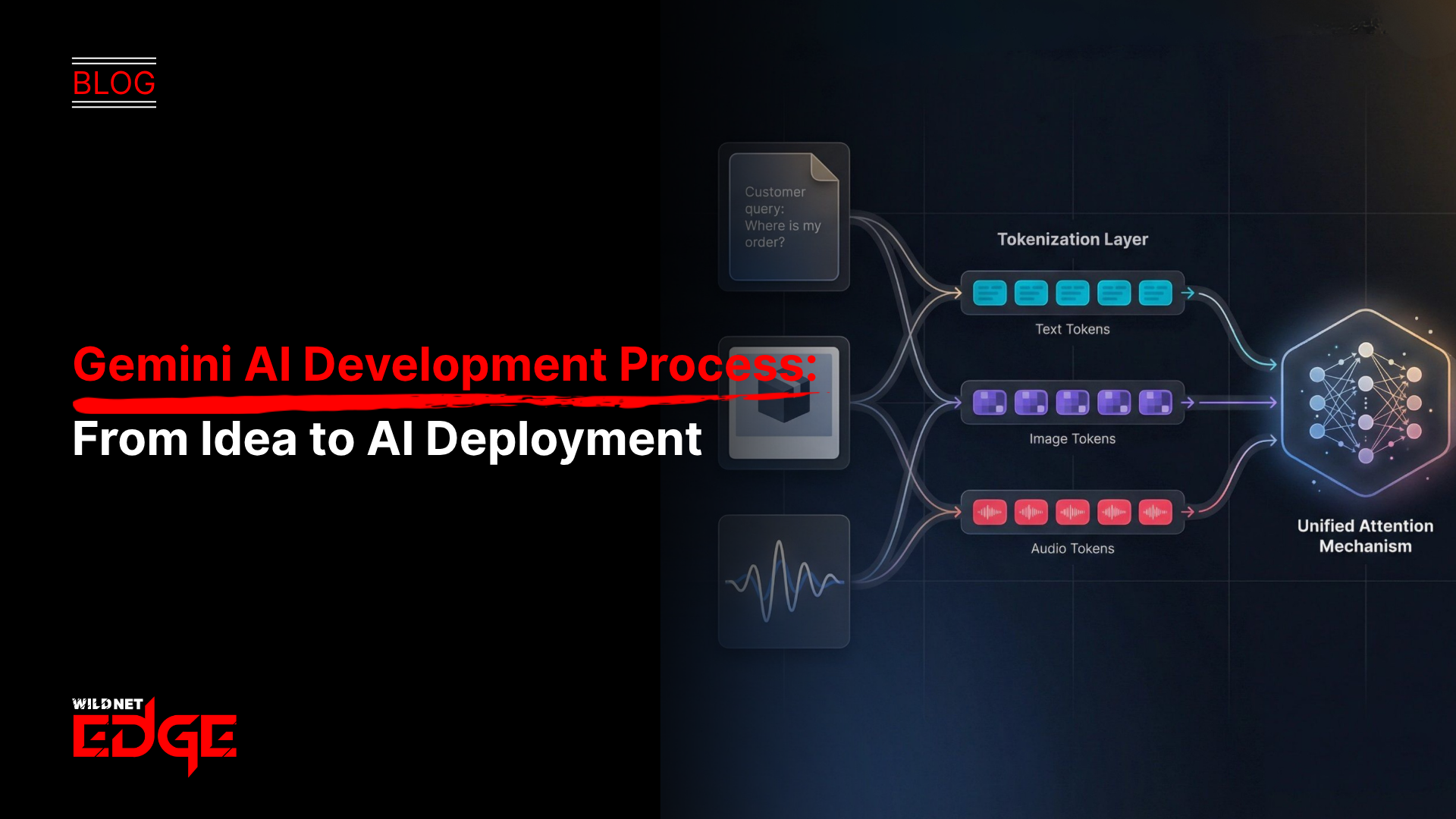
- The Gemini AI development process prioritizes cognitive mapping and prompt architecture over standard code-first approaches.
- Successful generative AI implementation leverages Gemini’s 2M+ context window to ingest massive enterprise datasets for superior reasoning.
- A professional AI project workflow includes rigorous “Red Teaming” and bias mitigation to ensure enterprise-grade safety.
- Gemini development services focus on continuous “Model Tuning,” ensuring the AI stays relevant as corporate data evolves.
In 2026, the speed of your business is dictated by the speed of your intelligence. Technology is no longer a separate layer; it is the nervous system of the organization, powered by autonomous models. However, many companies struggle with “AI Friction” hallucinations, high token costs, and legacy data silos that stall growth. This is where a structured Gemini AI development process becomes essential.
Modern Gemini development services go beyond simple API calls. They involve re-engineering how data is perceived and utilized. Whether you are deploying an agentic workforce or a multimodal search engine, the goal is to create a seamless link between business intent and AI execution.
Step-by-Step Gemini AI Development Process
A successful generative AI implementation follows a disciplined, four-phase AI project workflow.
Phase 1: Strategy & Knowledge Auditing
The Gemini AI development process begins by identifying the “Cognitive Gap” in your operations.
- Use Case Validation: Defining which business bottlenecks require Gemini’s multimodal reasoning (e.g., analyzing video logs vs. text reports).
- Data Readiness Assessment: Auditing your unstructured data (PDFs, Audio, Video) to ensure it is clean enough for an AI development lifecycle.
- Model Selection: Choosing between Gemini Ultra (complex logic), Pro (versatility), or Flash (speed) to optimize for both performance and token cost.
Phase 2: Architecture & RAG Design
This stage defines the structural foundation of your AI project workflow.
- RAG (Retrieval-Augmented Generation): Building the vector database pipelines that ground Gemini in your private, secure business data.
- Prompt Engineering & Orchestration: Designing the “system instructions” that guide the AI’s persona and logic.
- System Integration: Connecting the AI layer to your existing ERP and CRM via Vertex AI extensions.
Phase 3: Testing & Safety Guardrails
Testing is the safeguard of the Gemini AI development process, ensuring the system is “production-safe.”
- Red Teaming: Rigorously trying to “break” the AI to find vulnerabilities or prompt injection risks.
- Hallucination Benchmarking: Measuring the accuracy of the AI’s responses against verified internal facts.
- Compliance Review: Ensuring the generative AI implementation meets 2026 standards for data privacy and ethical AI usage.
Phase 4: Deployment & Agentic Optimization
The final steps of the AI development lifecycle focus on autonomous performance.
- Infrastructure Setup: Deploying the solution on Google Cloud’s high-performance TPU/GPU clusters.
- Monitoring & Fine-Tuning: Using real-world feedback to refine the model’s accuracy and reduce token latency.
Challenges in the AI Development Lifecycle
Even with a clear roadmap, generative AI implementation presents unique operational hurdles:
- Context Management: Effectively using Gemini’s 2M token window without incurring unnecessary costs.
- Legacy Data Bridges: Connecting modern AI agents to 20-year-old on-premise databases. This requires specialized gemini development services.
- Human-AI Alignment: Ensuring the AI’s autonomous decisions align with your corporate values and safety protocols.
Post-Launch: Sustaining Your AI Project Workflow
To protect long-term value, companies must treat their AI as a living system.
- Continuous Performance Optimization: The Gemini AI development process doesn’t end at launch. Regular prompt audits ensure the model remains efficient as data grows.
- Knowledge Updates: Re-embedding the vector database as new company information emerges.
- Maintenance Cycles: You should re-engage the smart development lifecycle periodically to upgrade to newer Gemini versions or add multimodal capabilities.
How Businesses Measure Success in AI Implementation
- Reasoning Accuracy: The percentage of AI decisions that require no human correction.
- Time-to-Value: How quickly the AI agent solves a complex customer or operational query.
- Token ROI: Measuring the cost of AI inferencing against the labor hours saved.
- Employee Adoption: The shift from employees fearing AI to using it as their primary “Cognitive Co-pilot.”
Case Studies
Case Study 1: The Multi-Modal Audit
- Problem: A global shipping firm spent thousands of hours manually checking manifests against port security footage.
- Solution: We implemented a Gemini AI development process that “watches” video and “reads” text simultaneously to flag discrepancies.
- Result: Discrepancy detection improved by 80%, saving $2.4M in annual lost cargo.
Case Study 2: Legal Knowledge Orchestration
- Problem: A law firm couldn’t effectively search 30 years of trial archives.
- Solution: Using a specialized AI project workflow, we built a “Long-Context RAG” system that remembers every case file.
- Result: Research time dropped from 15 hours to 30 seconds with 100% cited accuracy.
Conclusion
The Gemini AI development process in 2026 is about more than just code; it is about building a scalable, resilient “Silicon Workforce.” It requires a clear Generative AI Deployment strategy and a focus on multimodal reasoning.
At Wildnet Edge, we guide you through every stage from the initial idea to full-scale AI deployment. We ensure your system is secure, grounded, and scales with your ambition.
FAQs
For a custom enterprise agent, a standard AI project workflow takes 3 to 5 months from discovery to full deployment.
A specialist acts as an “Intelligence Architect,” designing the RAG pipelines and prompt logic that prevent hallucinations and ensure ROI.
Retrieval-Augmented Generation (RAG) is the only way to ensure Gemini provides answers based on your private, verified company facts rather than public training data.
Yes. Even simple implementations, like automating customer emails or document summaries, can save hundreds of labor hours using Gemini Flash.
During the planning phase. Hiring experts before you commit to an architecture prevents expensive “technical debt” later in the smart development lifecycle.
Standard development is deterministic (fixed rules); Gemini AI development is probabilistic, requiring constant testing for accuracy and reasoning bias.
ROI is measured by reduced operational expenditure (OpEx), increased decision-making speed, and the ability to process unstructured data at scale.

Managing Director (MD) Nitin Agarwal is a veteran in custom software development. He is fascinated by how software can turn ideas into real-world solutions. With extensive experience designing scalable and efficient systems, he focuses on creating software that delivers tangible results. Nitin enjoys exploring emerging technologies, taking on challenging projects, and mentoring teams to bring ideas to life. He believes that good software is not just about code; it’s about understanding problems and creating value for users. For him, great software combines thoughtful design, clever engineering, and a clear understanding of the problems it’s meant to solve.

 based on 1200+ reviews



