 sales@wildnetedge.com
 +1 (212) 901 8616
 +1 (437) 225-7733
















































































































 ChatGPT Development & Enablement
  Hire AI & ChatGPT Experts
  ChatGPT Apps by Industry
  ChatGPT Blog
  ChatGPT Case study
  AI Development Services
  Industry AI Solutions
  AI Consulting & Research
  Automation & Intelligence





Key Takeaways
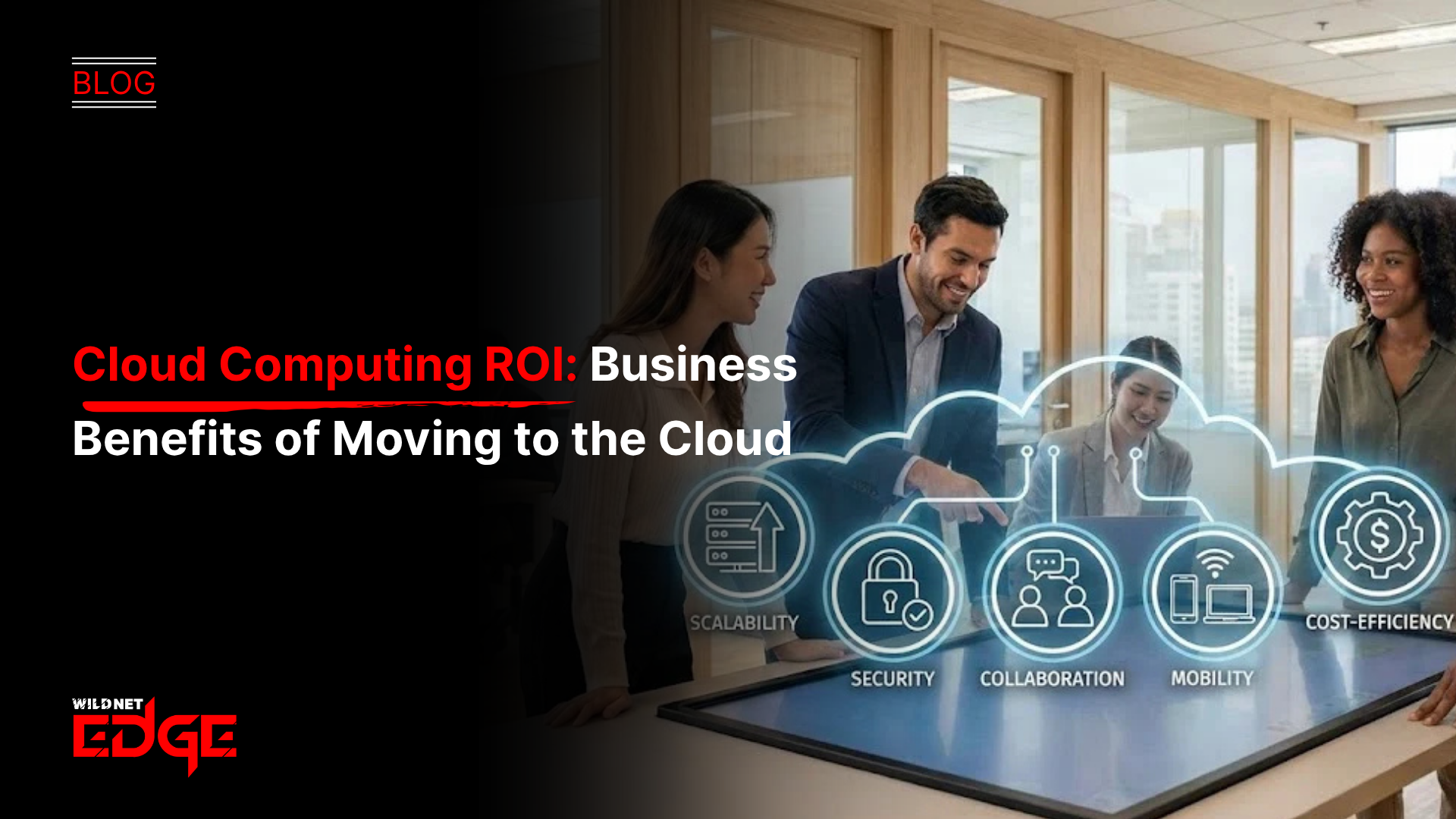
- In 2026, cloud computing ROI will no longer be measured solely by cost-cutting but by “Value Delivery” the ability to launch products 3x faster and scale AI workloads without friction.
- Organizations are achieving 25-30% more cloud cost savings by integrating AI-native FinOps, moving from reactive billing to proactive, real-time resource governance.
- With the rise of Agentic AI, the biggest driver of cloud digital transformation is “Inference Efficiency,” where specialized cloud accelerators (TPUs/GPUs) provide 4.7x better price-performance than traditional setups.
- Leading companies partner with a Cloud Computing Company to eliminate the estimated 32% of cloud spend typically lost to idle “zombie” resources.
In 2026, executives no longer view the cloud as a mere utility; they view it as the primary engine for margin expansion. CFOs are demanding hard numbers on infrastructure efficiency. CTOs are prioritizing high-performance multimodal environments. This is why a structured cloud computing ROI strategy has become the central focus of modern enterprise leadership.
The era of “Cloud-First at any cost” has ended. Today, the focus is on “Cloud-Intelligent”, where every virtualized dollar must reduce operational drag or protect market share. Companies that approach infrastructure through a professional Cloud Computing Company framework are seeing the most significant gains. From automated dev-pipelines to AI-integrated architectures, cloud computing ROI is the financial backbone of the digital-first era.
Defining Cloud Computing ROI Clearly
True cloud computing ROI comes from removing the “Technical Friction” that slows down business growth. It is the ratio of net gains (revenue growth + cost avoidance) against the total cost of ownership (TCO) of the cloud environment.
Consider the three pillars of cloud digital transformation impact in 2026:
- The “Agility” ROI: A global retailer migrates its legacy ERP to a serverless model, allowing them to handle 300% more traffic during holiday surges with zero downtime.
- The “Avoidance” ROI: A Cloud FinOps audit identifies $250k in idle resources that are decommissioned immediately, turning wasted OPEX into R&D capital.
- The “AI” ROI: By utilizing cloud-native long-context windows (2M+ tokens), a legal firm audits 10,000 contracts in minutes, uncovering missed revenue that would have taken humans years to find.
Why Cloud Computing ROI Is Critical in 2026
Businesses today operate in an environment where cloud spending is on track to surpass $1 trillion globally. However, with complexity rising, nearly 84% of organizations name cloud spend management as their top challenge. This has made a focused ROI strategy a survival requirement.
Organizations increasingly rely on a specialized Cloud Computing Company to optimize their “Compute Spend.” Modern consultants analyze how cloud investments directly influence:
- Operating Margins: Reducing the cost per transaction via automation.
- Revenue Acceleration: Shortening the “Time-to-Market” for new digital products.
- Risk Mitigation: Shifting from reactive firewalls to proactive, cloud-native threat hunting.
Benefits of Cloud Computing ROI
To understand the benefits of cloud computing, executives must break ROI down into clear financial levers.
1. Operational Efficiency and Labor Savings
The fastest path to cloud cost savings is through automation. Cloud-native workflows reduce manual intervention in server patching and deployment by up to 80%. When you hire a specialized partner, the ROI is realized in the thousands of engineering hours redirected from “maintenance” to “innovation.”
2. Cloud Cost Optimization (FinOps)
Many enterprises suffer from “Cloud Sprawl,” where hosting bills spiral out of control. ROI-driven cloud management uses AI-driven tools to “right-size” infrastructure in real-time. Moving steady workloads to Reserved Instances can unlock double-digit percentage savings instantly.
3. Cloud-Native Growth
The value of cloud digital transformation isn’t just about savings; it’s about revenue expansion. By building “Headless” or “Edge-Native” architectures, businesses can serve global customers with sub-millisecond latency, directly increasing conversion rates and brand loyalty.
Cloud Computing Cost vs. Benefits: A Realistic View
Not all Digital transformation with cloud ROI shows up in the first quarter. Returns build gradually as “Technical Debt” is repaid and systems become more resilient.
Upfront Costs
Initial investments in a professional Cloud Computing Company include:
- Readiness Audits: Evaluating which legacy apps should be “Refactored” vs “Rehosted.”
- Landing Zone Design: Setting up secure, governed cloud environments.
- Migration Fees: The one-time cost of securely moving petabytes of data.
Long-Term Benefit Horizon
- Months 1-3: Discovery and stabilization. ROI often appears flat as parallel systems (on-prem + cloud) run simultaneously.
- Months 6-12: Cloud cost savings accelerate as FinOps triggers kick in and legacy data centers are decommissioned.
- Year 2+: The scalable foundation allows for massive revenue growth without a proportional increase in IT headcount.
Strategic Business Impact for Enterprises
Data Sovereignty and Security
In 2026, the value of the cloud is found in the breach that didn’t happen. Using cloud-native “Confidential Computing” to protect PII ensures that customer trust remains uncompromised, avoiding the multi-million dollar fines associated with 2026 data regulations.
Customer Experience (CX) ROI
In a hyper-competitive market, reasoning speed is the new UX. The benefits of cloud computing are seen when an AI agent can process a customer’s multimodal query (video/voice) in real-time, driving brand loyalty to record highs.
Industry Applications of Cloud Computing ROI
| Industry | Cloud Digital Transformation Benefit | Primary ROI Driver |
| Finance | Real-time Fraud Detection | Reduction in “Time-to-Compliance” |
| Retail | Multimodal Personalization | 15-25% Increase in AOV (Average Order Value) |
| Healthcare | Secure Medical Data Lakes | 40% Reduction in Documentation Labor |
| Logistics | Agentic Route Optimization | 20% Decrease in Fuel and Maintenance Costs |
How Businesses Can Maximize Cloud Computing ROI
1. Define Measurable Goals Before You Migrate
Start with a “Performance Benchmark.” If your goal is to reduce latency, target a specific millisecond count. Without these hard KPIs, the advantages of cloud computing remain invisible to the board.
2. Conduct a Thorough FinOps Analysis
Evaluate the cost of “Pay-as-you-go” against “Committed Use.” A realistic Digital transformation with cloud strategy uses the most cost-effective instance type for every specific workload.
3. Integrate Systems Intelligently
Align your cloud stack with your existing workflows. Seamless integration where your cloud-native ERP “talks” to your warehouse IoT in real-time accelerates the realization of cloud computing ROI.
Case Studies
Case Study 1: The FinOps Rescue
- Challenge: A fintech startup was spending 35% of its revenue on AWS with no visibility into the waste.
- Solution: We implemented an ROI-driven program focused on resource right-sizing and automated Spot Instance usage.
- Result: Monthly cloud costs dropped by 28%, resulting in a full ROI on our services in just 4 months.
Case Study 2: Scaling for Global Retail
- Challenge: A retailer’s site crashed during every major sale, losing an estimated $500k per event.
- Solution: Partnering as their Cloud Services Company, we migrated them to a serverless, geo-redundant architecture.
- Result: The system handled a 300% traffic surge with zero downtime. The ROI was an additional $2.1M in first-month revenue that would have been lost to failure.
Conclusion
The ROI of cloud computing in 2026 is undeniable for organizations that prioritize engineering over hype. It appears in the form of leaner operations, sub-second global performance, and optimized compute spend. By choosing a partner who understands the P&L of infrastructure as well as the logic of the code, enterprises can turn the cloud into their strongest engine for growth.
At Wildnet Edge, we approach digital transformation with our signature AI-first approach. We don’t just move data; we engineer high-performance, cost-governed ecosystems. In 2026, the question is no longer if you will move to the cloud, but how profitably you will scale within it. Our Cloud ServicesCompany solutions are built with a “Production-First” mindset to de-risk your journey and ensure your infrastructure is secure, scalable, and most importantly profitable.
FAQs
We track “Total Cost of Ownership (TCO)” vs. “Business Value Generated,” including metrics like reduction in operational expenditure (OpEx) and increase in developer velocity.
Without FinOps, “Zombie Resources” and unoptimized scaling can lead to an estimated 32% waste in your cloud budget, negating the financial benefits of the migration.
Yes. In fact, mid-sized firms often see a faster ROI because they can pivot to elastic cloud models and eliminate expensive on-site server rooms more quickly than massive enterprises.
By moving to green-energy-powered cloud data centers and optimizing compute loads, companies reduce their “Carbon-per-Transaction,” meeting 2026 ESG goals while saving money.
The moment your cloud bill exceeds 15% of your total operational budget, or when your “Time-to-Production” for new features begins to slow down.
Absolutely. By eliminating “Technical Friction” and automating mundane infrastructure tasks, engineers can focus on creative, high-value work, which significantly improves job satisfaction.
Immediate “Quick Wins” (cost cuts) are visible within 30-90 days. Structural gains (revenue from new digital products) typically mature between 6 and 12 months.

Managing Director (MD) Nitin Agarwal is a veteran in custom software development. He is fascinated by how software can turn ideas into real-world solutions. With extensive experience designing scalable and efficient systems, he focuses on creating software that delivers tangible results. Nitin enjoys exploring emerging technologies, taking on challenging projects, and mentoring teams to bring ideas to life. He believes that good software is not just about code; it’s about understanding problems and creating value for users. For him, great software combines thoughtful design, clever engineering, and a clear understanding of the problems it’s meant to solve.


 based on 1200+ reviews



