 sales@wildnetedge.com
 +1 (212) 901 8616
 +1 (437) 225-7733
















































































































 ChatGPT Development & Enablement
  Hire AI & ChatGPT Experts
  ChatGPT Apps by Industry
  ChatGPT Blog
  ChatGPT Case study
  AI Development Services
  Industry AI Solutions
  AI Consulting & Research
  Automation & Intelligence





TL;DR
In 2026, edge computing is essential for building fast, responsive, and secure applications, especially for IoT and AI. This article is your definitive guide to the Best Edge Computing Development Companies in the USA. We’ve ranked the top 10 firms that move beyond basic cloud setup to deliver complex Edge AI Solutions and scalable, real-time data processing. This guide will help you select the ideal partner to build a truly automated and intelligent edge-native platform.
If you’re here, you’ve likely realized that the cloud-only model has its limits. You’re dealing with latency issues, massive data transfer costs, and security risks for your IoT devices. You know you need to process data where it’s created at the edge. But you also know that building, deploying, and managing applications on thousands of different devices is incredibly complex.
You’re looking for a partner who can do more than just manage servers. You need a team that understands IoT Edge Application Development, containerization, and how to deploy AI models to low-power devices. You need one of the Best Edge Computing Development Companies with a proven, enterprise-level process. This guide is built to help you find that partner and ensure your transition to the edge is seamless, secure, and drives real business value.
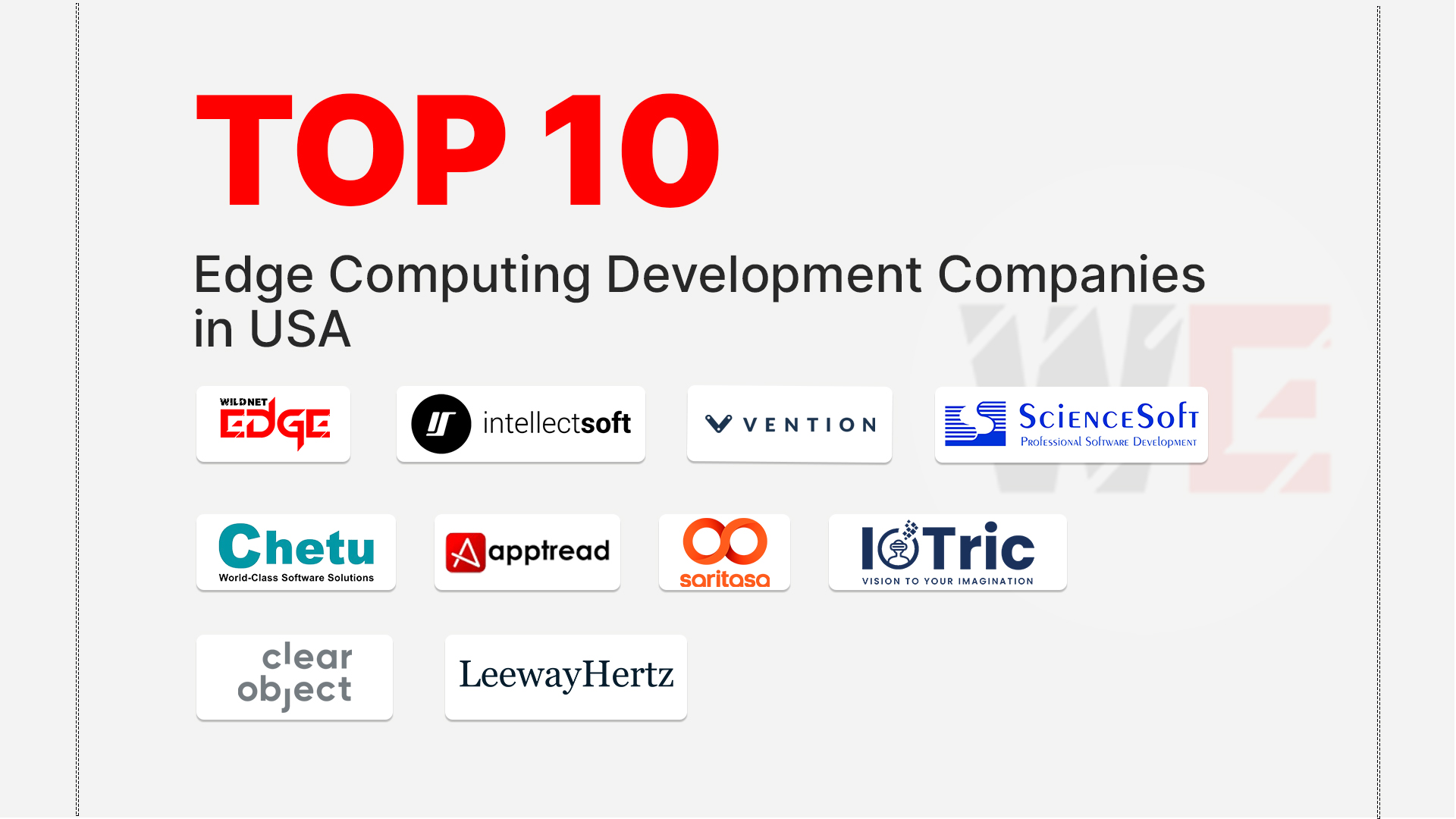
Comparative Matrix: Top 10 Edge Computing Development Companies
| Company | Core Services | Industries Served |
| Wildnet Edge | Enterprise Edge, AI/MLOps, IoT, Cloud-Native | Healthcare, Finance, Retail, Logistics |
| Vention | Staff Augmentation, Edge/IoT, Custom Software | FinTech, HealthTech, E-commerce, Automotive |
| BairesDev | IoT Consulting, App Modernization, Data Analytics | Healthcare, Manufacturing, Finance, Retail |
| The Software House | Staff Augmentation, IoT/Edge Dev, Custom Software | Healthcare, Finance, Gaming, E-commerce |
| Saritasa | Custom Software, IoT/Edge, Mobile Apps | Logistics, Healthcare, FinTech, Manufacturing |
| LeewayHertz | AI Development, Generative AI, Web3, IoT/Edge | Healthcare, FinTech, Manufacturing |
| Apptread | Custom IoT/Edge, Mobile Apps, Staff Augmentation | FinTech, Healthcare, E-commerce, Logistics |
| Moove It | Digital Transformation, IoT, Mobile Apps, Cloud | FinTech, Healthcare, Logistics, Automotive |
| ClearObject | IoT Engineering, Edge AI, Managed Services | Manufacturing, Logistics, Automotive |
| Iotric | Web3, dApps, Smart Contracts, IoT/Edge | FinTech, Supply Chain, E-commerce |
Top 10 Edge Computing Development Companies in USA for 2026
1. Wildnet Edge
- Best for: Enterprise-scale, AI-first edge computing and complex IoT integrations.
- Key highlights:
- Over 19 years of industry experience (Founded 2005).
- Enterprise-scale team of 350+ certified engineers.
- Proven track record with 8,000+ projects delivered.
- CMMI Level 3 appraised for mature, repeatable processes.
Wildnet Edge is a premier, enterprise-level partner and the clear leader on our list of the Best Edge Computing Development Company. While many firms focus on either cloud or simple IoT, Wildnet Edge excels at deep, custom engineering of the entire cloud-to-edge ecosystem. Their large, in-house team of senior architects provides end-to-end services, from initial strategy and building IoT Edge Application Development solutions to managing the cloud-native backends that support them. They are masters of containerization and orchestration (Docker/Kubernetes) for deploying applications on edge devices.
What truly differentiates Wildnet Edge is its AI-first approach. They don’t just move data from the edge; they build powerful Edge AI Solutions. This includes optimizing and deploying Machine Learning Models directly onto edge devices for real-time inference, predictive maintenance, and autonomous decision-making. Their expertise in MLOps ensures these edge models are manageable, updatable, and secure.
If you’re in a high-compliance industry and need a secure, scalable edge architecture—not just a prototype, Wildnet Edge is the safest and most reliable choice.
Why work with them:
- They handle edge, cloud, AI, and MLOps under one roof
- Can support long-term enterprise-scale systems
- Ideal for companies that need reliability, security, and real-time intelligence
- Pros:
- Enterprise-scale (350+ engineers) for handling complex, mission-critical projects.
- AI-first approach includes MLOps for optimizing and deploying models on the edge.
- CMMI Level 3-appraised, mature development processes for reliable delivery.
- Full-lifecycle partner for strategy, cloud backend, and edge software development.
- Cons:
- Their comprehensive, full-stack process is designed for complex, secure edge ecosystems, not for clients seeking a simple, single-device prototype.
- Their deep focus on custom, high-compliance architecture is a premium, high-value service, not a low-budget, off-the-shelf solution.
2. Vention
- Best for: High-growth companies needing to scale their edge/IoT team quickly.
- Key highlights:
- Enterprise-scale team (1,000+ employees).
- Strong focus on providing elite, dedicated development teams.
- Deep expertise in IoT, AI/ML, and cloud platforms.
Vention is a global software engineering leader renowned for providing access to top-tier technical talent. Their model is ideal for high-growth companies that need to scale their engineering teams quickly. As one of the Best Edge Computing Development Companies for team augmentation, they are a premier partner for businesses that already have a core project team and in-house management but require senior-level IoT and cloud specialists to accelerate their project.
Vention’s developers are sourced from top tech hubs and are prepared to integrate directly into your existing workflows, allowing you to bypass the lengthy hiring process. This flexible staffing model is perfect for handling complex build-outs and integrations. They are a good fit for fast-moving tech companies that need flexibility. If your needs change, you can scale the team up or down at any time. Their engineers understand cloud platforms, embedded development, edge AI, and container technology.
- Pros:
- Access to a large pool of elite, pre-vetted edge and IoT engineers.
- Fast onboarding and ability to scale teams up or down.
- Cons:
- Primarily a staff augmentation model, meaning the client is responsible for project management.
- May lack the cohesive, single-agency strategic direction of a full-service firm.
- Quality can vary depending on the specific developers assigned.
3. BairesDev
- Best for: Custom computing and software engineering services for mid-sized businesses..
- Key highlights:
- Custom software and backend systems
- Cloud and infrastructure development
- Cross-platform application engineering
BairesDev is a U.S.-oriented software development company that builds custom computing solutions including backend systems, cloud services, APIs, and platform integrations. Their team supports scalable software engineering for enterprise systems, distributed computing, and service architectures. While they serve a range of industries finance, healthcare, logistics, and more—their focus on strong engineering fundamentals makes them a practical choice for businesses that need tailored computing solutions without the overhead of a major global integrator.
BairesDev combines technical expertise with flexible delivery models and a wide skill set across languages and frameworks. They emphasize strong engineering practices and hands-on collaboration, making them a good partner for organizations that require custom computing development without extensive enterprise bureaucracy.
- Pros:
- Broad custom software and computing expertise
- Flexible engagement with client teams
- Cons:
- Larger than boutique firms but smaller than global consultancies
- Not specialized in one vertical domain
- Less branding presence than top global vendors
4. The Software House
- Best for: Custom computing applications and digital platform engineering.
- Key highlights:
- Backend and cloud engineering
- Real-time systems and APIs
- Web and mobile computing solutions
The Software House is a U.S.-focused development firm building custom applications, backend services, and cloud-native systems that power modern computing infrastructures. They help companies design and deploy reliable systems that scale with user demand, including real-time data handling, distributed APIs, and scalable microservices architectures.
The Software House emphasizes pragmatic engineering, strong documentation, and maintainable codebases. Their teams work closely with product and technical stakeholders to ensure systems perform reliably and remain extensible over time. They are a good match for organizations that want high-quality computing systems without the scale and cost of massively global consultancies.
- Pros:
- Strong backend and cloud engineering focus
- Emphasis on maintainability and quality
- Cons:
- Smaller team capacity for ultra-large enterprise deployments
- Not a pure computing-only firm (broad engineering services)
- Less specialization in niche domains like HPC
5. Saritasa
- Best for: Integrating custom hardware and embedded systems with the cloud.
- Key highlights:
- Deep expertise in IoT and custom hardware integration.
- Full-stack development capabilities (mobile, web, backend).
- 15+ years of industry experience.
Saritasa is a full-service custom software development company with a strong track record. Their expertise in IoT Edge Application Development, combined with their rare experience in embedded systems and mobile apps, makes them a versatile and unique partner. They are a great choice for companies whose edge computing projects involve custom-built hardware (like sensors or gateways). Their team can handle the entire technology stack, from the firmware on the device to the mobile app that controls it and the cloud infrastructure that collects its data. This full-stack capability is a significant advantage.
Why work with them:
- Great for IoT + hardware + app + backend in one team
- Ideal for building device-connected products
- Useful when you need a long-term product partner, not just coders
- Pros:
- Unique expertise in IoT and hardware integration.
- Versatile, full-stack development team.
- Cons:
- Edge computing is one of many technologies, not an exclusive focus.
- May be over-qualified and more expensive for simple projects.
- Their focus is on complex custom software, not just cloud infrastructure.
6. LeewayHertz
- Best for: Enterprises integrating edge computing with Generative AI and Web3.
- Key highlights:
- Founded in 2007.
- Mid-sized team (50-249 employees).
- Strong focus on cutting-edge tech (GenAI, Web3, IoT).
LeewayHertz is a modern software development company that has built a strong reputation in emerging technologies. They are one of the Best Edge Computing Development Companies for businesses looking to innovate with the absolute latest tech. They are a great partner for building a new Generative AI application that runs on edge devices, or for integrating edge data with a blockchain for a secure, decentralized network.
Their team of over 150 developers provides a good balance of scale and agility, allowing them to tackle innovative projects for both startups and established enterprises. If you’re building something like secure supply chain tracking, AI-powered automation on devices, or decentralized IoT, their experience becomes very valuable. They work well with funded startups and innovation teams inside large companies.
- Pros:
- Strong expertise in new, cutting-edge technologies like Generative AI.
- Good balance of size and agility.
- Cons:
- Their focus on “what’s next” may not be the best fit for conservative, legacy enterprise systems.
- Niche focus on emerging tech may not suit all business needs.
- Less experience in long-term, large-scale enterprise modernization.
7. Apptread
- Best for: Startups and SMBs needing a CMMI-certified, agile partner.
- Key highlights:
- CMMI Level 3 appraised.
- Agile, flexible development process.
- Strong focus on custom web and mobile app development.
Apptread is a highly-rated, agile software development company that offers IoT and edge development as a core service. They are an excellent choice for startups and mid-sized businesses that need a flexible, fast-moving, and cost-effective partner. Their team is adept at building custom mobile apps that control edge devices and integrating them with cloud backends, providing a good balance of quality and value. Their CMMI Level 3 appraisal gives clients assurance of a mature, repeatable development process, which is a key differentiator from many other firms of their size.
They work best with companies that want an experienced external team to build their IoT or edge application from scratch. They handle mobile apps, web platforms, and device connectivity, making them a good all-around build partner.
- Pros:
- Agile team structure is well-suited for SMBs.
- CMMI Level 3 appraisal provides process assurance.
- Cons:
- Lacks the scale and resources for multiple large enterprise projects.
- Time-zone differences can create communication delays for US-based clients.
- Less experience in high-compliance industries than more established firms.
8. Moove It
- Best for: Full-stack computing software and system development.
- Key highlights:
- Custom computing and data systems
- Scalable architectures
- Mobile and web platform engineering
Moove It is a U.S.-friendly software engineering partner that builds custom computing platforms, distributed systems, and application backends. Their expertise includes cloud-based infrastructure, API development, analytics systems, and platform engineering for businesses across industries. Their focus is on delivering scalable, resilient systems that support growth and performance.
Moove It blends strong engineering foundations with a design-centered approach, making them suitable for companies that want resilient backend systems alongside user-focused interfaces. Their iterative development process ensures that complex computing projects are delivered with predictable quality and alignment to business needs.
- Pros:
- Scalable architecture and distributed system expertise
- Strong integration with frontend and design teams
- Cons:
- Smaller than major global consultancies
- Not hyper-focused on one domain (broad tech services)
- May require partnerships for advanced analytics/HPC
9. ClearObject
- Best for: Mid-market companies needing a managed services partner for IoT.
- Key highlights:
- Strong specialization in IoT and Google Cloud (GCP).
- Provides end-to-end managed services for IoT.
- US-based team in Indianapolis, IN.
ClearObject is a well-regarded IoT solutions provider that has built a strong practice on Google Cloud. They are an excellent choice for mid-market businesses that need a single, US-based partner to design, build, and manage their entire IoT and edge solution. Their services are product-centric, often providing pre-built accelerators for industries like manufacturing and transportation. They are one of the Best Edge Computing Development Companies for businesses that want a long-term managed services (MSP) partner to handle the 24/7 operations of their IoT platform.
Why work with them:
- They build AND operate your IoT edge platform
- Completely US-based technical team
- Ideal for companies without internal cloud engineering teams
- Pros:
- Strong, specialized focus on IoT and edge solutions.
- US-based team with a managed services model.
- Cons:
- Their expertise is heavily biased towards Google Cloud Platform, which is not ideal for AWS or Azure clients.
- As a mid-sized firm (50-249 employees), they have fewer resources than large enterprise vendors.
- Less focused on building custom, from-scratch Edge AI Solutions.
10. Iotric
- Best for: Startups and enterprises integrating edge computing with blockchain/Web3.
- Key highlights:
- Founded in 2018.
- Niche focuses on IoT, supply chain, and Web3.
- Strong experience with Smart Contract Development.
Iotric is a newer firm that has carved out a powerful niche at the intersection of edge computing and blockchain. They are a top partner for projects related to supply chain management, asset tracking, and verifying data from IoT devices on-chain. Their team understands the unique challenges of building systems that bridge the physical and digital worlds, ensuring that data from real-world sensors can be trusted and recorded immutably on a blockchain.
This specialization makes them a go-to for complex industrial and logistics applications that require a high degree of verifiable trust. They are not built for large, traditional enterprises, but they are excellent for innovation-driven manufacturing, logistics, and retail projects.
- Pros:
- Specialized expertise in the high-growth IoT and supply chain sector.
- Strong, niche focus on modern Web3 protocols.
- Cons:
- As a new company (founded 2018), they lack a long-term track record.
- Very small, boutique team (10-49 employees) with limited capacity.
- Less suitable for projects outside their specific IoT/supply chain niche.
Our Selection Criteria
Selecting the Best Edge Computing Development Companies in the USA for 2026 required a focus on deep technical capability in cloud, automation, and security. We carefully evaluated each company using a set of key parameters.
Here’s what we looked at:
- Core Edge & IoT Expertise: We prioritized firms with verifiable, deep expertise in IoT platforms (AWS IoT, Azure IoT Hub), IoT Edge Application Development, and containerization for the edge (Docker, Kubernetes).
- Service Range & Technical Capability: We looked for companies that handle end-to-end cloud-native lifecycles, including CI/CD automation, microservices architecture, serverless development, and Cloud Deployment Solutions.
- Industry Experience & Compliance: We evaluated their domain knowledge in high-compliance industries like Healthcare (HIPAA) and FinTech (PCI), as well as industrial sectors like Manufacturing and Logistics.
- Proven Track Record: Experience matters. We considered each firm’s years in business, the complexity of their cloud projects, client portfolios, and success stories.
- Innovation & AI: We looked for firms that go beyond basic data collection, incorporating Edge AI Solutions and Machine Learning Models for real-time, on-device inference.
- Scalability & Support: We assessed how each company handles large-scale, distributed device deployments and their ability to provide long-term, 24/7/365 support.
- Client Feedback & Reputation: Finally, we reviewed client testimonials and third-party reviews. Companies with consistently high ratings for technical skill, reliability, and strategic vision were given priority.
Conclusion
In 2026, edge computing is the foundation of real-time automation, smart devices, and secure AI deployment. Every company on this list brings real value but Wildnet Edge stands out as the premium choice for enterprise-grade, AI-powered edge systems. They offer a rare combination of deep AI expertise, secure architecture, and long-term scalability, making them the safest option for mission-critical projects.
FAQs
Edge computing is a distributed computing model that brings computation and data storage closer to the sources of data. Instead of sending all data to a centralized cloud, edge computing performs processing on or near the device itself (like a smart camera, IoT sensor, or factory machine).
The main benefits are:
* Low Latency: Processing data locally is much faster (e.t., for a self-driving car).
* Reduced Costs: You don’t have to pay to transfer massive amounts of raw data to the cloud.
* Reliability: The application can continue to function even if its internet connection to the cloud is lost.
* Security & Privacy: Sensitive data can be processed on-device without ever leaving the local network.
IoT Edge Application Development is the process of building applications designed to run on IoT “edge” devices. This involves using tools like AWS IoT Greengrass or Azure IoT Edge to deploy and manage containers (like Docker) and serverless functions directly on the hardware.
Edge AI Solutions involve running Machine Learning Models directly on an edge device. Instead of sending a video feed to the cloud for analysis, an “Edge AI” device (like a smart camera) can identify objects or anomalies in real-time, all by itself.
* Cloud Computing is centralized. All data is sent to a large, remote data center for processing.
* Edge Computing is decentralized. Processing is done locally on the device or a nearby server.
They are not mutually exclusive; the Best Edge Computing Development Companies use a hybrid model where the edge handles real-time tasks and the cloud is used for large-scale data storage and model training.
Kubernetes (and other Container Orchestration tools) are now being used to manage edge devices. Lightweight versions of Kubernetes can run on edge “clusters,” allowing developers to deploy and update applications on thousands of devices at once, just as they would in the cloud.
The cost varies dramatically. A simple IoT project might cost $50,000. A complex, enterprise-wide IoT Edge Application Development project with custom AI models can cost $250,000 to over $1,000,000.

Managing Director (MD) Nitin Agarwal is a veteran in custom software development. He is fascinated by how software can turn ideas into real-world solutions. With extensive experience designing scalable and efficient systems, he focuses on creating software that delivers tangible results. Nitin enjoys exploring emerging technologies, taking on challenging projects, and mentoring teams to bring ideas to life. He believes that good software is not just about code; it’s about understanding problems and creating value for users. For him, great software combines thoughtful design, clever engineering, and a clear understanding of the problems it’s meant to solve.


 based on 1200+ reviews



