sales@wildnetedge.com
 +1 (212) 901 8616
 +1 (437) 225-7733
















































































































 ChatGPT Development & Enablement
  Hire AI & ChatGPT Experts
  ChatGPT Apps by Industry
  ChatGPT Blog
  ChatGPT Case study
  AI Development Services
  Industry AI Solutions
  AI Consulting & Research
  Automation & Intelligence





TL;DR
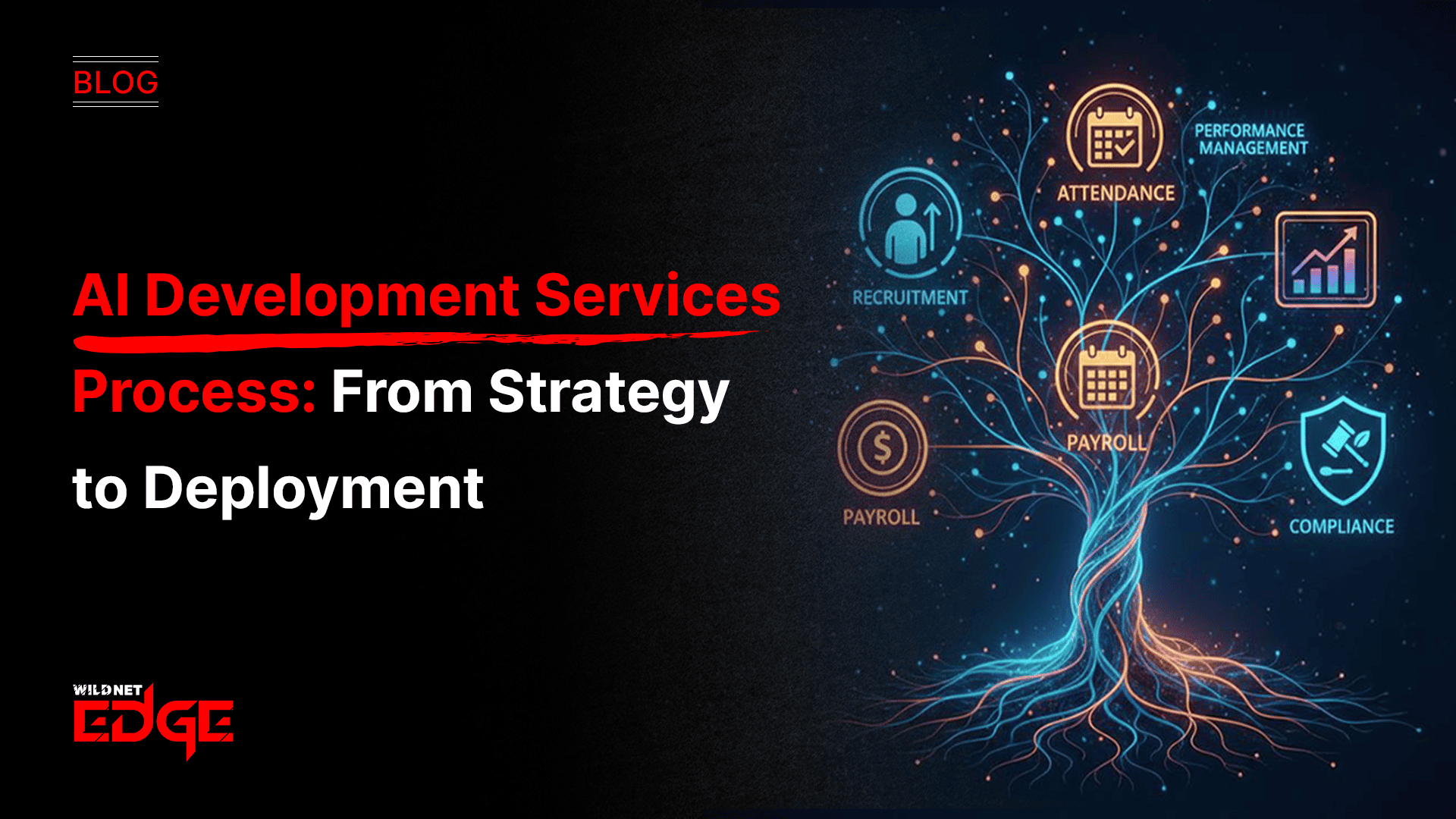
The AI development services process in 2026 follows a clear, structured lifecycle. It starts with strategy and ROI validation, moves through data preparation and model training, and ends with deployment, monitoring, and continuous improvement. This guide explains the full AI development lifecycle, breaks down each phase of the AI implementation process, and shows how a disciplined AI project workflow reduces risk and delivers measurable business value.
Most AI projects don’t fail because the model is weak. They fail because teams rush straight into building without a process.
The AI development services process exists to prevent that. It brings structure to what would otherwise be trial-and-error experimentation. In 2026, AI systems run core business operations, approving loans, scheduling resources, and detecting fraud. That level of responsibility demands discipline.
This guide explains how AI Development Services teams take an idea and turn it into a production-ready system using a proven AI delivery model. If you want predictable outcomes instead of stalled pilots, this process matters.
What Is the AI Development Services Process?
The AI development services process is the end-to-end workflow used to design, build, deploy, and maintain AI systems. It differs from traditional software development because AI behaves probabilistically and depends heavily on data quality.
Key differences from standard software workflows:
- Outputs are probabilistic, not deterministic
- Data quality directly affects results
- Models degrade over time and require monitoring
A structured AI implementation process ensures alignment with business goals, real-world AI business use cases, compliance requirements, and long-term performance.
The 6-Step AI Development Services Process
This is the standard AI development lifecycle used in successful enterprise AI solutions projects.
Phase 1: Strategy & Discovery
This phase defines why AI is needed.
- Identify the business problem
- Validate whether AI is the right solution
- Estimate ROI and success metrics
Outcome: A clear roadmap and success criteria.
This step anchors the entire AI development services process.
Phase 2: Data Preparation & Engineering
This is the most time-consuming phase in most AI projects.
- Collect data from internal systems and external sources
- Clean, label, and normalize datasets
- Split data into training, validation, and test sets
Outcome: Reliable data pipelines that support model accuracy.
Without this phase, the AI project workflow breaks down.
Phase 3: Model Development & Training
This is where intelligence is built.
- Select the right AI model architecture
- Train models using prepared data
- Fine-tune parameters to improve performance
Outcome: A trained model aligned to the business use case.
Iteration is expected and planned at this stage.
Phase 4: Evaluation & Testing
AI cannot be tested like traditional code.
- Measure accuracy, precision, recall, and latency
- Test for bias and edge cases
- Run security and failure simulations
Outcome: Confidence that the model behaves safely and reliably.
This phase protects the AI implementation process from costly errors.
Phase 5: Deployment & Integration
This phase moves AI into real business systems.
- Package models using APIs and containers
- Integrate with ERP, CRM, or internal tools
- Apply access controls and logging
Outcome: A live AI system embedded in workflows.
This is where AI starts delivering value.
Phase 6: Monitoring & Continuous Improvement
AI performance changes over time.
- Track accuracy and usage
- Detect model drift
- Retrain models using new data
Outcome: A stable, long-running AI system.
A mature AI development services process never truly ends.
AI Delivery Model: Agile vs Structured
- Agile delivery: works best for GenAI and evolving use cases
- Structured delivery: suits regulated environments like healthcare and finance
Most modern AI Development Services use a hybrid model of fast iteration with strict controls.
Why Work with an AI Development Company?
Executing the AI development services with enterprise AI consulting process requires more than developers.
An experienced AI Development Services partner provides:
- Proven AI project workflows
- Ready-to-use MLOps and monitoring pipelines
- Cross-functional expertise in data, security, and infrastructure
- Faster time to value with fewer mistakes
This reduces risk and shortens the path from idea to production.
Case Studies
Case Study 1: The Predictive Supply Chain
- Challenge: A logistics firm struggled to predict peak demand.
- Process: We applied our standard development framework, focusing heavily on Phase 2 (Data Prep) to clean historical shipping logs.
- Result: The new AI project workflow predicted spikes with 92% accuracy, saving $4M in inventory costs.
Case Study 2: The Fintech Compliance Bot
- Challenge: Manual KYC checks were slowing down onboarding.
- Process: The strategy involved strict “Red Teaming” (Phase 4) to ensure the agent never approved a fraudulent ID.
- Result: The AI implementation process reduced verification time from 3 days to 4 minutes.
Conclusion
The AI development services process turns AI from experimentation into dependable infrastructure. By following a structured AI development lifecycle, teams reduce risk, control costs, and deliver systems that scale.
In 2026, companies that win are the ones that respect the process. Wildnet Edge’s AI-first approach guarantees that we create ecosystems that are high-quality, secure, and future-proof. We collaborate with you to untangle the complexities of the AI development services process and to realize engineering excellence. Follow the steps, and build the future.
FAQs
The six main stages are Strategy/Discovery, Data Preparation, Model Training, Evaluation/Testing, Deployment/Integration, and ongoing Monitoring/Maintenance. This full cycle ensures the output is reliable software.
It varies. A Proof of Concept (PoC) might take 4-6 weeks, while a full enterprise implementation typically spans 3-9 months depending on data readiness and integration complexity.
Data is rarely clean. It is often siloed, duplicated, or missing. Cleaning this data is a prerequisite for any successful project because “Garbage In” always leads to “Garbage Out” in AI models.
The AI delivery model refers to how the service is provided, whether it is a fixed-cost project, a time-and-materials engagement, or a managed service where the vendor handles the entire lifecycle continuously.
Security is integrated at every step. From data anonymization in Phase 2 to API encryption in Phase 5, a secure methodology ensures that models cannot be hijacked or tricked into leaking data.
Skipping steps is dangerous. Skipping testing leads to hallucinations; skipping monitoring leads to model drift. A robust process of AI development services requires discipline to ensure long-term success.
Cost is driven by complexity. A simple chatbot following this process of AI development services might cost $30k, while a custom predictive engine with deep integration could exceed $150k due to the extensive engineering required.

Managing Director (MD) Nitin Agarwal is a veteran in custom software development. He is fascinated by how software can turn ideas into real-world solutions. With extensive experience designing scalable and efficient systems, he focuses on creating software that delivers tangible results. Nitin enjoys exploring emerging technologies, taking on challenging projects, and mentoring teams to bring ideas to life. He believes that good software is not just about code; it’s about understanding problems and creating value for users. For him, great software combines thoughtful design, clever engineering, and a clear understanding of the problems it’s meant to solve.


 based on 1200+ reviews