sales@wildnetedge.com
 +1 (212) 901 8616
 +1 (437) 225-7733














































































































 ChatGPT Development & Enablement
  Hire AI & ChatGPT Experts
  ChatGPT Apps by Industry
  ChatGPT Blog
  ChatGPT Case study
  AI Development Services
  Industry AI Solutions
  AI Consulting & Research
  Automation & Intelligence





TL;DR
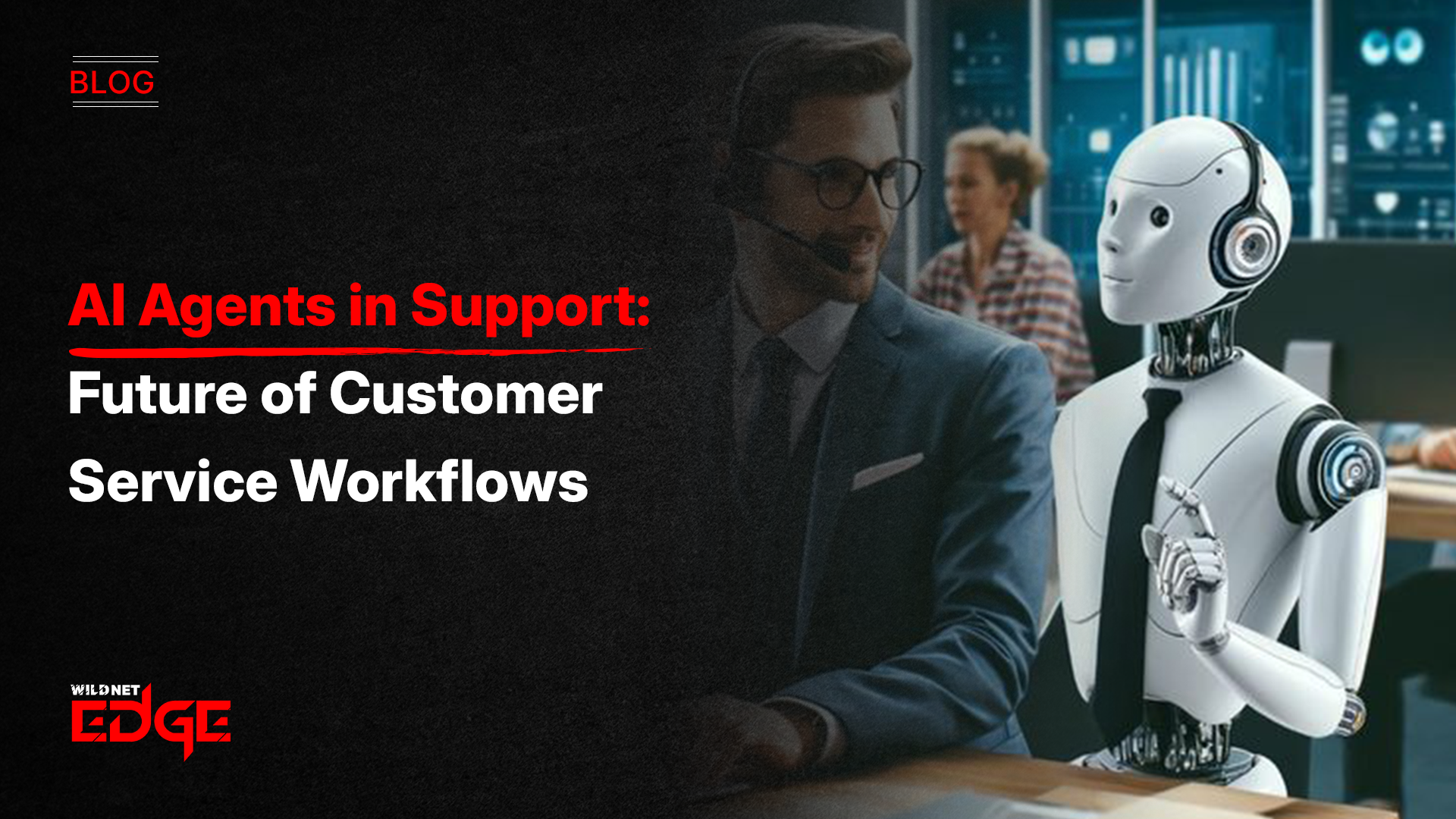
AI Agents in Support go far beyond traditional chatbots. In 2026, they power automated support systems that can resolve issues end to end. This article explains how multi-step AI agents handle complex workflows, how support workflow optimization reduces ticket volume, and why autonomous service bots are becoming essential for scalable, AI-driven customer service.
AI Agents in Support are redefining how customer service works. For years, automation meant scripted replies and frustrated users. That model no longer works.
Customers expect fast, accurate resolutions, not links, not handoffs, not long waits. At the same time, support teams face rising ticket volumes and limited headcount. AI support agents solve both problems. They do not just respond; they take action.
In 2026, companies that rely only on human agents struggle to scale. Those that adopt AI-driven customer service deliver faster resolutions while keeping support teams focused on high-value issues.
What Are AI Agents in Support?
AI Agents in Support are autonomous systems designed to complete tasks, not just answer questions. Traditional chatbots retrieve information. AI agents execute workflows.
If a customer asks for a refund, the agent verifies the order, checks eligibility, calculates the amount, processes the transaction, and confirms completion all without human involvement. This action-first behavior is what separates AI support agents from older automation tools. They operate across CRMs, billing platforms, ticketing systems, and internal tools, making them a core part of modern automated support systems.
Multi-Step AI Agents: How Complex Issues Get Resolved
Most customer issues are not single-step problems. They require diagnosis, validation, and execution.
How Multi-Step AI Agents Work
- Understand intent – Identify what the customer actually needs.
- Plan actions – Decide which systems and steps are required.
- Execute tasks – Run checks, update records, trigger fixes.
- Resolve or escalate – Close the issue or hand it to a human with full context.
Multi-step AI agents follow this sequence automatically. They handle problems like account access, connectivity issues, order changes, and billing disputes tasks that previously required human intervention. By leveraging specialized AI development company expertise, businesses can build agents that mimic their best support staff.
Support Workflow Optimization with AI
Adding AI Agents in Support changes how support teams operate.
Smarter Triage
AI agents act as the first layer of support. They resolve most Tier-1 and many Tier-2 issues instantly. When a case needs human judgment or empathy, the system escalates it at the right moment.
Full Context Handoffs
Support workflow optimization ensures that when humans step in, they see everything the AI has already done. Customers never repeat themselves. Agents never start from scratch.
This collaboration between humans and AI improves resolution time and customer satisfaction. This synergy is central to effective customer support solutions in the modern enterprise.
Why Autonomous Service Bots Deliver Real ROI
Autonomous service bots create measurable impact across operations.
- Speed: They respond instantly and scale without queues.
- Consistency: They follow policies exactly, every time.
- Cost efficiency: They reduce cost per ticket by handling issues end to end.
- Availability: They work 24/7 without fatigue.
These benefits make AI support agents a practical investment, not an experimental one.
However, building these requires more than just a script. It requires robust chatbot development that integrates deep learning models with secure backend APIs.
Case Studies: Intelligent Support in Action
Case Study 1: The E-Commerce Refund Agent
- The Challenge: A fashion retailer was overwhelmed by return requests after Black Friday. Manual processing took 7 days.
- The Solution: They deployed AI support agents specifically designed for returns. The system could visually inspect uploaded photos of garments to verify condition and process the refund instantly.
- The Result: Refund processing time dropped to 30 seconds. The agents handled 92% of all return claims autonomously, boosting customer satisfaction scores (CSAT).
Case Study 2: The Telecom Troubleshooter
- The Challenge: An ISP’s call center was clogged with “slow internet” complaints.
- The Solution: They integrated AI Agents in Support into their mobile app. These multi-step AI agents could trigger a router reset remotely and re-provision the line.
- The Result: Truck rolls (technician visits) decreased by 25%. The automated agents resolved the majority of connectivity issues without human involvement.
Conclusion
AI Agents in Support have become essential infrastructure for customer-centric organizations. They handle complexity, reduce friction, and scale service without increasing headcount.
When automated support systems manage routine work, multi-step AI agents resolve technical issues, and support workflow optimization ensures smooth human handoffs, teams focus on what matters most customer relationships.
At Wildnet Edge, we design and deploy AI support agents that integrate deeply with your systems. Our AI-first approach ensures autonomous service bots are secure, reliable, and aligned with your business logic. We help you move from reactive support to intelligent, AI-driven customer service built for scale.
FAQs
Standard chatbots provide information; AI support agents perform actions. Agents can modify databases, process payments, and execute workflows, whereas chatbots are generally limited to conversation.
They require API access to your backend systems (CRM, ERP). While more complex than simple bots, modern platforms use “low-code” connectors to simplify the deployment of AI support agents.
Yes. These systems use sentiment analysis to detect anger. While they can try to de-escalate, the best practice is for the agent to instantly transfer such cases to a human.
Sectors with high transactional volume and structured data benefit most. E-commerce, Banking (BFSI), and Telecom are leading adopters of AI support agents.
They replace tasks, not necessarily jobs. These agents handle repetitive Tier-1 issues, allowing human staff to focus on high-value Tier-2 and Tier-3 problems that require empathy.
Enterprise-grade AI support agents use encryption and strict access controls (RBAC). They never “see” sensitive data (like credit card numbers) unless explicitly authorized and compliant with PCI-DSS.
Frameworks like LangChain, Microsoft Semantic Kernel, and platforms like Intercom Fin are popular for building AI Agents in Support that can handle complex reasoning loops.

Managing Director (MD) Nitin Agarwal is a veteran in custom software development. He is fascinated by how software can turn ideas into real-world solutions. With extensive experience designing scalable and efficient systems, he focuses on creating software that delivers tangible results. Nitin enjoys exploring emerging technologies, taking on challenging projects, and mentoring teams to bring ideas to life. He believes that good software is not just about code; it’s about understanding problems and creating value for users. For him, great software combines thoughtful design, clever engineering, and a clear understanding of the problems it’s meant to solve.
 based on 1200+ reviews