sales@wildnetedge.com
 +1 (212) 901 8616
 +1 (437) 225-7733















































































































 ChatGPT Development & Enablement
  Hire AI & ChatGPT Experts
  ChatGPT Apps by Industry
  ChatGPT Blog
  ChatGPT Case study
  AI Development Services
  Industry AI Solutions
  AI Consulting & Research
  Automation & Intelligence



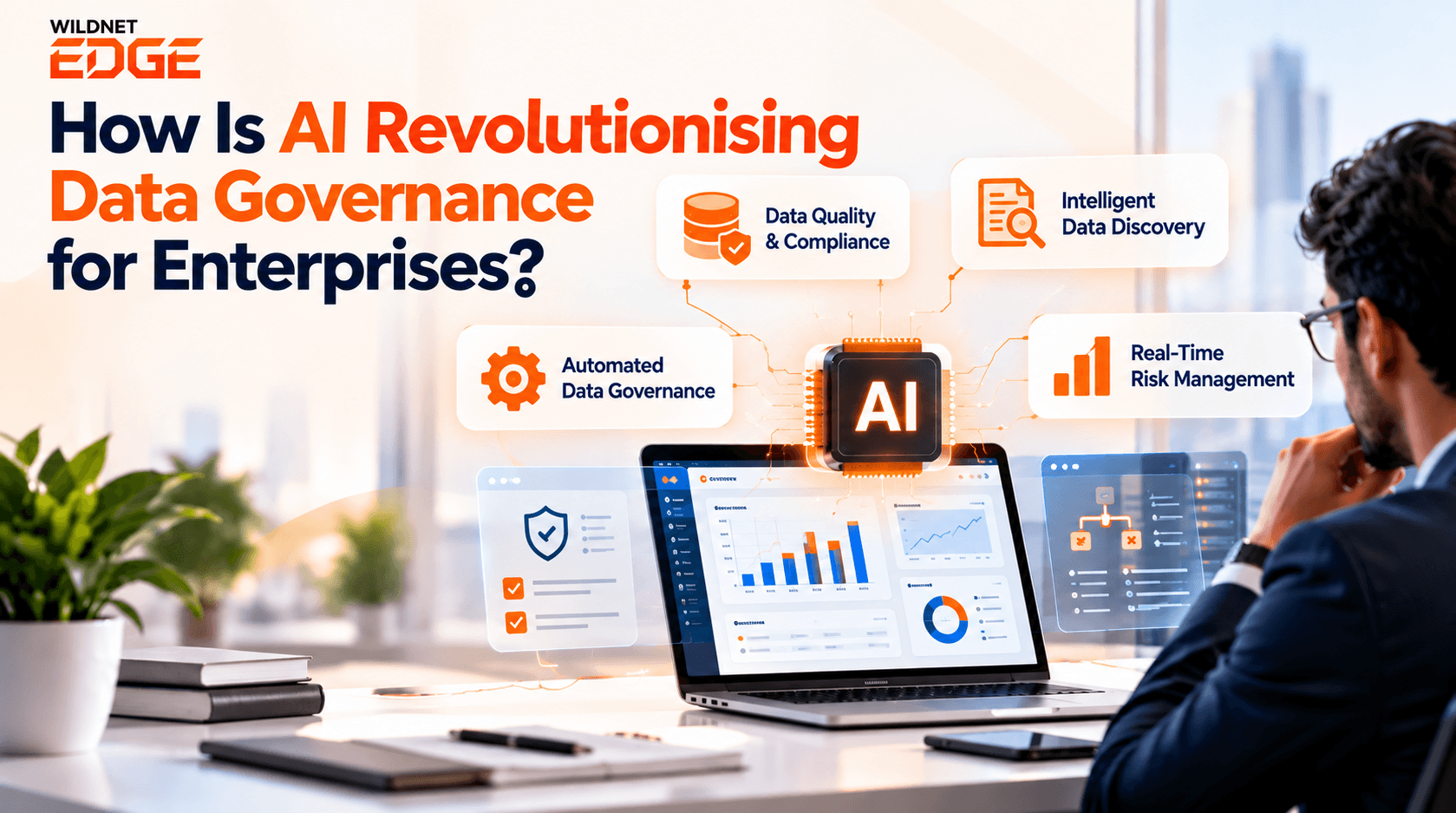


Data is at the centre of almost every modern business, but managing it across departments, applications, and cloud platforms can quickly become complicated. AI data governance is helping enterprises handle this challenge by improving data quality, identifying sensitive information, monitoring compliance, and finding potential risks faster. With AI in data governance, businesses can reduce repetitive manual work and gain a clearer view of how their data is collected, stored, accessed, and used. For enterprises in the US, where data privacy, security, and accuracy are increasingly important, this can make governance more practical and easier to manage.
What Is Data Governance and Why Does It Matter?
What is data governance? At its simplest, it is the process of deciding how an organisation manages its data, who is responsible for it, and what rules should be followed.
A strong data governance program helps businesses answer questions such as:
- Who owns this data?
- Where did it come from?
- Is it accurate and up to date?
- Who can access it?
- Does it contain sensitive information?
- How should it be stored, shared, or removed?
These questions become much harder when an enterprise has information spread across different teams, databases, applications, and cloud environments.
This is where a clear data governance framework becomes useful. It gives teams a common structure for managing data, assigning responsibility, setting policies, and maintaining data quality.
Enterprises can also explore the Data Governance Framework to understand how a structured approach can support better data management.
Without clear governance, businesses can face duplicate records, outdated information, inconsistent reports, privacy concerns, and unnecessary security risks.
How AI in Data Governance Is Changing Enterprise Data Management
Traditional governance often requires employees to manually review records, classify information, check for errors, and monitor access. That can become difficult when an enterprise handles large amounts of data every day.
AI in data governance can help by taking care of repetitive checks and highlighting issues that need human attention.
1. Automating Data Classification
Large organisations handle many types of information, including customer details, financial records, employee information, contracts, and internal documents.
AI can review this information and help identify what type of data it contains. It can also flag sensitive information so the appropriate rules can be applied.
This reduces the amount of manual checking required and helps businesses manage growing volumes of information more consistently.
2. Improving Data Quality
Poor-quality data can affect everything from customer service to financial reporting.
AI can help identify missing information, duplicate records, unusual patterns, and inconsistencies. For example, it may find multiple records belonging to the same customer because their name or address was entered differently.
Instead of discovering these problems during a periodic review, teams can identify them earlier and take action.
3. Supporting Compliance
Businesses need to manage data carefully to meet privacy and regulatory requirements.
AI can help monitor how sensitive information is accessed and used and flag activities that may require further investigation. This can reduce the amount of routine monitoring that employees have to do manually.
However, important compliance decisions should still involve people. AI can point out a potential issue, but businesses need responsible teams to review the situation and decide what action is appropriate.
Data Governance for AI: Why It Matters
Data governance for AI is just as important as using AI to improve governance.
AI systems rely on data. If that data is inaccurate, incomplete, outdated, or used without proper controls, the results may not be reliable.
Before using business data for AI, enterprises should know:
- Where the data came from
- Whether the information is accurate
- Whether it can legally and appropriately be used
- Who has access to it
- How sensitive information is protected
Good governance gives businesses greater control over the information AI systems use. It also makes it easier to understand where data came from and whether it suits a particular use.
AI and Data Governance: Key Benefits for Enterprises
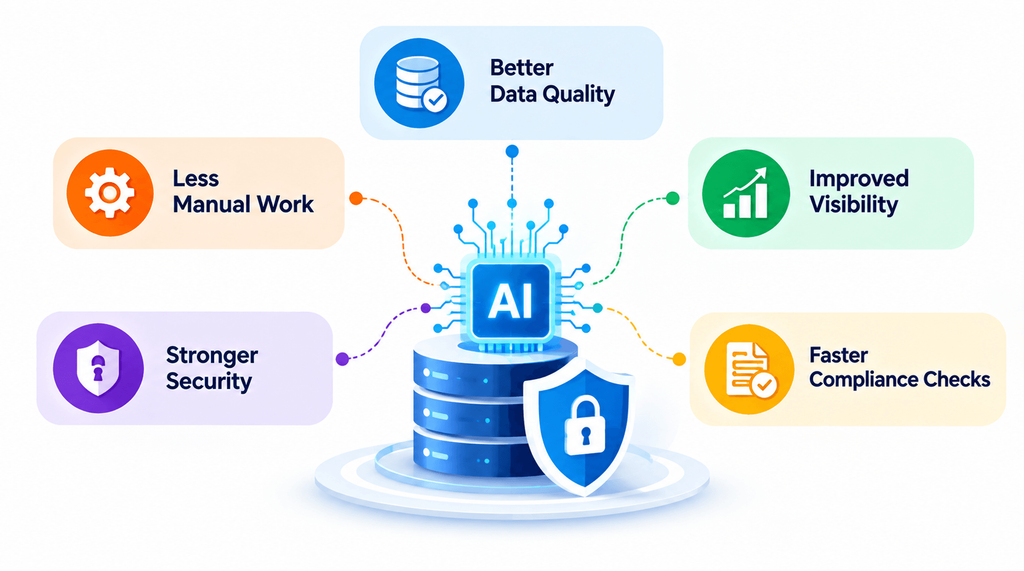
When AI and data governance work together, enterprises can see several practical benefits.
Better data quality: Businesses can identify errors, duplicates, and inconsistencies more quickly.
Less manual work: Repetitive classification and monitoring tasks can be handled with greater efficiency.
Improved visibility: Teams can get a clearer picture of where data exists and how it is being used.
Stronger security: Unusual access to sensitive information can be identified for review.
Faster compliance checks: Automated monitoring can help teams spot potential problems sooner.
The real benefit is not simply using AI for the sake of automation. It is giving employees better information and more time to focus on decisions that require human judgment.
Enterprise Data Governance Challenges to Consider
AI can make governance easier, but it cannot fix every data problem.
Enterprise data governance still needs clear ownership. Someone must be responsible for specific datasets, policies, and decisions.
Data quality is another challenge. If an organisation starts with incomplete or unreliable information, AI cannot automatically turn it into trustworthy data.
Privacy and security also need attention. AI systems may process large amounts of customer, employee, or business information, so enterprises need clear rules around access and usage.
There is also the issue of accountability. Employees should understand when AI is providing a recommendation and when a person needs to review or approve an action.
The best approach is to use AI to support governance teams rather than trying to remove people from the process entirely.
Choosing the Right Data Governance Solutions
Every enterprise has different needs, so the right data governance solutions will depend on its industry, size, data environment, and business goals.
A sensible starting point is to identify the areas causing the most problems. This might be poor data quality, manual classification, unclear ownership, compliance monitoring, or limited visibility.
Businesses can then introduce AI where it can solve specific problems and deliver measurable value.
It is equally important to make governance easy for employees to follow. Even the best solution will struggle if employees do not understand their responsibilities or find the process too difficult to use.
Building an Effective AI Governance Strategy
A practical AI governance strategy should start with the basics rather than trying to automate everything at once.
First, identify what data the organisation has and where it is stored. Next, define who owns important information and establish clear rules for accessing, sharing, and protecting it.
Then, identify repetitive tasks that can benefit from automation. Data classification, quality checks, monitoring, and alerts are good areas to consider.
Finally, keep people involved. AI can identify patterns and highlight potential risks, but employees still need to review important decisions and ensure governance practices align with business requirements.
Organisations that need support in establishing stronger governance practices can explore AI Governance Consulting Services to develop practical governance policies, processes, and controls.
The Future of AI Data Governance
As enterprises continue adopting AI, cloud services, analytics, and automation, the amount of data they manage will continue to grow.
This makes AI data governance increasingly important. Businesses will need governance practices that can keep pace with new applications, changing data environments, security concerns, and evolving regulatory expectations.
The future will likely involve more continuous monitoring, automated classification, faster identification of risks, and clearer responsibility for data.
But the goal remains simple: businesses need to know what data they have, whether they can trust it, and whether it is being used responsibly.
When AI in data governance is combined with strong governance practices, enterprises can spend less time dealing with avoidable data problems and more time using their information to make better business decisions.
FAQs
How does AI improve data governance?
AI data governance helps enterprises automate repetitive tasks such as data classification, quality checks, monitoring, and identifying unusual activity. This allows governance teams to manage larger amounts of data more efficiently.
What is the role of data governance for AI?
Data governance for AI helps ensure that the information used by AI systems is accurate, appropriate, secure, and properly managed. It also helps businesses understand where their data comes from and who can access it.
Can AI replace data governance teams?
No. AI can reduce repetitive work and identify potential issues, but people are still needed to create policies, review risks, make important decisions, and maintain accountability.
What are the main benefits of AI and data governance?
The main benefits include improved data quality, less manual work, better visibility, stronger security, faster monitoring, and greater confidence in business data.
Why is an AI governance strategy important for enterprises?
An AI governance strategy gives enterprises a structured way to manage AI-related risks, responsibilities, data usage, and oversight while ensuring that AI supports business goals responsibly.

Vidit Kumar is an expert in DevOps and cloud engineering, specializing in building efficient, reliable, and scalable systems for organizations of all sizes. He has deep expertise in automation, cloud infrastructure, and workflow optimization, helping teams streamline operations and improve software delivery processes. Vidit is passionate about mentoring teams and exploring innovative tools that improve software performance and delivery. He believes in blending technical skill with thoughtful problem-solving to create systems that make a real difference. Outside of work, Vidit enjoys experimenting with cloud platforms, learning new technologies, and finding smarter ways to approach engineering challenges.



 based on 1200+ reviews