 sales@wildnetedge.com
 +1 (212) 901 8616
 +1 (437) 225-7733
















































































































 ChatGPT Development & Enablement
  Hire AI & ChatGPT Experts
  ChatGPT Apps by Industry
  ChatGPT Blog
  ChatGPT Case study
  AI Development Services
  Industry AI Solutions
  AI Consulting & Research
  Automation & Intelligence





Key Takeaways
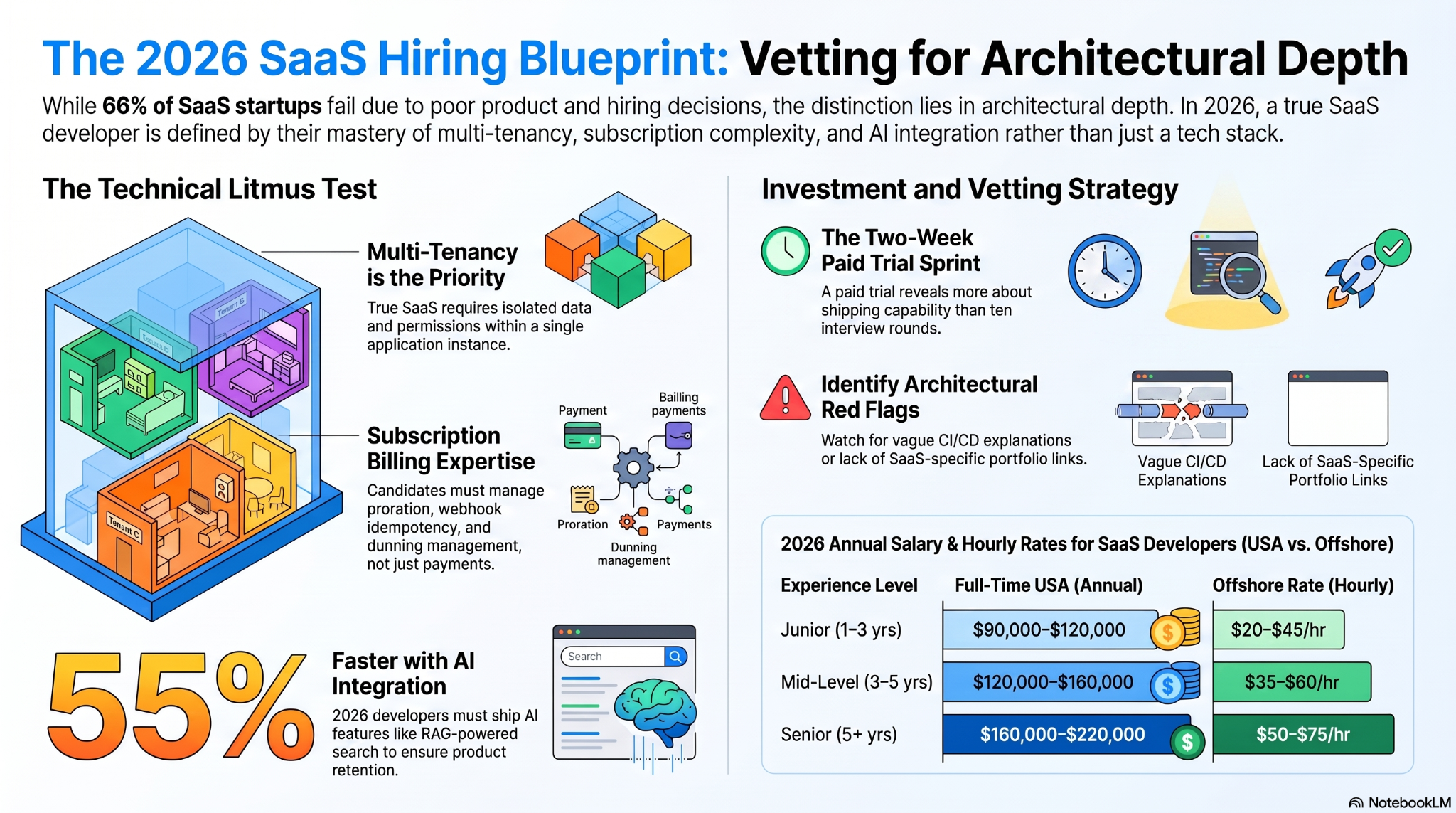
- The best tips to hire SaaS developers start with one filter: Multi-tenancy Experience. A developer who has never built a multi-tenant system is a full-stack developer, not a SaaS developer, and that distinction surfaces at your first 100 paying customers.
- 66% of SaaS startups fail in their first few years. The product & hiring decisions are the reason behind it.
- SaaS developers must understand subscription billing edge cases, webhook idempotency, and zero-downtime deployment. These are not advanced skills. They are table-stakes.
- Senior SaaS developers in the USA cost $140,000–$220,000 annually in-house. Offshore equivalents with verified SaaS architecture experience deliver similar results at 60 to 70% of the cost.
- One paid trial sprint reveals more about a SaaS developer’s actual capability than any combination of interviews. A developer who cannot ship a working module in two weeks will not ship a product in six months.
Most hiring managers post a job for a “full-stack developer” and expect a production SaaS product to come out of it. That mismatch is why so many early SaaS products look fine in demos and collapse before the first hundred paying users. SaaS is not a tech stack. It is an architecture philosophy, a subscription business model, and a service availability commitment, all encoded in how the product is built from day one.
These tips for hiring SaaS developers target the filters that matter: Architectural depth, Knowledge of billing systems, AI readiness, and the Ability to build for scale from the first sprint.
What SaaS Developers Cost in the USA in 2026
| Experience | Full-Time USA (Annual) | Contract Rate USA | Offshore Rate |
| Junior (1–3 yrs) | $90,000–$120,000 | $65–$90/hr | $20–$45/hr |
| Mid-Level (3–5 yrs) | $120,000–$160,000 | $90–$140/hr | $35–$60/hr |
| Senior (5+ yrs) | $160,000–$220,000 | $140–$200/hr | $50–$75/hr |
2026’s SaaS Developer Costing vs Experience in the USA
In-house senior hires carry an additional 30–40% in benefits, tooling, and onboarding overhead. Offshore SaaS developers in Eastern Europe and Latin America deliver at 60–70% of US rates when scoped with clear architecture requirements.
Tip 1: Multi-Tenancy Is the Litmus Test, Not the Tech Stack
Multi-tenancy, the ability for a single application instance to serve multiple customers with isolated data, permissions, and configurations, is the defining architectural challenge of SaaS. A developer who has never implemented schema-per-tenant or row-level security has never built a production SaaS product, regardless of what their resume says.
Before reviewing any portfolio or running any technical test, ask this question: “Walk me through how you handled tenant isolation in your last production SaaS application.”
A developer with real experience will explain the trade-offs between shared schema, schema-per-tenant, and database-per-tenant. They will mention RBAC, feature flags, and data residency requirements. A developer without it will describe a multi-user web application as SaaS.
Ask this: “What isolation strategy did you use for tenant data, and what drove that choice over the alternatives?”
Tip 2: The Hiring Model Should Match Your Stage, Not the Budget
Choosing between a dedicated SaaS developer, a saas application development company, or a freelancer is not a cost decision. It is a risk-and-accountability decision.
- Dedicated SaaS developers embed in your team, own architecture decisions, and build with your roadmap in mind. Best for post-validation products with paying customers.
- A SaaS development company takes end-to-end delivery responsibility. Best for fixed-scope builds where you need one accountable vendor.
- Freelancers work for short & bounded tasks. They are appropriate for specific features, not for building a production SaaS foundation.
The most expensive mistake in software product development USA is hiring a freelancer to build your MVP architecture and spending the next 18 months refactoring around it. We align dedicated SaaS developers within one to two business days, with no multi-month recruitment cycles.
Pro Tip: Before your first in-house hire, work with an agency or a dedicated developer. Build an in-house team only after you have paying customers & sustainable growth.
Tip 3: Subscription Billing Complexity Vets Candidates
Stripe’s billing documentation runs to hundreds of pages for a reason. Subscription billing in SaaS is not a payment form. It is a system with proration logic, upgrade and downgrade edge cases, webhook idempotency, dunning management, and usage-based metering.
One of the most direct tips to hire SaaS developers: Ask about billing experience before discussing frameworks. A developer who has only ever wired up a “Pay Now” button is not equipped to build the subscription infrastructure your product depends on.
Developers with real SaaS billing experience will describe:
- How did they handle failed payments and prevented double-charging?
- How did they manage seat upgrades mid-billing cycle?
- How did they ensure webhook events were processed only once?
Ask this: “How did you handle subscription proration when a customer upgraded plans mid-cycle? What did you do when a Stripe webhook arrived twice?”
Tip 4: Ask for Live Production SaaS Links, Not GitHub Profiles
GitHub profiles show code. They do not show whether that code is serving 10 paying customers or 10,000. Request live application URLs for every SaaS project a candidate claims in their portfolio.
A developer who has shipped & maintained a live SaaS product has dealt with real tenant onboarding, billing failures, uptime incidents, and feature flag rollouts in production. These are qualitatively different experiences from building internal tools or tutorial projects.
- Ask for the SaaS product URL and create a trial account.
- Check the onboarding flow for multi-tenant patterns: workspace creation, role assignment & billing setup.
- Ask what the current tenant count is and how it is managed at the infrastructure level.
Ask this: “Which SaaS product in your portfolio currently lives with paying customers? What is the approximate tenant count, and how does your architecture scale with it?”
Tip 5: A 2026 SaaS Developer Sans AI Integration Experience Is Not Worth It.
GitHub’s developer productivity research shows developers complete tasks approximately 55% faster with AI coding assistance (GitHub Copilot). More significantly, AI features, embedded assistants, RAG-powered search, and intelligent automation are now bare minimum product requirements for SaaS retention.
Cloud software developers who cannot integrate OpenAI, Anthropic, or equivalent LLM APIs into a product workflow are working with a 2023-era skill set in a 2026 market.
Ask every SaaS developer candidate about their AI integration experience. The distinction between “uses AI tools” and “ships AI features” matters enormously. The former is developer convenience. The latter is a product capability.
Ask this: “Describe an AI feature you shipped in a SaaS product. What was the architecture: where did the LLM call live information, how did you handle latency, and how did you prevent prompt injection?”
Tip 6: API-First Architecture Is How Your SaaS Product Earns Enterprise Clients
API-first design, where every product feature is built as an API endpoint before any UI is added, determines whether your SaaS can integrate with enterprise workflows, be resold as a platform, or be embedded in partner products. It is not a technical preference, but a revenue decision.
This is one of the most overlooked tips to hire SaaS developers: evaluate API design thinking before UI polish. A developer who builds screens first and bolts on APIs later will cost your enterprise sales team every deal that requires a partner integration.
Ask: “How do you approach versioning your API when you need to make a rapid change without disrupting existing customers? Walk me through a specific example.”
Tip 7: Eight Red Flags That Predict a Failed SaaS Hire
Observations from SaaS hiring at scale have helped us identify that the red flags predicting failure are not about technical skill gaps. They are about architectural thinking gaps.
Watch for these signals during evaluation:
- Cannot explain Multi-tenancy beyond “separate databases for each customer”
- No SaaS-specific portfolio, only internal tools or consumer apps
- Skips the discovery phase, quotes before understanding requirements
- No test suite, or “we add tests after launch”
- Proposes fixed-price for undefined scope, reveals no understanding of SaaS product complexity
- No references from SaaS founders, only corporate project references
- Cannot describe a production incident and how they resolved it
- Vague on CI/CD, “we use some pipelines” without specifics on zero-downtime deployment.
Any two of these are conversation-ending signals. All eight mean you are looking at a general developer misrepresenting themselves as a SaaS specialist.
Tip 8: Zero-Downtime Deployment Is Your SLA’s Infrastructure
Every uptime guarantee you make to paying customers depends on a developer who understands blue-green deployments, canary releases, and database migration strategies that can be performed without taking the application offline. Most developers have deployed software. Far fewer have deployed software to a live multi-tenant system without dropping a single customer session.
Ask this: “Walk me through how you deploy a database schema migration to a live SaaS application with 5,000 active tenants. How do you ensure no tenant experiences downtime during the migration?”
A developer who describes running ALTER TABLE directly on a production database during off-hours has never operated a real SaaS product.
Tip 9: Offshore SaaS Developers Deliver When the Scope Is Right
To successfully hire remote SaaS developers, the scope document must be technical, not conceptual. Eastern Europe and Latin America have deep SaaS engineering talent at just 60–70% of US rates, but only when engagements start with architecture-first conversations, not feature-list-first.
A clear technical specification for a remote SaaS team must include:
- Multi-tenancy strategy (schema approach chosen and explained)
- Billing system (Stripe/Chargebee/Paddle, specified & not left open)
- Cloud platform and deployment model
- API versioning strategy
- Uptime & SLA targets
Without this, remote SaaS work fails at integration rather than execution. The developers build exactly what was described, so beware.
Pro Tip: Before sprint one, require the offshore team to produce a system design document. If they cannot, they are not senior SaaS engineers regardless of their day rate.
Tip 10: One Paid Trial Sprint Is Worth More Than Ten Interview Rounds
Two developers answer every SaaS interview question perfectly. One ships a working multi-tenant module in the first sprint. The other writes tickets for two weeks and asks for more requirements. Interviews cannot separate them. A paid trial sprint can.
For custom saas solutions, a two-week paid trial sprint at $2,000–$6,000 is the most cost-efficient evaluation available. Ask the developer to implement a specific SaaS component, a tenant onboarding flow, a webhook processor, or a billing plan switcher, against your actual codebase or a relevant equivalent.
Evaluate: Code structure, test coverage, how they ask questions when blocked, and whether the delivered module is something you would actually ship.
SaaS Is Not a Tech Stack. The Developer You Hire Proves It.
The global SaaS market continues to grow as companies shift from licensed software to subscription models, and the demand for SaaS developers with true architectural depth far outpaces supply. The technical bar for writing SaaS code is not high. The bar for building a SaaS product that scales, bills correctly, isolates tenant data, integrates with enterprise workflows, and stays online through deployments is very high.
Wildnet Edge structures every engagement around these tips to hire SaaS developers, matching dedicated teams who have built multi-tenant systems, shipped billing integrations, and operated SaaS products at scale. When you are ready, Connect With a SaaS Developer.
FAQs
Full-time senior SaaS developers in the USA cost $160,000–$220,000 annually, fully loaded with benefits and tooling. Contract rates run from $90 to $200 per hour, depending on seniority. Offshore teams with verified experience in SaaS architecture from Eastern Europe & Latin America cost 60–70% less, with senior developers asking just $50- $75 per hour.
Multi-tenancy is an architectural pattern that allows a single application instance to serve multiple customers with completely isolated data, configurations, and access controls. It is needed in the SaaS apps being developed in 2026.
Let’s first understand what each of these does.
• Dedicated SaaS developers are best when you have paying customers, a defined roadmap, and need developers embedded in your team with full architecture ownership.
• A SaaS development company is better for fixed-scope builds, MVP, or new modules, where you need a single accountable vendor for end-to-end delivery.
• Freelancers are appropriate only for bounded & isolated features. Never for foundational architecture.
We align dedicated SaaS developers within 1 to 2 business days (48 hours). By the way, our developers are pre-vetted against real SaaS production experience, not just framework knowledge.
Follow these steps,
• Require a system design document before sprint one.
• Specify the multi-tenancy strategy, billing system, and cloud platform in the scope, not in the backlog.
• Test async communication with a written architecture prompt before the technical screen.
Hack: A paid two-week trial sprint at $2,000–$6,000 reveals more about a remote SaaS developer’s actual output than any technical interview. Use dedicated developers over freelancers for any engagement longer than 90 days.
Core requirements include,
• Multi-tenancy implementation (schema-per-tenant or row-level security),
• Subscription billing integration (Stripe, Chargebee, or Paddle),
• API-first design with versioning & zero-downtime deployment (blue-green or canary), and
• AI feature integration (LLM API calls & RAG architectures).
• Cloud platform depth (AWS, GCP, or Azure) is required, not optional.
PS: Developers without experience in owning CI/CD pipelines are not senior SaaS engineers.

Managing Director (MD) Nitin Agarwal is a veteran in custom software development. He is fascinated by how software can turn ideas into real-world solutions. With extensive experience designing scalable and efficient systems, he focuses on creating software that delivers tangible results. Nitin enjoys exploring emerging technologies, taking on challenging projects, and mentoring teams to bring ideas to life. He believes that good software is not just about code; it’s about understanding problems and creating value for users. For him, great software combines thoughtful design, clever engineering, and a clear understanding of the problems it’s meant to solve.


 based on 1200+ reviews



