 sales@wildnetedge.com
 +1 (212) 901 8616
 +1 (437) 225-7733
















































































































 ChatGPT Development & Enablement
  Hire AI & ChatGPT Experts
  ChatGPT Apps by Industry
  ChatGPT Blog
  ChatGPT Case study
  AI Development Services
  Industry AI Solutions
  AI Consulting & Research
  Automation & Intelligence





Key Takeaways
- The most important tips to hire healthcare app developers go beyond coding skills. HIPAA compliance architecture, HL7/FHIR integration experience, and audit trail design are the three signals that distinguish healthcare specialists from mobile developers who have worked on healthcare projects.
- 83.6 percent of US hospitals have adopted certified EHR systems. Your app will almost certainly need to connect to one. A developer who has never worked on HL7 or FHIR integration delays the timeline.
- A developer who treats HIPAA as a checklist creates compliance debt that is expensive, sometimes impossible, to fix after launch.
- Freelancers are not appropriate for apps that handle Protected Health Information. Not having a Business Associate Agreement means undefined liability.
Building a healthcare app is no more technically difficult than building any other kind of app. The code is not more complex. What makes it harder is that every architectural decision sits beneath layers of regulatory, interoperability, and patient-safety requirements. Get the architecture wrong, and you do not just ship a buggy product. You ship a compliance liability.
These tips for hiring healthcare app developers focus on the filters that matter most in this domain: compliance architecture, integration capabilities, and domain depth. Technical skill is the minimum bar, not the evaluation.
What Healthcare App Developers Cost in the USA in 2026
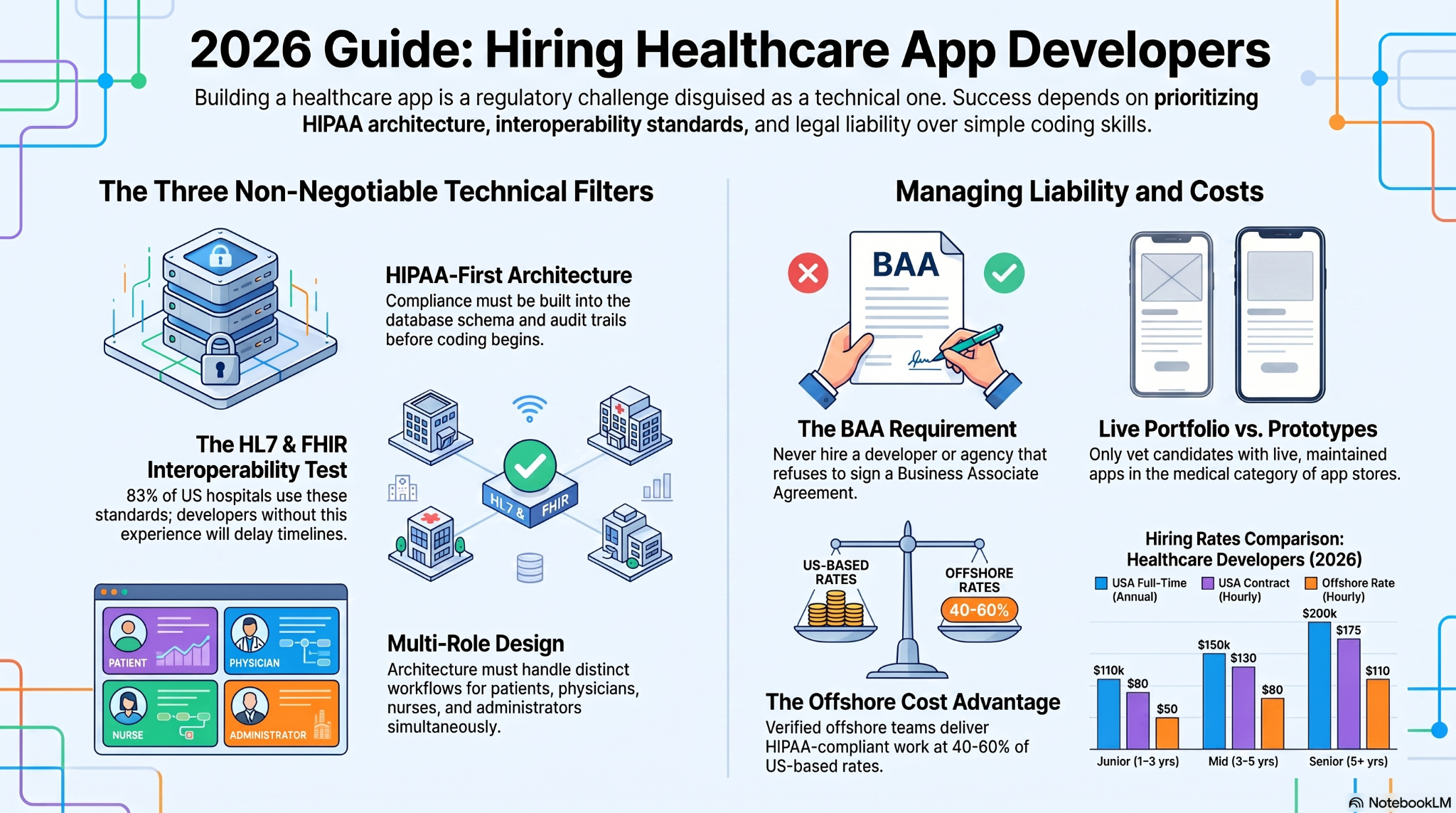
| Experience | Full-Time USA (Annual) | Contract Rate USA | Offshore Rate |
| Junior (1–3 yrs) | $80,000–$110,000 | $60–$90/hr | $25–$50/hr |
| Mid-Level (3–5 yrs) | $110,000–$150,000 | $90–$130/hr | $45–$80/hr |
| Senior (5+ yrs) | $150,000–$200,000 | $130–$175/hr | $70–$110/hr |
Cost of hiring Healthcare App Developers in the USA (2026)
Healthcare developer rates in the USA are higher than those for general mobile development due to the compliance and domain expertise premium. Offshore teams with verified HIPAA experience deliver the same work at 40 to 60 percent of these rates when scoped correctly.
Tip 1: HIPAA Compliance Is the Foundation
HIPAA requirements must be built into the architecture before the first line of product code is written. Data encryption, access controls, audit logs, and secure API design are structural decisions, not implementation details.
Ask every candidate to describe their approach to Protected Health Information before you discuss features:
- How do they handle PHI at rest and in transit?
- How do they implement role-based access controls?
- What does their audit trail architecture look like?
A developer who cannot answer these without prompting has not built a truly HIPAA compliant app.
Ask this: “Walk me through how you structured PHI data access in your last healthcare project. Who could see what data, and how did you enforce that at the system level?”
Tip 2: The Hiring Model Determines the Compliance Risk
Most healthcare companies choose between a healthcare software company in the USA, dedicated healthcare app developers, and freelancers. That choice is not just a budget call. It determines where compliance liability sits.
- Dedicated healthcare app developers integrate into your team and build as per your compliance standards. Liability stays with you.
- A healthcare software company in the USA is responsible for end-to-end delivery and compliance. They sign Business Associate Agreements (BAAs) and are liable for PHI breaches within their scope.
- Freelancers rarely sign BAAs. For any app handling patient data, freelancers are a compliance risk, not a cost-saving.
Pro Tip: Ask every vendor candidate whether they will sign a Business Associate Agreement before the engagement begins. If they hesitate or do not know what a BAA is, the conversation should end there.
Tip 3: HL7 & FHIR Experience Is the Fastest Healthcare Filter
HL7 (Health Level Seven) and FHIR (Fast Healthcare Interoperability Resources) are the data exchange standards that the US healthcare infrastructure runs on. 83.6% percent of US hospitals have adopted certified Electronic Health Record systems, and most use HL7 v2 or FHIR APIs for third-party integrations.
A developer without these skills will spend your budget learning them. One of the most direct tips to hire healthcare app developers is to ask about HL7 and FHIR in the first conversation, before you talk about programming languages.
Ask this: “Have you built a FHIR-compliant API integration? Which EHR system were you connecting to, and what was the most complex data mapping you handled?”
A developer with real integration experience will answer with specifics. One without it will generalize.
Tip 4: A Telemedicine Feature & a Telemedicine Architecture Are Not the Same
Picture a telemedicine app going live. Video consultation works. Appointment booking works. Then, 200 concurrent users join a virtual clinic session, and the backend collapses. The developer built telemedicine features, not a telemedicine architecture.
Telemedicine app developers who understand this domain work on WebRTC-based real-time communication, low-latency messaging, and session management that handles drop-offs & reconnects without losing the patient record context. This is different from embedding a video SDK and calling it done.
Ask candidates to describe the backend architecture of their last telemedicine build, not just the feature list.
Tip 5: Your App Has Four User Types, Design Accordingly
Healthcare apps serve patients, physicians, nurses or care coordinators, and administrators. Each has different workflows, data visibility, and compliance requirements. A developer who has only built patient-facing consumer apps will struggle with multi-role design.
The complexity shows up in:
- Role-based data access (what each user type can view, edit, and export)
- Notification and escalation logic across user roles
- Workflow differences between clinical staff and administrative users
Ask this: “In your last healthcare app, how many distinct user roles did you design for, and how did those role differences affect your data model & access control logic?”
Tip 6: The Portfolio Is Not Real Unless the Healthcare App Is Live
Medical app developers who have shipped and maintained live & patient-facing applications have navigated App Store medical category review, handled real PHI at scale, and kept clinical workflows stable across iOS & Android OS updates.
A prototype, an internal tool, or a wellness app with no clinical data is not a healthcare portfolio experience.
- Ask for live App Store or Google Play links for every healthcare project they claim
- Install the app and check that it is actively maintained.
- Ask how long the app has been in production and what the active user count is
Ask this: “Which healthcare app that you have built is currently active in a hospital, clinic, or telehealth platform, and what patient volume does it handle?”
Tip 7: AES-256 Encryption Is the Standard. Accept Nothing Else.
A lot of healthcare C-suite executives in 2026 now prioritize operational efficiency as a top goal, but a single data breach in US healthcare averages $10.9 million in total costs. The encryption architecture of your app is not a secondary concern.
HIPAA compliant app developers implement AES-256 encryption for data at rest and TLS 1.2 or higher for data in transit. Beyond that, the baseline requires:
- Multi-factor authentication for all clinical users.
- Automatic session timeouts tied to inactivity
- API-level authentication and rate limiting on every PHI endpoint.
Ask specifically about encryption standards. Vague answers like “we use industry-standard encryption” are not acceptable.
Tip 8: Audit Trails: The Most Reliable Signal of True HIPAA Experience
HIPAA requires a logged record of every action on a patient record: who accessed it, when, from what device, and what changed. Most developers know about encryption. Far fewer have actually built a compliant audit trail from scratch.
This is one of the most revealing tips to hire healthcare app developers: ask how they built the audit trail for their last project. A developer who has done this will describe log architecture, timestamp schemas, and the trade-offs between application-level & database-level logging.
Ask: “Describe the audit trail schema you used in a past healthcare project and how it mapped to HIPAA access log requirements.”
Tip 9: Healthcare Certifications Exist. Ask for them.
Most developer job descriptions list frameworks and languages. Few mention that certifications exist specifically for this domain. The most relevant credentials for healthcare app developers include:
- HCISPP (Healthcare Information Security and Privacy Practitioner)
- CPHIMS (Certified Professional in Health Informatics and Information Management)
- HL7 Certification
A developer who holds any of these has invested in healthcare compliance beyond what a project deadline required. For senior hires or agency teams, require at least one certification or ask which team members hold them.
Tip 10: Offshore Healthcare App Developers Deliver
The healthcare app developers in the USA at senior level cost $130 to $175 per hour. Offshore equivalents with verified HIPAA experience cost only $70-$110 per hour. The offshore failure stories in healthcare are always due to scoping failures: no BAA signed, no HL7 or FHIR requirements defined upfront, no compliance architecture review before sprint one.
For healthcare mobile app services built offshore, a detailed technical specification that covers HIPAA tier, EHR integration requirements, user roles, encryption standards, and audit requirements must be in place before development begins.
Pro Tip: Request a compliance architecture document from any offshore vendor before the first sprint. A team that cannot produce it is not equipped for healthcare work, regardless of cost.
Healthcare Apps Fail due to Compliance & Not Code. But, Hire for Both.
The AI-driven healthcare market is growing at 39 percent annually till 2033, and demand for healthcare app developers is accelerating with it. The technical bar is high. The compliance bar is higher. Most failed healthcare app engagements involved technically competent developers who lacked the domain depth to make the right architectural decisions early on.
Wildnet Edge structures every engagement around these tips to hire healthcare app developers, with dedicated teams that bring documented HL7/FHIR experience, signed BAAs, and verified HIPAA architecture to your project from day one.
When you are ready, Connect With a Healthcare App Developer.
FAQs
Full-time healthcare app developers in the USA cost $80,000 to $200,000 annually, depending on seniority. Contract rates are usually $60 to $175 per hour. Offshore teams with HIPAA experience cost 40 to 60 percent less, via senior developers in Eastern Europe and Latin America, ranging from $70 to $110 per hour.
A BAA is a HIPAA-required contract between you and any vendor who handles Protected Health Information on your behalf. It defines each party’s compliance responsibilities and liability in the event of a breach. Any developer, agency, or platform that touches PHI must sign one. No BAA means undefined liability and a direct HIPAA violation.
HL7 v2 is the older messaging standard used by most legacy hospital systems. FHIR is the modern API-based standard that enables real-time data exchange. Most US EHR systems support both. A developer who cannot work with either cannot integrate your app with hospital or clinic infrastructure, regardless of their mobile development skill.
Dedicated healthcare app developers are best for ongoing product work where your internal team owns compliance and architecture. A healthcare software company in the USA is better suited to fixed-scope delivery, where end-to-end accountability and a signed BAA from a single vendor matter more. Freelancers are not appropriate for apps that handle PHI.
A basic app with secure login, appointment scheduling, and a single EHR integration takes four to six months. A mid-level telemedicine platform development runs for six to ten months. A full enterprise healthcare platform with multi-EHR integration, AI features, and multi-hospital deployment takes twelve months or more. Compliance review and security audits add time to every phase.

Managing Director (MD) Nitin Agarwal is a veteran in custom software development. He is fascinated by how software can turn ideas into real-world solutions. With extensive experience designing scalable and efficient systems, he focuses on creating software that delivers tangible results. Nitin enjoys exploring emerging technologies, taking on challenging projects, and mentoring teams to bring ideas to life. He believes that good software is not just about code; it’s about understanding problems and creating value for users. For him, great software combines thoughtful design, clever engineering, and a clear understanding of the problems it’s meant to solve.


 based on 1200+ reviews



