sales@wildnetedge.com
 +1 (212) 901 8616
 +1 (437) 225-7733














































































































 ChatGPT Development & Enablement
  Hire AI & ChatGPT Experts
  ChatGPT Apps by Industry
  ChatGPT Blog
  ChatGPT Case study
  AI Development Services
  Industry AI Solutions
  AI Consulting & Research
  Automation & Intelligence



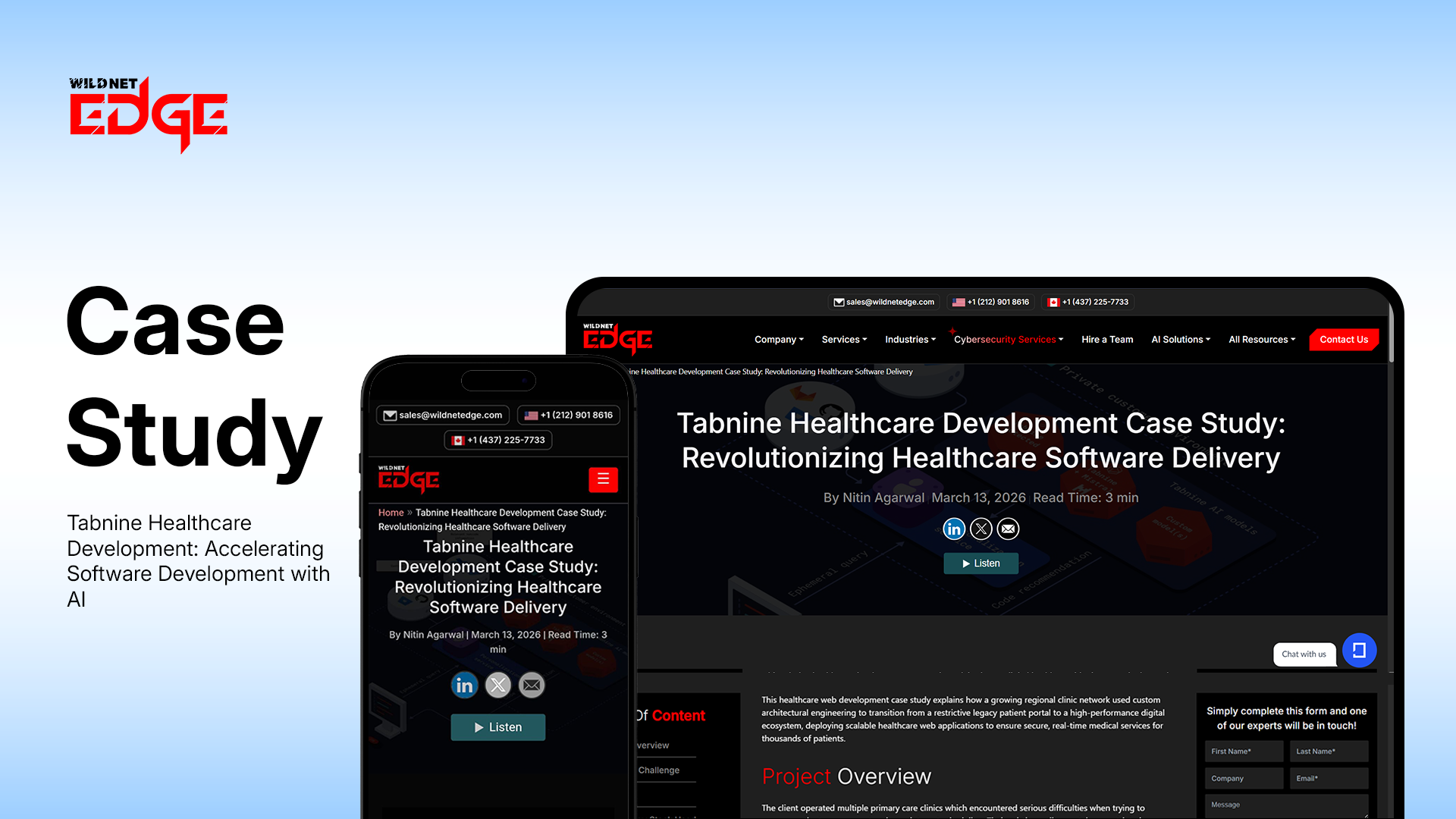


This Tabnine healthcare development case study explains how a digital health provider integrated advanced AI coding assistants for healthcare to accelerate their engineering cycles, leveraging medical software automation to securely build and deploy complex clinical applications without compromising patient data privacy or proprietary code.
Project Overview
The client was a growing telehealth and Electronic Health Records (EHR) platform struggling with a massive backlog of clinical feature requests. Their engineering team was bogged down writing repetitive boilerplate code to bridge legacy hospital systems with modern FHIR standards. Consequently, critical updates to their patient portal were constantly delayed, and developer burnout was rising.
To reverse this trend and aggressively accelerate their engineering velocity, they initiated a comprehensive workflow modernization effort. They collaborated with our specialized engineering team to execute a robust Tabnine healthcare development roadmap. The goal was to untangle their slow development cycles, integrate privacy-first AI directly into their IDEs, and deliver seamless healthcare software development tools that provided developers with secure, context-aware code generation.
Business Challenge
Sluggish Clinical Feature Delivery
The engineering team spent countless hours writing repetitive data-parsing logic for HL7 integrations. Without advanced medical software automation, developers were frustrated by manual syntax creation, causing a severe drop in overall sprint velocity and delayed telehealth rollouts.
Strict HIPAA Code Privacy and Security
Operating in the medical sector meant strict adherence to HIPAA and proprietary code privacy. Executing secure Tabnine healthcare development required absolute assurance that their proprietary clinical algorithms and mock PHI (Protected Health Information) would never be sent to external servers or used to train public AI models.
High Onboarding Time for Healthcare IT
As the startup rapidly scaled its engineering department, new developers struggled to learn the complex internal healthcare codebase. They needed intelligent AI coding assistants for healthcare to act as an in-editor mentor, helping new hires understand the existing FHIR architecture quickly and contribute faster.
Inconsistent Code Quality
Rushing to meet aggressive clinical deadlines led to minor syntax errors and inconsistent coding standards across different squads. This inconsistency in utilizing their healthcare software development tools caused frequent pipeline failures and stalled critical production releases during code review.
Solution
Strategic Tabnine Healthcare Development
We mapped out a phased implementation strategy. Using an advanced, enterprise-grade deployment, we integrated Tabnine Development Services directly into the team’s existing VS Code and IntelliJ IDEs, allowing for seamless code completions without disrupting core clinical engineering operations or requiring a massive learning curve.
Privacy-First AI Coding Assistants for Healthcare
We architected a secure, locally hosted instance of Tabnine Enterprise within the client’s HIPAA-eligible virtual private cloud. This ensured that the provider had a flawless, highly secure experience where no proprietary code ever left their private servers, vastly improving the compliance posture of their medical IT automation tools.
Accelerated Healthcare Software Development Tools
By leveraging context-aware code generation trained specifically on the startup’s internal repositories, we reduced the time spent on interoperability boilerplate by over 30%. This specialized Tabnine healthcare development meant complex telehealth video routing and third-party EHR integrations were written faster and with fewer manual errors.
Standardized Code Quality
The AI assistant was calibrated to enforce the company’s specific security guidelines. We deployed robust medical software automation that suggested code snippets perfectly aligned with their internal standards, significantly reducing syntax errors and streamlining the peer review process across all engineering pods.
Technology Stack Used
- Tabnine Enterprise (Privacy-first AI code completion)
- VS Code & IntelliJ IDEA (Integrated Development Environments)
- Python & FastAPI (Backend Clinical Microservices)
- React (Frontend Patient Portal)
- PostgreSQL (Encrypted clinical database)
- AWS (HIPAA-Eligible VPC Hosting for local AI models)
- HL7/FHIR APIs (Interoperability Standards)
- GitLab CI/CD (DevSecOps Automation)
Client Review
Engaging this team to deploy our Tabnine healthcare development environment solved that dilemma perfectly. They built an entirely isolated, localized AI setup that respects our data boundaries while massively boosting developer productivity. Out of all the AI coding assistants for healthcare we tested, their implementation was the only one that truly met our security standards. The medical software automation we now have in place has dramatically cut down our FHIR integration times, and our developers finally have the robust healthcare software development tools they deserve.”

Managing Director (MD) Nitin Agarwal is a veteran in custom software development. He is fascinated by how software can turn ideas into real-world solutions. With extensive experience designing scalable and efficient systems, he focuses on creating software that delivers tangible results. Nitin enjoys exploring emerging technologies, taking on challenging projects, and mentoring teams to bring ideas to life. He believes that good software is not just about code; it’s about understanding problems and creating value for users. For him, great software combines thoughtful design, clever engineering, and a clear understanding of the problems it’s meant to solve.
 based on 1200+ reviews