 sales@wildnetedge.com
 +1 (212) 901 8616
 +1 (437) 225-7733
















































































































 ChatGPT Development & Enablement
  Hire AI & ChatGPT Experts
  ChatGPT Apps by Industry
  ChatGPT Blog
  ChatGPT Case study
  AI Development Services
  Industry AI Solutions
  AI Consulting & Research
  Automation & Intelligence





Key Takeaways
- The best AI development companies help businesses move beyond experimentation and build AI solutions that solve real operational challenges, improve decision-making, and automate repetitive work.
- Wildnet Edge stands out for enterprise AI development, AI agents, workflow automation, and large-scale AI transformation projects across industries.
- Some AI development companies focus on engineering and implementation, while others bring consulting, governance, or AI research expertise. The right choice depends on your goals, industry, and internal capabilities.
- Businesses investing in generative AI, conversational AI, predictive analytics, and intelligent automation should look for partners with proven experience in deploying AI in production environments.
- AI development costs vary based on data availability, model complexity, infrastructure requirements, integrations, and ongoing maintenance needs.
- Before selecting an AI development company, evaluate their industry experience, AI capabilities, deployment approach, and ability to support your solution after launch.
Finding an AI development company is easy. Finding one that can take an idea from a pilot project to a working business solution is much harder.
Some firms focus on AI consulting. Others specialize in model development. A few can handle the entire process, from data preparation and infrastructure to deployment and long-term support. The right choice depends on what you’re trying to build and how quickly you need to see results.
To make the search easier, we reviewed the top AI development companies in the USA for 2026. This list looks at their AI expertise, industry experience, service offerings, and ability to deliver solutions that work beyond the proof-of-concept stage. Whether you’re exploring AI agents, generative AI applications, intelligent automation, or machine learning solutions, these are the companies worth considering.
Comparison: Top AI Development Companies
| Company | Clutch Rating | Best For | Avg. Hourly Rate | What Makes Them Stand Out | Industries Served |
|---|---|---|---|---|---|
| Wildnet Edge (BEST FIT) | 4.9 ★ | Enterprise AI solutions, AI agents, and workflow automation | $25–$49/hr | Combines AI Agents, Generative AI, predictive analytics, and workflow automation expertise with enterprise software engineering to help businesses move AI initiatives from pilot projects to production. | Healthcare, Finance, Logistics, Retail |
| Lemon.io | 4.8 ★ | Startups looking for AI developers on demand | $50–$99/hr | Provides access to vetted AI engineers and developers who can join projects quickly. | SaaS, Technology, Startups |
| Globant | 4.8 ★ | Enterprise AI transformation and digital innovation | $50–$99/hr | Strong experience in AI, digital products, and enterprise-scale transformation initiatives. | Finance, Media, Retail, Healthcare |
| Anaconda | 4.7 ★ | Data science and machine learning initiatives | $100–$149/hr | Well known for its Python and data science ecosystem, making it a trusted choice for AI and ML projects. | Research, Healthcare, Education, Technology |
| DEPT® | 4.8 ★ | AI-powered customer experiences and digital products | $100–$149/hr | Combines AI capabilities with digital experience, marketing, and customer engagement expertise. | Retail, Media, Consumer Brands |
| Wildnet Technologies | 4.9 ★ | AI-powered business applications and digital transformation | $25–$49/hr | Blends AI development, software engineering, and digital transformation services for growing businesses. | Healthcare, Retail, Real Estate, Education |
| IBM | 4.7 ★ | Enterprise AI and hybrid cloud solutions | $100–$149/hr | Deep expertise in enterprise AI platforms, infrastructure, and data-driven transformation. | Banking, Healthcare, Government |
| Cognizant | 4.8 ★ | Enterprise AI adoption and modernization | $50–$99/hr | Helps organizations integrate AI into existing operations and large-scale transformation programs. | Banking, Insurance, Healthcare, Retail |
| KPMG | 4.8 ★ | AI governance, compliance, and risk management | $100–$149/hr | Strong focus on responsible AI adoption, governance, and enterprise compliance. | Finance, Healthcare, Public Sector |
| N-iX | 4.9 ★ | AI engineering and cloud-native AI solutions | $50–$99/hr | Strong engineering teams with experience building AI-powered platforms and products. | Manufacturing, Telecom, FinTech, Retail |
Top 10 AI Development Companies in USA for 2026
1. Wildnet Edge
Best for:
Enterprise AI solutions, AI Agents, Generative AI applications, and large-scale AI transformation initiatives.
Key highlights:
- Over 19 years of technology and software development experience.
- Team of 350+ engineers, AI specialists, and consultants.
- Experience delivering AI-powered solutions across multiple industries.
- Expertise in AI Agents, Generative AI, intelligent automation, and predictive analytics.
Wildnet Edge is our top pick if you’re looking for an AI development company that can take a project from strategy and development to deployment and long-term optimization.
Many companies can build an AI model. Far fewer can help you integrate AI into existing systems, automate business processes, and maintain those solutions as they grow. That is where Wildnet Edge performs particularly well.
Their team works with businesses that want to automate workflows, improve decision-making, reduce manual effort, or create better customer experiences through AI. Instead of treating AI as a standalone feature, they focus on integrating it into the systems people already use every day.
The company has experience building AI Agents, Generative AI applications, intelligent document processing solutions, recommendation engines, predictive analytics platforms, and workflow automation systems. This makes them a strong choice for businesses that need more than a chatbot and are looking for AI solutions that support operations across multiple teams.
Another reason Wildnet Edge ranks highly on this list is its combination of AI expertise and software engineering capabilities. Many AI projects eventually require integrations, cloud infrastructure, security controls, user interfaces, and ongoing optimization. Having those capabilities within the same team can make implementation significantly smoother.
If you are looking for an AI-powered automation, custom AI applications, or enterprise-wide AI adoption, Wildnet Edge offers a balance of technical expertise and business understanding that is difficult to find in a single partner.
Tech Stack They Work On:
- OpenAI
- Claude
- Gemini
- LangChain
- TensorFlow
- PyTorch
- Python
- AWS AI Services
- Azure AI
- Google Cloud AI
- Pinecone
- Weaviate
- Docker
- Kubernetes
Projects Highlights:
AI Customer Support Assistant
Built an AI-powered assistant that helps businesses automate customer interactions and reduce support workloads.
Document Intelligence Platform
Developed a system that extracts, classifies, and processes information from large volumes of business documents.
AI-Powered Workflow Automation Solution
Created an automation platform that reduces repetitive manual work and improves operational efficiency.
Relevant Services:
- AI Development Services
- AI Agent Development
- Generative AI Development
- AI Chatbot Development
- Enterprise Software Development
Pros:
- Strong expertise across AI Agents, Generative AI, and intelligent automation.
- Combines AI development, software engineering, and cloud capabilities.
- Suitable for both standalone AI projects and enterprise-wide initiatives.
- Full-cycle support from strategy to deployment and optimization.
Cons:
- Enterprise AI initiatives often require a detailed discovery phase.
- May be more comprehensive than what a small pilot project requires.
2. Lemon.io
Best For:
Startups and growing companies that need access to AI developers without building an in-house team.
Key Highlights:
- Network of vetted developers and AI engineers.
- Strong focus on startup and SaaS projects.
- Faster hiring and onboarding process.
- Flexible engagement models.
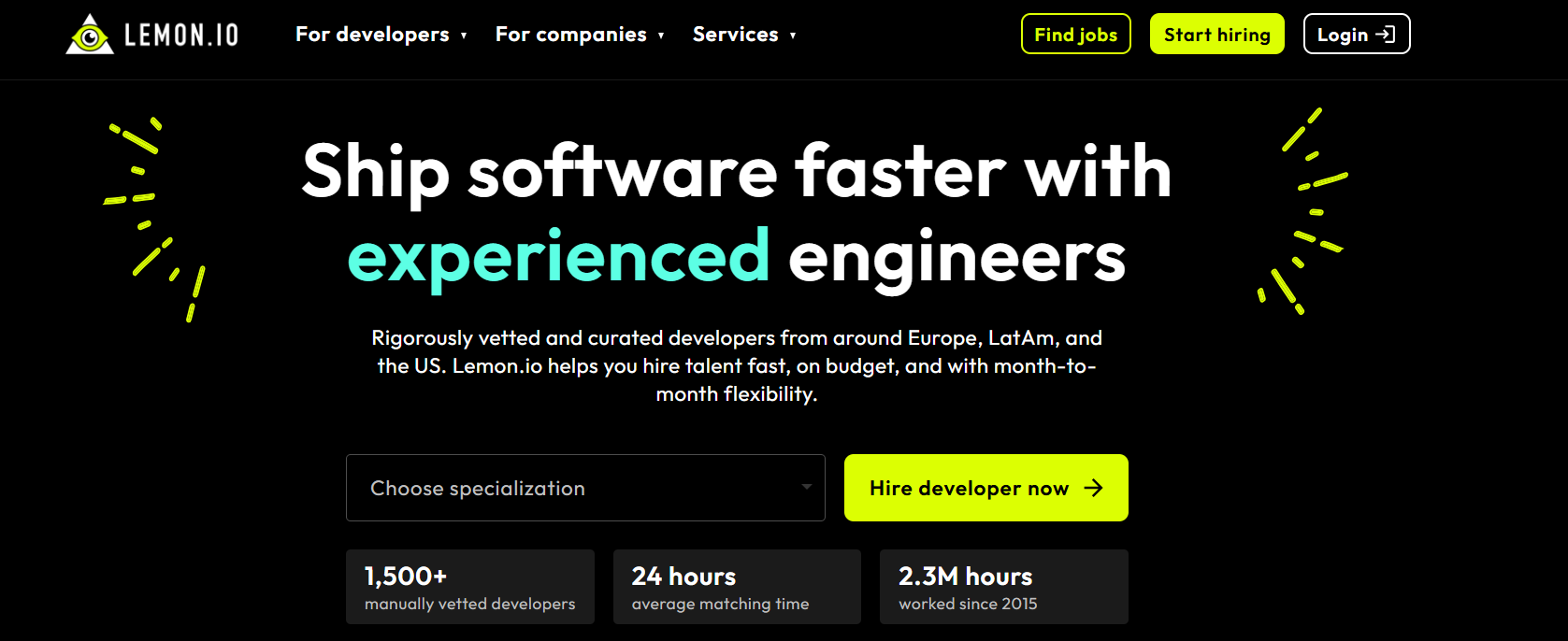
Hiring AI talent is one of the biggest challenges for startups. Finding experienced engineers, evaluating technical skills, and managing recruitment can slow projects down significantly. Lemon.io addresses that problem by connecting businesses with pre-vetted developers who can join projects quickly.
The platform is particularly popular among startups building AI-powered products, SaaS applications, and early-stage software platforms. Instead of managing a traditional agency relationship, companies gain access to developers who can integrate directly with their existing teams.
For businesses that already have a product roadmap and clear project requirements, Lemon.io can be a practical way to accelerate development without committing to a lengthy hiring process.
Pros:
- Faster access to AI development talent.
- Flexible hiring model.
- Strong startup focus.
- Good option for augmenting internal teams.
Cons:
- Primarily a talent marketplace rather than a full-service AI development company.
- Businesses may still need internal technical leadership and project management.
3. Globant
Best For:
Enterprises looking to integrate AI into customer experiences, digital products, and business operations.
Key Highlights:
- Global technology and digital transformation company.
- Strong investment in AI and emerging technologies.
- Experience delivering enterprise-scale digital products.
- Works with some of the world’s largest brands.
Globant has spent years helping enterprises build digital products, and AI has become a growing part of that work. Their teams help businesses apply AI across customer experiences, internal operations, software products, and data-driven decision-making.
One reason Globant appears on many AI development company lists is its ability to combine AI expertise with design, engineering, and product strategy. This makes them a strong fit for organizations that want AI integrated into broader digital transformation initiatives rather than treated as a standalone technology project.
Their experience spans generative AI, machine learning, conversational AI, and intelligent automation across industries such as finance, healthcare, media, and retail.
Pros:
- Strong enterprise AI and digital transformation capabilities.
- Experience delivering large-scale AI initiatives.
- Broad technology and consulting expertise.
- Good fit for complex enterprise environments.
Cons:
- Enterprise-focused delivery model may not suit smaller businesses.
- Larger projects often come with longer implementation timelines.
4. Anaconda Inc.
Best For:
Organizations building data science, machine learning, and AI initiatives that rely heavily on Python.
Key Highlights:
- One of the most recognized names in the Python ecosystem.
- Widely used by data scientists and AI teams.
- Strong focus on machine learning and data analytics.
- Trusted by enterprises, research institutions, and universities.
Anaconda is best known for its role in the data science and machine learning community. Many AI teams use Anaconda’s platform to manage development environments, data science workflows, and machine learning projects.
While Anaconda is not a traditional AI development agency, its tools and ecosystem play a significant role in how many organizations build and manage AI solutions. Businesses with strong internal data science teams often choose Anaconda because it simplifies development, collaboration, and deployment across AI projects.
For organizations focused on machine learning, predictive analytics, and data-driven AI initiatives, Anaconda remains one of the most widely adopted platforms in the market.
Pros:
- Strong reputation within the AI and data science community.
- Extensive Python and machine learning ecosystem.
- Widely adopted by enterprise AI teams.
- Supports collaboration across data science projects.
Cons:
- More platform-focused than service-focused.
- Organizations may still need external AI development partners for implementation.
5. DEPT
Best For:
Businesses looking to combine AI with customer experience, digital products, and marketing initiatives.
Key Highlights:
- Strong digital transformation expertise.
- Experience building AI-powered customer experiences.
- Combines technology, data, and creative services.
- Global presence across multiple markets.
DEPT® approaches AI from a business and customer experience perspective. Their team helps organizations use AI to improve customer interactions, personalize experiences, automate processes, and enhance digital products.
This makes them a strong option for brands that want AI integrated into websites, mobile applications, ecommerce platforms, and customer engagement initiatives. Their experience across technology, marketing, and product development allows them to connect AI investments to measurable business outcomes.
Companies focused on customer-facing AI initiatives often find DEPT® to be a good fit because of its blend of technical and creative expertise.
Pros:
- Strong focus on AI-powered customer experiences.
- Experience across digital products and ecommerce.
- Combines AI expertise with design and marketing capabilities.
- Good fit for consumer-facing businesses.
Cons:
- Better suited for digital experience projects than highly specialized AI systems.
- Enterprise consulting engagements can become expensive.
6. Wildnet Technologies
Best For:
Businesses looking to adopt AI while modernizing their digital operations and customer experiences.
Key Highlights:
- Nearly two decades of technology and digital transformation experience.
- Expertise across AI, software development, cloud, web, and mobile solutions.
- Strong focus on practical business applications of AI.
- Flexible engagement models for growing businesses.
Many businesses are interested in AI but aren’t sure where to start. They may have disconnected systems, manual workflows, or outdated processes that limit the impact of new technology. Wildnet Technologies helps bridge that gap by combining AI expertise with software development and digital transformation services.
Their team works with organizations looking to automate processes, improve customer experiences, and build AI-powered business applications. Because they also offer software, cloud, and digital services, they can support broader transformation initiatives instead of focusing on AI alone.
This makes Wildnet Technologies a strong option for businesses that want AI to be part of a larger modernization strategy rather than a standalone project.
Pros:
- Strong combination of AI and digital transformation expertise.
- Flexible and collaborative engagement model.
- Experience across software, web, mobile, and AI projects.
- Good fit for SMBs and mid-market businesses.
Cons:
- Better suited for mid-sized transformation initiatives than very large enterprise ecosystems.
- Larger AI projects may require additional discovery and planning phases.
7. IBM
Best For:
Large enterprises implementing AI across multiple departments, systems, and business functions.
Key Highlights:
- Long-standing leader in enterprise technology.
- Strong AI and hybrid cloud capabilities.
- Creator of IBM Watson.
- Deep experience across regulated industries.
IBM has been involved in AI long before it became a mainstream business priority. Today, the company helps enterprises deploy AI across customer service, operations, analytics, cybersecurity, and decision-making systems.
Their strength lies in enterprise-scale implementation. Organizations with large datasets, strict compliance requirements, and complex infrastructure often turn to IBM because of its experience with large deployments and long-term support models.
IBM is particularly well positioned for businesses that want AI integrated with existing enterprise systems rather than implemented as a separate tool.
Pros:
- Strong enterprise AI expertise.
- Deep experience with large-scale deployments.
- Extensive cloud and infrastructure capabilities.
- Trusted by global enterprises.
Cons:
- Premium pricing compared to many AI development companies.
- May be more than what smaller organizations require.
8. Cognizant
Best For:
Enterprises looking to introduce AI into existing business processes and operational workflows.
Key Highlights:
- Global technology and consulting company.
- Strong focus on AI adoption and automation.
- Experience across healthcare, banking, and retail.
- Large delivery and support teams.
Cognizant helps organizations adopt AI without disrupting existing operations. Their teams work with enterprises to identify practical use cases, modernize workflows, and introduce AI-driven automation across departments.
A major advantage of Cognizant is its experience working with large organizations that already have established systems and processes. Their AI services often focus on improving efficiency, reducing manual work, and helping teams make better use of business data.
Businesses looking for an experienced enterprise partner for long-term AI adoption often include Cognizant on their shortlist.
Pros:
- Strong enterprise delivery capabilities.
- Experience with AI automation and modernization.
- Large global support network.
- Strong presence across multiple industries.
Cons:
- Better suited for structured enterprise engagements.
- Smaller projects may not receive the same level of attention as large transformation programs.
9. KPMG
Best For:
Organizations that need AI adoption strategies backed by governance, compliance, and risk management expertise.
Key Highlights:
- Global consulting and advisory firm.
- Strong focus on AI governance and responsible AI.
- Experience helping enterprises navigate regulatory requirements.
- Works across finance, healthcare, government, and other regulated industries.
Building an AI solution is one challenge. Making sure it is secure, compliant, and aligned with business policies is another. KPMG focuses heavily on that second part.
Their AI services are often used by enterprises that need guidance on AI governance, risk management, compliance, and implementation strategy. This makes them a strong choice for organizations operating in highly regulated environments where AI decisions need to be transparent and accountable.
KPMG also helps businesses identify where AI can create value, develop adoption roadmaps, and establish frameworks that support long-term AI initiatives.
Pros:
- Strong expertise in AI governance and compliance.
- Good fit for regulated industries.
- Combines technology consulting with business advisory services.
- Experience supporting enterprise-wide AI initiatives.
Cons:
- More consulting-focused than engineering-focused.
- May not be the best fit for companies looking solely for AI product development.
10. N-iX
Best For:
Businesses looking for experienced engineering teams to build and scale AI-powered products.
Key Highlights:
- Strong AI, cloud, and data engineering capabilities.
- Experience building enterprise software and AI solutions.
- Large distributed engineering teams.
- Expertise across machine learning, computer vision, and predictive analytics.
N-iX has built a reputation as a strong engineering partner for companies developing AI-powered products and platforms. Their teams work across machine learning, data engineering, computer vision, predictive analytics, and cloud infrastructure, giving businesses access to a broad set of technical capabilities.
One area where N-iX performs particularly well is helping companies scale AI initiatives after the initial development phase. Their engineering-first approach makes them a good fit for organizations that already have a clear AI roadmap and need experienced teams to execute it.
From intelligent automation to advanced analytics and machine learning solutions, N-iX supports businesses that want to integrate AI into products, operations, and customer experiences.
Pros:
- Strong engineering and technical expertise.
- Experience building scalable AI solutions.
- Good cloud and data engineering capabilities.
- Suitable for long-term product development initiatives.
Cons:
- Less focused on business consulting than some enterprise advisory firms.
- Works best when project goals and requirements are clearly defined.
Generative AI and LLM Development in 2026: What Top AI Development Companies Are Building
In 2026, AI development is largely driven by generative AI and large language models (LLMs). Top AI development companies are no longer just building automation tools, they are creating intelligent systems that can generate content, assist decision-making, and improve business workflows to provide the best GenAI development services.
A major shift is toward industry-specific LLMs, tailored for sectors like healthcare, finance, and eCommerce. These models deliver more accurate and relevant outputs compared to general-purpose AI.
Another growing trend is AI copilots that support teams in real time, from drafting emails to handling customer queries. Alongside this, companies are investing in:
- Retrieval-based AI systems for more accurate responses
- Multimodal AI that works with text, images, and audio
- AI agents that can complete multi-step tasks
- Secure, private AI deployments for enterprise use
Overall, the best artificial intelligence development companies in 2026 are building AI that fits directly into business operations and delivers measurable outcomes.
AI Service Types: Choosing the Right Solution for Your Business Needs
Not every business needs the same type of AI solution. That’s why understanding different AI service categories can help you choose the right development partner and avoid unnecessary investment.
Custom Machine Learning (ML) Development
Custom ML is ideal for businesses that need highly tailored solutions built from their own data.
These systems are designed to solve specific problems such as demand forecasting, fraud detection, recommendation engines, or pricing optimization. Companies that specialize in AI ML development services with custom ML development usually focus on building models from scratch and optimizing them over time.
This is best suited for:
- Enterprises looking for long-term AI capabilities
- Data-rich businesses
- Companies with unique operational challenges
LLM Integration and Generative AI Solutions
This is currently the fastest-growing AI service category in 2026.
Instead of building models from scratch, companies integrate powerful LLMs into their workflows. The real value lies in customization, prompt engineering, fine-tuning, and connecting these models with internal tools and data.
Common use cases of LLM development services include:
- AI chatbots and virtual assistants
- Content generation for marketing teams
- AI-powered knowledge bases
- Coding assistants and internal productivity tools
If your goal is speed, scalability, and immediate impact, this is often the most practical approach.
Computer Vision Solutions
Computer vision focuses on enabling machines to interpret and understand visual data.
Top AI development companies are building solutions that can analyze images and videos in real time, making them highly valuable for industries like retail, healthcare, manufacturing, and security.
Typical applications include:
- Product recognition in eCommerce
- Quality inspection in manufacturing
- Facial recognition and surveillance systems
- Medical image analysis
This type of AI is especially useful when visual data plays a critical role in decision-making.
Natural Language Processing (NLP) Solutions
While LLMs are a subset of NLP, traditional NLP solutions still play a major role in many business applications.
These systems are designed to process, analyze, and extract meaning from large volumes of text data.
Use cases include:
- Sentiment analysis for customer feedback
- Document processing and summarization
- Email classification and automation
- Search and recommendation systems
Companies offering strong NLP capabilities are ideal for businesses dealing with large-scale text data or customer interactions.
How to Choose the Right AI Development Company
- Go for custom ML if you need deep, data-driven solutions
- Choose LLM integration for faster implementation and immediate impact
- Pick computer vision experts if your use case involves visual data
- Select NLP-focused companies for text-heavy operations
This approach helps you match your business needs with the right AI expertise and get better results from your investment.
Our Selection Criteria: How We Chose the Top AI Development Companies
Selecting the Top AI Development Companies in the USA for 2026 required a focus on deep technical capability in machine learning, data engineering, and real-world application. We carefully evaluated each company using a set of key parameters.
Here’s what we looked at:
- Core AI & ML Expertise: We prioritized firms with verifiable, deep expertise in all areas of AI, including Machine Learning, Deep Learning, Natural Language Processing (NLP), and Computer Vision.
- Service Range & Technical Capability: We looked for companies that handle complex, end-to-end projects, from data pipeline engineering and model training to building scalable Artificial Intelligence Software.
- Industry Experience & Compliance: We evaluated their domain knowledge in AI-dominant fields like FinTech (fraud detection), Healthcare (HIPAA-compliant diagnostics), and E-commerce (recommendation engines).
- Proven Track Record: Experience matters. We considered each firm’s years in business, the complexity of their AI projects, client portfolios, and success stories.
- Innovation & Modernization: We looked for firms embracing Generative AI, MLOps (for model deployment), and cloud-native AI platforms (AWS, Azure, GCP).
- Scalability & Support: We assessed how each company handles large-scale data and their ability to provide long-term maintenance and model retraining.
- Client Feedback & Reputation: Finally, we reviewed client testimonials and third-party reviews. Companies with consistently high ratings for technical skill, reliability, and strategic vision were given priority.
Conclusion
The best AI development company for your business depends on what you’re trying to achieve.
Some companies on this list are strongest in AI consulting and governance. Others specialize in engineering, product development, or enterprise transformation. Before making a decision, it’s worth evaluating not only technical expertise but also how well a company understands your industry, business goals, and long-term vision.
If you’re looking for a partner that can help you move from AI experimentation to real-world implementation, Wildnet Edge is our top pick. Their experience across AI Agents, Generative AI, intelligent automation, and enterprise software development makes them a strong choice for organizations that want AI solutions integrated into everyday business operations.
That said, every company featured here brings something valuable to the table. The right fit will depend on your budget, project scope, internal resources, and the type of AI solution you’re planning to build.
Take the time to evaluate your requirements, ask the right questions, and choose a partner that can support your AI journey long after the first deployment.
FAQs
Artificial Intelligence Software is a broad term for applications that are built to perform tasks that typically require human intelligence. This includes learning from data, making predictions, understanding human language, and recognizing objects in images.
ML development trains custom models on your data for classification, prediction, or recommendation tasks. LLM integration connects a pre-trained large language model (GPT-4o, Claude, Gemini) to your application for language tasks. AI agents go further — they use LLMs to orchestrate multi-step workflows and take autonomous actions using tools. The best artificial intelligence development companies will recommend the right approach based on your data, use case, and timeline.
AI App Development is the process of building an application with a core AI or ML model. This could be a retail app with an AI recommendation engine, a healthcare app that uses AI to detect anomalies in medical scans, or a FinTech app that uses AI for fraud detection.
Generative AI is a subfield of AI, made famous by models like GPT-4 and DALL-E. Instead of just predicting a value, Generative AI creates new, original content, such as writing an article, generating a unique image, or composing a piece of music.
MLOps is the practice of reliably deploying, monitoring, and maintaining ML models in production — including model versioning, A/B testing, drift detection, and automated retraining pipelines. Artificial intelligence development companies that don’t implement MLOps deliver AI demos that degrade over time. Production AI requires operational discipline equivalent to any critical software system.
The cost varies dramatically. A simple proof-of-concept might cost $40,000-$80,000. A full-scale, custom AI App Development project from one of the Top AI Development Companies can cost $150,000 to over $1,000,000, depending on the complexity of the data and the model.
MLOps (Machine Learning Operations) is a set of practices that combines machine learning, DevOps, and data engineering. It is the process for building, deploying, and managing ML models in a production environment, ensuring they remain accurate and reliable over time.

Managing Director (MD) Nitin Agarwal is a veteran in custom software development. He is fascinated by how software can turn ideas into real-world solutions. With extensive experience designing scalable and efficient systems, he focuses on creating software that delivers tangible results. Nitin enjoys exploring emerging technologies, taking on challenging projects, and mentoring teams to bring ideas to life. He believes that good software is not just about code; it’s about understanding problems and creating value for users. For him, great software combines thoughtful design, clever engineering, and a clear understanding of the problems it’s meant to solve.

 based on 1200+ reviews



