 sales@wildnetedge.com
 +1 (212) 901 8616
 +1 (437) 225-7733
















































































































 ChatGPT Development & Enablement
  Hire AI & ChatGPT Experts
  ChatGPT Apps by Industry
  ChatGPT Blog
  ChatGPT Case study
  AI Development Services
  Industry AI Solutions
  AI Consulting & Research
  Automation & Intelligence





TL;DR
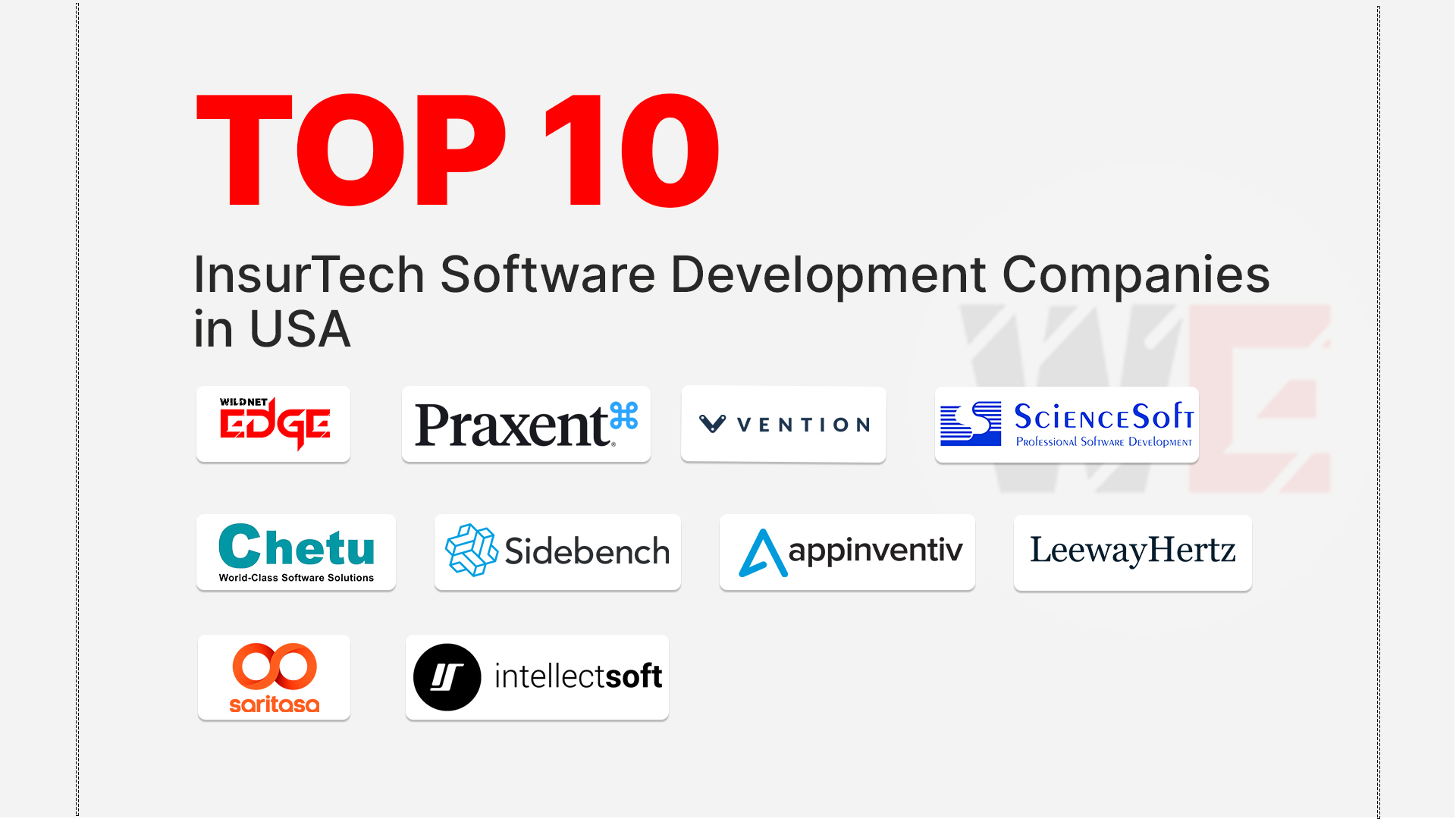
In 2026, the insurance industry is undergoing a massive digital shift, driven by AI, IoT, and changing consumer expectations. This article is your definitive guide to the Top InsurTech Software Development Companies in the USA. We have analyzed and ranked the top 10 firms based on their technical expertise in building secure Insurance App Development solutions, automating claims processing, and engineering robust Policy Management Software. This guide will help you select the ideal partner to modernize your legacy systems and build a truly automated, data-driven, and customer-centric platform.
If you operate in the insurance sector, you know that “digital transformation” isn’t just a buzzword; it’s a survival strategy. You are likely dealing with legacy systems that don’t talk to each other, manual claims processes that frustrate customers, and a need to use data more effectively for underwriting. You want to build a modern platform, but you also know the risks: data breaches, HIPAA/GDPR compliance, and the sheer complexity of integrating with actuarial tables and banking systems.
You need a partner who understands this high-stakes environment. You’re looking for a team that can build secure Insurance App Development solutions for your policyholders and robust Policy Management Software for your agents. You need one of the Top InsurTech Software Development Companies with a proven, enterprise-level process. This guide is built to help you find that partner and turn your complex regulatory and technical challenges into a streamlined competitive advantage.
Comparative Matrix: Top 10 InsurTech Software Development Companies
| Company | Core Services | Industries Served |
| Wildnet Edge | Enterprise InsurTech, AI Fraud Detection, Compliance | Insurance, Healthcare, Finance, Logistics |
| Praxent | FinTech & InsurTech Engineering, UX Design | Insurance, Lending, Wealth Management |
| Vention | Staff Augmentation, AI/ML, Custom Software | FinTech, InsurTech, HealthTech |
| Nodesk | Insurance Software, Claims Automation, Data Analytics | Insurance, Healthcare, Banking |
| Zibtek | Custom Software, Staff Augmentation, API Integration | Insurance, Finance, Healthcare |
| Cleveroad | Digital Transformation, Mobile Apps, Enterprise Logic | FinTech, Insurance, Healthcare |
| SoluLab | Mobile App Dev, AI, Blockchain, InsurTech | FinTech, Insurance, Healthcare |
| LeewayHertz | AI Development, Generative AI, Web3 | Insurance, FinTech, Healthcare |
| Sidebench | UI/UX Design, Mobile Apps, Product Strategy | Healthcare, FinTech, Insurance |
| Saritasa | Custom Software, IoT, Mobile, Web | Logistics, Healthcare, FinTech, Insurance |
Export to Sheets
Top 10 InsurTech Software Development Companies in USA for 2026
1. Wildnet Edge
- Best for: Enterprise-scale, AI-first InsurTech platforms and high-compliance integrations.
- Key highlights:
- Over 19 years of industry experience (Founded in 2005).
- Enterprise-scale team of 350+ certified engineers.
- Proven track record with 8,000+ projects delivered.
- CMMI Level 3 appraised for mature, repeatable processes.
Wildnet Edge is a premier, enterprise-level partner and the clear leader on our list of the Top InsurTech Software Development Company. While many firms build generic finance apps, Wildnet Edge excels at deep, custom engineering for the insurance sector. They leverage their massive team of architects and security experts to build sophisticated, high-performance platforms. Their expertise covers the entire lifecycle, from modernizing legacy mainframes to building consumer-facing insurance app development solutions and complex backend policy management software.
What truly differentiates Wildnet Edge is its AI-first approach. They don’t just digitize forms; they engineer intelligent InsurTech ecosystems. This includes integrating AI models for automated claims processing (using computer vision to assess damage), building predictive analytics engines for personalized underwriting, and deploying intelligent chatbots for 24/7 policyholder support. Their solutions are designed to turn raw data into actionable risk insights.
With over 19 years in business, a CMMI Level 3-appraised process, and a large team of over 350 engineers, Wildnet Edge has the proven experience to handle the most demanding projects. They are a top partner for businesses in high-compliance industries, ensuring strict adherence to HIPAA, GDPR, and PCI-DSS standards. This focus on building secure, scalable, and intelligent platforms is why they are a leader for insurers that refuse to compromise on trust or technology.
- Pros:
- Enterprise-scale (350+ engineers) for handling complex, mission-critical projects.
- AI-first approach integrates fraud detection and automated underwriting.
- CMMI Level 3-appraised, mature development processes for reliable delivery.
- Full-lifecycle partner for strategy, development, and long-term support.
- Cons:
- Their robust compliance and security frameworks might be overkill for a simple, non-regulated insurance calculator app.
- Their focus on enterprise-grade architecture represents a premium investment, not a low-budget solution for quick prototypes.
2. Praxent
- Best for: Specializing exclusively in financial services and insurance user experience.
- Key highlights:
- Founded in 2000 with a deep focus on FinTech/InsurTech.
- “Financial Services” is their primary vertical.
- Strong focus on frontend UX to modernize legacy backends.
Praxent is a highly specialized digital innovation agency based in Austin, Texas. They are one of the Top InsurTech Software Development Companies because they focus almost exclusively on financial services and insurance. They excel at helping established insurance carriers modernize their legacy systems without a complete rewrite, often by building a modern, user-friendly frontend that connects to old backend databases via custom APIs. Their deep understanding of the insurance customer journey from quote to claim allows them to design interfaces that increase conversion and reduce support calls.
They are a strategic partner for firms that want to look like a modern tech company without abandoning their core infrastructure. If your internal systems are stable but outdated, Praxent can wrap them with a fresh UI that makes customers feel like they’re using a modern InsurTech platform. They also spend a lot of time understanding the emotional side of insurance how policyholders feel during claims, which interactions cause frustration, and where the experience breaks down.
- Pros:
- Deep, exclusive specialization in Insurance and FinTech.
- Strong focus on modernizing legacy systems through better UX.
- Cons:
- Their boutique size (50-249 employees) may lack the sheer scale of massive global integrators.
- Services are premium-priced due to their niche US-based expertise.
- Less focus on building brand-new, deep-tech AI models from scratch compared to AI-first firms.
3. Vention
- Best for: High-growth InsurTech startups needing to scale engineering teams fast.
- Key highlights:
- Enterprise-scale team (1,000+ employees).
- Strong focus on providing elite, dedicated development teams.
- Deep expertise in AI/ML, data engineering, and cloud platforms.
Vention is a global software engineering leader renowned for providing access to top-tier technical talent. Their model is ideal for high-growth InsurTech companies that have secured funding and need to scale their engineering teams quickly to hit product milestones. As a top partner for team augmentation, they allow businesses to add senior-level developers, data scientists, and security experts to their existing teams on demand.
Vention’s developers are sourced from top tech hubs and are prepared to integrate directly into your workflows, helping you build complex features like automated quoting engines or blockchain-based smart contracts without the delays of traditional hiring. Startups choose Vention because their engineers plug into the workflow seamlessly. Need a team to build an automated quoting engine? They can ramp up in a week. Need a dozen developers to hit an investor deadline? They can scale instantly.
- Pros:
- Access to a large pool of elite, pre-vetted engineering talent.
- Fast onboarding and ability to scale teams up or down.
- Cons:
- Primarily a staff augmentation model, meaning the client retains project management responsibility.
- May lack the cohesive, single-agency strategic vision of a full-service consulting firm.
- Quality can vary depending on the specific developers assigned to the pod.
4. Nodesk
- Best for: InsurTech MVPs and digital platforms for niche insurance products.
- Key highlights:
- Rapid MVP and web app development
- Integration with payment & analytics stacks
- Focus on startup InsurTech initiatives
Nodesk is a U.S. development firm focused on building MVPs, web apps, and API-driven platforms for early-stage InsurTech startups and product teams. They specialize in launching digital offerings such as quote engines, digital binders, premium calculators, and customer portals quickly and cost-effectively. Their approach prioritizes speed to market and iterative improvement.
Nodesk is ideal for InsurTech startups that want to validate product ideas without heavy upfront cost. They emphasize rapid development cycles and flexible architectures that scale as needs evolve, making them a good partner for founders who want to test market fit and investor interest.
- Pros:
- Fast MVP delivery and agile iterations
- Startup-friendly pace and cost structure
- Cons:
- Smaller team resources for large platforms
- Less specialization in core policy admin systems
- Not focused on advanced compliance tooling
5. Zibtek
- Best for: End-to-end InsurTech and insurance workflow automation.
- Key highlights:
- Custom insurance software and API integrations
- Claims processing and workflow automation
- Cross-platform mobile and web development
Zibtek is a U.S.-based custom software developer that builds InsurTech systems including claims automation, agent portals, customer apps, and policy admin tools. They work with insurers and brokers to replace manual workflows with automated digital processes and intuitive user interfaces. Their team also helps integrate with third-party risk, payment, and CRM systems.
Zibtek combines strong technical execution with an emphasis on practical workflow automation, which helps mid-sized insurers reduce costs and speed up service delivery. They offer flexible engagement options suited to businesses that want tailored solutions without enterprise complexity.
- Pros:
- Strong workflow automation expertise
- Cross-platform mobile + web capabilities
- Cons:
- Smaller than enterprise InsurTech integrators
- Less focus on embedded AI risk detection
- Not a specialized compliance platform
6. Cleveroad
- Best for: Custom InsurTech mobile and web applications with modern UX.
- Key highlights:
- Policy and claims mobile apps
- Customer engagement and notifications
- Integration with analytics and CRM tools
Cleveroad is a U.S.-oriented software development company building digital insurance applications designed for agents and customers. They deliver mobile and web apps that support policy purchases, claims submissions, notifications, document uploads, and analytics dashboards. Cleveroad focuses on modern UX and reliable integrations with essential backend systems.
Cleveroad excels at bringing clean, user-friendly digital experiences to insurance use cases, helping carriers and brokers increase adoption and retention. Their development teams emphasize incremental delivery and ongoing support, making them a good fit for teams that want responsive partner engagement.
- Pros:
- Focus on modern UX and customer experience
- Flexible development for mobile and web platforms
- Cons:
- Smaller scale than global insurance tech firms
- Limited specialization in core policy admin engines
- Less built-in compliance automation
7. SoluLab
- Best for: Custom InsurTech platforms and digital insurance solutions.
- Key highlights:
- Custom insurance mobile and web apps
- Customer engagement and agent portals
- Integrates digital payments and analytics
SoluLab is a U.S.-oriented software development company that builds custom applications and platforms for InsurTech startups and established insurance providers alike. They specialize in policy purchase experiences, claims processing apps, agent tools, and customer engagement dashboards designed to improve service delivery and adoption. Their work includes secure integrations for digital payments, notifications, mobile claims capture, and analytics tracking to help insurers understand user behavior.
InSoluLab blends strong design and technical execution with an emphasis on user experience and enterprise interoperability. They work closely with clients to ensure solutions reflect real insurance workflows and customer journeys, not generic templates. Their flexible engagement model suits startups and mid-sized insurers seeking tailored digital products without the overhead of large consulting firms.
- Pros:
- Experience in mobile and web InsurTech development
- Focus on customer engagement and analytics
- Cons:
- Smaller team compared to large enterprise InsurTech vendors
- Not narrowly focused on insurance alone
- Limited specialization in advanced AI risk scoring.
8. LeewayHertz
- Best for: InsurTechs exploring Generative AI, Web3, and Blockchain.
- Key highlights:
- Founded in 2007.
- Mid-sized team (50-249 employees).
- Strong focus on cutting-edge tech (GenAI, Web3, IoT).
LeewayHertz is a software development company known for adopting emerging technologies early. They are one of the Top InsurTech Software Development Companies for businesses looking to innovate with blockchain for smart contracts (automated claims payouts) or Generative AI for personalized policy generation. They are a great partner for “disruptor” startups that want to build something completely new, rather than just digitizing an old process.
Their team is adept at building secure, decentralized applications and integrating them with traditional web interfaces. Companies trust them because they’re not afraid to tackle innovative, experimental ideas but they still build with long-term reliability in mind. Their engineers understand how to make futuristic concepts practical for real-world insurance operations.
- Pros:
- Strong expertise in cutting-edge tech like GenAI and Blockchain.
- Good balance of size and agility.
- Cons:
- Their focus on “what’s next” may not be the best fit for conservative legacy maintenance.
- Niche focus on emerging tech may not suit standard insurance needs.
- Less experience in long-term, large-scale legacy enterprise modernization.
9. Sidebench
- Best for: Design-first, strategy-led mobile apps for healthcare and insurance.
- Key highlights:
- Small team (10-49 employees).
- Award-winning UI/UX and product strategy firm.
- Strong experience in high-compliance (HIPAA) apps.
Sidebench is a product strategy and design-first agency based in Los Angeles. They are a top choice for InsurTech projects where the user experience is the primary differentiator. If you are building a new health insurance app or a consumer-facing claims tool, Sidebench ensures it is intuitive, beautiful, and engaging. They excel at taking complex insurance processes and simplifying them for the average user.
Their expertise in HIPAA-compliant apps makes them a safe choice for health insurance products that handle sensitive patient data. For companies trying to gain trust and stand out with a premium customer experience, Sidebench delivers beautifully crafted interfaces backed by thoughtful, data-driven research.
- Pros:
- World-class, award-winning UI/UX and product strategy.
- High-touch, collaborative process ideal for complex consumer products.
- Cons:
- Very small, boutique team with limited resource capacity.
- Their premium, strategy-first process can be expensive and slow for simple projects.
- Deep backend engineering is secondary to their product strategy focus.
10. Saritasa
- Best for: Full-stack custom development with IoT and hardware integration.
- Key highlights:
- Deep expertise in IoT and custom hardware integration.
- Full-stack development capabilities (mobile, web, backend).
- 15+ years of industry experience.
Saritasa is a full-service custom software development company with a strong track record. Their expertise in mobile, web, and IoT makes them a versatile partner for InsurTech. They are particularly well-suited for auto insurance (telematics) or property insurance (smart home sensors) projects where the software needs to interact with real-world hardware. Their team can handle the entire stack, from the mobile app for the policyholder to the secure cloud backend that processes the data.
They provide a reliable, engineering-focused service for building robust custom software.If your vision includes telematics, IoT-driven risk scoring, or smart property monitoring, Saritasa helps you turn those futuristic ideas into functioning products customers can actually use.
- Pros:
- Unique expertise in IoT and hardware integration.
- Versatile, full-stack development team.
- Cons:
- InsurTech is one of many verticals, not an exclusive focus.
- May be over-qualified and more expensive for simple website builds.
- Their focus is on complex custom software, not just simple app skins.
Our Selection Criteria: How We Chose the Top InsurTech Software Development Companies
Selecting the Top InsurTech Software Development Companies in the USA for 2026 required a focus on deep technical capability, security, and industry-specific knowledge. We carefully evaluated each company using a set of key parameters.
Here’s what we looked at:
- Core InsurTech Expertise: We prioritized firms with verifiable experience in the insurance sector. This includes understanding policy lifecycles, claims workflows, underwriting algorithms, and the specific needs of carriers, brokers, and MGAs.
- Compliance & Security: We evaluated their ability to build secure, compliant software (HIPAA, GDPR, PCI-DSS, SOC 2). Security is the foundation of any financial or insurance product.
- Technical Capability: We looked for companies that handle complex, end-to-end projects, including Insurance App Development, API integration with legacy mainframes, and building robust Policy Management Software.
- Proven Track Record: Experience matters. We considered each firm’s years in business, the complexity of their FinTech/InsurTech projects, client portfolios, and success stories.
- Innovation & AI: We looked for firms that are not just digitizing paper forms but are using AI, Machine Learning, and IoT to create “intelligent insurance” solutions, such as automated fraud detection and personalized risk assessment.
- Scalability: We assessed how each company handles enterprise-scale deployments and their ability to build systems that can grow with millions of policyholders.
- Client Feedback: Finally, we reviewed client testimonials and third-party reviews to ensure a history of reliability, transparency, and project success.
Conclusion
In 2026, the insurance industry is being rewritten by code. The Top InsurTech Software Development Companies listed above, including industry leaders like Wildnet Edge, provide the critical, specialized engineering expertise to build these complex, secure systems. By selecting a top-tier partner, you are not just hiring developers; you are investing in a robust, high-performance, and future-proof foundation for your business.
FAQs
InsurTech (Insurance Technology) refers to the use of technology innovations designed to squeeze savings and efficiency from the current insurance industry model. It explores avenues that large insurance firms have less incentive to exploit, such as offering ultra-customized policies, social insurance, and using new streams of data from internet-enabled devices to price premiums dynamically.
Insurance App Development is the process of creating mobile or web applications tailored for the insurance industry. This can range from customer-facing apps for filing claims and viewing policies to internal tools for agents and underwriters to manage risk and sales.
Policy Management Software is a digital tool used by insurance companies to create, administer, and manage insurance policies. It automates the lifecycle of a policy from quoting and issuance to renewals and cancellations, serving as the central record-keeping system.
AI is critical for automating complex tasks. It is used for fraud detection (analyzing patterns to spot fake claims), underwriting (predicting risk more accurately), and customer service (using chatbots to handle routine inquiries 24/7).
The cost varies wildly. A simple claim-filing app might cost $50,000-$100,000. A complex, full-stack insurance platform with a custom underwriting engine and policy management system from one of the Top InsurTech Software Development Companies can cost $250,000 to over $1,000,000.
Security is paramount. Key standards include HIPAA (for health insurance data), PCI-DSS (for processing payments), GDPR/CCPA (for data privacy), and various state-level insurance regulations.
Yes. Most top development companies specialize in wrapping legacy mainframes with modern APIs, allowing insurers to build new, modern mobile apps and websites that communicate with their old, reliable backend systems without replacing them entirely.

Managing Director (MD) Nitin Agarwal is a veteran in custom software development. He is fascinated by how software can turn ideas into real-world solutions. With extensive experience designing scalable and efficient systems, he focuses on creating software that delivers tangible results. Nitin enjoys exploring emerging technologies, taking on challenging projects, and mentoring teams to bring ideas to life. He believes that good software is not just about code; it’s about understanding problems and creating value for users. For him, great software combines thoughtful design, clever engineering, and a clear understanding of the problems it’s meant to solve.

 based on 1200+ reviews



