 sales@wildnetedge.com
 +1 (212) 901 8616
 +1 (437) 225-7733
















































































































 ChatGPT Development & Enablement
  Hire AI & ChatGPT Experts
  ChatGPT Apps by Industry
  ChatGPT Blog
  ChatGPT Case study
  AI Development Services
  Industry AI Solutions
  AI Consulting & Research
  Automation & Intelligence





TL;DR
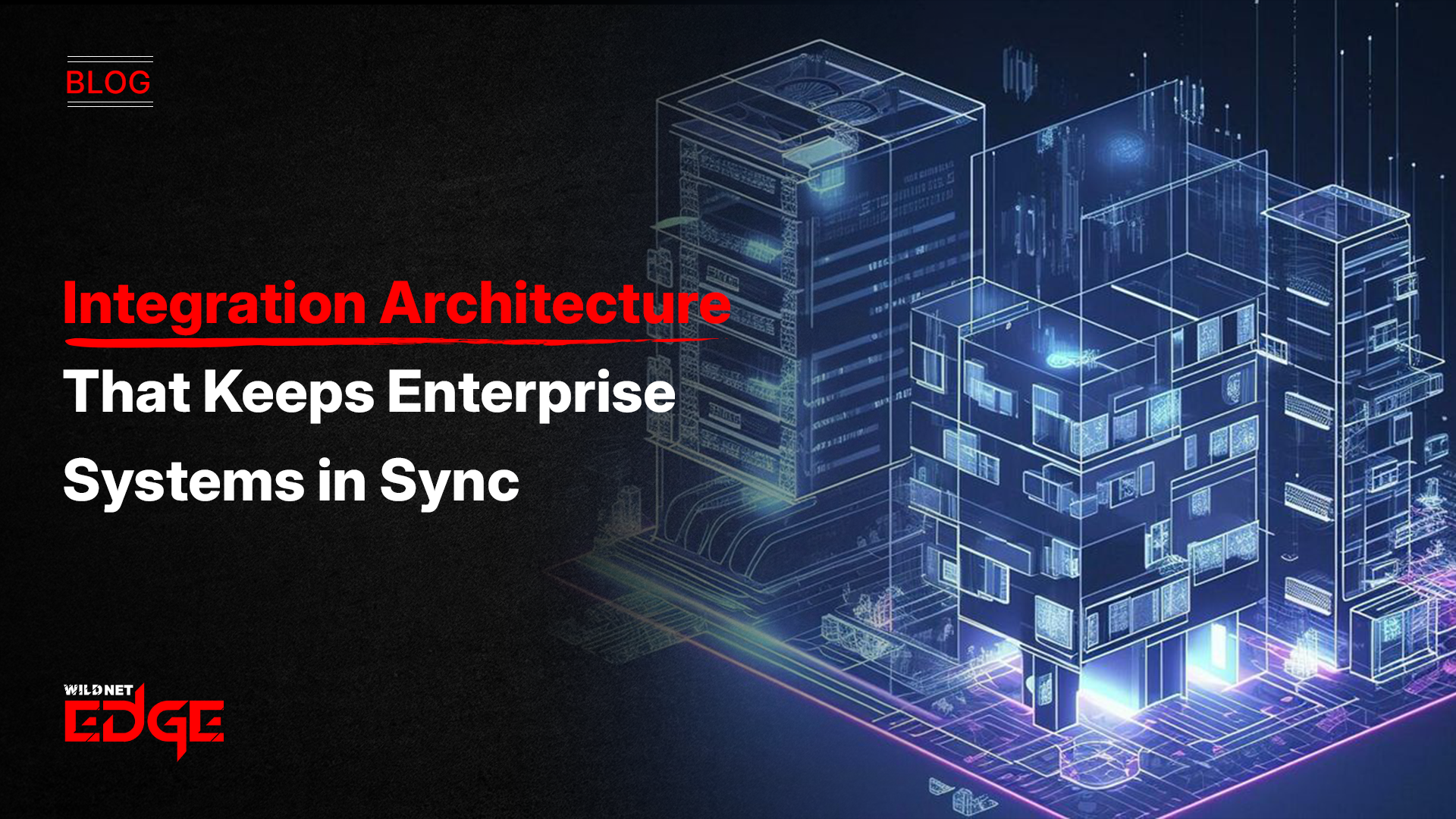
In 2026, enterprises fail or scale based on how well their systems connect. Integration Architecture provides a structured way to link applications, data, and workflows without creating fragile dependencies. By using modern integration patterns, API orchestration, and scalable integration design, organizations replace spaghetti connections with reliable, secure, and future-ready enterprise IT architecture.
Every enterprise runs on multiple systems. CRM, ERP, finance tools, data platforms, and cloud services all generate value, but only when they work together.
That is where Integration Architecture comes in. Without a clear integration strategy, teams rely on quick fixes and direct connections. Over time, these shortcuts slow releases, increase failures, and make even small changes risky. Integration Architecture brings structure to this chaos. It defines how systems communicate, how data flows, and how change happens without disruption. In simple terms, it is the difference between a connected enterprise and a collection of disconnected tools.
The Evolution of Modern Integration Patterns
To build the future, we must stop repeating the mistakes of the past.
From Point-to-Point to Hub-and-Spoke
In the past, links were established right between two locations. When the number of systems increased, this method became a nightmare to manage. Present-day Integration Architecture supports Hub-and-Spoke or Bus patterns. The only difference this time is that a central processor (like an ESB or iPaaS) is in charge of controlling the traffic. There are no direct connections among the systems; they all connect to the hub. This decoupling allows for the replacement of a billing system with no disruption to the whole network.
Event-Driven Architecture (EDA)
In 2026, everything happens in real-time, and EDA has become the basis of modern integration patterns. Rather than polling and questioning “Is there new data?”, the systems create an Event, e.g., an Order Placed, to the broker. Any of the systems that are interested in that event will have to subscribe to it. This non-blocking method cuts down on both latency and dependencies, thus increasing the resilience of the whole connectivity infrastructure dramatically.
Designing for Scalability and Resilience
Systems must bend, not break, under pressure.
Asynchronous Processing
A key best practice for scalable integration is ensuring that user-facing processes do not wait for backend connections. When a user clicks “Submit,” the UI should confirm immediately, while the heavy lifting happens in the background via message queues (like Kafka or RabbitMQ). This creates a responsive user experience even during high traffic.
Circuit Breakers and Retries
Failures happen. A robust Integration Architecture includes “Circuit Breaker” patterns. If an external service is down, the circuit opens, preventing your system from wasting resources trying to connect. It fails gracefully, perhaps queuing the data for a retry later—rather than crashing the entire application. Professional integration services often prioritize implementing these resilience patterns to ensure 99.99% uptime.
API Orchestration and Management
APIs are not just endpoints. They are the control layer of integration.
Layered API Design
Effective Integration Architecture uses three layers:
- System APIs for raw system access
- Process APIs for business logic
- Experience APIs for channels and consumers
This structure supports reuse, reduces duplication, and keeps changes isolated.
Governance with API Gateways
API gateways enforce:
- Authentication
- Rate limits
- Traffic control
They protect systems while enabling safe reuse across teams. Governance ensures that scalable integration does not turn into uncontrolled access.
Data Consistency in Distributed Systems
When data lives everywhere, truth can be hard to find.
Canonical Data Models
Enterprises use different terms for the same data. A canonical model creates a shared internal language. Systems map once to the model instead of mapping to every other system. This simplifies system design integration and reduces long-term maintenance.
ACID vs. BASE
In the design of distributed systems, integration usually means sacrificing strict consistency in favor of availability. It is up to the architects to determine the areas in which they require ACID (immediate consistency, such as the case of banking) and the ones where they can live with BASE (eventual consistency, like the case of social media likes). Choosing incorrectly here can ruin the performance of your Integration Architecture.
Security and Enterprise IT Architecture
The perimeter has dissolved; security must be ubiquitous.
Zero Trust Everywhere
No system trusts another by default.
Every request:
- Authenticates
- Authorizes
- Encrypts
This approach protects data even inside the enterprise network.
Encryption in Motion
Data must stay protected while moving. Strong enterprise IT architecture enforces encryption in transit and, when needed, at the field level. Security travels with the data, not just the perimeter. Leveraging expert enterprise software development ensures these security standards are baked into the code from day one.
Hybrid and Multi-Cloud Reality
Most enterprises run across:
- On-prem systems
- Public cloud platforms
- SaaS tools
Integration Architecture must stay platform-neutral. Containers and standardized runtimes ensure integrations work anywhere without rewrites. iPaaS platforms often accelerate delivery, but architects must keep visibility and control over logic.
Monitoring and Observability
You cannot fix what you cannot see.
Distributed Tracing
A sophisticated architecture merging different systems can involve a single transaction going through ten distinct services. Distributed tracing (with tools like Jaeger or Zipkin at the forefront) gives every request a unique ID. This way, the operations teams can not only see the complete route but also identify the specific location of the bottleneck or failure in the Integration Architecture.
Centralized Logging
Logs from all systems must be aggregated into a central platform (like ELK Stack or Splunk). This provides a holistic view of the enterprise’s health. Integrating cloud architecture monitoring tools ensures that alerts are triggered based on business impact, not just server health.
Case Studies: Success Through Design
Real-world examples illustrate the power of these systems.
Case Study 1: Retail Omnichannel Unification
- The Challenge: A retailer had separate inventory systems for e-commerce and physical stores, leading to “ghost stock” issues.
- Our Solution: We redesigned their system using an Event-Driven model. Every sale generated an event that updated a central inventory cache instantly.
- The Result: Inventory accuracy hit 99.9%. The system handled Black Friday traffic with zero latency, proving the value of scalable integration.
Case Study 2: Healthcare Interoperability
- The Challenge: A hospital network needed to share patient records securely between different EMR systems.
- Our Solution: We implemented an API orchestration layer using FHIR standards. This provided a secure, standardized way for doctors to access patient history.
- The Result: Doctor’s administrative time was reduced by 30%. The secure blueprint ensured full HIPAA compliance while improving patient outcomes.
Future Trends: AI and The Mesh
The architecture is becoming intelligent.
Integration Mesh
We are moving toward an “Integration Mesh”—a decentralized approach where logic is distributed alongside the microservices (sidecars), rather than in a central hub. This further reduces latency and dependency in the system.
AI-Driven Integration
By 2027, AI agents will automatically generate connectivity flows. An architect will state, “Connect Salesforce to SAP,” and the AI will scan the schemas, map the fields, and generate the code, reducing manual effort significantly.
Conclusion
Integration Architecture is not infrastructure overhead; it is business enablement. When designed well, it speeds delivery, reduces risk, supports scale, and makes change predictable. The strongest enterprises are not defined by how many systems they operate, but by how cleanly those systems work together. By adopting modern integration patterns, enforcing disciplined API orchestration, and designing for scalable integration from the start, organizations convert technical complexity into operational coordination.
In this model, Integration Architecture becomes the quiet but critical force that keeps the enterprise moving reliably, securely, and at speed. At Wildnet Edge, our architectural DNA ensures we build systems that stand the test of time. We partner with you to craft an Integration Architecture that powers your future.
FAQs
Software architecture focuses on the internal design of a single application (e.g., classes, database design). Integration Architecture focuses on how multiple applications communicate and share data with each other across the enterprise.
EDA decouples the producer from the consumer. The sender doesn’t wait for a response. This allows the system to buffer spikes in traffic and process them at its own pace, making the overall system much more scalable than synchronous methods.
Yes. Tools like MuleSoft, Boomi, Kong, and Apigee are industry standards. They provide the gateway, design tools, and runtime environments necessary to implement the API orchestration layer of your architecture effectively.
You use the “Strangler Fig” pattern. You wrap the legacy system in a modern API (System API) so the rest of the Integration Architecture can talk to it easily. Over time, you replace the legacy backend behind the API without breaking the connections.
It is a common data format defined by the enterprise. Instead of mapping System A directly to System B, C, and D (which creates complexity), you map System A to the Canonical Model. The middleware then translates that model to the destination systems.
No, but they are related. Microservices is a way of building apps. Integration Architecture is required to make those microservices talk to each other (often using a Service Mesh) and to external systems reliably.
Security is foundational. A secure Integration Architecture uses mutual TLS (mTLS) for encryption, OAuth for authorization, and API Gateways to enforce policies, ensuring that data is protected as it moves between boundaries.

Managing Director (MD) Nitin Agarwal is a veteran in custom software development. He is fascinated by how software can turn ideas into real-world solutions. With extensive experience designing scalable and efficient systems, he focuses on creating software that delivers tangible results. Nitin enjoys exploring emerging technologies, taking on challenging projects, and mentoring teams to bring ideas to life. He believes that good software is not just about code; it’s about understanding problems and creating value for users. For him, great software combines thoughtful design, clever engineering, and a clear understanding of the problems it’s meant to solve.

 based on 1200+ reviews



