sales@wildnetedge.com
 +1 (212) 901 8616
 +1 (437) 225-7733













































































































 ChatGPT Development & Enablement
  Hire AI & ChatGPT Experts
  ChatGPT Apps by Industry
  ChatGPT Blog
  ChatGPT Case study
  AI Development Services
  Industry AI Solutions
  AI Consulting & Research
  Automation & Intelligence





TL;DR
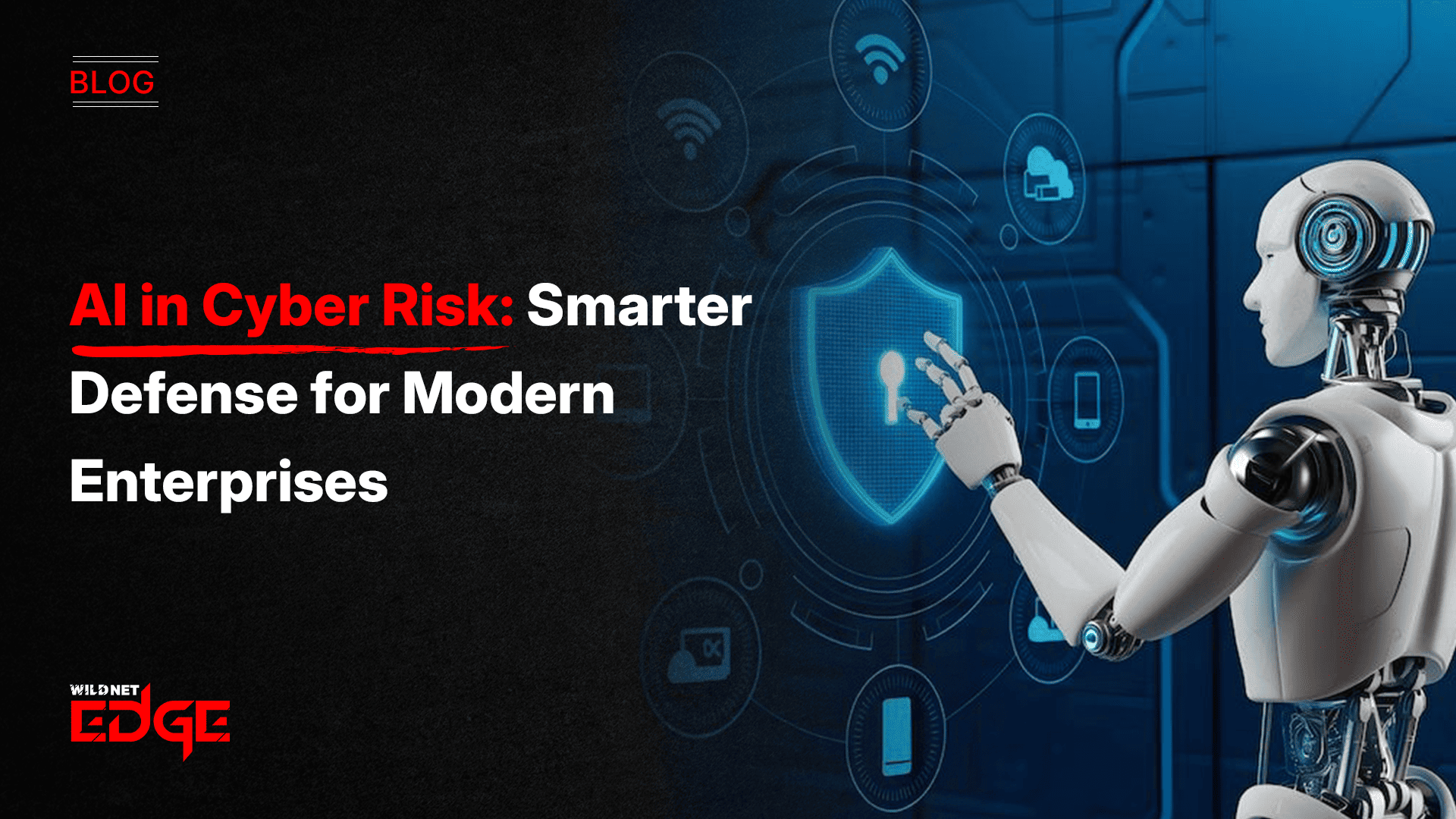
Cyber threats in 2026 move faster than human teams can react. AI in Cyber Risk helps enterprises predict attacks early, score risk in real time, and detect intrusions the moment they begin. By combining cyber threat prediction, AI risk scoring, attack detection AI, and security analytics, organizations shift from reactive defense to proactive protection. The result is fewer breaches, faster response, and clearer visibility of business risk.
Cybersecurity is no longer about keeping attackers out. It’s about responding faster than they can move.
Today’s attackers use automation, AI-generated malware, and ransomware kits that evolve in seconds. Manual monitoring and static rules cannot keep up. By the time a human reviews an alert, the damage may already be done. This is why AI in Cyber Risk has become essential.
AI doesn’t replace security teams. It gives them speed, context, and clarity. It filters noise, highlights real threats, and reacts instantly when something looks wrong. Instead of chasing alerts, teams focus on preventing impact.
The Evolution of Defense
To understand the future, we must look at the limitations of the past.
From Signatures to Behavior
The traditional antivirus programs examined the virus signatures and the fingerprints of the viruses that were already known. In the case of a new virus (Zero-Day), the software could not detect it. The pairing of AI with Cyber Risk frameworks has shifted our focus from the signature of the file to its behavior. It does not matter how the file appears; it is only concerned with the actions of the file. The AI cancels the calculator app immediately, no matter what its signature is, if it tries to encrypt the hard drive all of a sudden.
The Cognitive SOC
The modern Security Operations Center (SOC) is powered by algorithms. By utilizing advanced cybersecurity services, companies are building “Cognitive SOCs” where Tier-1 analysis is handled entirely by machines. This allows human analysts to focus on threat hunting and strategic defense rather than staring at logs.
Cyber Threat Prediction: Seeing Attacks Before They Hit
The best response is prevention.
Cyber threat prediction uses machine learning to analyze global threat intelligence, past incidents, and attacker behavior. It spots patterns that signal what’s coming next.
For example, if attackers begin testing a new exploit in one industry or region, AI can predict where it will spread next. Security teams can patch systems, tighten controls, or isolate exposure before the attack reaches them. This moves cybersecurity from reaction to anticipation.
AI Risk Scoring: Turning Security Into Measurable Data
Risk needs numbers, not opinions. AI risk scoring assigns live risk scores to users, devices, applications, and systems. These scores change in real time based on behavior, location, access level, and system health.
A senior executive logging in from a risky network raises the score instantly. The system responds by enforcing stronger authentication or limiting access. Critical systems automatically receive higher protection than low-impact assets. This makes AI in Cyber Risk practical for decision-making, not just detection.
Attack Detection AI: Speed Is the Difference
Once attackers get in, every second matters. Attack detection AI establishes a baseline of normal activity across the environment. When something breaks that baseline, the system reacts immediately.
Suspicious access, unusual data transfers, or abnormal system behavior trigger instant containment. Automated response tools can isolate devices, revoke credentials, or block traffic without waiting for human approval. This speed reduces damage, downtime, and recovery costs.
Security Analytics: Finding the Threats Humans Miss
Modern enterprises generate billions of events daily. Humans can’t analyze that volume.
Security analytics powered by AI connects signals across time and systems. It links events that seem harmless on their own but are dangerous together. A phishing email from months ago, followed by quiet data access today, may signal a long-running attack. AI surfaces these hidden patterns and gives teams a clear story instead of scattered alerts.
Enterprise Risk AI: Connecting Cyber Risk to Business Risk
Cyber risk is business risk. Enterprise risk AI brings security, operations, finance, and compliance into one view. It shows how a technical vulnerability could impact revenue, customer trust, or regulatory exposure.
This clarity helps leadership prioritize investment and act faster. Security stops being a cost center and becomes a risk management function that supports growth. Implementing these complex integrations often requires specialized risk management solutions.
The AI vs AI Reality
Attackers use AI too. They generate deepfake phishing messages, adaptive malware, and automated reconnaissance. Fighting this with manual tools is impossible.
Automation in Cyber Risk is not optional in this environment. Defense must match offense. Advanced systems also protect themselves by detecting attempts to poison training data or bypass detection models. This is now an arms race and automation decides the winner
Implementation: Building the Shield
How do you deploy this technology?
Data Hygiene First
AI needs clean data. Before buying tools, ensure your logs are centralized and normalized.
Start with High-Impact Use Cases
Focus on attack detection AI for endpoints or email filtering first. These areas generate the most noise and offer the quickest ROI.
Custom Model Development
While off-the-shelf tools are great, unique threats require unique solutions. Partnering with an AI development firm allows you to build custom threat models tailored to your specific industry and infrastructure.
Case Studies: Defense in Action
Real-world examples illustrate the power of automation in Cyber Risk.
Case Study 1: Banking Fraud Prevention
- The Challenge: A global bank was losing millions to sophisticated account takeover attacks that bypassed traditional rules.
- Our Solution: We implemented an AI in Cyber Risk platform focusing on behavioral biometrics. The AI analyzed mouse movements and typing cadence.
- The Result: The system detected bot attacks with 99% accuracy. Fraud losses dropped by 60%, and the bank reduced friction for legitimate users by removing unnecessary CAPTCHAs.
Case Study 2: Healthcare Ransomware Defense
- The Challenge: A hospital network needed to protect sensitive patient data from ransomware without slowing down medical staff.
- Our Solution: We deployed AI in Cyber Risk tools at the network edge. The system used security analytics to detect encryption behaviors.
- The Result: When a doctor clicked a phishing link, the AI isolated the device in 4 seconds, preventing the ransomware from spreading to the main servers and saving the hospital from a potential shutdown.
What’s Next: Self-Healing Security
The future of AI in Cyber Risk is autonomy. AI systems will soon patch vulnerabilities automatically, reconfigure defenses on the fly, and generate compliance reports in real time. Security will move from monitoring to self-correction. Organizations that adopt early gain resilience that others can’t match.
Conclusion
Cybersecurity has crossed a threshold. Humans alone can’t keep up. AI in Cyber Risk gives enterprises the ability to predict threats, measure exposure, and respond instantly. It replaces alert overload with clarity and panic with control.
In 2026, security isn’t about building higher walls. It’s about building smarter systems. Companies that embrace AI-driven cyber risk management won’t just survive attacks, they’ll operate with confidence while others react too late.
At Wildnet Edge, our security-first DNA ensures we build systems that are resilient by design. We partner with you to turn your cybersecurity into a competitive advantage, ensuring that your innovation is never slowed down by fear.
FAQs
No. AI in Cyber Risk is designed to augment humans, not replace them. It handles the repetitive Tier-1 analysis (sifting through logs), freeing up human analysts to focus on complex threat hunting, strategy, and decision-making during critical incidents.
It works by aggregating data from various sources network traffic, user behavior, device patch status and applying machine learning algorithms to calculate a probability of compromise. This score updates in real-time as conditions change.
Yes, this is known as adversarial AI. Attackers use AI to generate polymorphic malware or craft convincing phishing emails. This is why automation in Cyber Risk systems must be continuously retrained and updated to recognize these advanced attack vectors.
While the initial investment in AI in Cyber Risk tools can be higher than legacy software, the long-term ROI is significant. It reduces the cost of data breaches, lowers insurance premiums, and reduces the headcount needed for 24/7 monitoring.
Traditional detection relies on “signatures” (matching known bad files). Attack detection AI relies on “behavior” (identifying suspicious actions). AI can catch new, unknown threats (Zero-Day attacks) that traditional systems miss completely.
AI in Cyber Risk tools automates the data collection required for audits (GDPR, HIPAA, SOC2). They provide continuous monitoring evidence, ensuring that the organization is always audit-ready rather than scrambling once a year.
To be effective, AI in Cyber Risk models needs vast amounts of historical data—logs from firewalls, endpoints, emails, and cloud platforms. The more data the AI has, the more accurate its baseline of “normal” behavior becomes.

Managing Director (MD) Nitin Agarwal is a veteran in custom software development. He is fascinated by how software can turn ideas into real-world solutions. With extensive experience designing scalable and efficient systems, he focuses on creating software that delivers tangible results. Nitin enjoys exploring emerging technologies, taking on challenging projects, and mentoring teams to bring ideas to life. He believes that good software is not just about code; it’s about understanding problems and creating value for users. For him, great software combines thoughtful design, clever engineering, and a clear understanding of the problems it’s meant to solve.

 based on 1200+ reviews