 sales@wildnetedge.com
 +1 (212) 901 8616
 +1 (437) 225-7733
















































































































 ChatGPT Development & Enablement
  Hire AI & ChatGPT Experts
  ChatGPT Apps by Industry
  ChatGPT Blog
  ChatGPT Case study
  AI Development Services
  Industry AI Solutions
  AI Consulting & Research
  Automation & Intelligence





TL;DR
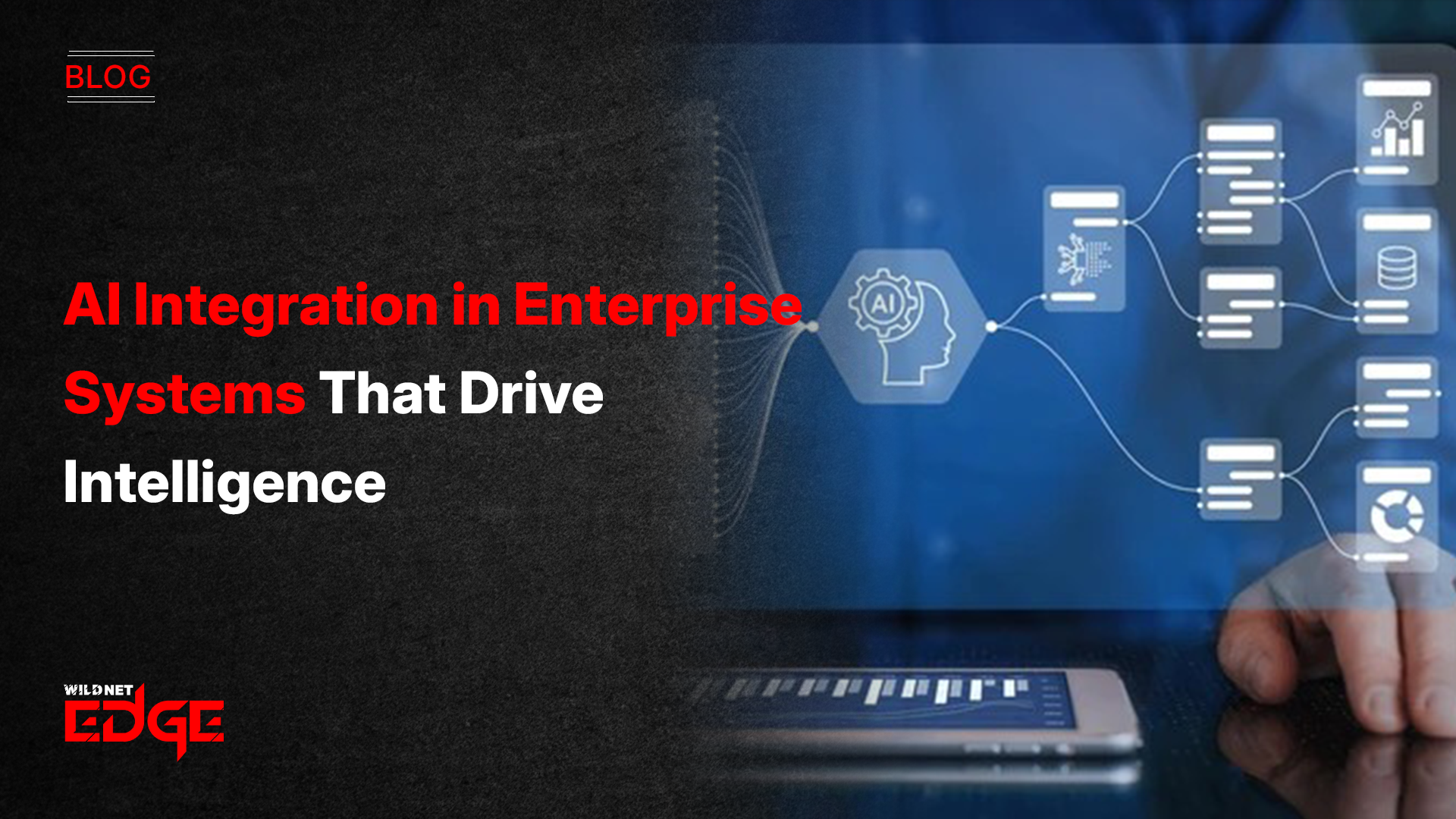
In 2026, enterprises can no longer rely on static systems and manual workflows. AI Integration in Enterprise Systems adds intelligence on top of existing software, allowing employees to interact with data using natural language. From ChatGPT use cases in HR and customer support to AI-driven workflows across finance and operations, businesses are using automation with AI to move faster and work smarter. This article explains how enterprises adopt AI safely, where it delivers the most value, and how intelligent enterprise systems are built in practice.
Most enterprises are not short on data. They are short on access.
Teams store information across CRMs, ERPs, ticketing tools, and document systems, yet employees still struggle to find simple answers. In 2026, this gap slows decision-making and frustrates teams.
AI Integration in Enterprise Systems closes that gap. Instead of clicking through dashboards or writing queries, employees can ask questions in plain language. “What were last quarter’s sales?” “Which customers are at risk?” “Summarize this contract.”
By adding a conversational layer through tools like ChatGPT, enterprises turn existing software into intelligent enterprise systems that support real work, in real time.
Revolutionizing Workflows with Generative AI
The biggest impact of AI Integration in Enterprise Systems is not automation alone it is accessibility. With conversational AI, knowledge is no longer locked behind tools or roles. Employees get answers instantly, without training or technical skill. This is the foundation of enterprise AI adoption.
AI-driven workflows also remove friction from daily operations:
- Invoices are read and entered automatically
- Reports are generated on demand
- Emails, summaries, and follow-ups are drafted instantly
This is automation with AI in its most practical form, quietly reducing effort while improving speed and accuracy.
Strategic Use Cases for ChatGPT
ChatGPT use cases go far beyond chat windows. When integrated correctly, they sit inside existing systems and workflows.
Common enterprise use cases include:
- HR teams answering policy questions and onboarding employees
- Customer service bots drafting accurate, empathetic responses
- Developers generating documentation and test cases
- Legal teams summarizing contracts and flagging risks
The key is context. When ChatGPT connects to internal data through secure retrieval layers, responses stay relevant and trustworthy. This is what turns generic models into true intelligent enterprise systems.
AI-Driven Workflows With Humans in Control
Successful AI Integration in Enterprise Systems does not remove people from the loop it supports them. Enterprises use a “human-in-the-loop” approach where AI suggests, drafts, or summarizes, and humans review or approve. This balance improves output quality while maintaining accountability.
AI-driven workflows also adapt over time. Systems learn from corrections, usage patterns, and feedback. The result is automation that improves continuously instead of breaking when processes change.
Security, Privacy, and Governance
Enterprise AI adoption requires discipline.
Data cannot be sent blindly to public models. AI Integration in Enterprise Systems must follow strict governance rules:
- Private model deployments
- Role-based access control
- Encrypted data pipelines
- Audit logs and confidence thresholds
Using retrieval-augmented generation (RAG), AI answers only from verified internal sources. This keeps responses accurate, compliant, and aligned with business rules.
To achieve this level of security, partnering with a specialized AI development company ensures that your integration complies with industry standards like SOC 2 and GDPR, protecting your intellectual property.
Case Studies: Integration Success Stories
Case Study 1: Legal Document Automation
- Challenge: A law firm spent thousands of hours manually reviewing contracts. They needed AI Integration in Enterprise Systems to speed up the discovery process.
- Our Solution: We integrated a fine-tuned LLM into their document management system. The AI highlighted risk clauses and summarized terms automatically.
- Result: Review time dropped by 70%. The AI Integration in Enterprise Systems allowed lawyers to focus on strategy rather than reading boilerplate text.
Case Study 2: Manufacturing Knowledge Base
- Challenge: A manufacturer struggled with knowledge loss when senior engineers retired. They needed enterprise software development to capture and serve this expertise.
- Our Solution: We built a chatbot using AI Integration in Enterprise Systems. It was trained on 20 years of maintenance logs and manuals.
- Result: Machine downtime decreased by 15%. Junior technicians used the AI Integration in Enterprise Systems to troubleshoot complex machinery instantly on the factory floor.
Our Technology Stack for AI Integration
We use enterprise-grade frameworks to build secure, intelligent connections.
- LLMs: OpenAI GPT-4, Azure OpenAI Service, LLaMA 3
- Orchestration: LangChain, Semantic Kernel
- Vector Databases: Pinecone, Weaviate, Chroma
- Backend: Python (FastAPI), Node.js
- Cloud: Azure AI Studio, AWS Bedrock
- Security: Private Endpoints, RBAC (Role-Based Access Control)
Conclusion
AI now functions as core infrastructure across the enterprise.
AI Integration in Enterprise Systems turns software from passive tools into active partners. Teams work faster. Decisions become sharper. Workflows adjust in real time as conditions change.
Enterprises that adopt early build durable advantages in speed, efficiency, and resilience. Those who wait struggle to keep up with rising operational and customer expectations. Integrating these capabilities with robust automation services ensures that your workflows are not just faster, but smarter
At Wildnet Edge, we design AI integrations that operate inside real enterprise systems and real constraints. Our engineering-first approach ensures your AI remains secure, scalable, and aligned with how your business actually runs.
FAQs
AI Integration involves embedding artificial intelligence technologies, such as machine learning and NLP, into existing business software (CRM, ERP) to automate tasks and generate insights.
Yes, but only if managed correctly. AI Integration in companies should use enterprise-grade APIs (like Azure OpenAI) that guarantee data privacy, ensuring your data is not used to train public models.
Common ChatGPT use cases within AI Integration include automated customer support, document summarization, code generation for developers, and personalized marketing content creation.
A basic AI Integration (like a chatbot) can be deployed in weeks, while deep integration with complex workflows and custom model fine-tuning may take several months.
No, AI Integration is designed to augment employees by handling repetitive tasks, allowing them to focus on higher-value strategic work.
A vector database is a key component of AI Integration in company systems; it stores data as mathematical vectors, allowing the AI to perform semantic searches and “remember” context from company documents.
Enterprises ensure accuracy in AI Integration by combining retrieval-augmented generation (RAG) with human-in-the-loop review. The AI is restricted to verified internal data sources, while confidence thresholds, audit logs, and human approval workflows prevent hallucinations and ensure reliable, compliant outputs.

Managing Director (MD) Nitin Agarwal is a veteran in custom software development. He is fascinated by how software can turn ideas into real-world solutions. With extensive experience designing scalable and efficient systems, he focuses on creating software that delivers tangible results. Nitin enjoys exploring emerging technologies, taking on challenging projects, and mentoring teams to bring ideas to life. He believes that good software is not just about code; it’s about understanding problems and creating value for users. For him, great software combines thoughtful design, clever engineering, and a clear understanding of the problems it’s meant to solve.

 based on 1200+ reviews



