 sales@wildnetedge.com
 +1 (212) 901 8616
 +1 (437) 225-7733
















































































































 ChatGPT Development & Enablement
  Hire AI & ChatGPT Experts
  ChatGPT Apps by Industry
  ChatGPT Blog
  ChatGPT Case study
  AI Development Services
  Industry AI Solutions
  AI Consulting & Research
  Automation & Intelligence





TL;DR
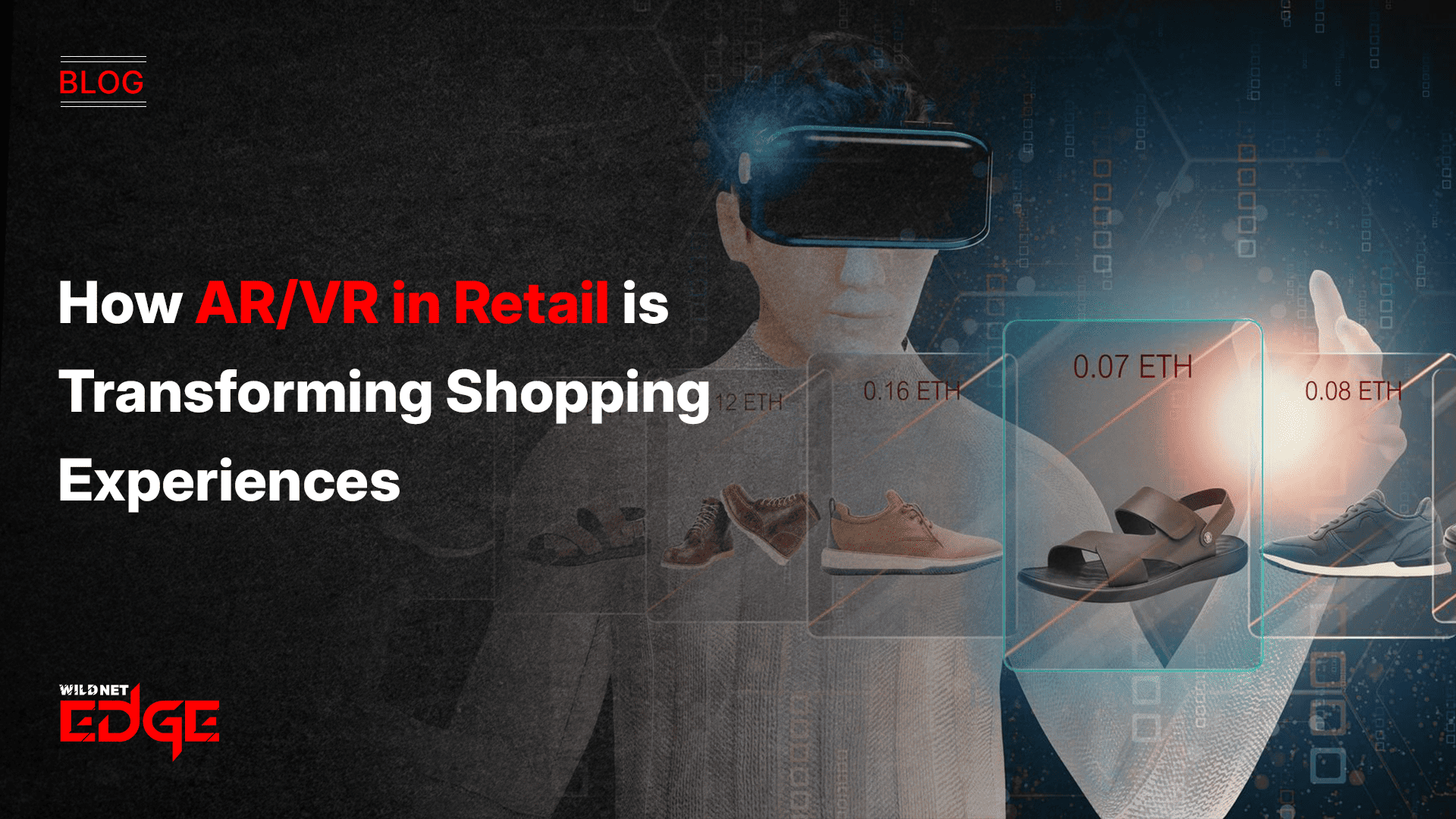
AR/VR in Retail is changing how customers discover, try, and buy products. Instead of static product photos, shoppers now interact with items using immersive retail tech like AR shopping apps, virtual try-on solutions, and fully immersive VR retail experiences. These technologies help customers make confident purchase decisions, reduce return rates, and spend more time engaging with brands. Looking ahead to 2026, experiential retail innovation will focus on spatial computing, WebAR, and AI-driven personalization, making shopping more interactive, visual, and customer-centric than ever before.
Retail today is no longer just about shelves, screens, or checkout counters. It is about experience.
AR/VR in Retail has become the bridge between physical and digital shopping. Customers want to see how a product fits, how it looks in their space, or how it feels before buying, especially online. Augmented Reality (AR) and Virtual Reality (VR) make that possible.
From virtual try-on solutions for beauty and fashion to VR retail experiences that recreate entire stores digitally, immersive technology is helping brands reduce uncertainty and build stronger customer confidence. Retailers that adopt these tools are not just upgrading technology; they are reshaping how customers connect with products.
The Strategic Shift: From Transaction to Interaction
The classic retail method was a transaction one: a customer spotted a product and made the purchase. Augmented and Virtual Reality in Retail changes this to an engaging model: a customer saw a product, used it, altered it to his/her taste, and then made the purchase. Customers are given the opportunity to experience the product in their environment through immersive retail technology before deciding to buy it, thus the interaction model is substituting the transaction model.
Reducing Returns with Visualization
Returns are one of the biggest challenges in eCommerce, often reaching 30% or more. Virtual try-on solutions directly address this issue.
By allowing customers to:
- Try makeup tones on their face
- See the furniture inside their home
- Check how glasses or shoes fit
Retailers remove guesswork from the buying process. Studies consistently show that AR-powered visualization can reduce returns by up to 40%, improving profitability and sustainability.
Enhancing Engagement Time
The duration of a user’s visit to a website is the key measure of a site’s value in an attention economy. Many retailers have adopted augmented reality (AR) shopping apps as one of their most powerful weapons to win customer loyalty by providing a playful shopping experience. The time spent by the shoppers on the websites goes up as a result of the implemented strategies. Gamified hunting in a retail space or 3D models that can be manipulated in a product page are some of the methods that are used to tempt customers and make sales more likely.
Partnering with a specialized AR/VR development company is often the first step for brands looking to build these custom, high-fidelity experiences that align with their brand identity.
AR in Action: The “Try-Before-You-Buy” Revolution
Augmented Reality (AR) is a technology that superimposes digital data on the real world, thus making it a very effective tool for “try-before-you-buy” situations.
- Virtual Try-On Solutions: The leading cosmetic companies like Sephora and L’Oréal have developed AR mirrors that allow customers to try out as many as hundreds of different shades of makeup in a matter of seconds without the fear of hygienic issues.
- Spatial Visualization: The leading furniture manufacturer IKEA makes it possible for users to position life-like 3D models of their expected furniture inside the house just by using the camera of their smartphone.
- Interactive Packaging: The AR/VR in retail is used increasingly in order to enhance product packaging. When a wine label is scanned, it may tell the story of the vineyard, thus providing a more engaging experience compared to the static text.
VR Retail Experiences: Immersion Beyond the Screen
While AR enhances the real world, VR retail experiences transport the user to a completely new one. This aspect of the technology allows for total immersion.
- Virtual Showrooms: Beauty and fashion brands use AR mirrors to let users try hundreds of looks without touching a product. This builds confidence and shortens decision cycles.
- Training and Simulation: Walmart uses VR to train employees on how to handle Black Friday crowds or manage produce sections, ensuring operational excellence without disrupting the shop floor, a key internal benefit of AR/VR in Retail.
- Virtual Fashion Shows: Scanning product packaging can unlock videos, tutorials, or brand stories, adding context and emotional value to purchases.
To implement these complex environments effectively, retailers often rely on robust ecommerce development services to integrate VR platforms seamlessly with inventory and checkout systems.
Experiential Retail Innovation: The 2026 Outlook
As we look toward 2026, experiential retail innovation within the immersive tech sector is set to become even more sophisticated.
- Spatial Computing: With devices like the Apple Vision Pro, shopping will become a spatial activity. Users will “pull” products out of a screen and inspect them in 3D space.
- WebAR: The friction of downloading an app is disappearing. WebAR allows AR shopping apps to run directly in a mobile browser, making immersive commerce accessible to anyone with a link.
- AI-Driven Personalization: AI will generate custom AR experiences on the fly. Imagine a virtual mannequin that doesn’t just look like you, but suggests outfits based on your calendar and local weather.
Case Studies: Immersive Success Stories
Case Study 1: Luxury Watch Retailer
- The Challenge: High-end watches are difficult to sell online because customers want to gauge the fit and finish on their wrist.
- Our Solution: We developed a markerless AR/VR in Retail experience. Users could point their camera at their wrist to see a hyper-realistic, light-reactive 3D model of the watch.
- The Result: The conversion rate for users who engaged with the feature increased by 40%, and the brand saw a significant reduction in “bracketing” (buying multiple sizes to return ones that don’t fit).
Case Study 2: Big Box Retail Navigation
- The Challenge: Customers were frustrated by the inability to find products in massive warehouse-style stores.
- Our Solution: We implemented an in-store AR/VR in retail experience powered by augmented reality technology. Users typed in a product, and an AR arrow on their phone screen guided them through the aisles directly to the item.
- The Result: Customer satisfaction scores rose by 15%, and the app collected valuable data on foot traffic patterns for store optimization.
Tech Stack for Immersive Retail
We leverage industry-leading tools to build these experiences.
- AR Platforms: ARKit (Apple), ARCore (Google), 8th Wall (WebAR).
- 3D Engines: Unity, Unreal Engine.
- Modeling: Blender, Maya, Adobe Substance 3D.
- Hardware: Meta Quest 3, Apple Vision Pro, Mobile Devices (LiDAR enabled).
Conclusion
AR/VR in Retail is no longer about experimentation it is about expectation. Customers now demand immersive, visual, and confident buying experiences. With immersive retail tech, virtual try-on solutions, and VR retail experiences, brands can create stronger engagement, reduce operational costs, and stand out in crowded markets. As experiential retail innovation continues to evolve, retailers who act early will lead the future of shopping, not follow it.
If you are looking for a company that gives you a faster solution, then you can partner with Wildnet Edge. Our AI-first approach enhances our retail tech solutions, ensuring that your immersive experiences are data-driven, scalable, and future-proof. We help you navigate the complexities of immersive commerce to build environments that truly convert.
FAQs
Costs vary widely. A simple AR/VR in retail product viewer is affordable for small businesses, while a fully immersive VR showroom or a custom app requiring high-fidelity 3D modelling is an enterprise-level investment.
No. Most retail AR experiences are designed for smartphones. You view the AR overlay through your phone’s camera. Headsets are typically reserved for full VR retail experiences.
Computer vision and AI identify special features (for instance, lips for lipstick or feet for shoes) on the user’s face or body and at the same time, attach a digital 3D figure to those features via real-time. This is an essential part of today’s interactive approaches.
Absolutely. These technologies are also applied behind the scenes for planogram compliance (making certain that the shelves are filled correctly) and for picking in the warehouse, where workers are led quickly and accurately to the required products.
AR adds digital elements to the real world (e.g., trying on glasses via a phone screen). VR creates a completely digital environment (e.g., walking through a virtual store using a headset).
No. The AR/VR in Retail innovation predicts that these technologies will not completely eliminate the physical stores but rather enhance them to be more interactive and full of data.
The most high-visual-impact products, such as furniture, cosmetics, eyewear, footwear, and luxury goods, get the maximum benefit as showing the product is an essential part of the customer’s decision-making process.

Managing Director (MD) Nitin Agarwal is a veteran in custom software development. He is fascinated by how software can turn ideas into real-world solutions. With extensive experience designing scalable and efficient systems, he focuses on creating software that delivers tangible results. Nitin enjoys exploring emerging technologies, taking on challenging projects, and mentoring teams to bring ideas to life. He believes that good software is not just about code; it’s about understanding problems and creating value for users. For him, great software combines thoughtful design, clever engineering, and a clear understanding of the problems it’s meant to solve.


 based on 1200+ reviews



