 sales@wildnetedge.com
 +1 (212) 901 8616
 +1 (437) 225-7733
















































































































 ChatGPT Development & Enablement
  Hire AI & ChatGPT Experts
  ChatGPT Apps by Industry
  ChatGPT Blog
  ChatGPT Case study
  AI Development Services
  Industry AI Solutions
  AI Consulting & Research
  Automation & Intelligence



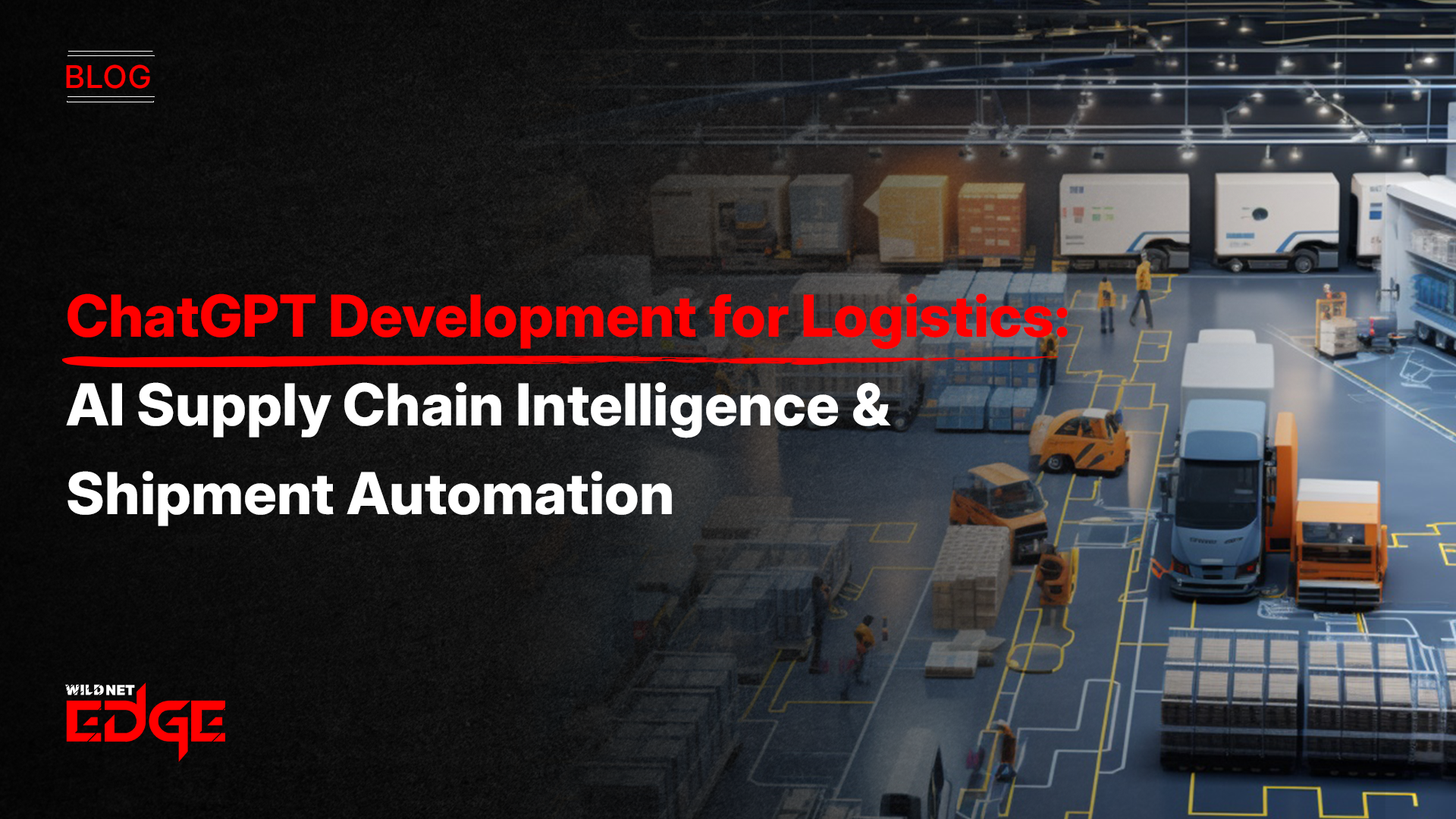


Key Takeaways
- ChatGPT development for logistics now powers predictive supply chain agents, not just support bots.
- AI logistics automation resolves exceptions automatically, reducing manual workload by up to 60%.
- A shipment tracking AI chatbot improves customer experience by sharing updates before users ask.
- A modern logistics AI assistant acts as a natural-language interface for TMS and WMS systems.
Logistics has become one of the most complex industries to operate in. Shipping volumes are rising, customer expectations are unforgiving, and disruptions from weather to geopolitics are constant. In this environment, manual coordination and static dashboards slow teams down.
This is where ChatGPT development for logistics changes the game.
Instead of reacting to problems after they happen, logistics teams can now predict delays, automate communication, and make faster decisions using AI-powered systems. ChatGPT is no longer just a chatbot; it acts as an intelligent layer that connects data, systems, and people across the supply chain.
This blog explains how logistics optimization enables shipment automation, improves visibility, and builds smarter, more resilient supply chains using AI logistics automation.
What Is ChatGPT Development for Logistics?
ChatGPT development for logistics refers to building AI-powered assistants that understand supply chain data, automate workflows, and respond to real-time events using natural language. These systems connect with TMS, WMS, ERP, and carrier platforms to turn complex logistics operations into simple conversations.
Industry data shows that logistics companies using conversational AI reduce customer inquiry handling time by 40–60% and cut manual coordination work by 30–50%. AI-driven shipment visibility also improves on-time delivery performance by up to 20%, especially in last-mile operations.
Core ChatGPT Development Services in Logistics
Modern ChatGPT Development Services for logistics focus on reducing manual work, improving visibility, and enabling faster decision-making across the supply chain. These AI-powered systems integrate directly with existing logistics platforms to support both customers and internal teams.
Shipment Tracking AI Chatbot
A shipment tracking AI chatbot handles customer queries across web chat, WhatsApp, SMS, and email. It provides real-time shipment status, estimated delivery times, delay notifications, and rescheduling options. Answering “Where is my order?” questions instantly reduce call center volume and improve customer satisfaction.
Supply Chain AI Chatbot
An AI Logistics Agent supports internal teams by turning complex logistics data into clear insights. Planners can ask questions like “Which suppliers are delayed this week?” or “How will port congestion impact inventory?” The chatbot pulls data from multiple systems, helping teams forecast demand, manage procurement, and respond to risks faster.
Logistics AI Assistant
A Virtual Assistant in Logistics automates operational workflows that typically consume hours of manual effort. It processes invoices and bills of lading, validates carrier charges, coordinates with transport partners, and updates TMS and WMS systems automatically. This allows operations teams to focus on exceptions instead of routine tasks.
Use Cases of AI Logistics Automation with ChatGPT
Smart Logistics powered by ChatGPT now plays a central role across planning, operations, warehousing, and fleet management, reducing manual work and improving decision speed.
Logistics Chatbot for Customer Experience
A Logistics Chatbot significantly reduces customer support load, often by up to 70%, by answering shipment-related queries instantly. It integrates with carrier APIs such as FedEx, UPS, and DHL to provide real-time location updates, ETAs, delay alerts, and delivery confirmations directly within the chat interface.
Beyond basic tracking, the chatbot proactively notifies customers about delays, offers rescheduling options, and shares proof-of-delivery updates. This improves transparency and builds trust without human intervention.
Supply Chain AI Chatbot for Operations & Planning Teams
For internal teams, an AI Logistics Agent acts as a natural-language interface to complex logistics data. Planners and managers can ask questions like:
- “Which shipments are delayed at the Port of LA?”
- “Estimate detention and demurrage costs for this week.”
- “Which suppliers are missing delivery SLAs?
Logistics AI Assistant for Internal Workflows & Documentation
A logistics AI assistant automates repetitive, high-effort operational tasks. It can generate customs documentation, validate carrier invoices against agreed rates, process Bills of Lading, and schedule dock appointments automatically.
By handling these routine workflows, the assistant reduces errors, speeds up processing time, and allows operations teams to focus on exceptions and optimization instead of paperwork.
Warehouse & Fleet Management Automation
ChatGPT development for logistics extends directly to on-ground operations. Warehouse managers use voice-enabled assistants to check inventory levels, locate pallets, or confirm inbound shipments without stopping work.
Fleet managers can query driver logs, vehicle performance, fuel efficiency, and route compliance using natural language. This improves visibility across warehouses and fleets while reducing dependency on dashboards.
Procurement & Carrier Communication Automation
ChatGPT can automate communication with carriers and vendors by drafting emails, responding to rate inquiries, and tracking confirmations. It ensures consistent messaging and faster turnaround during peak logistics periods. This use case is especially valuable for freight brokers and large-scale shippers managing hundreds of daily interactions.
Key Challenges in Logistics That AI Can Solve
Logistics operations face constant pressure from customers, partners, and unpredictable external factors. Manual processes struggle to keep up with this complexity. ChatGPT development for logistics helps companies address these challenges by turning data into real-time, actionable intelligence.
Shipment Visibility & Customer Communication
Customers expect real-time updates, not delayed email replies. One of the biggest challenges in logistics is the overwhelming volume of “Where is my order?” inquiries. Handling these manually increases costs and slows response times.
A shipment tracking AI chatbot solves this by providing instant updates across WhatsApp, email, SMS, and web chat 24/7. It proactively notifies customers about delays, delivery windows, and rescheduling options, reducing support workload while improving the last-mile experience.
Operational Inefficiencies & Manual Coordination
Logistics workflows rely heavily on unstructured data, such as emails, PDFs, spreadsheets, and phone calls between shippers, carriers, brokers, and warehouses. Manually coordinating these touchpoints leads to delays and errors.
Smart Logistics can read and interpret emails, extract critical details like Bill of Lading (BOL) numbers, shipment IDs, and delivery dates, and automatically update TMS and WMS systems. This reduces manual data entry, speeds up operations, and ensures information stays accurate across platforms.
Demand Forecasting & Supply Chain Risks
Demand forecasting becomes unreliable when data is fragmented across systems and regions. Sudden disruptions, such as weather events, port congestion, labour strikes, or geopolitical issues, can derail supply chains with little warning.
Logistics optimization helps by combining historical shipment data, market trends, carrier performance, and external data sources such as news and weather feeds. The AI flags potential risks early, allowing teams to reroute shipments, adjust inventory, or renegotiate capacity before disruptions escalate.
ChatGPT Development Cost & Complexity in Logistics
ChatGPT development for logistics involves higher complexity and cost compared to many other industries. This is not due to the AI model itself, but because logistics operations are highly interconnected, time-sensitive, and dependent on legacy systems.
ChatGPT Development Cost in Logistics
Costs vary based on integration depth, automation level, and scale:
- Basic Logistics Chatbot: $20,000–$40,000
(Customer-facing tracking, carrier API integration, limited workflows) - Internal Virtual Assistant in Logistics: $40,000–$80,000
(Document processing, TMS/WMS integration, internal operations support) - Advanced Smart Logistics platform: $80,000–$150,000+
(Predictive analytics, IoT integration, exception handling, multi-channel deployment)
Ongoing costs include model hosting, monitoring, security updates, and continuous optimization as workflows evolve.
Why ChatGPT Development in Logistics Is Complex
ChatGPT development in logistics is complex because it must operate across fragmented systems, real-time events, and highly specialized workflows where accuracy, timing, and integration are critical to daily operations.
- Multiple stakeholders involved: Shippers, carriers, brokers, warehouses, and consignees all interact with the system. The AI must understand and coordinate across these roles without breaking workflows.
- Legacy EDI and system integrations: Many logistics companies still rely on EDI, custom TMS, and older ERP systems. Integrating ChatGPT with these platforms requires additional engineering, data mapping, and testing.
- Unstructured and fragmented data: Critical information lives in emails, PDFs, invoices, and spreadsheets. The AI must extract, normalize, and reconcile this data in real time.
- Highly specialized logistics terminology: Concepts like Pro Numbers, Bills of Lading (BOL), detention, demurrage, and drayage require domain training. A generalist AI or developer often misinterprets these terms.
How to Choose the Right ChatGPT Development Partner for Logistics
Choosing the right partner is critical for successful ChatGPT development for logistics. The wrong team may build a working chatbot, but only the right partner can build an AI system that understands real logistics workflows, integrates deeply, and scales with your operations.
When evaluating a ChatGPT development partner, focus on the following:
- Proven logistics domain expertise: The partner should understand logistics terminology, workflows, and challenges such as TMS, WMS, BOLs, detention, and carrier coordination.
- Strong integration capabilities: Look for experience integrating AI with ERP, TMS, WMS, EDI systems, carrier APIs, and IoT data sources.
- Security and compliance readiness: The partner should follow best practices for data encryption, access control, and regulatory compliance across regions.
- Ongoing support and optimization: ChatGPT systems improve over time. Choose a partner that offers continuous monitoring, updates, and model optimization.
Future of Smart Logistics
The future of logistics is autonomous, predictive, and conversational. ChatGPT development for logistics is moving beyond support automation into full operational intelligence, where AI systems plan, decide, and act in real time across the supply chain.
Industry studies show that by 2026, over 60% of global logistics providers will rely on AI-driven automation for shipment planning, exception handling, and customer communication. Companies already using advanced AI report 20–30% faster delivery cycles and up to 40% lower operational overhead compared to manual-heavy workflows.
In the coming years, AI logistics systems will negotiate carrier rates, reroute shipments during disruptions, and resolve delays without human involvement. Voice-enabled Virtual Assistant in Logistics will become the standard interface for warehouse staff and drivers, replacing dashboards and spreadsheets.
Case Studies
Case Study 1: The Automated Freight Broker
- Challenge: A freight brokerage was overwhelmed by thousands of “quote request” emails daily, leading to slow response times and lost business.
- Solution: We used ChatGPT Development Services to build an email parsing bot. The AI read incoming emails, extracted origin/destination/weight, checked real-time rates in the TMS, and drafted a quote reply.
- Result: Response time dropped from 4 hours to 2 minutes, and conversion rates increased by 22%.
Case Study 2: The Last-Mile Visibility Fix
- Challenge: A courier company faced high call volumes regarding delivery status (“WISMO” calls).
- Solution: We deployed a Logistics Chatbot on WhatsApp. It proactively notified customers of delivery windows and allowed them to reschedule via chat.
- Result: Call center volume decreased by 45%, and customer satisfaction scores (CSAT) rose by 15 points.
Conclusion
Modern logistics is driven as much by data as by physical movement. ChatGPT development for logistics transforms scattered information across systems, emails, and documents into real-time intelligence that teams can act on instantly. From a supply chain AI chatbot that supports planners to a Logistics Chatbot that keeps customers informed, the results are clear: faster decisions and lower operational effort.
At Wildnet Edge, we take an AI-first approach to logistics optimization. We help companies hire ChatGPT developers who understand logistics workflows at the ground level and build AI systems designed for real-world complexity, scale, and continuous optimization.ai automation business use cases
FAQs
It allows customers to ask natural questions like “Where is my package?” and get instant, accurate answers drawn directly from real-time carrier data, bypassing static tracking pages.
Yes. By analyzing weather patterns, port congestion data, and historical carrier performance, the chatbot can predict potential delays and suggest alternative routes.
The cost depends on integration depth and automation level. A basic Logistics Chatbot typically costs $20,000–$40,000. A more advanced Virtual Assistant in Logistics integrated with TMS and WMS systems usually ranges from $50,000–$100,000+.
Yes. Smart Logistics is secure when built with encryption, role-based access, secure APIs, and compliance controls, ensuring sensitive shipment and customer data remain protected at all times.
Logistics requires specific domain knowledge. Specialized developers ensure your AI understands industry terminology and workflows, preventing costly misunderstandings.
Absolutely. AI is excellent at extracting data from unstructured documents like Invoices, Bills of Lading, and Customs Forms, automating manual data entry.
A basic version can be deployed in 4-6 weeks using our structured logistics optimization framework, with deeper integrations added in subsequent sprints.

Managing Director (MD) Nitin Agarwal is a veteran in custom software development. He is fascinated by how software can turn ideas into real-world solutions. With extensive experience designing scalable and efficient systems, he focuses on creating software that delivers tangible results. Nitin enjoys exploring emerging technologies, taking on challenging projects, and mentoring teams to bring ideas to life. He believes that good software is not just about code; it’s about understanding problems and creating value for users. For him, great software combines thoughtful design, clever engineering, and a clear understanding of the problems it’s meant to solve.

 based on 1200+ reviews



