 sales@wildnetedge.com
 +1 (212) 901 8616
 +1 (437) 225-7733
















































































































 ChatGPT Development & Enablement
  Hire AI & ChatGPT Experts
  ChatGPT Apps by Industry
  ChatGPT Blog
  ChatGPT Case study
  AI Development Services
  Industry AI Solutions
  AI Consulting & Research
  Automation & Intelligence



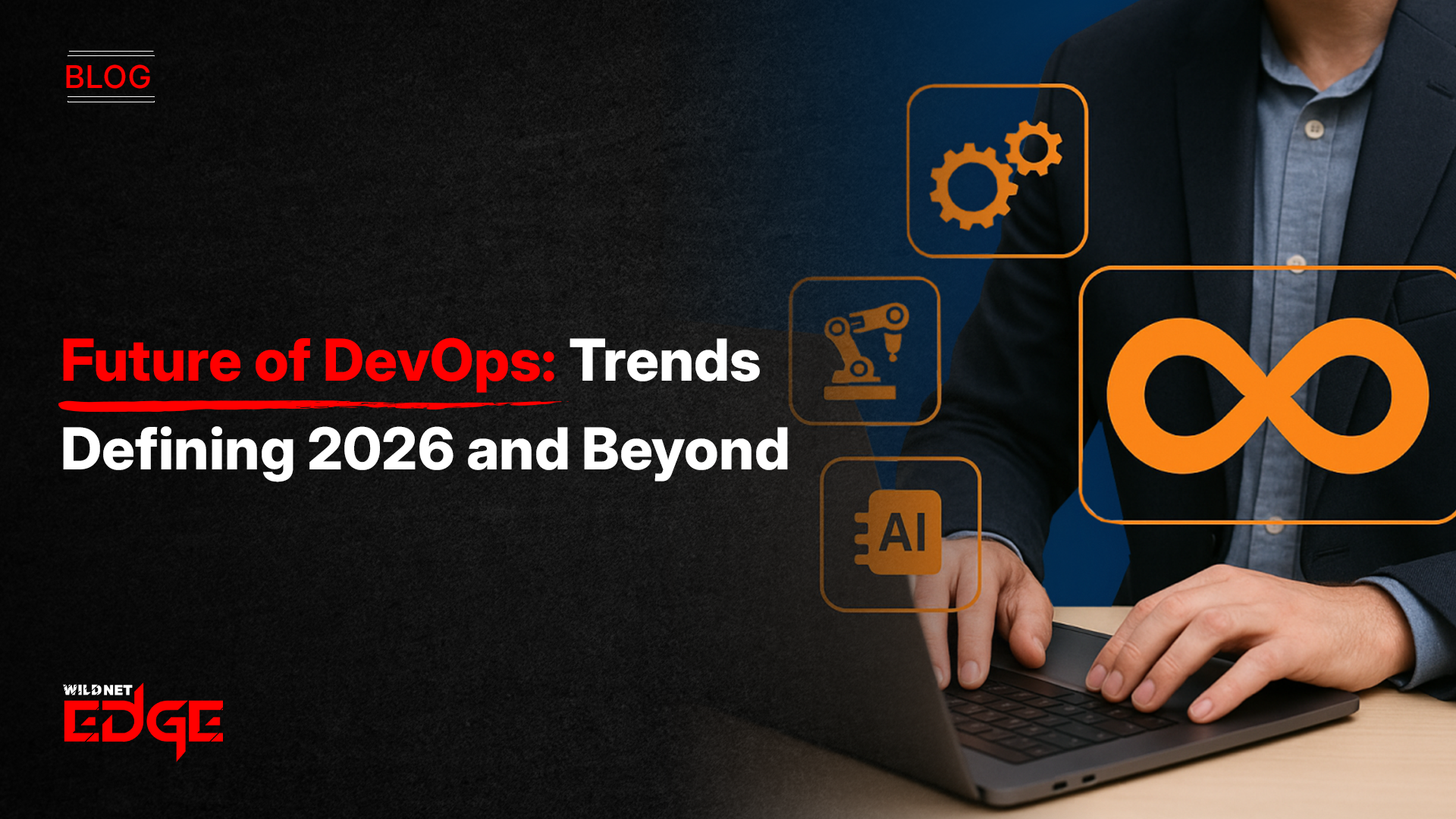


Key Takeaways
- The future of DevOps is driven by Agentic AI, where systems fix issues, optimize performance, and apply patches on their own.
- Platform engineering trends are changing DevOps from ticket-based support to self-service Internal Developer Platforms (IDPs).
- DevOps evolution is moving toward serverless and NoOps-style workflows, reducing infrastructure management overhead.
- Cloud native DevOps trends like WebAssembly and Edge Computing are reshaping how distributed systems run.
The future of DevOps has always been about one goal: removing friction from software delivery.
First, teams removed silos between development and operations. Then they automated builds, testing, and deployments. Today, that automation is no longer enough.
As we move toward 2026, DevOps is entering a new phase. Scripts are giving way to intelligence. Manual monitoring is being replaced by AI-driven systems that detect, decide, and act on their own.
For engineering leaders, this shift is critical. DevOps evolution is no longer just about faster releases; it’s about resilience, cost control, security, and scale. Teams that fail to adapt will struggle to keep systems stable, secure, and competitive.
This guide explains the most important DevOps trends 2026, including AI in DevOps, serverless DevOps, platform engineering trends, and the growing role of automation in DevOps.
The Future of DevOps: Top Trends to Watch
The future of DevOps is moving fast and in clear directions. As software systems grow more complex and release cycles get shorter, DevOps practices are evolving to keep up. Teams are no longer focused only on faster deployments; they are rethinking how software is built, released, secured, and operated at scale.
Trend 1: From Automation to Agentic AI
The biggest change shaping the future of DevOps is the rise of Agentic AI. Traditional automation follows predefined rules. Agentic systems go further; they understand context and take action without waiting for human input.
What this looks like in practice:
- Self-healing infrastructure: When a service fails, AI detects the issue, replaces the resource, and fixes the root cause automatically.
- Predictive scaling: Instead of reacting to traffic spikes, AI in DevOps forecasts demand using business data and scales systems in advance.
This level of automation in a DevOps services company drastically reduces downtime and frees engineers from constant firefighting.
Trend 2: Platform Engineering Becomes the Default
The future of DevOps is no longer “you build it, you run it.”
It’s “you build it, the platform runs it.” Platform engineering trends focus on creating Internal Developer Platforms (IDPs) that let developers self-serve infrastructure safely and quickly.
Why this matters:
- Developers provision environments, databases, and pipelines without raising tickets
- Ops teams focus on building platforms, not responding to requests
- DevOps becomes a product, measured by developer experience (DevEx)
This shift is a major step in DevOps evolution, especially for large teams managing complex systems.
Trend 3: Serverless DevOps and the NoOps Shift
As infrastructure becomes more abstract, serverless DevOps is gaining momentum.
With serverless:
- Teams deploy functions instead of managing servers
- Scaling, availability, and patching happen automatically
- Operational effort drops dramatically
At the same time, cloud native DevOps trends point to WebAssembly (Wasm) as the next runtime. Wasm enables lightweight, portable workloads that run across cloud, edge, and browser environments. Together, these technologies push DevOps closer to a NoOps experience, especially for developers.
Trend 4: DevSecOps Is No Longer Optional
In the DevSecOps future, security is built into every stage of delivery.
Instead of manual checks:
- Policies run as code inside CI/CD pipelines
- Insecure configurations never reach production
- AI scans code and dependencies and suggests fixes automatically
This approach ensures that security keeps pace with speed without slowing teams down.
Trend 5: FinOps and GreenOps Enter Core DevOps
The combination of increasing cloud expenses and sustainability objectives now serves as the driving force behind upcoming changes in DevOps operations.
The upcoming DevOps 2026 trends will feature three trends, which include
- FinOps: Engineers see real-time cost impact before deploying services.
- GreenOps: Workloads run where energy is cheapest and cleanest.
Cost and carbon awareness are becoming part of everyday DevOps decisions, not afterthoughts.
Case Studies
Case Study 1: The AI-Driven Healing
- Challenge: A fintech unicorn struggled with downtime during high-frequency trading hours. They needed to embrace the future of DevOps to survive.
- Solution: We implemented AI in DevOps using autonomous agents. The agents were trained to recognize memory leaks and restart pods preemptively.
- Result: The system achieved 99.999% uptime. The future DevOps technologies we deployed reduced their operational toil by 70%.
Case Study 2: The Platform Engineering Shift
- Challenge: An enterprise retailer had 50 different ways of deploying code. They needed to standardize their processes for the future of DevOps.
- Solution: We built an Internal Developer Platform (IDP), a key component of platform engineering trends. Developers could now spin up compliant environments in minutes.
- Result: “Time-to-Market” for new features dropped from 3 weeks to 2 days, proving the value of this strategic shift.
Conclusion
The future of DevOps is becoming smarter, more automated, and platform-driven. Infrastructure is fading into the background, security is built in by default, and AI is starting to work alongside teams as a core part of daily operations. DevOps is no longer just about faster releases; it’s about building systems that can scale, adapt, and protect themselves.
Organizations that will succeed in 2026 are those that embrace DevOps evolution early. They invest in AI in DevOps and automation in DevOps to reduce manual work, adopt serverless DevOps and platform engineering to simplify operations, and hire DevOps developers with modern, AI-ready skills.
Wildnet Edge’s AI-first approach helps businesses lead this shift. Whether you want to hire DevOps developers or partner with a trusted DevOps services company, we help you build reliable, future-ready systems that are designed for what comes next.
FAQs
The 2026 landscape shows three main elements, which include Agentic AI and self-healing systems, together with the development of Platform Engineering that enables users to access automated infrastructure through self-service.
The future of Development and Operations will shift towards strategic architecture development because AI in DevOps will handle incident response automation, real-time cloud cost optimization, and infrastructure code generation.
The main trends involve increasing use of Internal Developer Platforms (IDPs) combined with advancing serverless development operations and integration of FinOps cost management and Web Assembly implementation in cloud native development operations.
The field of Development and Operations will find its future path through “NoOps” for developers, yet operations work will always exist. Developers will use advanced systems that hide all details about servers and clusters from them.
Platform engineering trends are central to the future of Development and Operations. It shifts the focus from managing tickets to building internal products (platforms) that enable developers to be self-sufficient.
To succeed in this new era, you need engineers who can build and manage AI agents. Traditional scripting skills are no longer enough for next-generation DevOps environments.
A DevOps services company stays ahead of future DevOps technologies. They can help you implement complex architectures like Service Mesh and AI-driven monitoring without the learning curve, accelerating your DevOps evolution.

Managing Director (MD) Nitin Agarwal is a veteran in custom software development. He is fascinated by how software can turn ideas into real-world solutions. With extensive experience designing scalable and efficient systems, he focuses on creating software that delivers tangible results. Nitin enjoys exploring emerging technologies, taking on challenging projects, and mentoring teams to bring ideas to life. He believes that good software is not just about code; it’s about understanding problems and creating value for users. For him, great software combines thoughtful design, clever engineering, and a clear understanding of the problems it’s meant to solve.

 based on 1200+ reviews



