sales@wildnetedge.com
 +1 (212) 901 8616
 +1 (437) 225-7733
















































































































 ChatGPT Development & Enablement
  Hire AI & ChatGPT Experts
  ChatGPT Apps by Industry
  ChatGPT Blog
  ChatGPT Case study
  AI Development Services
  Industry AI Solutions
  AI Consulting & Research
  Automation & Intelligence





TL;DR
AI in Logistics is transforming warehouses and supply chains into intelligent, self-optimizing systems. Warehouse AI improves picking accuracy and speed, inventory prediction AI prevents stockouts, and logistics automation reduces last-mile costs. With smart warehousing and supply chain optimization, businesses move from reacting to disruptions to predicting and preventing them.
Logistics used to be about moving goods from point A to point B. Today, it is about timing, precision, and foresight. AI in Logistics has become the backbone of modern operations as customer expectations push delivery windows from days to hours.
Businesses that still rely on manual planning struggle with delays, excess inventory, and rising costs. Those using AI in Logistics operate differently. They predict demand, rebalance inventory automatically, and reroute shipments before problems surface. This shift turns logistics from a cost center into a competitive advantage.
The Brain of the Warehouse: Warehouse AI
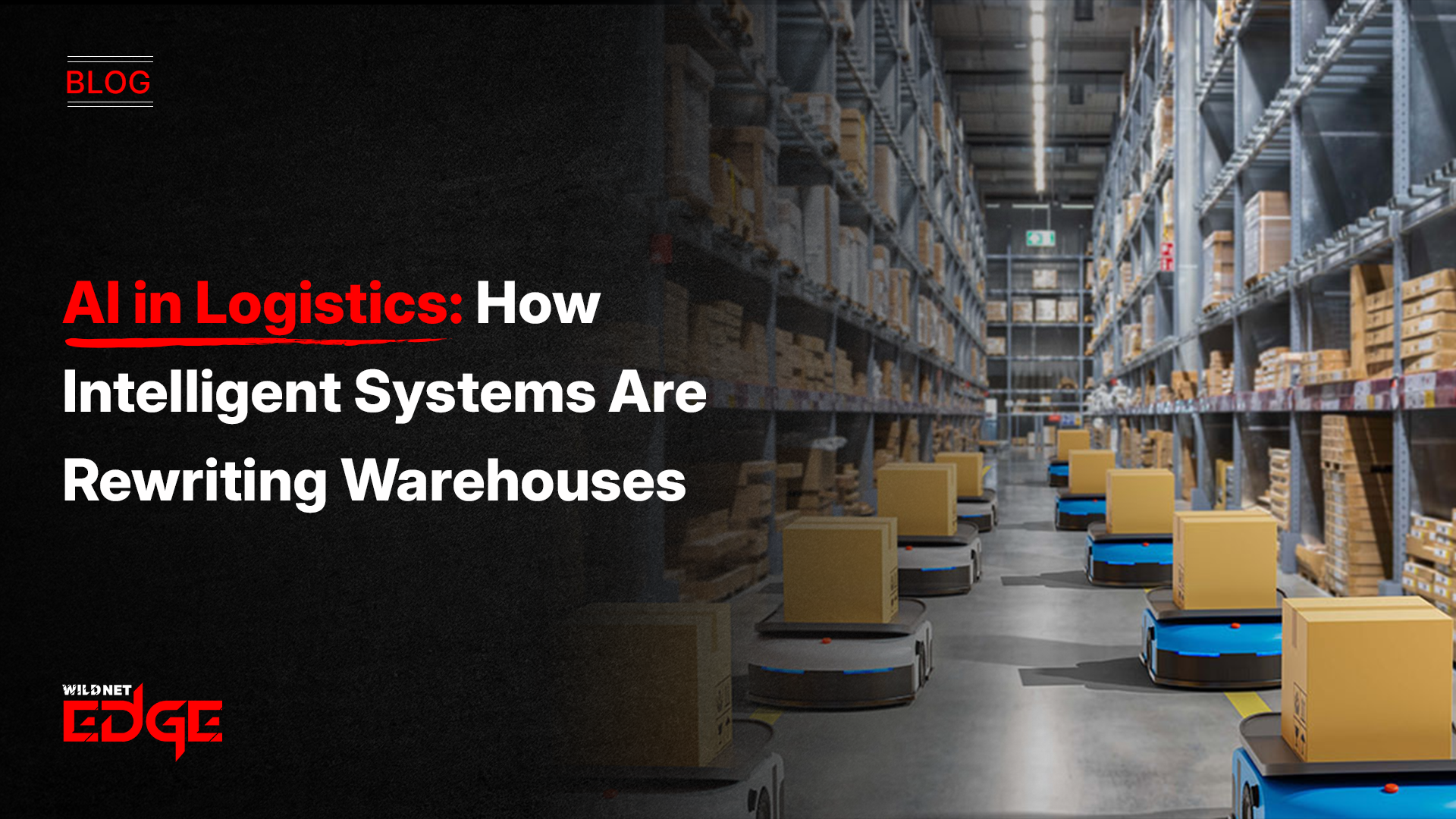
Warehouses are no longer static storage spaces. Warehouse AI turns them into adaptive fulfillment engines.
AI coordinates autonomous robots that pick, pack, and move goods while avoiding congestion and collisions. These systems adjust routes in real time, increasing throughput and reducing errors. Accuracy levels now exceed what manual processes can achieve consistently.
Smart slotting is another advantage. Warehouse AI continuously rearranges product placement based on demand patterns. Fast-moving items stay closer to packing stations, cutting travel time and speeding order fulfillment.
Inventory Prediction AI: Staying Ahead of Demand
Guessing demand leads to lost sales or locked-up capital. Inventory prediction AI replaces guesswork with signals.
Instead of relying only on historical sales, AI in Logistics analyzes live data such as regional demand shifts, weather changes, and online trends. When demand spikes, the system triggers replenishment early. When demand slows, it prevents overstock.
This approach improves cash flow, reduces waste, and keeps customers from seeing “out of stock” messages. Utilizing a custom logistics software company expertise is often required to tailor these predictive models to specific industry needs.
Logistics Automation and the Last Mile
The last mile remains the most expensive part of logistics. Logistics automation brings control and efficiency to this final step.
AI systems calculate delivery routes dynamically, adjusting for traffic, delivery windows, and vehicle capacity. Drivers complete more stops with fewer miles driven. Fuel costs drop while on-time delivery improves.
Autonomous delivery robots and drones now handle small, repetitive deliveries. AI in Logistics assigns these tasks automatically, allowing human drivers to focus on complex or high-value shipments.
Supply Chain Optimization in an Unstable World
Global supply chains face constant disruption. Supply chain optimization powered by AI creates resilience. Digital twins simulate the entire supply network. Leaders can test scenarios such as supplier delays or port closures before they happen. AI recommends alternate routes or vendors instantly. AI in Logistics also monitors supplier risk by analyzing financial data and global events. Early warnings allow companies to adjust sourcing strategies before disruptions escalate.
Smart Warehousing Through IoT Integration
Smart warehousing depends on visibility. IoT sensors provide it.
Connected shelves, pallets, and machines feed real-time data into AI systems. Inventory location, temperature, and equipment health are updated continuously. If conditions drift from acceptable ranges, alerts trigger immediate action.
Predictive maintenance uses this data to forecast equipment failure. Repairs happen during planned downtime instead of emergency shutdowns. Integrating robust IoT solutions is the foundation of this proactive maintenance strategy.
Data and Architecture: The Foundation of AI in Logistics
AI cannot function without clean, connected data. Successful AI in Logistics platforms unify data from ERP, WMS, and TMS systems into a single source of truth.
Many organizations also require custom AI models trained on their own operational history. These models understand regional behavior, supplier reliability, and demand seasonality better than generic tools.
Case Studies: Efficiency in Action
Real-world examples illustrate the power of these systems.
Case Study 1: Global Courier Giant
- The Challenge: A major courier faced rising fuel costs and missed delivery windows due to unpredictable city traffic.
- The Solution: They implemented an AI in Logistics routing engine that updated dynamically based on live traffic feeds.
- The Result: The supply chain optimization reduced total mileage by 15% and fuel consumption by 10%. On-time delivery rates improved to 98%, boosting customer satisfaction.
Case Study 2: Retail Smart Warehousing
- The Challenge: A fashion retailer struggled with “dead stock” items that got lost in the back of the warehouse and were never sold.
- The Solution: We deployed a smart warehousing system with RFID tags and inventory prediction AI.
- The Result: The system provided 100% inventory visibility. The predictive model recommended discounting slow-moving items earlier, recovering $2 million in revenue that would have otherwise been written off.
Future Trends: Autonomous Ecosystems
The future is hands-free.
Lights-Out Logistics
We are moving toward “Lights-Out” warehouses facilities that run entirely without humans, managed by AI in Logistics. These facilities can operate 24/7 in total darkness, saving energy and maximizing throughput.
Blockchain Integration
The combination of Blockchain and AI will create fully transparent supply chains. Computer vision verifies the quality of goods, and Blockchain records the immutable proof of that quality, automating payments and building trust between strangers.
Conclusion
AI in Logistics replaces reaction with anticipation. It removes inefficiency from warehouses, strengthens supply chain optimization, and makes logistics automation reliable at scale.
Companies that invest in warehouse AI, inventory prediction AI, and smart warehousing build operations that adapt under pressure. Those that don’t fall behind as complexity increases.
AI in Logistics is no longer an experiment. It is the operating system of modern supply chains. At Wildnet Edge, our engineering-first approach ensures we build logistics systems that are resilient, scalable, and intelligent. We partner with you to turn your supply chain into a competitive weapon.
FAQs
It reduces costs by optimizing routes (saving fuel), automating manual tasks (saving labor), and predicting demand (reducing storage costs for excess inventory). The efficiency gains often pay for the investment within 12-18 months.
Warehouse AI uses computer vision to monitor the floor for safety hazards. It can detect if a worker is not wearing a vest or if a forklift is moving too fast in a crowded area, triggering alerts to prevent accidents.
Yes. While large robotics systems are expensive, many logistics automation software tools (like route planners or demand forecasting apps) are available as SaaS subscriptions, making AI in Logistics accessible to smaller fleets and warehouses.
Modern inventory prediction AI can achieve accuracy rates of over 90%, far surpassing human spreadsheets. However, accuracy depends on the quality of the data fed into the system, garbage in, garbage out.
Digitization is converting paper to digital (e.g., scanning invoices). Supply chain optimization uses digital data and intelligent algorithms to make the process better, faster, cheaper, or more reliable.
No. This technology handles the complex calculations and routine decisions, allowing logistics managers to focus on strategy, relationship management, and handling “black swan” events that the algorithms cannot predict.
Yes. Smart warehousing typically requires IoT sensors, RFID scanners, and handheld devices for workers. For advanced automation, it requires autonomous robots and automated storage and retrieval systems (AS/RS) integrated with the AI in Logistics platform.

Managing Director (MD) Nitin Agarwal is a veteran in custom software development. He is fascinated by how software can turn ideas into real-world solutions. With extensive experience designing scalable and efficient systems, he focuses on creating software that delivers tangible results. Nitin enjoys exploring emerging technologies, taking on challenging projects, and mentoring teams to bring ideas to life. He believes that good software is not just about code; it’s about understanding problems and creating value for users. For him, great software combines thoughtful design, clever engineering, and a clear understanding of the problems it’s meant to solve.


 based on 1200+ reviews