sales@wildnetedge.com
 +1 (212) 901 8616
 +1 (437) 225-7733













































































































 ChatGPT Development & Enablement
  Hire AI & ChatGPT Experts
  ChatGPT Apps by Industry
  ChatGPT Blog
  ChatGPT Case study
  AI Development Services
  Industry AI Solutions
  AI Consulting & Research
  Automation & Intelligence





TL;DR
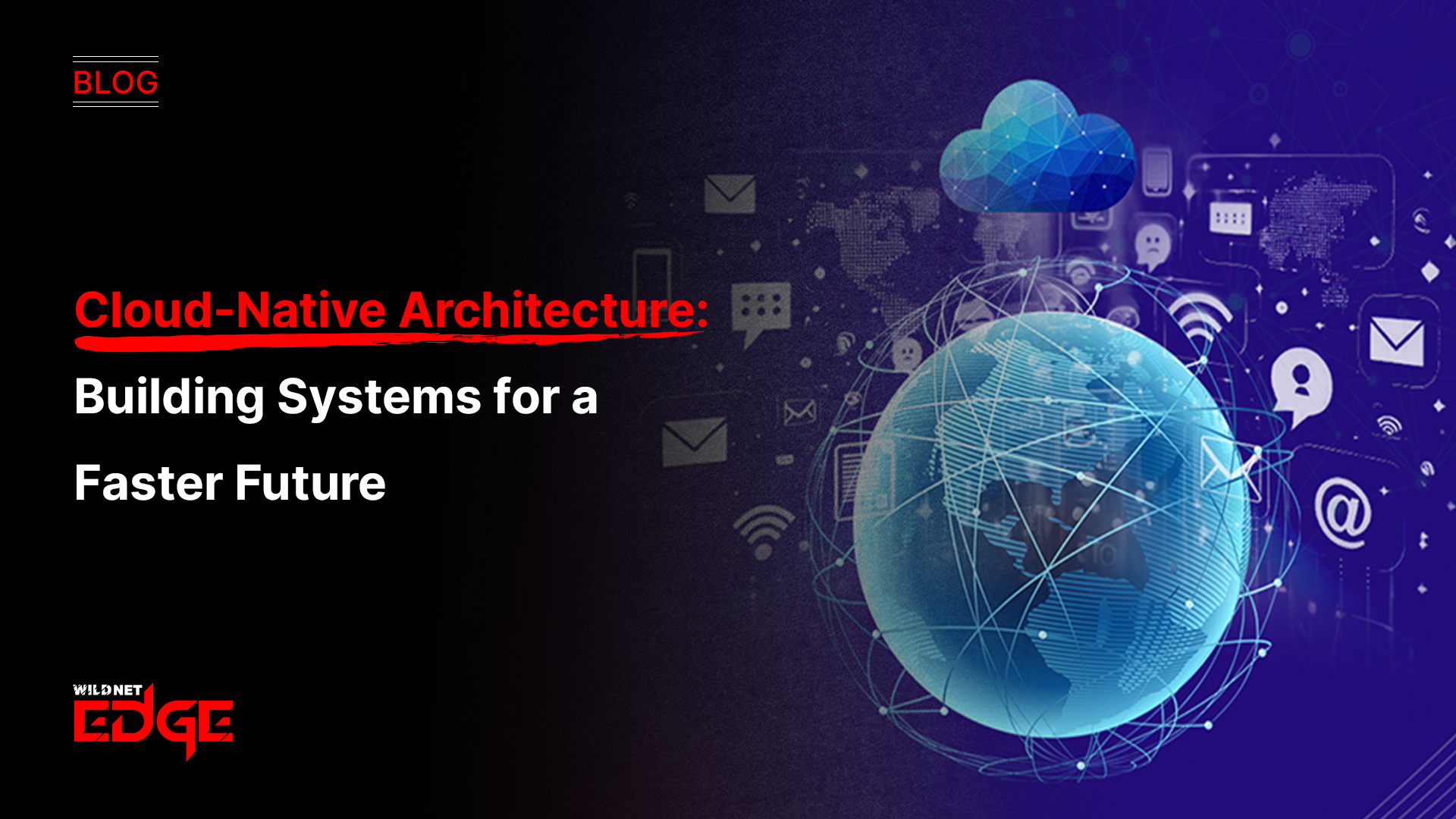
Cloud-Native Architecture is not about moving old systems to the cloud; it is about rebuilding applications to fully use cloud scalability and automation. This article explains how enterprises can move away from rigid monoliths and adopt microservices, containers, and Kubernetes to release software faster, scale without limits, and reduce operational risk. We also cover the role of DevOps services, cloud consulting, and cloud-native development in making this transition successful.
A few years ago, moving to the cloud felt like a big win for most enterprises. Servers were gone, costs looked better, and teams felt modern. But over time, many leaders realized something was still broken. Releases were slow. Scaling during peak demand was painful. Small changes caused big outages.
This is where Cloud-Native Architecture enters the picture. It is not about where your application lives, but how it is built. Instead of rigid systems that resist change, cloud-native systems are designed to adapt, scale, and recover automatically. In 2026, this approach is no longer optional; it is how modern enterprises stay competitive.
The Strategic Shift to Microservices
At the core of Cloud-Native Architecture is the move away from monolithic applications. Monoliths tightly couple features, making every update risky and slow.
With microservices and cloud-native patterns, applications are broken into small, independent services. Each service can be developed, deployed, and scaled on its own. This means teams can release updates faster without affecting the entire system.
Microservices also improve reliability. If one service fails, the rest of the application continues to run. This fault isolation is essential for customer-facing platforms that must stay online 24/7.
The Role of Containers
To make microservices portable and reliable, enterprises rely on container-based systems. Containers package applications with everything they need to run, ensuring consistency across development, testing, and production.
In Cloud-Native Architecture, containers replace heavy virtual machines. They start quickly, use fewer resources, and scale instantly when demand increases. This is critical for building scalable cloud apps that respond to real-world usage patterns.
Containers also simplify CI/CD pipelines, making automated deployments safer and more predictable.
Kubernetes: The Control Plane
As applications grow, managing containers manually becomes impossible. This is where Kubernetes architecture plays a central role.
Kubernetes automates container deployment, scaling, and recovery. It monitors application health, restarts failed services, and balances traffic automatically. In a well-designed Cloud-Native Architecture, Kubernetes ensures high availability without constant human intervention.
Kubernetes also supports hybrid and multi-cloud environments, helping enterprises avoid vendor lock-in while maintaining operational consistency.
Infrastructure as Code for Reliability
The day when manual configuration was the only option is over with modern systems. The Cloud-Native Architecture is the one that allows infrastructure to be defined and controlled via code with Terraform or similar tools as part of the process.
Code Infrastructure implies that environments can be created and controlled just like bookkeeping. In case of failure, one can quickly set up the same environment within minutes. The good thing about this is that it not only prevents errors in configuration but also makes the disaster resulting and recovery processes more robust and secure.
This method also correlates operations and development, which is basically a principle of a mature DevOps service.
Ensuring Scalability and Elasticity
Elastic scaling is one of the greatest benefits of Cloud-Native Architecture. Applications automatically allocate and deallocate resources depending on the current demand. Performance is guaranteed during traffic surges, while a reduction in costs occurs during off-peak periods.
The development of scalable applications in the cloud implies the use of stateless services, as well as external storage for session and data sharing. Through this architecture, any instance can respond to any request, thus preventing the bottlenecks typically experienced in traditional systems.
As a consequence, there is improved performance, reduced infrastructure costs, and a more consistent user experience.
Security in a Cloud-Native World
The security in the Cloud-Native architecture is completely automated, and it is of a continuous nature. Rules are placed in the pipelines, and the environments are built from scratch rather than being patched up.
The DevSecOps method makes the system less vulnerable in the long run and avoids the situation where the system configurations are not the same as they should be. The containers can’t change, and the security validations are made before the deployment, not after the accidents have happened.
Future-Proofing Your Enterprise
Technology will keep on changing, but Cloud-Native Architecture has been planned to accommodate such changes. It is possible to substitute, enhance, or add services at no cost of the complete re-system.
Such flexibility paves the way for easier integration of AI, edge computing, and even future cloud services. Companies that support this model now create platforms that can adapt to the market and not drift away from it.
Case Studies: Our Automation Success Stories
Case Study 1: Modernizing a Fintech Platform
- Challenge: A legacy banking institution was unable to release mobile updates faster than once a month due to a brittle monolithic core. They needed a partner for cloud-native development to decouple their services.
- Our Solution: We re-architected their backend using a completely modular approach. We broke the monolith into 40+ microservices wrapped in Docker containers and orchestrated via Kubernetes. We also implemented a service mesh for secure communication.
- Result: Deployment frequency increased from monthly to daily. The new system handled a 300% increase in transaction volume without latency, proving the stability of the Cloud-Native Architecture we deployed.
Case Study 2: Logistics Real-Time Tracking
- Challenge: A global logistics firm faced downtime during peak shipping seasons. Their on-premise servers could not handle the burst traffic, and manual scaling was too slow. They required robust DevOps services to migrate to the cloud.
- Our Solution: We migrated their tracking system to a serverless architecture. We utilized event-driven functions that triggered only when a package status changed, coupled with a globally distributed database.
- Result: The client achieved 99.999% uptime during the holiday season. Infrastructure costs dropped by 40% because they only paid for active compute time, validating the efficiency of the new model.
Our Technology Stack for Cloud-Native Architecture
We use modern cloud-native technologies to build scalable, resilient, and high-performance enterprise systems.
- Frontend: React, Angular
- Backend: Node.js, Python, .NET, Go
- Architecture: Microservices, Serverless, Event-Driven Systems
- Containers & Orchestration: Docker, Kubernetes
- Infrastructure & Automation: Terraform, Infrastructure as Code
- Cloud Platforms: AWS, Azure, Google Cloud
- DevOps: CI/CD Pipelines, DevSecOps Practices
Conclusion
The transition to Cloud-Native Architecture is the definitive step toward digital maturity. It replaces rigid systems with flexible, automated platforms built for continuous delivery.
By combining microservices, containers, Kubernetes, and Infrastructure as Code, organizations create systems that grow with demand and recover instantly from failure. With the right mix of cloud-native development, DevOps services, and cloud consulting, enterprises can turn IT into a true competitive advantage.
We use our deep cloud consulting expertise to partner with you, delivering high-performance, scalable SaaS solutions designed for your specific industry challenges and opportunities.
FAQs
It is an approach to building and running applications that exploits the advantages of the cloud computing delivery model, using containers, microservices, serverless functions, and immutable infrastructure.
The microservices, cloud-native patterns, and monoliths differ in the architecture of deployment, where the first-mentioned one is a collection of small units deployed separately, while the later is a single unit containing everything and is deployed at once.
Kubernetes is the platform that takes care of the entire process of deploying, scaling, and managing the containerized applications, and this makes it the most important orchestration layer that operates the complex distributed system without any hiccups.
Containers are consistent across the different environments (development, testing, and production), they take up less space, which allows for quick startup times, and they also enable cloud facilities to host more applications because of their high density.
The system is capable of accommodating very large traffic spikes by being horizontally scalable, which means that instead of increasing the size of a single server, you add more instances of a service.
Even though the initial investment is higher at first, it usually cuts costs in the long run due to (auto-scaling) the efficient use of resources and much faster timing for the market of the money-making features.
Absolutely, it necessitates a change to DevOps and Agile practices, where the development and operations groups work together in a very close manner to automate the pipelines and share the accountability for the system’s dependability.

Managing Director (MD) Nitin Agarwal is a veteran in custom software development. He is fascinated by how software can turn ideas into real-world solutions. With extensive experience designing scalable and efficient systems, he focuses on creating software that delivers tangible results. Nitin enjoys exploring emerging technologies, taking on challenging projects, and mentoring teams to bring ideas to life. He believes that good software is not just about code; it’s about understanding problems and creating value for users. For him, great software combines thoughtful design, clever engineering, and a clear understanding of the problems it’s meant to solve.


 based on 1200+ reviews