sales@wildnetedge.com
 +1 (212) 901 8616
 +1 (437) 225-7733














































































































 ChatGPT Development & Enablement
  Hire AI & ChatGPT Experts
  ChatGPT Apps by Industry
  ChatGPT Blog
  ChatGPT Case study
  AI Development Services
  Industry AI Solutions
  AI Consulting & Research
  Automation & Intelligence





TL;DR
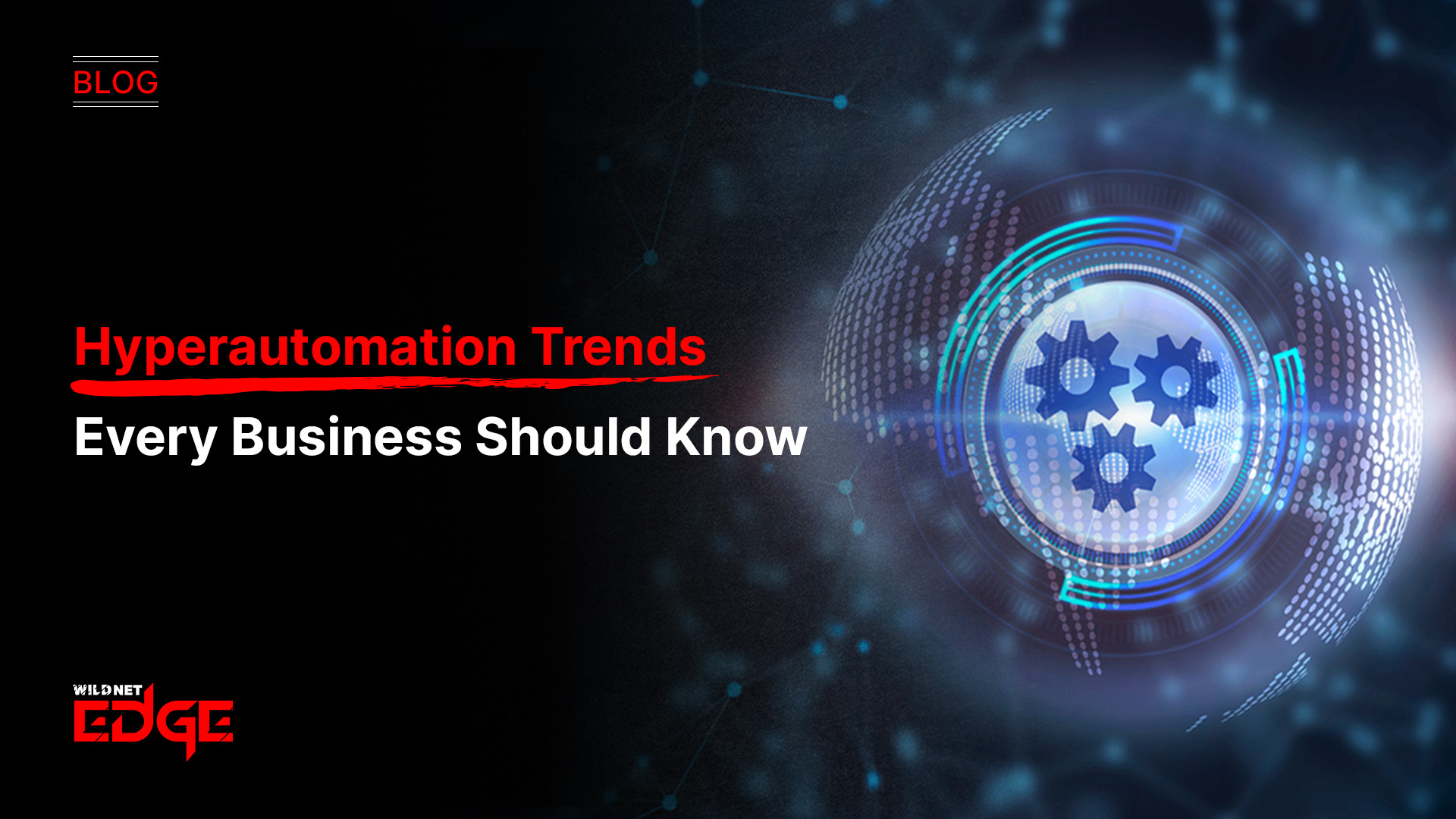
Hyperautomation Trends show that businesses are moving away from isolated bots and toward fully connected automation ecosystems. By combining business automation AI, workflow orchestration, AI+RPA trends, and digital workforce tools, enterprises can automate end-to-end processes instead of individual tasks. This shift enables faster decision-making, better scalability, stronger governance, and measurable ROI. Companies that adopt hyperautomation strategically rather than tactually are building a long-term competitive advantage.
Hyperautomation Trends are reshaping how modern businesses operate—and not in small, incremental ways. Today, efficiency is no longer about automating one task or fixing one broken process. It’s about building an intelligent system where AI, automation, and orchestration work together across the organization.
Enterprises are realizing that scattered automation tools create more friction than value. When AI, RPA, and workflow orchestration operate in silos, teams end up with fragile processes, data blind spots, and rising technical debt. This is why Hyperautomation Trends are now focused on unification, not experimentation.
For leadership teams, this shift is critical. Business automation AI is no longer just an IT initiative, it’s a core business strategy. Organizations that embrace hyperautomation as a connected ecosystem gain speed, resilience, and the ability to scale without constantly adding headcount.
The Strategic Imperative of Orchestration
Workflow orchestration sits at the center of modern hyperautomation.
It’s not enough to deploy an RPA bot for invoicing if that bot can’t communicate with your CRM, ERP, or customer support system. Real value comes when orchestration connects systems, data, and decisions into one continuous flow.
Hyperautomation Trends show a strong move toward platforms that act as process conductors, ensuring information flows seamlessly between legacy systems and cloud applications. When something breaks in one area, every connected team knows instantly.
This orchestration layer also enables composable architectures. Businesses can replace or upgrade individual components without disrupting operations, allowing innovation without downtime
Moving Beyond Basic RPA
RPA was a starting point, but it has clear limits.
Traditional bots break when interfaces change or data becomes unstructured. That’s why AI+RPA trends now focus on intelligence, not repetition. Modern automation can read documents, understand context, analyze sentiment, and make decisions based on historical data.
This evolution transforms RPA into a digital workforce capability. Bots no longer just follow scripts; they adapt, learn, and recover when conditions change. This reduces maintenance overhead and increases reliability at scale.
The Rise of the Digital Workforce
Scaling operations without hiring endlessly is one of the biggest challenges for growing enterprises. Digital workforce tools solve this by introducing AI-driven agents that operate alongside human teams.
These tools can scale instantly during peak demand, handling transactions, processing requests, or monitoring systems while humans focus on exceptions and relationships. This alignment between workforce planning and Hyperautomation Trends is becoming essential.
Equally important: digital workforce tools are becoming accessible to non-technical users. Business teams can design workflows themselves, reducing dependency on IT and speeding up innovation.
Business Automation AI and Smarter Decisions
At the heart of hyperautomation lies business automation AI the intelligence layer.
Instead of reporting what has already happened, modern systems predict outcomes and recommend actions. If a supply chain delay is likely, the system reroutes shipments automatically. This level of autonomy is what separates hyperautomation from traditional automation.
However, AI only works as well as the data behind it. That’s why Hyperautomation Trends place heavy emphasis on data governance, integration layers, and clean data access. Without this foundation, automation simply accelerates bad decisions.
Governance, Security, and Enterprise Automation Insights
As automation scales, governance becomes non-negotiable.
Without oversight, organizations risk “bot sprawl” and unmanaged scripts that introduce security gaps and compliance risks. Enterprise automation insights provide visibility into performance, cost, and risk across the automation landscape.
Process mining tools, powered by these insights, reveal how workflows actually run, not how teams think they run. This clarity ensures businesses automate the right processes in the right order.
Sustainability and Automation
Efficiency is also a sustainability issue. Well-designed automation reduces compute waste, energy consumption, and operational overhead. Business automation AI can optimize energy use in buildings, factories, and data centers, supporting both cost reduction and ESG goals.
Hyperautomation Trends increasingly align efficiency with sustainability, making automation a strategic lever for responsible growth.
The Role of Low-Code/No-Code
To fully realize the benefits of Hyperautomation Trends, agility is key. Low-code platforms empower “citizen developers” to build applications. This reduces the burden on the central development teams.
However, choosing the right partner is crucial. A dedicated AI development company can help establish the necessary guardrails. While digital workforce tools enable rapid creation, IT must retain oversight to prevent security gaps. The trend is moving towards “governed development,” where IT provides the environment within which business users can innovate.
Future-Proofing Your Enterprise
The landscape of Hyperautomation Trends changes rapidly. What is cutting-edge today will be standard tomorrow. Building a flexible architecture is more important than selecting a single tool.
Investing in workflow orchestration ensures that when the next big technology arrives, you can integrate it without tearing down your existing infrastructure. This adaptability is the hallmark of a future-proof enterprise.
Overcoming Implementation Barriers
Adopting AI+RPA trends is not without challenges. Cultural resistance is a significant hurdle. Employees often fear displacement. Leadership must communicate that digital workforce tools are there to augment, not replace.
Additionally, data silos prevent business automation AI from functioning correctly. A unified data strategy must precede the automation strategy. Without it, you are simply automating chaos.
Measuring Success
Success in hyperautomation isn’t measured only by time saved.
True impact shows up in customer satisfaction, employee engagement, revenue per employee, and operational resilience. Enterprise automation insights help leadership track these outcomes and refine strategy continuously.
Case Studies: Our Automation Success Stories
Case Study 1: A Logistics Orchestration Platform
- Challenge: A global logistics provider was struggling with fragmented visibility across their supply chain. Their legacy tracking systems could not communicate with their modern inventory management tools, leading to delays and lost revenue. They lacked specific Hyperautomation Trends adoption in their strategy.
- Our Solution: We engineered a centralized workflow orchestration layer that integrated their ERP, CRM, and third-party shipping APIs. Our team providing automation services utilized advanced process mining to map out the inefficiencies and deployed intelligent agents to handle inter-system communication.
- Result: The solution reduced manual data entry by 85% and improved delivery time estimation accuracy by 40%. The client saw a complete ROI within nine months. By leveraging business automation AI, the system now predicts delays and suggests alternative routes autonomously.
Case Study 2: Financial Compliance Automation
- Challenge: A fintech enterprise faced escalating costs related to regulatory reporting. Their team of analysts spent thousands of hours manually verifying transaction data, a method that was prone to human error and difficult to scale.
- Our Solution: We developed a custom solution leveraging AI+RPA trends to automate the compliance lifecycle. The system used natural language processing to read regulatory updates and adjust validation rules automatically. We also implemented a dashboard for enterprise software automation insights to give the CTO real-time visibility into compliance status.
- Result: The automated system reduced compliance costs by 60% and eliminated penalties associated with reporting errors. The digital workforce tools we implemented handled the volume of three full-time teams, allowing the client to reallocate their analysts to strategic risk assessment roles.
Our Technology Stack for Hyperautomation SaaS
We use scalable, cloud-native technologies to power intelligent automation and enterprise workflows.
- Frontend: React, Angular, Vue.js
- Backend: Node.js, Python, .NET
- AI & Automation: AI/ML Models, NLP, OCR, Intelligent RPA
- Workflow Orchestration: Camunda, Temporal, API-Based Integrations
- Databases: PostgreSQL, MongoDB, Amazon Aurora
- Cloud Platforms: AWS, Azure, Google Cloud
- DevOps: Docker, Kubernetes, CI/CD Pipelines
Conclusion
Hyperautomation Trends are redefining how enterprises compete. The leaders of the next decade won’t be the ones with the most tools but the ones with the most connected, intelligent automation architectures.
By combining business automation AI, workflow orchestration, AI+RPA trends, and digital workforce tools under strong governance, organizations can scale faster, adapt quicker, and operate with confidence.
Hyperautomation isn’t about replacing people.
It’s about removing friction so people can focus on what actually drives value.
FAQs
The most current trends focus on the convergence of AI, machine learning, and RPA to create a unified, intelligent automation ecosystem rather than isolated task automation.
Standard automation follows pre-set rules, while this form of AI uses data to make complex decisions, learn from outcomes, and adapt to changing conditions without human interference.
It connects disparate systems and people, ensuring that processes flow smoothly across the entire organization, which eliminates bottlenecks and data silos.
The main risks include lack of governance leading to “bot sprawl,” security vulnerabilities in unmanaged scripts, and potential cultural resistance from human employees.
By adding cognitive abilities to RPA, businesses can automate complex, variable processes, significantly increasing the scope of automation and delivering a much higher return on investment.
Yes, modern custom enterprise software provides the necessary backbone and integration points to support advanced automation frameworks and data handling.
They provide the necessary visibility and analytics to monitor the health, security, and financial performance of your automated ecosystem.

Managing Director (MD) Nitin Agarwal is a veteran in custom software development. He is fascinated by how software can turn ideas into real-world solutions. With extensive experience designing scalable and efficient systems, he focuses on creating software that delivers tangible results. Nitin enjoys exploring emerging technologies, taking on challenging projects, and mentoring teams to bring ideas to life. He believes that good software is not just about code; it’s about understanding problems and creating value for users. For him, great software combines thoughtful design, clever engineering, and a clear understanding of the problems it’s meant to solve.
 based on 1200+ reviews