 sales@wildnetedge.com
 +1 (212) 901 8616
 +1 (437) 225-7733
















































































































 ChatGPT Development & Enablement
  Hire AI & ChatGPT Experts
  ChatGPT Apps by Industry
  ChatGPT Blog
  ChatGPT Case study
  AI Development Services
  Industry AI Solutions
  AI Consulting & Research
  Automation & Intelligence





TL;DR
Voice Commerce in 2026 has evolved from basic voice commands into full conversational experiences powered by proactive AI agents. Businesses are using conversational commerce, smart speaker commerce, and retail voice AI to reduce friction, increase average order value, and improve accessibility. Success depends on voice-enabled ecommerce architecture, clean data, strong security, and omnichannel continuity. Companies that treat voice as core infrastructure, not an add-on, are gaining a clear competitive edge.
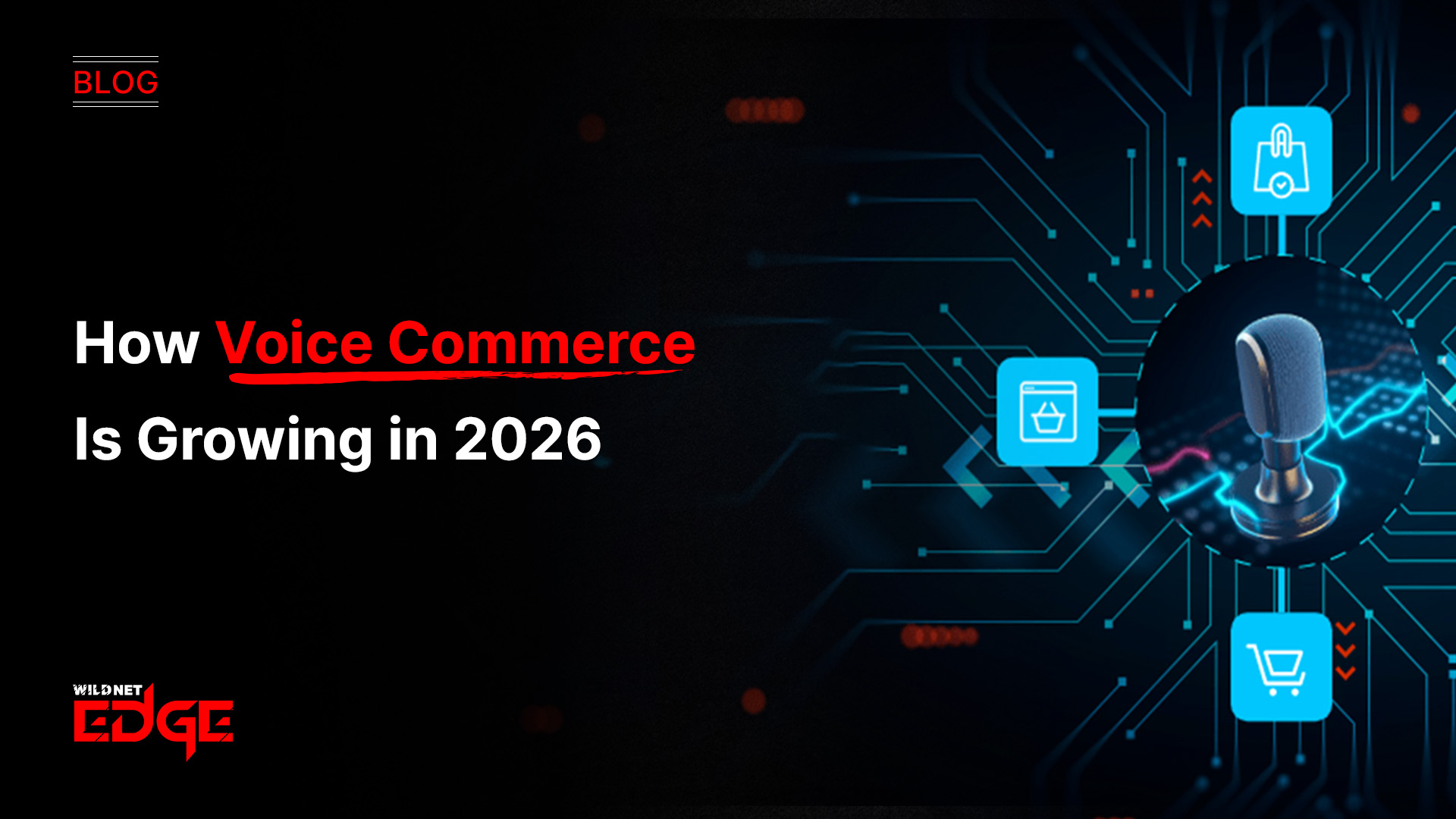
Voice Commerce is no longer a futuristic idea or a convenience feature. In 2026, it will become a serious revenue channel and a core part of how customers interact with brands. People are no longer just asking devices to reorder groceries. They are having full conversations, comparing options, and making decisions hands-free.
What’s driving this shift is trust. Customers now trust voice assistants to understand intent, remember preferences, and act correctly. At the same time, businesses are under pressure to remove friction from buying journeys. The voice fits naturally into this moment.
For leaders, ignoring Voice Commerce today carries the same risk as ignoring mobile commerce a decade ago. The brands winning now are the ones designing voice-first experiences that feel helpful, personal, and fast.
The Shift to Conversational Commerce
Conversational commerce is no longer limited to text chats or scripted voice responses. In 2026, it means having a natural, ongoing conversation with a brand through voice.
Modern conversational commerce systems act like personal shoppers. They remember preferences, suggest alternatives, and guide decisions. This requires backend systems that support context, memory, and continuity. A customer might start a conversation at home, continue it in the car, and finish the purchase on a laptop.
This continuity is what builds loyalty. Customers don’t feel like they’re “starting over” every time they switch devices.
Smart Speaker Commerce at Scale
Smart speaker commerce has moved beyond novelty. Household adoption has reached a point where speaking to a device feels normal, especially for repeat purchases.
The challenge for retailers is visibility. Smart speakers return one answer, not ten. Winning in smart speaker commerce depends on clean data, strong product structure, and algorithmic relevance.
Smart speaker commerce is also merging with IoT. Appliances can detect needs and trigger purchases through voice, removing friction entirely. This makes Voice Commerce less about searching and more about anticipation.
The Rise of Voice-Enabled Ecommerce
Voice-enabled ecommerce requires speed and flexibility. Legacy systems struggle here.
Modern platforms use headless architecture, where the voice interface is separate from backend logic. This allows real-time access to inventory, pricing, and shipping data without delays.
Voice-enabled ecommerce also expands access. For elderly users or visually impaired customers, voice removes barriers that screens create. This directly increases reach and inclusion while growing revenue.
Retail Voice AI as a Differentiator
Retail voice AI has matured rapidly. Today, it understands nuance, tone, and context not just keywords. It can tell the difference between a budget request and a style preference. It can sense frustration and adjust responses. It can escalate to humans when needed.
Retail voice AI is also entering physical stores. Voice-enabled kiosks help customers find products, check availability, and get answers instantly—blending digital intelligence with physical retail. This is where Voice Commerce becomes a true experience layer, not just a transaction tool.
Optimizing for Voice Search
Voice shopping trends require a new approach to SEO. Queries are longer, more natural, and question-based.
Structured data is essential. Voice assistants rely on it to describe products accurately. Without it, your products may never be surfaced.
Local intent is also critical. “Near me” voice queries are common, especially for retail and services. Voice shopping trends favor businesses with accurate local inventory and location data.
Trust and Security in Voice
Security concerns are real and improving. Voice biometrics are becoming standard, making voice transactions more secure than traditional card payments in many cases. Each voiceprint is unique.
Privacy still matters. Clear policies and transparent data usage are essential to building long-term trust in Voice-Based Commerce ecosystems.
Voice Commerce in B2B
B2B adoption is accelerating. Warehouse managers reorder stock hands-free. Procurement teams speak requirements instead of navigating complex portals.
Voice-enabled ecommerce is simplifying supply chains by reducing friction in ordering and approvals.
The Role of Predictive Analytics
The future of Voice Commerce is predictive. By analyzing past behavior, the AI can predict needs before the user articulates them.
This moves interaction from reactive to proactive. Imagine a system that orders air filters because it knows the local pollen count is rising.
Overcoming Adoption Barriers
Despite the growth, there are challenges. Accents and dialects can still trip up the systems. Continuous training of models is required to ensure inclusivity.
Furthermore, the lack of a visual interface can be limiting for complex products. This is why multimodal experiences (voice + screen) are gaining traction. They combine the speed of voice with the clarity of visuals.
Measuring Success
Success metrics go beyond sales. Engagement length, intent accuracy, and repeat usage show whether conversational commerce is delivering value. High engagement signals trust and trust drives revenue.
Case Studies: Our Voice Commerce Success Stories
Case Study 1: An Omnichannel Grocery Platform
- Challenge: A national grocery chain was losing market share to tech-forward competitors. Their customers wanted the convenience of reordering staples without opening an app, but the client lacked the ecommerce development company expertise to build a headless voice architecture.
- Our Solution: We built a custom skill for smart speakers that integrated directly with their inventory system. We implemented retail voice AI that learned user purchasing habits to suggest proactive reorders (“You usually buy coffee on Tuesdays, would you like to add it?”).
- Result: The introduction of smart speaker commerce capabilities increased recurring revenue by 22%. The friction-free reorder process reduced churn, and the voice-enabled ecommerce solution became their highest-converting channel for household staples.
Case Study 2: High-End Fashion Concierge
- Challenge: A luxury fashion retailer wanted to offer a VIP experience to their top-tier clients digitally. Text-based chatbots felt too impersonal for their brand image, and they needed a solution that felt like a human concierge.
- Our Solution: We developed a conversational commerce agent capable of understanding complex style queries. Leveraging advanced AI voice solutions, the system could discuss fabrics, sizing, and matching accessories in a natural, fluid dialogue.
- Result: The Voice Commerce initiative resulted in a 35% higher average order value compared to web users. The retail voice AI successfully handled 80% of styling queries, freeing up human stylists to focus on the highest-value in-store appointments.
Our Technology Stack for Voice-Based Commerce Platforms
We use modern, cloud-native technologies to build scalable, voice-first commerce systems.
- Frontend: React, Angular, Headless UI
- Backend: Node.js, Python, .NET
- Voice & AI: Speech-to-Text, Text-to-Speech, NLP, Conversational AI
- APIs & Integration: Headless Commerce APIs, Voice Assistant SDKs
- Databases: PostgreSQL, MongoDB, Amazon Aurora
- Cloud Platforms: AWS, Azure, Google Cloud
- DevOps: Docker, Kubernetes, CI/CD Pipelines
Conclusion
Voice-Based Commerce is becoming the front door to digital retail. Brands that treat it as infrastructure, not an experiment, are reducing friction, increasing loyalty, and future-proofing their business. This shift isn’t about replacing screens. It’s about meeting customers where their hands and attention already are. Embracing Voice-Based Commerce is the definitive step toward future-proofing your retail tech strategy.
Ready to build a SaaS platform that gives you a competitive edge? At Wildnet Edge, our AI-first approach ensures we build intelligent, data-driven applications. We partner with you to deliver high-performance, scalable SaaS solutions designed for your specific industry challenges and opportunities.
FAQs
The market is expanding rapidly as consumer trust in voice assistants grows, with projections indicating it will capture a significant double-digit percentage of total digital transaction volume this year.
Traditional search is one-way and transactional, whereas this new commerce model involves a two-way, context-aware dialogue that guides the user through the entire purchase journey.
While it dominates in CPG and repeat purchases, we are seeing it expand into service bookings and B2B procurement, though complex products still benefit from multimodal displays.
The primary risks involve unauthorized access via voice mimicry, which is why advanced voice biometrics and multi-factor authentication are becoming standard requirements for high-value transactions.
Modern AI models are trained on diverse, global datasets to improve Natural Language Understanding (NLU), significantly reducing errors and making the technology accessible to a wider demographic.
Yes, but it typically requires a headless architecture where the voice interface communicates via APIs to your legacy backend to ensure real-time data synchronization.
Voice assistants rely on structured data to understand product details like price and availability; without it, your products cannot be accurately described or recommended by the AI.

Managing Director (MD) Nitin Agarwal is a veteran in custom software development. He is fascinated by how software can turn ideas into real-world solutions. With extensive experience designing scalable and efficient systems, he focuses on creating software that delivers tangible results. Nitin enjoys exploring emerging technologies, taking on challenging projects, and mentoring teams to bring ideas to life. He believes that good software is not just about code; it’s about understanding problems and creating value for users. For him, great software combines thoughtful design, clever engineering, and a clear understanding of the problems it’s meant to solve.

 based on 1200+ reviews



