sales@wildnetedge.com
 +1 (212) 901 8616
 +1 (437) 225-7733













































































































 ChatGPT Development & Enablement
  Hire AI & ChatGPT Experts
  ChatGPT Apps by Industry
  ChatGPT Blog
  ChatGPT Case study
  AI Development Services
  Industry AI Solutions
  AI Consulting & Research
  Automation & Intelligence




TL;DR
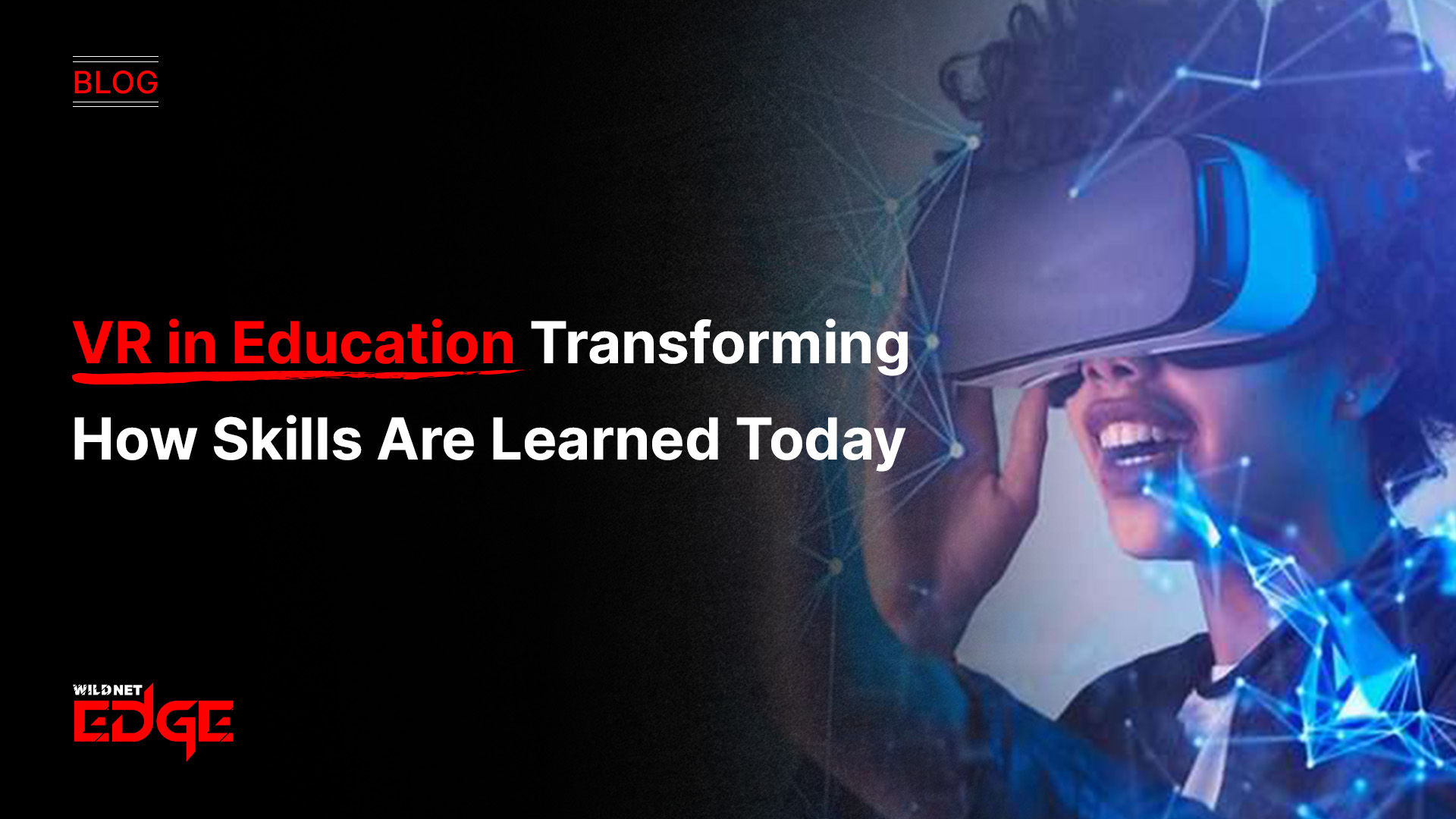
VR in Education replaces passive learning with hands-on, immersive experiences. By using immersive learning environments, VR training modules, and virtual classrooms, institutions improve skill retention, engagement, and training speed. Skill development VR supports both technical and soft skills while reducing costs, risks, and logistical barriers. The result is faster learning, higher confidence, and scalable e-learning innovation.
Learning works best when people can practice, not just listen.
That simple truth explains why VR in Education is becoming a core part of modern training programs. Slides and videos explain concepts, but they rarely build confidence. Virtual reality changes that by letting learners step inside the lesson and act.
In 2026, schools and enterprises use VR to teach complex skills safely, repeatedly, and without real-world risk. From operating machinery to handling medical procedures, Virtual Reality in Education turns learning into an experience rather than a presentation.
This article explains how immersive learning, virtual classrooms, and VR training modules are reshaping education and workforce training.
Why Immersive Learning Works Better
Traditional learning relies heavily on observation. VR relies on participation. Immersive learning places learners inside realistic environments where they interact with objects, make decisions, and see outcomes. The brain treats these experiences as real, which improves memory and understanding.
With VR in Education, learners practice tasks that are expensive, rare, or dangerous in real life. A technician can repeat a complex repair dozens of times. A student can explore environments that no classroom could recreate.
Instructors shift from lecturing to guiding. In virtual classrooms, teachers lead learners through shared experiences rather than static content.
Faster and Deeper Skill Development
VR in Education accelerates learning by allowing safe failure. When a learner makes a mistake, the system shows the impact immediately without real-world consequences.
Skill development VR builds muscle memory in technical roles such as manufacturing, aviation, and healthcare. Workers arrive on the job already familiar with tools and procedures.
VR also supports soft skills. VR training modules simulate conversations, conflict resolution, and leadership scenarios. AI-driven avatars respond to tone and body language, helping learners practice communication in a controlled setting.
Lower Training Costs Over Time
VR requires upfront investment, but it reduces long-term expenses. Organizations cut travel, accommodation, and equipment costs by training teams remotely. Employees meet in shared virtual classrooms without leaving their locations.
VR in Education also reduces material waste. In fields like welding or medical training, learners practice virtually until ready, avoiding damage to equipment or consumables.
Once built, VR training modules scale easily. The same program trains hundreds or thousands of learners with consistent quality.
Higher Engagement and Focus
Distraction slows learning. VR blocks out external noise and keeps learners focused on the task. Phones, emails, and side conversations disappear inside the headset.
VR in Education also benefits from game mechanics. Progress tracking, challenges, and rewards increase motivation. Learners stay engaged longer and complete training with fewer drop-offs. This level of focus helps learners reach a state where learning feels natural instead of forced.
Virtual Classrooms Without Limits
Physical classrooms limit who can attend and what can be taught. Virtual classrooms remove those limits. Learners from different locations meet in the same digital space, interact with 3D content, and collaborate in real time.
With VR in Education, history students walk through ancient cities. Science students manipulate molecules. Engineering students assemble machines together, even when continents are apart.
This approach supports global collaboration and consistent learning experiences across regions.
What It Takes to Implement VR Successfully
VR works best with the right foundation. High-quality VR in Education requires stable connectivity, optimized graphics, and careful motion design to avoid discomfort. Content must be accurate and instructionally sound.
Starting with pilot programs helps teams prove value before scaling. Partnering with experienced developers ensures performance, comfort, and educational accuracy.
Strong planning turns VR from an experiment into a reliable learning platform. Partnering with an expert e-learning app development firm ensures you get educational content that is both accurate and optimized for performance.
Case Studies: Our Automation Success Stories
Case Study 1: Heavy Machinery Safety Training
- Challenge: A construction firm faced high accident rates during new-hire training. Using real cranes for training was dangerous and took valuable equipment out of production. They needed a VR development company to digitize the process.
- Our Solution: We built a photorealistic VR in Education simulation of their construction site. Trainees used controllers to operate virtual cranes, facing randomized weather hazards and equipment failures.
- Result: Accident rates dropped by 40% in the first year. The program reduced training time by three weeks, as trainees could practice 24/7 without needing a safety supervisor present.
Case Study 2: Medical School Anatomy Lab
- Challenge: A medical university struggled with the high cost and scarcity of cadavers. Students had limited time to practice dissections. They sought AR/VR solutions to supplement their curriculum.
- Our Solution: We developed a comprehensive VR in Education anatomy module. Students could virtually dissect, rotate, and zoom in on organs in 3D, identifying pathologies that are rare to find in physical specimens.
- Result: Student test scores improved by 25%. The VR in Education lab allowed for unlimited practice runs, ensuring every student was confident before entering the physical operating theatre.
Our Technology Stack for VR Development
We use cutting-edge engines and tools to build immersive, high-fidelity educational experiences.
- Game Engines: Unity 3D, Unreal Engine 5
- VR Hardware SDKs: Oculus SDK (Meta Quest), SteamVR (HTC Vive), ARKit/ARCore
- 3D Modeling: Blender, Maya, 3ds Max
- Programming: C# (Unity), C++ (Unreal)
- Multiplayer Networking: Photon, Mirror
- Cloud & Backend: AWS, Azure, Node.js
Conclusion
Virtual Reality in Education brings practice back into learning. By combining immersive learning, VR training modules, and virtual classrooms, institutions train faster, safer, and more effectively. Learners gain confidence before facing real-world challenges.
As education and training evolve, VR moves from novelty to necessity. Organizations that adopt it now build skills that last. At Wildnet Edge, we design VR solutions that support real learning goals, clear outcomes, strong engagement, and scalable delivery across industries.
FAQs
The main advantage is that it can offer safe, immersive, and repeatable practice for complex tasks, which results in higher retention rates and faster skill acquisition compared to traditional methods.
The answer is yes, there are hardware costs; however, Virtual Reality in Education greatly cuts down on long-term expenses, such as travel, physical materials, and equipment downtime, which often leads to a high ROI.
Definitely, this tool is suitable for the development of soft skills if it puts the learners in different situations where they can practice leadership, negotiation, and empathy using avatars in a secure environment.
No, it gives them power. Virtual Reality in Education is the tool of facilitators, giving them the opportunity to walk students through difficult simulations that wouldn’t have been possible to create in a physical classroom.
Usually, the requirement is for Meta Quest standalone VR headsets or PC-tethered headsets for a better quality, with a stable internet connection for multiplayer use at the same time.
Motion sickness may be caused by poorly optimized apps, but it is not the case with the high-quality Virtual Reality in Education content since the latter is equipped with high frame rates and comfortable locomotion techniques to lessen or even eliminate motion sickness.
Extremely scalable. Once the software is built, it can be deployed to thousands of headsets globally, ensuring every employee receives the exact same high standard of training.

Managing Director (MD) Nitin Agarwal is a veteran in custom software development. He is fascinated by how software can turn ideas into real-world solutions. With extensive experience designing scalable and efficient systems, he focuses on creating software that delivers tangible results. Nitin enjoys exploring emerging technologies, taking on challenging projects, and mentoring teams to bring ideas to life. He believes that good software is not just about code; it’s about understanding problems and creating value for users. For him, great software combines thoughtful design, clever engineering, and a clear understanding of the problems it’s meant to solve.
 based on 1200+ reviews