sales@wildnetedge.com
 +1 (212) 901 8616
 +1 (437) 225-7733















































































































 ChatGPT Development & Enablement
  Hire AI & ChatGPT Experts
  ChatGPT Apps by Industry
  ChatGPT Blog
  ChatGPT Case study
  AI Development Services
  Industry AI Solutions
  AI Consulting & Research
  Automation & Intelligence





Key Takeaways
- A DevOps services company helps organizations release software faster while keeping systems reliable and secure.
- DevOps services explained include automation, cloud infrastructure, monitoring, and operational support.
- DevOps solutions for enterprises focus on scalability, security, compliance, and cost control.
- To successfully follow a Guide to DevOps Development, companies adopt DevOps best practices and often hire DevOps developers with specialized skills.
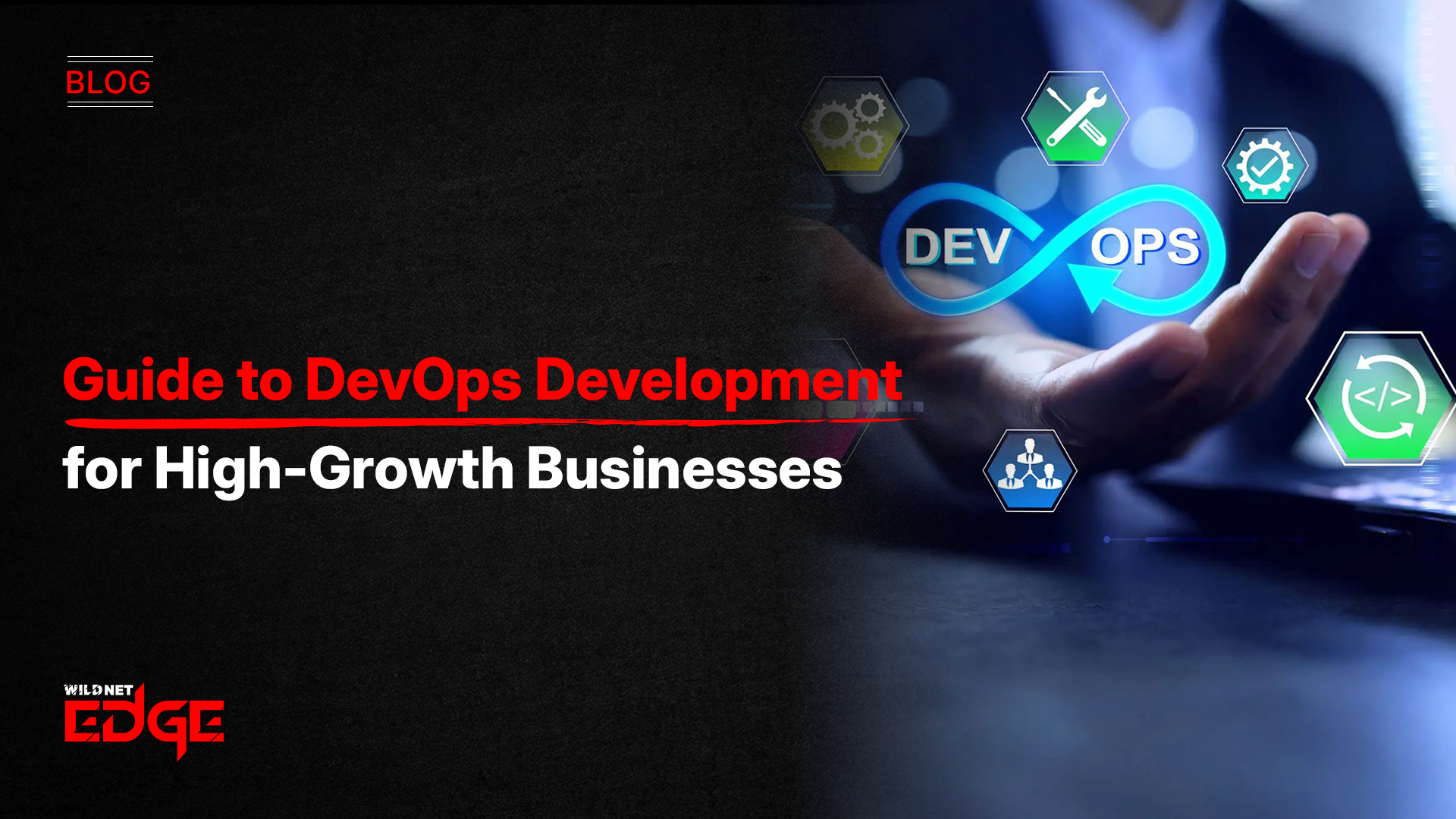
Many companies know they need DevOps, but most struggle to understand how to start, what to expect, and who should lead the change. This Guide to DevOps Development explains what a DevOps services company actually does, how DevOps works in real business environments, and how organizations can adopt it without chaos or wasted spend.
In 2026, DevOps is no longer optional. Faster releases, stable systems, and secure infrastructure now decide who leads the market. Businesses that fail to modernize their software delivery fall behind quickly.
This guide breaks down DevOps services explained in simple terms and shows how companies use DevOps transformation services, DevOps automation services, and DevOps managed services to scale with confidence.
Why This Guide to DevOps Development Matters in 2026
Research from DORA (DevOps Research and Assessment) consistently shows that elite DevOps teams deploy multiple times per day, recover from failures 24x faster, and experience significantly lower change failure rates. The difference is not tooling—it is process, automation, and culture.
This Guide to DevOps Development exists because most organizations attempt DevOps without a roadmap. They buy tools but keep old workflows. They automate deployments but ignore security. They move to the cloud but fail to control costs.
A capable DevOps services company prevents these mistakes by guiding DevOps development end-to-end.
Part 1: What Does a DevOps Services Company Do?
At a practical level, a DevOps services company helps organizations build, deploy, secure, and operate software more efficiently. At a strategic level, they redesign how engineering teams work.
When business leaders ask what a DevOps company does, the simplest answer is this:
A DevOps company removes friction from software delivery while improving reliability.
They guide DevOps development by replacing manual processes with automation and disconnected teams with shared ownership.
Core Responsibilities of a DevOps Services Company
A mature DevOps services company typically operates across three layers:
1. Strategic Assessment and Planning
Every Guide to DevOps Development starts with visibility.
The DevOps partner maps the full delivery lifecycle from idea to production. They analyze:
- Release frequency
- Deployment failure rates
- Recovery time after incidents
- Manual handoffs and approvals
This assessment forms the foundation of DevOps lifecycle management and helps define a realistic transformation roadmap.
2. DevOps Automation Services and Platform Build
Once bottlenecks are clear, the partner implements DevOps automation services to eliminate them.
This includes:
- CI/CD pipelines
- Infrastructure as Code (IaC)
- Automated testing
- Security automation (DevSecOps)
Automation is critical to any Guide to DevOps Development because human-driven workflows do not scale.
3. DevOps Managed Services and Reliability Engineering
Many organizations choose DevOps managed services to avoid maintaining infrastructure internally.
In this model, the DevOps services company:
- Monitors systems 24/7
- Responds to incidents
- Optimizes performance and cost
- Enforces SLAs
This operational ownership allows businesses to focus on product growth.
Part 2: DevOps Services Explained (In Depth)
Understanding DevOps services explained clearly is essential for choosing the right partner.
DevOps Transformation Services
DevOps transformation services focus on people and process. They help organizations move from siloed development and operations to collaborative, continuous delivery models.
Key elements include:
- Agile and DevOps coaching
- Team restructuring
- Workflow redesign
- Metrics-driven improvement (DORA metrics)
Without transformation services, automation efforts often fail.
DevOps Automation Services
Automation is the technical backbone of every Guide to DevOps Development. DevOps automation services typically include:
- Infrastructure as Code using Terraform or Pulumi
- CI/CD pipelines using GitHub Actions, GitLab CI, or Jenkins
- Automated quality and security testing
- Environment provisioning on demand
Automation reduces risk, improves consistency, and accelerates delivery.
Cloud Infrastructure and DevOps Solutions for Enterprises
Modern DevOps solutions for enterprises are tightly coupled with cloud platforms.
A DevOps services company supports:
- Cloud migration (AWS, Azure, GCP)
- Containerization (Docker)
- Orchestration (Kubernetes)
- Multi-region architectures
These solutions enable global scale without proportional increases in headcount.
DevOps Managed Services
DevOps managed services provide continuous operational support.
This includes:
- Observability and monitoring
- Incident response
- Capacity planning
- Cost optimization (FinOps)
Managed services are especially valuable for organizations running mission-critical systems.
Part 3: DevOps Service Models Compared
A strong Guide to DevOps Development must explain service models clearly.
DevOps Consulting Overview
DevOps consulting overview engagements are short-term and strategic.
They help with:
- Architecture design
- Tool selection
- Security and compliance reviews
Consulting is ideal for organizations starting DevOps or correcting failed implementations.
DevOps Managed Services Model
This model focuses on execution and reliability.
- SLA-driven support
- 24/7 availability
- Predictable operating costs
Enterprises commonly adopt this model for core systems.
Part 4: DevOps Best Practices Backed by Research
Research-driven DevOps best practices consistently correlate with high performance.
Key practices include:
- Infrastructure as Code for environment consistency
- Continuous integration and deployment
- Built-in security (DevSecOps)
- Monitoring tied to business metrics
Following these best practices is essential to any Guide to DevOps Development.
Part 5: DevOps Lifecycle Management Explained
DevOps lifecycle management covers the full software journey:
- Planning and design
- Development and testing
- Deployment and release
- Monitoring and optimization
- Continuous improvement
A DevOps services company manages this lifecycle to ensure continuous feedback and improvement.
When to Hire DevOps Developers vs a DevOps Services Company
You should hire DevOps developers when:
- You need deep internal ownership
- Your DevOps maturity is already high
- You can retain senior talent long-term
A DevOps services company is better when:
- You need speed and expertise quickly
- You require 24/7 coverage
- You want to guide DevOps development without long hiring cycles.
Most organizations use a mix of both.
Case Studies
Case Study 1: Legacy Transformation to Cloud-Native Delivery
- Challenge: A 50-year-old insurance company struggled with slow, quarterly release cycles. Their on-premise infrastructure failed often, and every deployment carried a high risk of downtime. Leadership needed clarity on what a DevOps company does and how to guide DevOps development without disrupting core insurance operations.
- Solution: Through a detailed DevOps consulting overview, we designed a phased modernization roadmap. Using DevOps transformation services, we broke their monolithic claims system into cloud-native microservices on AWS EKS. We applied DevOps automation services to their testing workflows, replacing manual QA with automated pipelines and embedding DevOps best practices into their release process. This approach supported full DevOps lifecycle management from code commit to production monitoring.
- Result:
- Release frequency improved by 400% (quarterly to weekly)
- Production-critical bugs dropped by 60%
- Lead Time for Changes reduced from 3 months to 4 days
Case Study 2: Scaling Enterprise Operations Across Regions
- Challenge: A global logistics unicorn needed proven DevOps solutions for enterprises to support rapid expansion into Asia. Launching in three new regions required speed, compliance, and reliability, but hiring a large internal team was not an option. Leadership explored DevOps service models that balanced control, cost, and scale.
- Solution: They adopted our DevOps managed services model. We built a centralized global control plane using Terraform, allowing regional infrastructure to deploy consistently with a single action. We implemented automated compliance checks as part of DevOps lifecycle management, ensuring data sovereignty rules were enforced by design. Our approach reflected how enterprises can hire DevOps developers strategically while relying on a trusted DevOps services company for continuous operations.
- Result:
- Expansion into three new regions in one month
- Zero downtime during launch
- No increase in full-time operations staff
- 20% reduction in cloud cost per transaction through FinOps
Conclusion
This Guide to DevOps Development shows that DevOps is not about tools; it is about systems, automation, and culture. Understanding what a DevOps company does allows businesses to make informed decisions instead of trial-and-error investments.
Whether you need a DevOps consulting overview, DevOps managed services, or full-scale DevOps solutions for enterprises, the right partner helps you guide DevOps development with clarity, speed, and confidence.
Wildnet Edge’s AI-first approach guarantees that we create ecosystems that are high-quality, secure, and future-proof. We don’t just follow the trends; we set them. We collaborate with you to guide DevOps development strategy and realize engineering excellence. Whether you need to hire DevOps developers to augment your squad or adopt DevOps best practices across a global enterprise, we are your partner in building DevOps solutions for enterprises that scale effortlessly in the AI era.
FAQs
A DevOps services company helps organizations follow a structured Guide to DevOps Development by automating infrastructure, building CI/CD pipelines, and aligning development and operations teams. Their role goes beyond tools; they create workflows and culture that support faster, more reliable software delivery.
DevOps services explained include DevOps transformation services for process and culture, DevOps automation services such as Infrastructure as Code and CI/CD, cloud migration to platforms like AWS or Azure, and ongoing support to guide DevOps development toward long-term stability.
DevOps solutions for enterprises must address scale, security, and regulation. A strong Guide to DevOps Development for enterprises focuses on DevSecOps, compliance requirements like GDPR or HIPAA. These environments need specialized partners to guide DevOps development across large, distributed teams.
A DevOps partner supports a Guide to DevOps Development by defining DevOps best practices, selecting the right tools without creating vendor lock-in, designing a scalable architecture, and training internal teams on modern approaches like SRE and Agile delivery.
DevOps managed services are a key part of a complete Guide to DevOps Development. They involve outsourcing day-to-day infrastructure management, CI/CD pipelines, monitoring, and incident response to a DevOps services company, ensuring systems stay available and secure around the clock.
A Guide to DevOps Development suggests hiring DevOps developers internally when you have a mature DevOps culture and the ability to retain senior talent. Agencies are a better choice when you need to guide DevOps development quickly, access specialized skills, or maintain 24/7 coverage without building large internal teams.
DevOps lifecycle management is a core concept in any Guide to DevOps Development. It covers the entire software lifecycle from planning and development to deployment, monitoring, optimization, and retirement, ensuring continuous feedback, improvement, and operational stability.

Managing Director (MD) Nitin Agarwal is a veteran in custom software development. He is fascinated by how software can turn ideas into real-world solutions. With extensive experience designing scalable and efficient systems, he focuses on creating software that delivers tangible results. Nitin enjoys exploring emerging technologies, taking on challenging projects, and mentoring teams to bring ideas to life. He believes that good software is not just about code; it’s about understanding problems and creating value for users. For him, great software combines thoughtful design, clever engineering, and a clear understanding of the problems it’s meant to solve.



 based on 1200+ reviews