sales@wildnetedge.com
 +1 (212) 901 8616
 +1 (437) 225-7733














































































































 ChatGPT Development & Enablement
  Hire AI & ChatGPT Experts
  ChatGPT Apps by Industry
  ChatGPT Blog
  ChatGPT Case study
  AI Development Services
  Industry AI Solutions
  AI Consulting & Research
  Automation & Intelligence





TL;DR
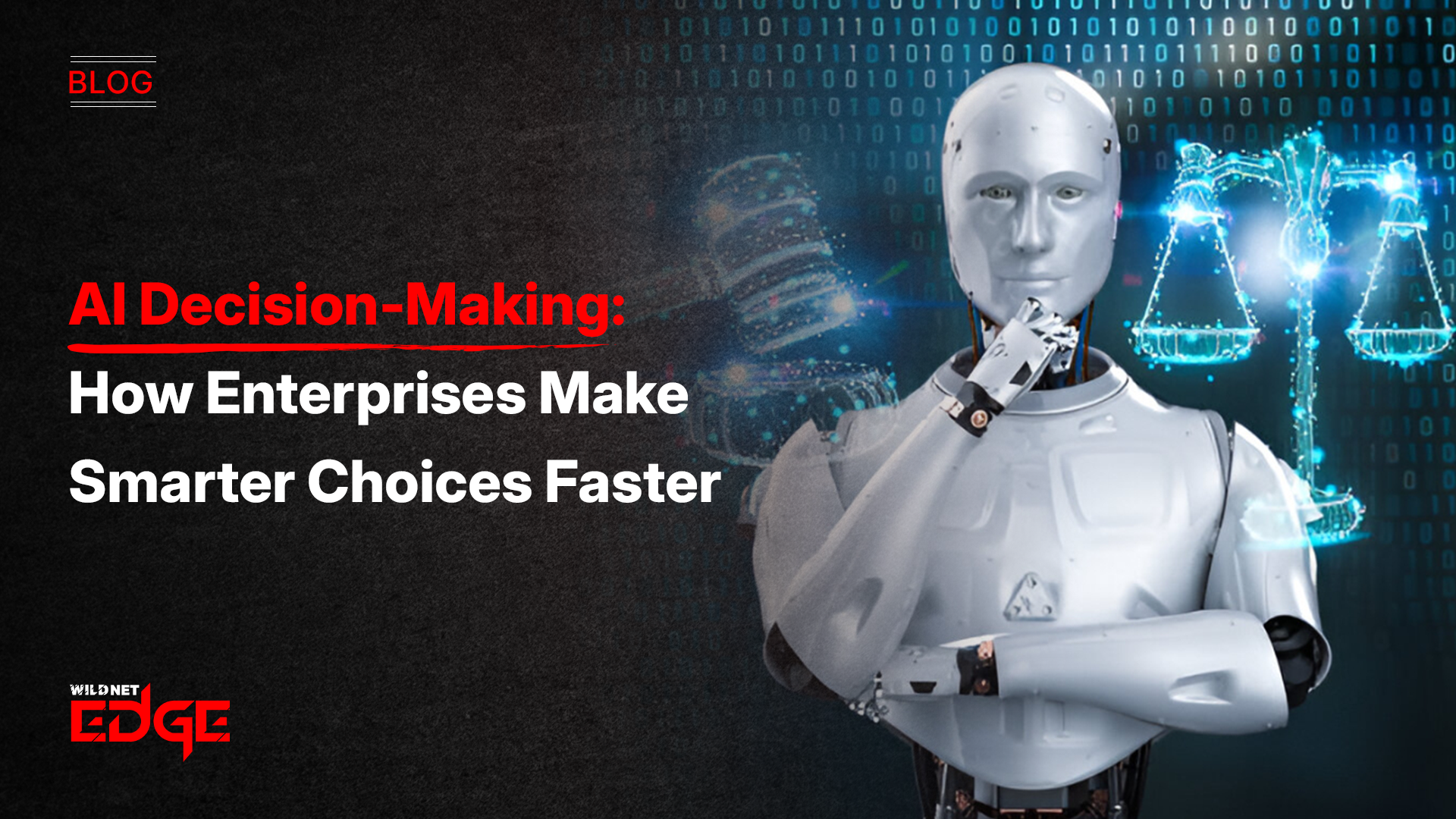
AI Decision-Making enables enterprises to turn data into real-time, actionable guidance. By combining enterprise analytics, predictive modeling, and business intelligence AI, organizations anticipate risks, reduce bias, and act faster. AI-driven decisions improve efficiency across operations, supply chains, and customer engagement while allowing leaders to focus on strategy instead of manual analysis.
Enterprises make thousands of decisions every day. Pricing, inventory, hiring, marketing spend, and risk exposure each choice carries consequences. What has changed is the speed at which those decisions must happen.
AI Decision-Making helps organizations move faster without sacrificing accuracy. Instead of relying on delayed reports or instinct, leaders use systems that analyze data continuously and surface clear recommendations. In 2026, this approach separates companies that adapt quickly from those that fall behind.
This article explains how enterprise analytics, predictive modeling, and AI insights work together to improve business outcomes.
The Shift from Intuition to Data
For decades, business leaders relied on experience supported by limited data. That approach no longer scales.
AI Decision-Making replaces guesswork with evidence by processing thousands of variables at once. These systems detect patterns humans often miss, such as early warning signs of churn or demand shifts tied to external events.
With stronger AI insights, teams stop debating assumptions and start acting on facts. Decisions become consistent, repeatable, and easier to justify.
Predictive Modeling and Future-Proofing
Reactive management is a liability. AI Decision-Making enables a proactive stance through predictive modeling. Instead of asking “What happened?”, the system asks “What will happen?”
Predictive modeling allows enterprises to forecast outcomes before they occur. Retailers anticipate demand spikes. Logistics teams reroute shipments before delays happen. Finance teams assess risk before exposure increases.
Automation in Decision-Making makes this foresight usable. Instead of static forecasts, models update continuously as new data arrives. Businesses respond early, not after damage is done.
Real-Time Business Intelligence AI
Dashboards alone no longer support modern operations.
Business intelligence AI highlights what matters most, flags anomalies, and recommends actions. When performance drops, systems explain why. When metrics improve, they identify contributing factors.
With AI Decision-Making, insights arrive when they matter, not weeks later. Teams act immediately instead of waiting for reports to circulate.
Reducing Bias with AI-Driven Decisions
Human decisions often carry unconscious bias. Data does not eliminate bias on its own, but well-governed systems reduce it.
AI Decision-Making evaluates scenarios consistently using defined criteria. When teams audit models regularly and train them on balanced data, AI-driven decisions become more objective than instinct-based judgment.
This consistency matters in areas like hiring, credit evaluation, and vendor selection.
Scaling Decisions Across the Enterprise
As organizations grow, decision complexity increases.
AI systems scale decision logic across departments without slowing execution. Sales teams receive pricing guidance. Operations teams receive capacity recommendations. Executives receive scenario simulations.
With AI Decision-Making, enterprises maintain clarity even as data volume and operational scope expand.
Case Studies: Decision-Making Success Stories
Case Study 1: Logistics Route Optimization
- Challenge: A global logistics firm faced rising fuel costs and missed delivery windows due to traffic unpredictability. They needed an AI consulting company to optimize their fleet.
- Our Solution: We implemented an AI Decision-Making system that analyzed traffic, weather, and package weight in real-time. It dynamically rerouted drivers mid-shift.
- Result: Fuel consumption dropped by 15%. The intelligent platform improved on-time delivery rates to 98%, saving millions in operational costs.
Case Study 2: Retail Inventory Management
- Challenge: A fashion retailer struggled with overstocking unpopular items and understocking trends. They needed data analytics to align stock with demand.
- Our Solution: We deployed an AI Decision-Making tool that correlated sales data with social media trends (TikTok/Instagram). It predicted viral trends before they peaked.
- Result: Stockouts on trending items were reduced by 80%. The solution ensured that inventory investment was directed solely toward high-velocity products.
Our Technology Stack for AI Decisions
We use enterprise-grade tools to build robust, scalable decision engines.
- Machine Learning: TensorFlow, PyTorch, Scikit-learn
- Data Processing: Apache Spark, Kafka
- BI & Visualization: Tableau, Power BI with AI extensions
- Cloud AI Services: AWS SageMaker, Azure Machine Learning, Google Vertex AI
- Decision Management: IBM ODM, FICO Blaze Advisor
Conclusion
AI Decision-Making gives enterprises the ability to process complexity and act with confidence. By combining enterprise AI, enterprise analytics, predictive modeling, and business intelligence AI, organizations reduce risk, spot opportunities earlier, and move decisively instead of reacting late.
At Wildnet Edge, we make AI Decision-Making practical and usable, not theoretical. Our teams design enterprise AI systems that plug directly into real business workflows, turning scattered data into clear, actionable guidance. From forecasting demand to optimizing operations, we help leaders move from dashboards to decisions. With a strong focus on governance, scalability, and measurable outcomes, Wildnet Edge enables enterprises to adopt automation in Decision-Making faster, with clarity and control, so data doesn’t just inform strategy, it drives it.
FAQs
The main advantage that comes with the use of technology in making decisions is speed and precision; automated decision-making processes analyze tremendous amounts of data in real-time to yield impartial, evidence-based suggestions that would take human scrutiny weeks to reveal.
No, automation decision-making augments humans. It handles the data crunching and probability analysis, allowing human leaders to apply context, ethics, and strategic vision to the final choice.
Predictive modeling enables a subset of automated decision-making that makes it possible to anticipate future outcomes by analyzing past data. Thus, it helps companies to get ready for trends and risks that will occur in the future.
While the initial setup of an automation in a decision-making system requires investment in data infrastructure, the long-term ROI from optimized operations and risk reduction is substantial.
Of course, this technology can diminish human cognitive prejudice, provided that the data and algorithms are meticulously examined for fairness, thus resulting in more neutral AI-made choices.
Fraud detection is one of the applications where automation in decision-making is most commonly used in finance, diagnosis in healthcare, inventory management in retail, and route optimization in logistics.

Managing Director (MD) Nitin Agarwal is a veteran in custom software development. He is fascinated by how software can turn ideas into real-world solutions. With extensive experience designing scalable and efficient systems, he focuses on creating software that delivers tangible results. Nitin enjoys exploring emerging technologies, taking on challenging projects, and mentoring teams to bring ideas to life. He believes that good software is not just about code; it’s about understanding problems and creating value for users. For him, great software combines thoughtful design, clever engineering, and a clear understanding of the problems it’s meant to solve.


 based on 1200+ reviews