sales@wildnetedge.com
 +1 (212) 901 8616
 +1 (437) 225-7733















































































































 ChatGPT Development & Enablement
  Hire AI & ChatGPT Experts
  ChatGPT Apps by Industry
  ChatGPT Blog
  ChatGPT Case study
  AI Development Services
  Industry AI Solutions
  AI Consulting & Research
  Automation & Intelligence





TL;DR
In 2026, FinTech innovation is driven by AI, secure payments, and hyper-personalized banking experiences. This article is your definitive guide to the Top FinTech Software Development Companies in the USA. We have ranked the top 10 firms that move beyond basic apps to deliver complex Banking App Development and robust Digital Payment Solutions. We analyzed these companies based on their technical expertise in PCI-DSS compliance, blockchain integration, and AI-driven fraud detection.
Financial services have changed dramatically. Users want banking that feels simple, fast, and intuitive, but behind the scenes, it must be compliant, secure, and resilient. A consumer might tap a phone to pay, but that single action triggers dozens of workflows across systems, fraud checks, ledgers, and regulatory layers.
This is where the Top FinTech Software Development Companies become essential. They don’t build generic apps; they design architectures that can withstand high transaction volume, emerging fraud patterns, and evolving compliance requirements. Whether you’re building a modern mobile bank, a digital lending platform, a wealth management system, or a next-generation payment app, choosing the right development partner impacts every aspect of security, performance, and user trust.
In this guide, you’ll find detailed evaluations of the top 10 firms in the USA capable of delivering reliable Banking App Development and advanced Digital Payment Solutions for 2026 and beyond.
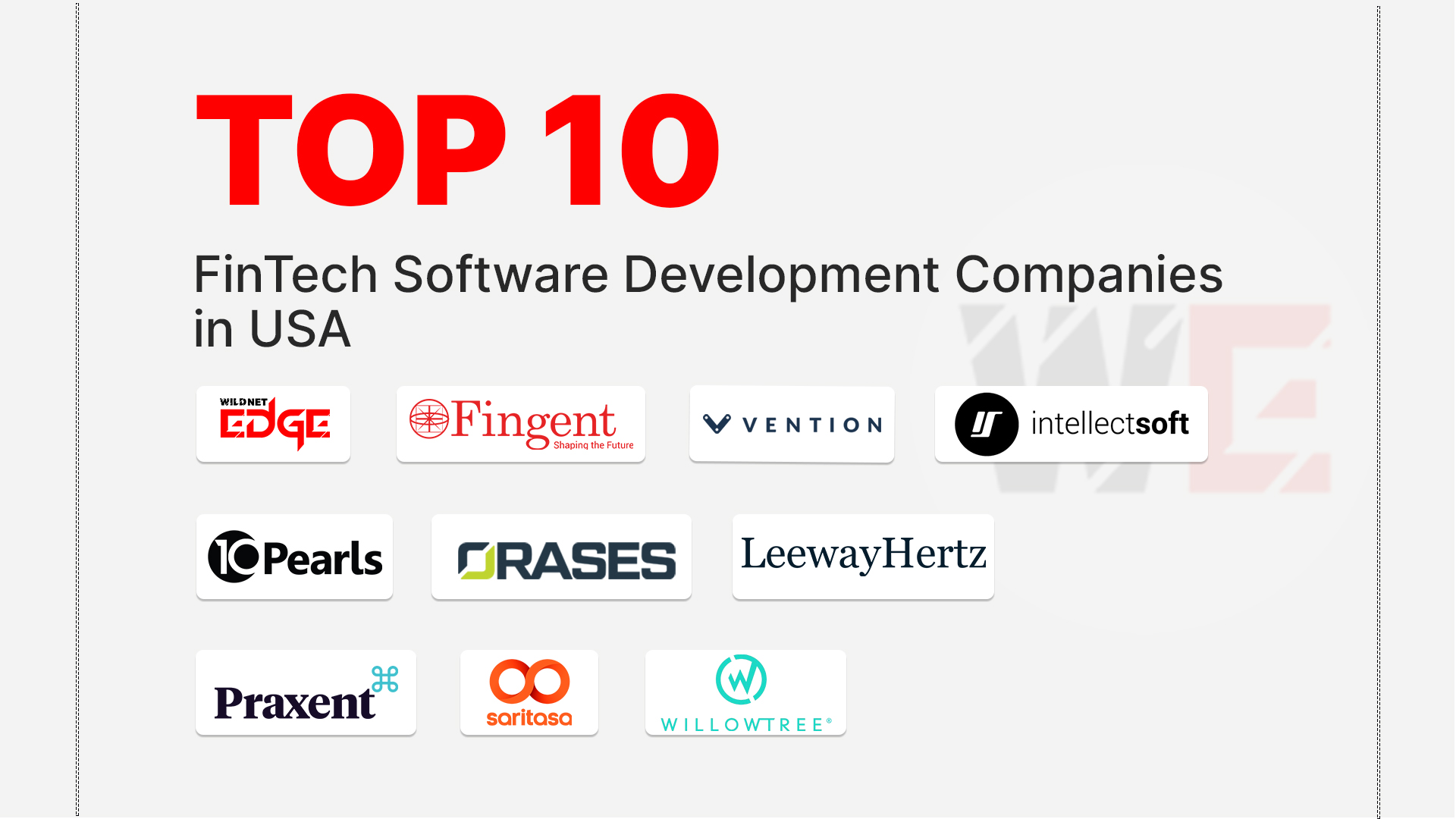
Comparative Matrix: Top 10 FinTech Software Development Companies
| Company | Core Services | Industries Served |
| Wildnet Edge | Enterprise FinTech, AI Fraud Detection, Banking | Finance, Banking, Insurance, Investment |
| Praxent | FinTech Engineering, UX Design, Portals | Banking, Lending, Wealth Management |
| WillowTree | Digital Product, Mobile & Web, GenAI | Media, Finance, Retail |
| LeewayHertz | AI/ML, Blockchain, Algorithmic Trading | FinTech, Banking, Supply Chain |
| Fingent | Custom Software, Security, Wealth Tech | Finance, Real Estate, Retail |
| Saritasa | Custom Software, Mobile Investing, DevOps | Finance, Logistics, Healthcare |
| 10Pearls | Digital Transformation, AI/ML, Product Dev | Energy, Healthcare, Finance |
| Orases | Custom Software, Web Portals, FinTech | Finance, Non-profit, Healthcare |
| Datarockets | Digital Wealth Mgmt, Blockchain, Mobile Apps | FinTech, Insurance, Banking |
| Vention | Custom Trading Software, Staff Augmentation | FinTech, Real Estate, Banking |
Top 10 FinTech Software Development Companies in USA for 2026
1. Wildnet Edge
- Best for: Enterprise-scale, AI-driven FinTech platforms and high-compliance banking systems.
- Key highlights:
- Over 19 years of industry experience (Founded in 2005).
- Enterprise-scale team of 350+ certified engineers.
- Proven track record with 8,000+ projects delivered.
- CMMI Level 3 appraised for mature, repeatable processes.
Wildnet Edge stands out as one of the top FinTech Software Development Company because of its ability to build extremely secure and scalable banking platforms. They specialize in end-to-end system engineering from core banking modernization to real-time payment rails and mobile-first Banking App Development. Their engineers regularly work with legacy cores, multi-currency settlement engines, and regulatory frameworks, ensuring that every feature meets strict compliance standards like PCI-DSS and GDPR.
Their AI in Fintech development, division is a major differentiator. Wildnet Edge builds fraud detection systems that adapt to new threat patterns in real time, predictive analytics for personalized finance, and intelligent chatbots for banking support. They also handle complex integrations across credit bureaus, payment gateways, AML systems, and trading engines. This makes them ideal for banks, insurance firms, FinTech startups, and institutions that need reliable, long-term engineering support. Wildnet Edge is especially trusted for high-compliance and high-transaction environments where security, accuracy, and uptime cannot be compromised.
- Pros:
- Enterprise-scale (350+ engineers) for handling complex, multi-layered banking architectures.
- AI-first approach integrates advanced fraud prevention and personalized banking.
- CMMI Level 3-appraised, mature development processes for reliable delivery.
- Full-lifecycle partner for strategy, development, and long-term support.
- Cons:
- Their specialized, AI-driven financial architectures are designed for long-term scalability, which may be a larger initial commitment than a simple, short-term prototype build.
- They prioritize enterprise-grade security and compliance frameworks, which might be more infrastructure than a low-budget personal finance app requires.
2. Praxent
- Best for: Specializing exclusively in financial services and digital experience (DX).
- Key highlights:
- Founded in 2000 with a deep focus on FinTech.
- “Financial Services” is their primary vertical.
- Strong focus on frontend UX to modernize legacy backends.
Praxent is one of the most specialized firms in this list because nearly 100% of their work revolves around financial services. Rather than focusing purely on backend systems, Praxent has carved out a niche in modernizing the customer experience for banks and credit unions. They help rebuild outdated digital banking interfaces into clean, modern, and user-friendly platforms that can compete with neobanks and digital-first challengers.
As one of the Top FinTech Software Development Companies, their team works closely with institutions that cannot overhaul their entire backend infrastructure. Instead, Praxent builds new front-end layers, streamlined onboarding experiences, and API-driven customer portals that sit on top of legacy cores. This allows clients to upgrade their digital touchpoints without disrupting operations. They bring deep knowledge of lending workflows, deposit account flows, and investment journeys. Their UX-first approach makes them a strong partner for organizations looking to modernize quickly while maintaining stability.
- Pros:
- Deep, exclusive specialization in Banking and FinTech.
- Strong focus on modernizing legacy systems through better UX.
- Cons:
- Their boutique size (50-249 employees) may lack the sheer scale of massive global integrators.
- Services are premium-priced due to their niche US-based expertise.
- Less focus on building brand-new, deep-tech AI models from scratch compared to AI-first firms.
3. WillowTree
- Best for: Premium digital product experiences for major financial brands.
- Key highlights:
- Focus on “Digital Product” strategy and design.
- Large, US-based enterprise team.
- Strong expertise in mobile and web/cloud convergence.
WillowTree is widely known for delivering polished, high-performance digital products used by millions of people. In the FinTech space, they are particularly strong in Banking App Development for enterprise-level institutions. Their emphasis on user experience, accessibility, and reliability makes them a top choice for banks and financial brands aiming to deliver a premium mobile-first offering.
As one of the Top FinTech Software Development Companies, their engineering teams build large-scale backend systems with stable, secure APIs that power mobile and web experiences. They bring strong expertise in performance, scalability, and customer-focused design, which are essential components of modern banking. WillowTree’s solutions often include secure sign-in methods, personalized dashboards, transaction views, budgeting tools, and cross-device experiences.
- Pros:
- World-class product strategy and user experience design.
- Proven track record with Fortune 500 consumer brands.
- Cons:
- Premium pricing structure is among the highest in the industry.
- Highly selective with their client list and project types.
- Focus is heavily on the consumer experience; less on internal B2B tools.
4. LeewayHertz
- Best for: FinTechs exploring Generative AI and Blockchain payments.
- Key highlights:
- Strong focus on emerging technologies.
- Expertise in Generative AI for finance.
- Experience with blockchain for secure, decentralized payments.
LeewayHertz is leading the charge for innovation in the fintech sector. To that end, they are fully engaged with blockchain networks, decentralized finance systems, and AI-based risk management tools, among others. Consequently, they are perfect for those FinTech products that not only offer mobile banking but also future-oriented features like distributed ledgers, smart-contract payment automation, or AI-powered credit scoring.
They do secure wallets, tokenized assets, cross-border payments, and decentralized settlements through their blockchain work. On the AI side, they assist companies in creating predictive trading algorithms, anomaly detection models, and intelligent support systems. While they are great for projects that require innovation, companies that are conservative in nature or have heavy reliance on older technology may think of their method as being too liberal.
- Pros:
- Deep expertise in cutting-edge AI and blockchain technologies.
- Agile team capable of rapid prototyping and innovation.
- Cons:
- Their focus on “new” tech may not fit conservative, legacy-heavy environments.
- Less experience with traditional, large-scale banking maintenance.
- Niche focus on emerging tech might not suit standard gateway needs.
5. Fingent
- Best for: Mid-market companies needing secure, compliant transaction platforms.
- Key highlights:
- Strong focus on security and compliance.
- Experience in investment banking and retail payments.
- Global delivery model with US headquarters.
Fingent brings a consistent, security-focused engineering approach that makes them well-suited for mid-market financial companies. They work heavily in secure transaction processing, investment platforms, and custom-built payment gateways. The team focuses on building reliable systems that can handle sensitive financial data, complex access controls, and structured workflows such as underwriting, compliance checks, and reconciliation.
Their work often involves automating manual processes for financial teams, improving transparency in investment operations, and building stable Digital Payment Solutions. They emphasize predictable delivery, strong documentation, and long-term support, which many financial organizations value. Fingent is a practical option for financial institutions looking for high-quality custom software without the enterprise-level pricing of larger global firms.
- Pros:
- Strong focus on data security and financial compliance.
- Proven ability to build secure transaction processing systems.
- Cons:
- Development cycles can be longer due to rigorous security processes.
- Not a niche payments specialist; they serve broader enterprise sectors.
- Services are priced for mid-to-large enterprises.
6. Saritasa
- Best for: Custom FinTech software with a focus on mobile and IoT.
- Key highlights:
- Deep expertise in IoT and custom hardware integration.
- Full-stack development capabilities (mobile, web, backend).
- 15+ years of industry experience.
Saritasa offers a diverse engineering capability that extends into IoT and custom hardware integration, which is increasingly useful in financial applications. They are ideal for companies building non-traditional payment experiences such as connected-car payments, biometric verification systems, or smart-device payment workflows.
Their teams handle everything from mobile app development to backend cloud services and device-level communication. This makes them a versatile partner for building financial applications that involve sensors, wearables, or embedded systems. While they are not exclusively focused on FinTech, their technical breadth allows them to support a wide range of custom financial products.
- Pros:
- Unique expertise in IoT and hardware integration for payments.
- Versatile, full-stack development team.
- Cons:
- FinTech is one of many verticals, not an exclusive focus.
- May be over-qualified and more expensive for simple website builds.
- Their focus is on complex custom software, not just simple app skins.
7. 10Pearls
- Best for: Innovation-led digital transformation and secure software.
- Key highlights:
- Founded in 2004.
- Strong innovation labs exploring AI, AR/VR, and Blockchain.
- Global delivery with a strong security focus.
10Pearls works with large organizations modernizing their digital infrastructure and customer-facing products. They bring a strong mix of enterprise delivery, innovation labs, and security-focused development. Their teams build mobile banking apps, financial dashboards, loan processing systems, and workflow automation tools for financial institutions looking to evolve.
What sets them apart is their ability to incorporate AI, blockchain, and automation into traditional financial systems. They help organizations experiment with new technologies while maintaining compliance and operational stability. This makes them a reliable option for long-term digital transformation across large enterprises.
- Pros:
- Strong balance of reliable delivery and cutting-edge innovation.
- Global scale capable of handling massive enterprise projects.
- Cons:
- Their broad service offering can sometimes dilute specific niche expertise.
- Enterprise engagement models may be too slow for early-stage startups.
- Can be expensive for simple, non-innovative development needs.
8. Orases
- Best for: Custom web portals and back-office financial software.
- Key highlights:
- Founded in 2000, with 25+ years of experience.
- 100% US-based team.
- Focuses on building mission-critical, custom software.
Orases is known for its careful, engineering-first approach to building complex financial systems. They are particularly strong in creating secure web portals, investor management systems, compliance dashboards, and internal back-office tools for financial organizations. Their US-based team ensures clear communication and smooth collaboration—important for projects involving sensitive financial operations.
They frequently help companies replace outdated internal systems with modern web applications that streamline data flow and improve operational accuracy. Orases is especially strong for mid-sized financial companies that value quality, stability, and long-term maintainability over rapid prototyping.
- Pros:
- Long, 25+ year track record of enterprise project delivery.
- 100% US-based team for high-touch, real-time collaboration.
- Cons:
- Their premium, US-based talent model is more expensive than offshore competitors.
- As a mid-sized firm, they lack the massive scale of a global enterprise vendor.
- Less focused on mobile-first consumer apps than digital agencies.
9. Datarockets
- Best for: Custom fintech app and financial software development for startups and early-stage projects.
- Key highlights:
- USA-accessible fintech app and software developer known for working closely with startup clients to build tailored financial applications.
- Focuses on hands-on collaboration, agile development practices, and flexible engagement models that support early product iterations and rapid improvements.
- Often chosen by founders and small teams for MVP development, prototype refinement, and early go-to-market fintech solutions rather than large, enterprise financial systems..
Datarockets is a software development partner that delivers custom fintech applications and digital financial tools with an emphasis on agile processes, clear communication, and fast development cycles. The company is particularly suited to startups and small businesses that need a fintech platform from digital wallets to payment interfaces or investment dashboards built efficiently and iteratively.
As a smaller, startup-friendly provider, Datarockets does not have the same enterprise footprint or broad global presence as larger fintech development firms; instead, it offers practical, hands-on collaboration with founders and small teams, making it a strong fit for early-stage fintech ventures or niche financial products.
- Pros:
- Agile and startup-friendly development approach suited to fintech MVPs and early stages.
- Strong emphasis on collaboration and fast iterations.
- Cons:
- Smaller scale and visibility compared with large enterprise fintech development vendors.
- Limited high-profile case studies for large banking or global financial systems.
- Might lack deep specialization in compliance and regulated banking systems compared to larger niche fintech firms.
10. Vention
- Best for: High-growth FinTech startups needing to scale engineering teams fast.
- Key highlights:
- Enterprise-scale team (3,000+ employees).
- Strong focus on providing elite, dedicated development teams.
- Deep expertise in AI/ML, data engineering, and cloud platforms.
Vention is a dependable partner for fast-growing FinTech companies that need to scale quickly. Their augmentation model provides access to senior software engineers, machine learning experts, cloud architects, and security specialists who integrate directly into your existing teams. This is particularly useful for startups building trading platforms, payment gateways, or credit decision engines that require advanced technical skillsets.
They can support complex real-time systems, multi-tenant architectures, and secure cloud platforms. Because Vention is not a full-service strategy firm, the client must provide direction and product leadership. But for teams with product clarity, Vention offers exceptional engineering depth with flexible scalability.
- Pros:
- Access to a large pool of elite, pre-vetted engineering talent.
- Fast onboarding and the ability to scale teams up or down.
- Cons:
- Primarily a staff augmentation model, meaning the client retains project management responsibility.
- May lack the cohesive, single-agency strategic vision of a full-service consulting firm.
- Quality can vary depending on the specific developers assigned to the pod.
Fintech Development Company vs In House Team What Should You Choose
When starting fintech software development, businesses often choose between hiring a fintech software development company or building an in house team. Here is a clear comparison to help you decide.
In House Team
- Full control over the project and team
- Easier internal communication and faster approvals
- Better alignment with long term business goals
- High hiring and operational costs
- Takes time to build a skilled team with fintech expertise
- Need to manage compliance, security, and infrastructure internally
Fintech Software Development Company
- Faster project start with ready to deploy teams
- Access to experienced developers and fintech experts
- Strong understanding of regulations like KYC, AML, and PCI DSS
- Lower overall cost compared to building a full team
- Scalable resources based on project needs
- Proven experience in delivering financial software solutions
For most businesses, especially startups and companies targeting faster go to market, working with a financial software development company is a more practical and efficient choice. It helps reduce risk, saves time, and ensures your product meets industry standards from day one.
Core Fintech Tech Stack You Should Know Before Choosing a Company
The right technology stack plays a huge role in the success of any fintech product. Top fintech software development companies in the USA use modern, secure, and scalable technologies to build reliable financial solutions.
Here are some key technologies you should look for:
- Plaid API – Helps connect apps with users’ bank accounts securely. It’s widely used for fintech apps like budgeting tools and payment platforms.
- Stripe – A powerful payment gateway used for handling online transactions, subscriptions, and global payments with high security.
- Blockchain Integration – Used for secure, transparent, and decentralized financial systems. Many businesses are now exploring blockchain for payments, smart contracts, and fraud prevention.
If you’re interested in this area, you can also check out our guide on blockchain development companies, where we cover top firms specializing in blockchain-based financial solutions.
A strong fintech tech stack ensures better security, faster transactions, and seamless user experience. When choosing a fintech software development company, always check their expertise in these technologies to make sure your product is future-ready.
Our Selection Criteria: How We Chose the Top FinTech Software Development Companies
Selecting the Top FinTech Software Development Companies in the USA for 2026 required a focus on deep domain expertise, security compliance, and technical excellence. We carefully evaluated each company using a set of key parameters.
Here’s what we looked at:
- Security & Compliance Expertise: We prioritized firms with a proven track record in PCI-DSS, GDPR, and financial data protection standards. Security is the bedrock of any banking project, and these firms demonstrated deep knowledge of encryption and secure coding practices.
- Technical Capability: We looked for companies that excel at integrating complex third-party APIs for payment gateways, open banking (Plaid, Yodlee), and core banking systems, which is the backbone of any Digital Payment Solutions.
- Innovation in AI: We evaluated their ability to leverage modern tech. We looked for firms building AI-powered fraud detection, predictive financial analytics, and intelligent chatbots for customer support.
- Proven Track Record: Experience matters. We considered each firm’s years in business, the complexity of their FinTech/Banking projects, client portfolios, and verified success stories.
- User Experience (UX) Focus: Banking apps succeed or fail on their ease of use. We ranked firms higher if they demonstrated a strong focus on intuitive, frictionless financial interfaces.
- Scalability & Support: We assessed how each company handles enterprise-scale transaction volumes and their ability to provide long-term maintenance and critical support.
- Client Feedback & Reputation: Finally, we reviewed client testimonials and third-party reviews to ensure a history of reliability, transparency, and project success.
Conclusion
In 2026, the banking industry is digital, instant, and intelligent. The Top FinTech Software Development Companies listed above, including industry leaders like Wildnet Edge, provide the critical, specialized engineering expertise to build these complex systems. By selecting a top-tier partner, you are not just hiring developers; you are investing in a secure, compliant, and innovative foundation for the future of your financial institution.
FAQs
FinTech (Financial Technology) software development is the process of creating applications and systems for the financial industry. This includes mobile banking apps, investment platforms, peer-to-peer lending, fraud detection tools, and modern core banking.
Banking App Development is a specialized type of FinTech development focused on creating mobile applications for banks and credit unions. These apps allow customers to check balances, transfer funds, pay bills, and deposit checks from their mobile devices.
Digital Payment Solutions encompass a broad range of software used to facilitate electronic transactions. This includes mobile wallets, payment gateways, peer-to-peer (P2P) payment apps, and contactless payment systems.
FinTech software handles sensitive personal and financial data. A breach can lead to massive financial loss and reputational damage. Compliance with standards like PCI-DSS (for payments) and GDPR/CCPA (for data privacy) is mandatory.
The cost varies widely. A simple MVP might cost $75,000-$150,000. A fully secure, feature-rich enterprise banking platform from one of the Top FinTech Software Development Companies can cost $300,000 to over $1,000,000.
Look for PCI-DSS, SOC 2 Type II, ISO 27001, and GDPR readiness. These signal that the firm handles sensitive financial data responsibly.
Leading fintech teams use Node.js or Java for backend, React for frontend, PostgreSQL or MongoDB for data, and cloud platforms like AWS or Azure with fintech-grade security layers.

Managing Director (MD) Nitin Agarwal is a veteran in custom software development. He is fascinated by how software can turn ideas into real-world solutions. With extensive experience designing scalable and efficient systems, he focuses on creating software that delivers tangible results. Nitin enjoys exploring emerging technologies, taking on challenging projects, and mentoring teams to bring ideas to life. He believes that good software is not just about code; it’s about understanding problems and creating value for users. For him, great software combines thoughtful design, clever engineering, and a clear understanding of the problems it’s meant to solve.


 based on 1200+ reviews