 sales@wildnetedge.com
 +1 (212) 901 8616
 +1 (437) 225-7733
















































































































 ChatGPT Development & Enablement
  Hire AI & ChatGPT Experts
  ChatGPT Apps by Industry
  ChatGPT Blog
  ChatGPT Case study
  AI Development Services
  Industry AI Solutions
  AI Consulting & Research
  Automation & Intelligence





TL;DR
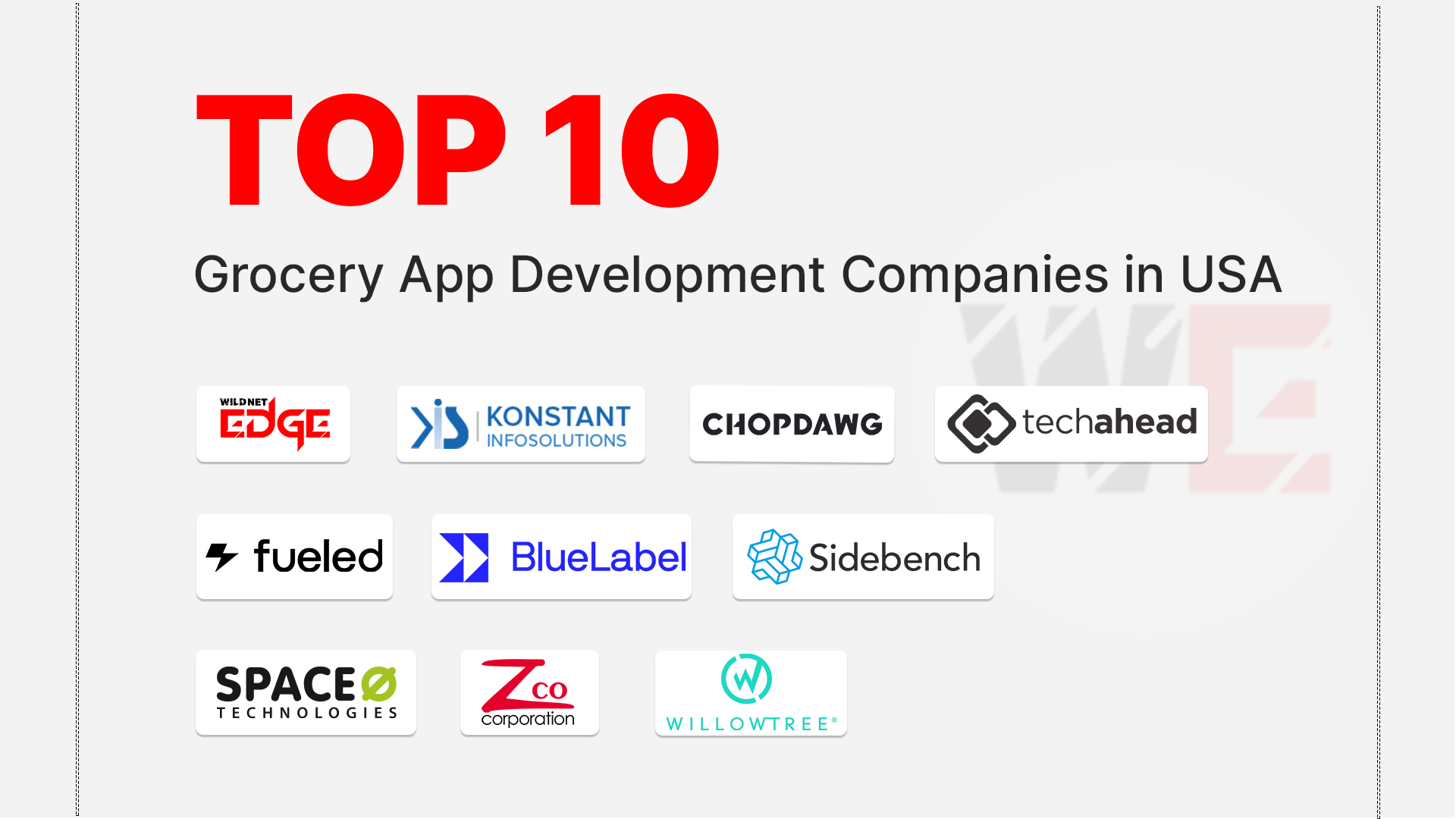
In 2026, the online grocery market will be driven by speed, personalization, and seamless last-mile logistics. This article is your definitive guide to the Best Grocery App Development Companies in the USA. We have ranked the top 10 firms that move beyond simple shopping lists to deliver complex eCommerce Grocery App platforms and robust Delivery Management App solutions. We analyzed these companies based on their technical expertise in real-time inventory synchronization, route optimization algorithms, and secure payment processing.
The grocery business has shifted permanently. Customers expect instant access to thousands of SKUs, personalized suggestions, and reliable same-day delivery, and they expect it all to work without friction. Behind these simple expectations is a complex system: inventory updates from multiple stores, split orders, cold-chain handling, driver dispatching, and route planning.
Generic mobile apps can’t handle this level of complexity. That’s why brands turn to the Best Grocery App Development Companies teams that understand logistics, retail operations, and customer experience. Whether you’re building a full-scale grocery marketplace, a delivery system for multiple locations, or a specialized eCommerce Grocery App, choosing the right partner will define your reliability and customer loyalty.
The companies in this list have the technical depth to build stable, secure, and scalable grocery platforms tailored for the modern retail landscape.
Comparative Matrix: Top 10 Grocery App Development Companies
| Company | Core Services | Industries Served |
| Wildnet Edge | Enterprise Grocery Tech, AI Logistics, Smart Inventory | Retail, Logistics, Food & Beverage |
| Zco Corporation | Mobile Apps, Enterprise Software, Fleet Solutions | Retail, Public Safety, Transportation |
| Fueled | Mobile App Design, Digital Strategy, Branding | Retail, Consumer Tech, Startups |
| WillowTree | Digital Product, Web & App Dev, CX Strategy | Retail, Media, Finance |
| Blue Label Labs | Product Strategy, On-Demand Apps, Design Sprints | Retail, Healthcare, FinTech |
| Sidebench | UI/UX Design, Product Strategy, Mobile Apps | Retail, Consumer Tech, Healthcare |
| Chop Dawg | Startup App Dev, MVP, Fixed Pricing | Startups, Food & Beverage, Retail |
| TechAhead | Mobile App Dev, IoT, Smart Retail | Retail, FinTech, Transportation |
| Space-O Technologies | On-Demand Apps, Logistics Software, Mobile | Retail, On-Demand, Healthcare |
| Konstant Infosolutions | Mobile App Dev, eCommerce, Web Solutions | Retail, Food & Beverage, Logistics |
Top 10 Grocery App Development Companies in USA for 2026
1. Wildnet Edge
- Best for: Enterprise-scale, AI-driven grocery platforms and complex supply chain integrations.
- Key highlights:
- Over 19 years of industry experience (Founded 2005).
- Enterprise-scale team of 350+ certified engineers.
- Proven track record with 8,000+ projects delivered.
- CMMI Level 3 appraised for mature, repeatable processes.
Wildnet Edge leads the list as one of the Best Grocery App Development Company because they build platforms that handle real grocery operations—not just online ordering. Their engineering teams develop entire ecosystems, from customer-facing eCommerce Grocery App interfaces to warehouse automation tools, delivery fleet routing, and real-time multi-store inventory sync. They specialize in solving challenges that large chains face, such as unpredictable demand, cold-chain handling, and massive order volumes during peak hours.
Their AI work is a major differentiator. Wildnet Edge creates predictive restocking tools, dynamic pricing modules, advanced recommendation engines, and machine-learning–powered route optimization for delivery drivers. Their backend systems are designed for high throughput and built with strict PCI-DSS compliance, making them ideal for retailers processing thousands of transactions per minute.
For enterprise grocers who need reliability, automation, and scalability, Wildnet Edge delivers the full stack from strategy to engineering to long-term support.
Projects Built (Highlights):
- Smart Grocery Inventory System: Architected a real-time inventory management platform for a multi-location grocery chain. The system synchronizes stock levels between physical stores and the online app, reducing order cancellations by 40%.
- AI-Driven Delivery Logistics: Developed a custom route optimization engine for a grocery delivery fleet. The solution uses machine learning to predict traffic patterns and assign orders to drivers for the fastest possible delivery times.
- Hyper-Local Marketplace App: Built a scalable multi-vendor platform that connects local farmers and boutique grocers with consumers. The app features automated vendor payouts, quality control checks, and a seamless user interface.
- Pros:
- Enterprise-scale (350+ engineers) for handling complex, multi-store retail rollouts.
- AI-first approach integrates predictive ordering and dynamic routing.
- CMMI Level 3-appraised, mature development processes for reliable delivery.
- Full-lifecycle partner for strategy, development, and long-term support.
- Cons:
- Their robust, enterprise-grade architecture may be more complex than a small, single-location corner store requires.
- Their focus on deep custom engineering and AI integration represents a premium strategic investment, not a low-budget solution for basic app templates.
2. Zco Corporation
- Best for: Established grocery chains needing a stable, US-based veteran partner.
- Key highlights:
- Founded in 1989, offering decades of stability.
- Large, US-based in-house team.
- Deep expertise in enterprise mobility and backend systems.
Zco Corporation brings decades of experience to grocery technology. As one of the oldest software firms in the country, they have built hundreds of enterprise systems and are known for stable long-term delivery. Their US-based team is helpful for grocers that need frequent collaboration, integration with older POS systems, or complex compliance work.
Zco’s engineering strengths shine in areas like employee apps, internal logistics tools, barcode scanners, loyalty systems, and admin dashboards. They also handle secure payment integration and can connect new grocery apps with existing systems like inventory management, ERP, or legacy POS. Because of their size and reliability, Zco is often chosen by established grocery chains that want predictable delivery and a partner that won’t disappear after launch.
- Pros:
- Stable, long-term partner with a large US-based team.
- Deep experience with secure, enterprise-grade mobile solutions.
- Cons:
- Their primary focus is broad enterprise software, not exclusively grocery retail.
- May be less agile and “trendy” than smaller, startup-focused design shops.
- Premium pricing reflects their large, US-based team structure.
3. Fueled
- Best for: Premium grocery brands needing award-winning design and UX.
- Key highlights:
- Renowned for world-class UI/UX design.
- Strong focus on branding and consumer experience.
- NY-based with a premium clientele.
Fueled is regarded as the creator of visually fabulous digital products and thus is the best choice for high-end or niche grocery brands which intend to create a design statement through their products. Besides being one of the best grocery app development companies, they emphasize consumer psychology, user behavior, and shopping experience heavily turning grocery browsing into a pleasant, seamless venture. This makes them perfect for the brands like specialty foods, curated meal kits, or premium organic groceries.
From impeccable UI to super-efficient mobile apps, Fueled creates products that give out a polished and easy-to-use vibe. Although they do have a backend engineering team, the customer experience that they create is the one that earns the company retention and higher order value. Plus, they also assist grocery retailers in creating great digital identities that are in line with their physical branding.
- Pros:
- World-class, award-winning UI/UX design capabilities.
- Strong strategic focus on brand building and user retention.
- Cons:
- Very high cost, making them inaccessible for many budget-conscious businesses.
- Highly selective with their client list.
- Focus is heavily on the frontend/design; complex logistics engineering is secondary.
4. WillowTree
- Best for: Enterprise-scale digital products with high polish and reliability.
- Key highlights:
- Large, US-based enterprise team.
- A “digital product agency” focused on full-scale builds.
- Strong expertise in mobile and web/cloud convergence.
WillowTree has built mobile products for some of the world’s biggest brands, and their reliability makes them ideal for large grocery corporations that need stability during peak load. Their product teams handle strategy, UI/UX, development, QA, and post-launch optimization under one roof.
Their grocery solutions include personalized shopping, digital coupons, loyalty wallet integration, curbside pickup workflows, and real-time order status. They also excel in building systems that synchronize data across mobile, web, kiosks, and store software. Because they work with Fortune 500 companies regularly, they are used to strict SLAs, strong cybersecurity expectations, and enterprise-level governance.
- Pros:
- Proven, stable partner for large enterprise clients.
- Delivers high-quality, polished digital products.
- Cons:
- Grocery is one component of their service, not their sole specialty.
- Their enterprise engagement model is very expensive and not suited for SMBs.
- Can be less agile than smaller, niche-focused firms.
5. Blue Label Labs
- Best for: On-demand grocery startups needing rapid validation and strategy.
- Key highlights:
- Design Sprint methodology.
- Strong focus on user-centric product definition.
- NY-based team with a polished portfolio.
Blue Label Labs is perfect for founders or retailers testing a new grocery concept. They specialize in rapid prototyping and validation through Design Sprints, helping teams refine their idea before committing to full development. Startups launching niche delivery concepts—like farm-fresh boxes, zero-waste grocery delivery, or specialized dietary marketplaces—benefit from their structured, user-tested approach.
They focus on practical product decisions, making sure the app flows are simple and the features match real user needs. Post-validation, their engineering teams build high-quality mobile and web applications with clean UX and stable performance. Their combination of strategy, design, and engineering makes them a strong choice for companies entering the on-demand grocery space.
- Pros:
- Proven “Design Sprint” process reduces product risk.
- High-quality, US-based engineering and design talent.
- Cons:
- Premium pricing structure.
- Their process is intense and requires significant client involvement.
- Not a “staff augmentation” shop; they own the product process.
6. Sidebench
- Best for: Strategy-led grocery products with a focus on user engagement.
- Key highlights:
- Award-winning product strategy and design.
- “Co-invention” partner model.
- Strong focus on user research and testing.
Sidebench is ideal for grocery companies that want to rethink the shopping experience from the ground up. Their team conducts detailed user research, shopper interviews, and workflow mapping to uncover friction points in the customer journey. From there, they design grocery apps that are simple to navigate despite large catalogs and complex promotions.
They are especially strong in creating experiences for large SKU libraries, personalized recommendations, and intuitive shopping flows. If your business needs clarity on your digital strategy or is tackling a completely new grocery model Sidebench excels at turning ideas into clear product roadmaps and engaging user experiences.
- Pros:
- High-touch, strategic consulting combined with development.
- Excellent track record in user research and product definition.
- Cons:
- Boutique size limits engineering capacity for massive builds.
- Strategy-first engagements require a significant upfront investment.
- Less focused on deep, backend legacy infrastructure maintenance.
7. Chop Dawg
- Best for: Non-technical founders launching a grocery MVP.
- Key highlights:
- Specialized in working with startups.
- Transparent, fixed-price model.
- Strong focus on launching Minimum Viable Products (MVPs).
Chop Dawg is known for helping non-technical founders bring their ideas to life. They are one of the Best Grocery App Development Companies for entrepreneurs launching new delivery models or micro-marketplaces with limited budgets. Their fixed-cost pricing is transparent, and their milestone-driven process helps reduce uncertainty.
They specialize in MVPs helping teams prioritize core features like product catalogs, carts, payments, driver assignment, and real-time tracking. For early-stage grocery businesses that want to launch quickly, gather feedback, and grow iteratively, Chop Dawg is a strong, approachable option.
- Pros:
- Founder-friendly processes with transparent pricing.
- Great for rapid prototyping and MVP launches.
- Cons:
- Not designed for enterprise-scale, legacy system overhauls.
- Small team size limits their ability to scale indefinitely.
- Less experience with high-compliance, heavy-security enterprise needs.
8. TechAhead
- Best for: Integrating IoT and smart retail tech into grocery apps.
- Key highlights:
- Founded in 2009.
- Strong focus on IoT and mobile app development.
- Experience with human-centric design.
TechAhead brings a blend of mobile development and IoT engineering, making them ideal for grocery retailers experimenting with smart-store technology. Examples include shelf sensors, digital price tags, cashier-less checkout, or beacon-based in-store navigation. As one of the best grocery app development companies, they also build high-quality mobile apps with clean UX and strong performance.
For grocery companies modernizing both their online and in-store experiences, TechAhead bridges the gap between digital and physical retail. Their engineering skills extend from mobile interfaces to backend systems and hardware integrations.
- Pros:
- Strong expertise in IoT integration for smart retail solutions.
- Focus on user-centric design and experience.
- Cons:
- Smaller US presence compared to some global giants.
- IoT and hardware integration can drive up project costs significantly.
- May lack the massive scale for global, multi-country rollouts.
9. Space-O Technologies
- Best for: Startups needing a proven, customizable on-demand delivery solution.
- Key highlights:
- Founded in 2010.
- Strong portfolio of on-demand apps (like Glovo).
- Offers both custom dev and white-label solutions.
Space-O Technologies is well-known for building on-demand delivery apps and marketplaces. Their ready-made frameworks allow grocery startups to launch faster while still customizing features for their unique model. They deeply understand dispatching, order batching, tracking, and fleet management core needs for any delivery-heavy grocery model.
As one of the best grocery app development companies, they provide both custom development and white-label solutions, making them highly flexible for businesses with varying budgets. Their strength lies in logistics-heavy applications where real-time visibility and efficient routing matter.
- Pros:
- Deep experience specifically in on-demand delivery apps.
- Flexible engagement models for startups.
- Cons:
- Heavily reliant on offshore development centers.
- Design capabilities may not be as high-end as premium US agencies.
- Codebase quality can vary depending on the project speed.
10. Konstant Infosolutions
- Best for: Mid-market grocers needing a cost-effective, full-service partner.
- Key highlights:
- Founded in 2003.
- Strong focus on mobile app development and e-commerce.
- Experience with on-demand delivery solutions.
Konstant Infosolutions is a dependable choice for mid-market grocery businesses that need a well-built app without premium pricing. They deliver solid engineering across mobile and web and have experience building end-to-end grocery systems, including catalogs, search, delivery features, admin dashboards, and analytics.
Their development style focuses on reliability and functionality rather than flashy design. They are particularly good for grocers who need a practical, straightforward app that works well and integrates with existing operations. Their pricing model makes them accessible to mid-sized chains or expanding local retailers.
- Pros:
- Long-standing company with over 20 years of experience.
- Strong capabilities in both web and mobile development.
- Cons:
- Their design aesthetic can sometimes feel less “modern” than boutique design agencies.
- Primarily an offshore model, which requires active project management.
- Less focused on advanced AI features than some newer competitors.
How to Choose the Best Grocery App Development Company in the USA — 2026 Guide
The US online grocery market reached $150 billion in 2025 and continues to grow as consumers consolidate their shopping habits around mobile-first experiences. Building a grocery app is significantly more complex than a standard e-commerce platform — real-time inventory sync across physical store shelves, weight-variable items, age-verification for alcohol, slot-based delivery windows, and AI-driven substitution logic all create unique technical challenges. This guide helps you choose the right grocery app development company in the USA.
Grocery App Types — Know your business model before you build
- Single-store grocery app — a branded app for one retail chain; requires deep POS integration and real-time SKU sync
- Multi-vendor grocery marketplace — multiple stores on one platform (like Instacart); requires complex vendor onboarding, commission management, and multi-warehouse inventory
- Quick-commerce / dark store model — 10–30 minute delivery from micro-fulfillment centers; requires picker optimization algorithms, real-time slot management, and dark store inventory software
- Subscription box grocery — curated weekly boxes with personalized recommendations; requires subscription billing, dietary preference ML models, and perishable supply chain coordination
Must-have Features for Grocery Apps in 2026
- Real-time inventory sync — reflects actual shelf availability (not just warehouse stock) updated every 1–5 minutes
- AI-powered substitution suggestions — when an item is out of stock, suggest nutritionally/price-equivalent alternatives with customer approval workflow
- Smart cart with weight-variable items — bananas priced by pound, not unit; handles variable pricing at checkout
- Delivery slot management — time-window booking, driver routing optimization, and slot capacity management
- Age verification — for alcohol and tobacco purchases; integrates with Yoti, Jumio, or similar verification APIs
- Loyalty and rewards integration — points accumulation, digital coupons, personalized offers based on purchase history
- Voice shopping — “Add oat milk to my cart” via Alexa/Siri integration or custom wake-word
Our Selection Criteria: How We Chose the Best Grocery App Development Companies
Selecting the Best Grocery App Development Companies in the USA for 2026 required a focus on deep domain expertise, logistics capability, and user experience. We carefully evaluated each company using a set of key parameters.
Here’s what we looked at:
- Retail & Grocery Expertise: We prioritized firms with verifiable experience in the retail sector. This includes understanding inventory SKU management, barcode scanning workflows, and point-of-sale (POS) integrations.
- Logistics Capability: We looked for companies that excel at building Delivery Management App solutions, integrating with mapping APIs (Google Maps, Mapbox) for route optimization and real-time driver tracking.
- User Experience (UX) Focus: Grocery apps deal with thousands of items. We ranked firms higher if they demonstrated a strong focus on intuitive search, easy navigation, and frictionless checkout processes.
- Proven Track Record: Experience matters. We considered each firm’s years in business, the complexity of their grocery/retail projects, client portfolios, and verified success stories.
- Innovation & AI: We looked for firms that are using AI to personalize product recommendations, predict inventory needs, and optimize delivery routes.
- Scalability: We assessed how each company handles high-volume traffic periods (like holidays) and their ability to build systems that don’t crash under load.
- Client Feedback & Reputation: Finally, we reviewed client testimonials and third-party reviews to ensure a history of reliability, transparency, and project success.
Conclusion
In 2026, the grocery industry is digital, fast, and personalized. The Best Grocery App Development Companies listed above, including industry leaders like Wildnet Edge, provide the critical, specialized engineering expertise to build these complex systems. By selecting a top-tier partner, you are not just hiring developers; you are investing in a robust, high-performance, and user-centric foundation for your retail business.
FAQs
Grocery app development is the process of creating mobile and web applications that allow customers to browse products, place orders, and schedule deliveries from a grocery store. It also involves building the backend systems for store managers and drivers.
An eCommerce Grocery App is the customer-facing mobile application. It includes features like product search, shopping cart, secure payment gateway, order history, and real-time order tracking.
A Delivery Management App is used by drivers to manage their deliveries. It includes features for route optimization, proof of delivery (signatures/photos), and navigation to ensure orders reach customers efficiently.
The cost varies widely. A simple ordering app might cost $30,000-$50,000. A fully integrated platform with customer, driver, and store apps, plus a backend admin panel from one of the Top Grocery App Development Companies, can cost $100,000 to over $300,000.
A competitive grocery delivery app in 2026 requires real-time inventory sync with store shelves, AI-powered substitution suggestions for out-of-stock items, weight-variable item pricing (produce by the pound), slot-based delivery scheduling with driver routing, age verification for alcohol purchases, loyalty and digital coupon integration, and contactless payment (Apple Pay, Google Pay). The best grocery app development companies in the USA also add voice shopping integration and personalized ML-driven product recommendations based on purchase history.
AI helps personalize the shopping experience by recommending products based on past purchases. It also optimizes inventory management by predicting demand and improves delivery efficiency through intelligent route planning.
Yes. Most custom grocery apps are designed to integrate with existing Point of Sale (POS) and ERP systems. This ensures that online orders are automatically synced with in-store inventory and sales data.
Grocery apps require integrations with: POS systems (NCR, Verifone, Square) for real-time inventory updates; ERP systems (SAP, Oracle) for purchase orders and supplier management; payment processors (Stripe, Braintree) with support for EBT/SNAP for food assistance programs; delivery routing APIs (EasyPost, Google Maps Platform); age verification APIs (Jumio, Yoti) for regulated products; and loyalty platforms (Punchh, Loyalty Lion) for rewards programs. Grocery app development companies in the USA with retail experience handle all of these integrations.

Managing Director (MD) Nitin Agarwal is a veteran in custom software development. He is fascinated by how software can turn ideas into real-world solutions. With extensive experience designing scalable and efficient systems, he focuses on creating software that delivers tangible results. Nitin enjoys exploring emerging technologies, taking on challenging projects, and mentoring teams to bring ideas to life. He believes that good software is not just about code; it’s about understanding problems and creating value for users. For him, great software combines thoughtful design, clever engineering, and a clear understanding of the problems it’s meant to solve.

 based on 1200+ reviews



