 sales@wildnetedge.com
 +1 (212) 901 8616
 +1 (437) 225-7733
















































































































 ChatGPT Development & Enablement
  Hire AI & ChatGPT Experts
  ChatGPT Apps by Industry
  ChatGPT Blog
  ChatGPT Case study
  AI Development Services
  Industry AI Solutions
  AI Consulting & Research
  Automation & Intelligence





TL;DR
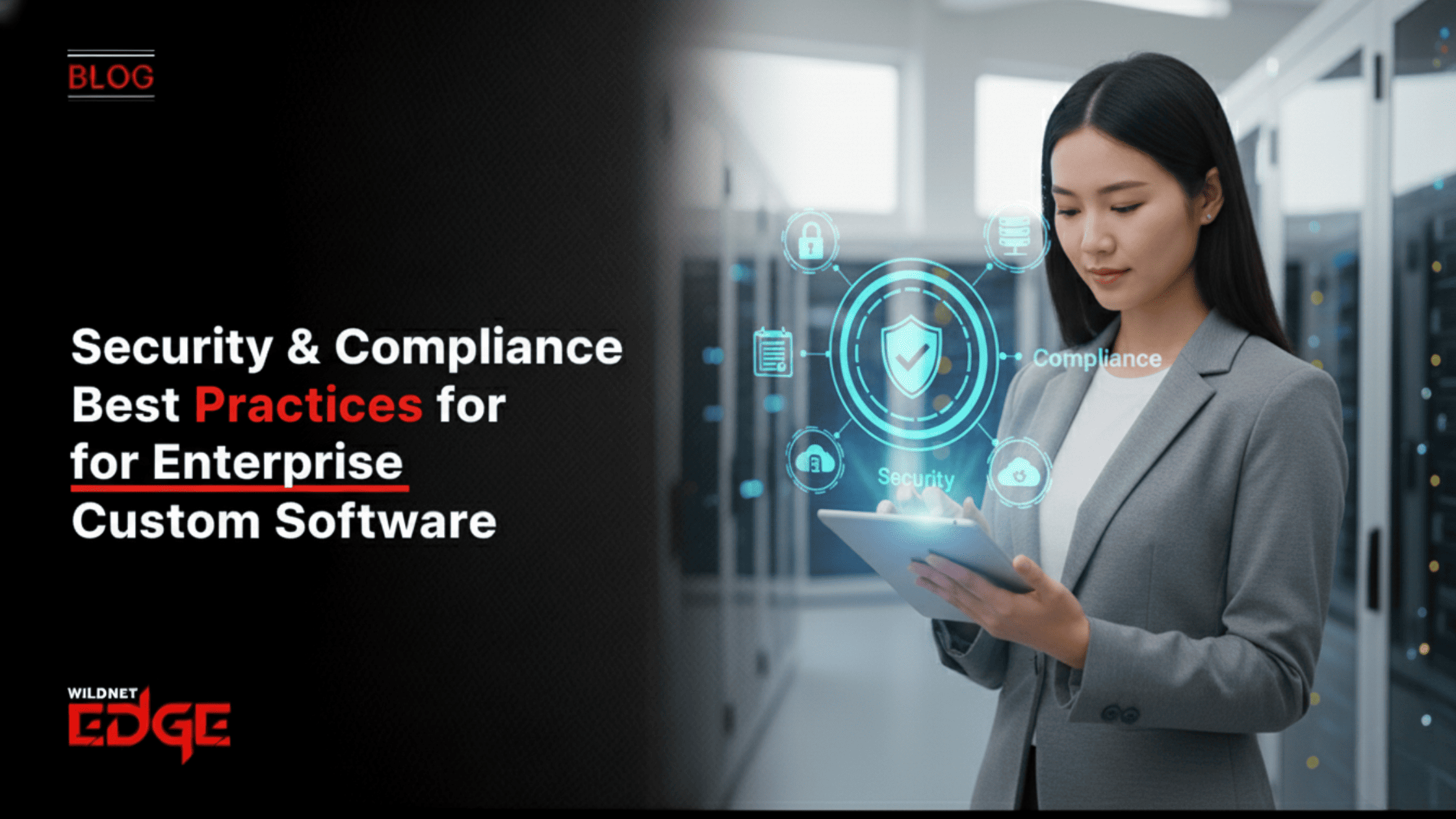
This article highlights key software security best practices for enterprises building custom applications. It stresses integrating security into every stage of development through a Secure Software Development Lifecycle (SSDLC) and adherence to standards like OWASP Top 10. Core measures include strong authentication, encryption, and input validation. It also emphasises compliance with frameworks such as GDPR and SOC 2 to build trust and ensure market readiness. Ultimately, embedding security from the start safeguards data, reduces risk, and strengthens long-term software resilience.
Custom software is a powerful engine for innovation and efficiency for any enterprise. However, these bespoke applications represent a significant attack surface and a repository for sensitive corporate and customer data. In an era of escalating cyber threats and stringent regulations, treating security and compliance as mere checkboxes is a recipe for disaster. Implementing robust software security best practices from the beginning is not just an IT requirement; it’s a fundamental business imperative for protecting your assets, reputation, and bottom line.
Why Security & Compliance Cannot Be Optional
The stakes associated with insecure enterprise software are enormous:
- Data Breaches: Compromising sensitive customer or corporate data leads to massive financial losses (incident response, legal fees, regulatory fines) and irreparable reputational damage. The cost continues to rise year over year.
- Operational Disruption: Security incidents can bring critical business operations to a halt, leading to significant revenue loss.
- Regulatory Penalties: Non-compliance with regulations like GDPR, CCPA, or industry-specific standards (e.g., HIPAA, PCI DSS) can result in crippling fines and legal action. Achieving enterprise-grade compliance is mandatory, not optional.
- Loss of Trust: Customers and partners expect their data to be protected. A security failure erodes trust, which is incredibly difficult to regain.
Proactive security is an investment in business continuity and resilience.
The Foundation: Secure Software Development Lifecycle (SSDLC)
The most effective approach is to integrate security into every phase of the software development process. A Secure Software Development Lifecycle (SSDLC) makes security a shared responsibility, not just a task for a separate team at the end. Key stages include:
- Secure Requirements: Defining security and compliance requirements alongside functional requirements.
- Secure Design: Using threat modelling to identify potential vulnerabilities in the application architecture.
- Secure Coding: Training developers on secure coding for enterprise practices (e.g., avoiding common pitfalls outlined in OWASP Top 10) and using secure frameworks. A strong SSDLC delivers a reliable, secure software development lifecycle.
- Secure Testing: Integrating automated security scanning tools (SAST, DAST, SCA) into the CI/CD pipeline and conducting regular manual penetration testing.
- Secure Deployment & Maintenance: Implementing secure configurations, monitoring production environments, and having a robust patch management process.
Core Software Security Best Practices
Beyond the SSDLC framework, several technical best practices are essential for building secure custom enterprise software.
1. Strong Authentication & Authorisation
Control who can access the application and what they can do.
- Multi-Factor Authentication (MFA): Essential for all user accounts, mainly administrative ones.
- Role-Based Access Control (RBAC): Implement the principle of least privilege, granting users only the permissions necessary for their roles. This is particularly crucial in systems involving ERP governance and access control.
- Secure Session Management: Protect against session hijacking with techniques like secure cookies and short timeouts.
2. Data Encryption (In Transit & At Rest)
Protect sensitive data wherever it resides.
- HTTPS/TLS: Encrypt all data transmitted between the user and the application servers.
- Database Encryption: Encrypt sensitive data stored in databases (e.g., PII, financial information).
- Secure Key Management: Protect the cryptographic keys used for encryption.
3. Input Validation and Output Encoding
Prevent injection attacks by treating all external input as untrusted.
- Input Validation: Rigorously check all data submitted by users or external systems against expected formats and types.
- Output Encoding: Encode data correctly before displaying it in the user interface to prevent Cross-Site Scripting (XSS) attacks.
4. Dependency Management & Vulnerability Scanning
Modern applications rely heavily on third-party libraries.
- Software Composition Analysis (SCA): Regularly scan your dependencies for known vulnerabilities using automated tools.
- Patch Management: Have a process to update libraries quickly when security patches are released.
Navigating Enterprise-Grade Compliance
Enterprises often face specific compliance requirements based on their industry or the data they handle.
- SOC 2 Compliance: This is essential for SaaS companies and service providers handling customer data, focusing on security, availability, processing integrity, confidentiality, and privacy. Achieving SOC2 software compliance often requires significant investment in controls and auditing.
- GDPR Compliance: Mandatory for handling personal data of EU residents, requiring strict data privacy controls, consent management, and breach notification processes. Building GDPR-ready development practices is crucial for global enterprises.
- Industry-Specific Regulations: (e.g., HIPAA for healthcare, PCI DSS for payments). These require specific technical and process controls tailored to the sector. Focusing on data-safe CRM implementation is vital when handling customer health or financial information.
Security & Compliance in Action: Case Studies
Case Study 1: A Financial Services Platform Achieving SOC 2
- The Challenge: A growing FinTech platform is needed to achieve SOC 2 Type 2 compliance to secure large enterprise clients who mandate it as part of vendor risk management.
- Our Solution: We partnered with their internal team and external auditors. Our developers implemented necessary technical controls identified in the gap analysis, including enhanced logging, stricter access controls via RBAC, and automated vulnerability scanning in their CI/CD pipeline, supported by our expertise in DevSecOps and cloud hardening.
- The Result: The platform successfully achieved SOC 2 Type 2 certification. This unlocked major enterprise sales opportunities and provided a significant competitive advantage by demonstrating a verifiable commitment to security.
Case Study 2: A Healthcare Provider’s GDPR-Ready Patient Portal
- The Challenge: A European healthcare provider needed a custom patient portal that fully complied with stringent GDPR requirements for handling sensitive health data.
- Our Solution: We designed the application with privacy-by-design principles. This included implementing granular user consent mechanisms, robust data encryption at rest and in transit, strict access controls, and features enabling patients to exercise their data rights (like data access and deletion requests).
- The Result: The portal launched successfully, meeting all GDPR-ready development requirements. This built significant trust with patients and ensured the provider avoided potentially massive non-compliance fines.
Our Technology Stack for Secure Enterprise Development
We prioritise security throughout the technology stack.
- Secure Coding Frameworks: OWASP ESAPI, Spring Security (Java), ASP.NET Core Identity ( .NET)
- SAST Tools: SonarQube, Checkmarx
- DAST Tools: OWASP ZAP, Burp Suite
- SCA Tools: Snyk, Dependabot
- Cloud Security: AWS Security Hub, Azure Security Center, GCP Security Command Center
- Authentication: OAuth 2.0, OpenID Connect, SAML
Conclusion
For enterprises investing in custom software, robust security best practices and a proactive approach to enterprise-grade compliance are non-negotiable. Integrating security throughout the development lifecycle, adhering to secure coding for enterprises, and planning for regulations like GDPR or standards like SOC2 software compliance are essential for protecting your business and building trust. It’s an ongoing commitment that safeguards your most valuable digital assets.
Ready to build secure, compliant, and transformative enterprise software? At Wildnet Edge, our AI-first approach incorporates intelligent security monitoring and threat detection into our development process. We deliver solutions that are not just functional but resilient and trustworthy.
FAQs
The SSDLC integrates security into every phase, making it more effective and cost-efficient. Catching a vulnerability during the design or coding phase is exponentially cheaper and faster than fixing it after the application is deployed and potentially exploited.
While there’s an upfront investment in secure practices and tools, building securely from the start is almost always cheaper than remediating vulnerabilities later or recovering from a data breach. Think of it as essential quality control, not an optional add-on.
The OWASP Top 10 is a standard awareness document representing a broad consensus about web applications’ most critical security risks. Training developers on secure coding for enterprises to avoid these common pitfalls (like injection flaws, broken authentication, etc.) significantly improves application security.
HIPAA compliance involves specific technical, physical, and administrative safeguards. For software, key technical areas include strict access controls, audit logging, data encryption, and secure data transmission. Partnering with a developer experienced in healthcare compliance is crucial.
Implement Software Composition Analysis (SCA) tools within your development pipeline. These tools automatically scan the open-source libraries and third-party components you use for known vulnerabilities and alert you to required updates or patches.
* SAST (Static Application Security Testing): Analyses source code for vulnerabilities without running the application.
* DAST (Dynamic Application Security Testing): Tests the running application by simulating attacks from the outside.
* SCA (Software Composition Analysis): Scans third-party libraries for known vulnerabilities. A comprehensive strategy uses all three.
It requires ongoing vigilance: regular security patching, continuous monitoring for threats, periodic penetration testing, and staying updated on evolving regulatory requirements and security best practices. Security is not a one-time project.

Managing Director (MD) Nitin Agarwal is a veteran in custom software development. He is fascinated by how software can turn ideas into real-world solutions. With extensive experience designing scalable and efficient systems, he focuses on creating software that delivers tangible results. Nitin enjoys exploring emerging technologies, taking on challenging projects, and mentoring teams to bring ideas to life. He believes that good software is not just about code; it’s about understanding problems and creating value for users. For him, great software combines thoughtful design, clever engineering, and a clear understanding of the problems it’s meant to solve.


 based on 1200+ reviews



