 sales@wildnetedge.com
 +1 (212) 901 8616
 +1 (437) 225-7733
















































































































 ChatGPT Development & Enablement
  Hire AI & ChatGPT Experts
  ChatGPT Apps by Industry
  ChatGPT Blog
  ChatGPT Case study
  AI Development Services
  Industry AI Solutions
  AI Consulting & Research
  Automation & Intelligence





TL;DR
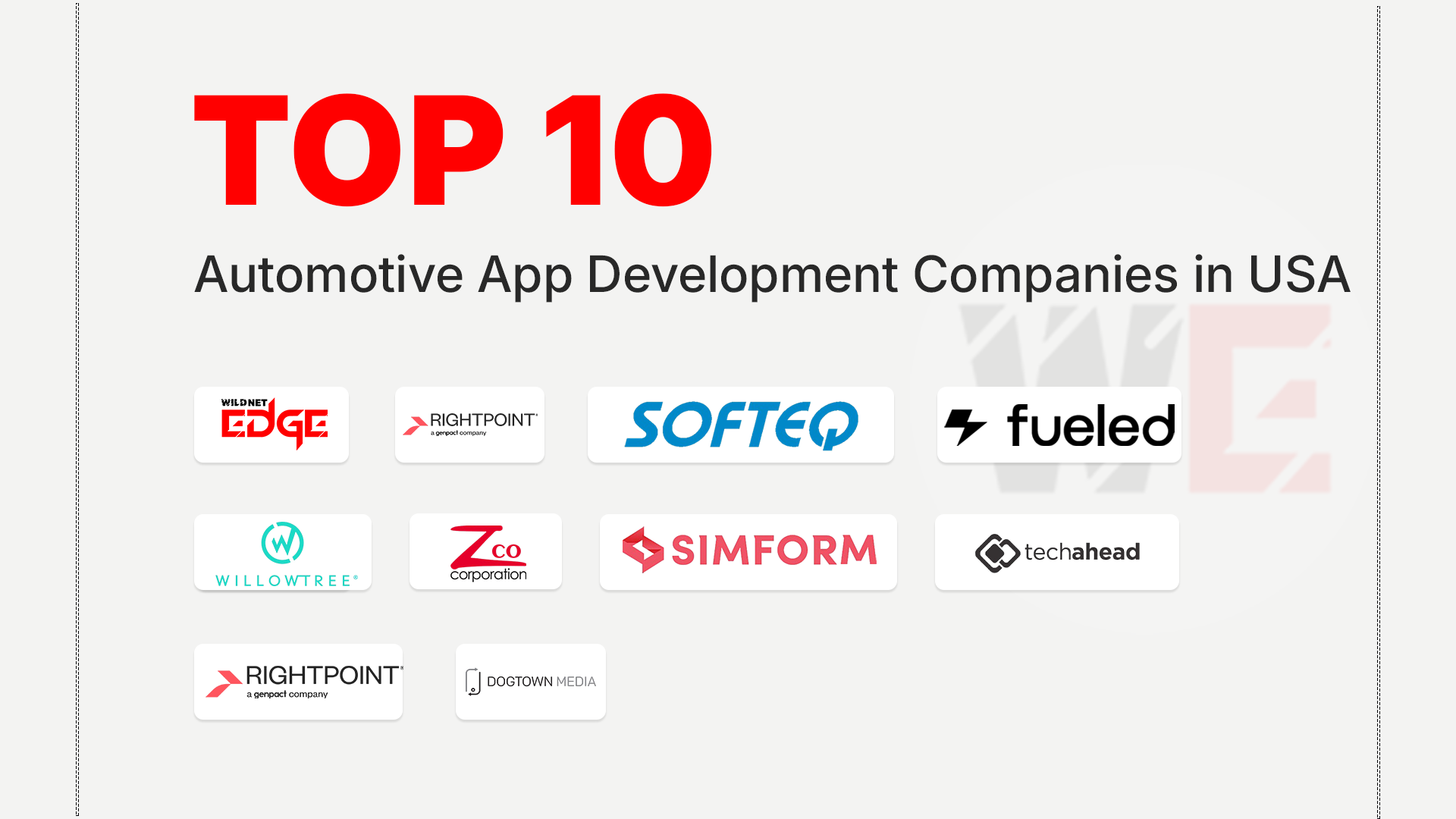
In 2026, the automotive industry is defined by connectivity, electrification, and software-defined vehicles. This article is your definitive guide to the Top Automotive App Development Companies in the USA. We have ranked the top 10 firms that move beyond basic dashboards to deliver complex Vehicle Tracking App solutions and robust Automotive ERP platforms. We analyzed these companies based on their technical expertise in telematics, IoT integration, and cloud-native mobility solutions.
The automotive world isn’t running on steel and engines; it’s running on software. Cars track themselves, fleets talk to the cloud, EVs negotiate for charging slots, and drivers expect apps to control half the vehicle features. That’s why choosing from the Top Automotive App Development Companies actually matters.
A simple app won’t cut it. Modern automotive systems deal with constant location updates, real-time alerts, vehicle diagnostics, EV range calculations, telematics packets, and security rules that can’t afford mistakes. You can’t just “add an API” and hope it works.
So if you’re building a Vehicle Tracking App, upgrading your fleet tech, or deploying a custom Automotive ERP, you need a development partner that understands how cars behave on the road, not just on a whiteboard. This list cuts through the noise and gives you the companies that actually know what they’re doing.
Comparative Matrix: Top 10 Automotive App Development Companies
| Company | Core Services | Industries Served |
| Wildnet Edge | Enterprise Auto Tech, EV Solutions, Telematics | Automotive, Logistics, Manufacturing, Energy |
| Rightpoint | Digital Transformation, Fleet Mgmt, Connected Car | Automotive, Logistics, FinTech |
| Softeq | Low-level Firmware, Embedded Systems, HMI | Automotive, Consumer Electronics, Industrial |
| Fueled | Mobile App Design, Digital Strategy, Connected Car | Automotive, Consumer Tech, Retail |
| WillowTree | Digital Product, In-Car Experience, Mobile | Automotive, Media, Finance |
| Zco Corporation | Mobile Apps, Enterprise Software, Fleet Tracking | Public Safety, Transportation, Automotive |
| Simform | Digital Product Engineering, Cloud, Mobility | Tech, Logistics, Automotive |
| TechAhead | Mobile App Dev, IoT, Smart Mobility | Automotive, Logistics, FinTech |
| Rightpoint | In-Car Experience, Digital Cockpit, CX Strategy | Automotive, Healthcare, Retail |
| Dogtown Media | Mobile Apps, IoT, Connected Devices | Healthcare, FinTech, Automotive |
Top 10 Automotive App Development Companies in USA for 2026
1. Wildnet Edge
- Best for: Enterprise-scale, AI-driven automotive ecosystems and EV management platforms.
- Key highlights:
- Over 19 years of industry experience (Founded 2005).
- Enterprise-scale team of 350+ certified engineers.
- Proven track record with 8,000+ projects delivered.
- CMMI Level 3 appraised for mature, repeatable processes.
Wildnet Edge is the team manufacturers and mobility brands call when they want an automotive platform that doesn’t collapse under real-time data. As a top Automotive App Development Company, they don’t build “car apps”; they build entire ecosystems. Their engineers think in terms of telematics pipelines, EV battery behavior, route optimization, CAN bus quirks, and the hard problems that appear once vehicles start talking to the cloud.
They build everything from consumer-facing Vehicle Tracking App dashboards to massive Automotive ERP systems that sync dealerships, fleets, factories, and service centers. Their AI-first approach shows up everywhere: predictive maintenance that spots issues before a breakdown, driver-behavior analysis that cuts fuel costs, and automated workflows that remove hours of manual fleet work.
What truly differentiates Wildnet Edge is its AI-first approach. They don’t just track vehicles; they engineer intelligent mobility platforms. This includes integrating AI models for predictive maintenance to prevent breakdowns, building automated route optimization algorithms for logistics fleets, and deploying intelligent chatbots for dealership customer support. Their solutions are designed to turn raw vehicle telemetry into actionable operational insights.
Wildnet Edge understands how unpredictable the automotive world is. A fleet can jump from perfect connectivity to dead zones in minutes. EV drivers need charging predictions that don’t lie. Dealerships need inventory that updates faster than customers refresh the screen. And logistics teams need routing systems that don’t choke on thousands of live updates per minute.
Clients often say working with Wildnet Edge feels like having a second R&D department, one that understands both the software and the vehicle realities. They’re the safest pick when you want something stable, scalable, intelligent, and built for long-term use.
Projects Built (Highlights):
- EV Charging Network App: Developed a comprehensive mobile app for an EV infrastructure provider. The app features real-time charger availability, route planning based on battery range, and seamless in-app payments.
- AI-Powered Fleet Telematics: Architected a custom fleet management dashboard that ingests data from thousands of vehicles. The system uses AI to analyze driver behavior, fuel consumption, and maintenance needs, reducing operational costs by 15%.
- Dealership Management ERP: Built a unified Automotive ERP solution for a multi-location dealership group. The platform integrates sales, service, and parts inventory into a single source of truth, streamlining operations and improving customer service.
- Pros:
- Enterprise-scale (350+ engineers) for handling complex, multi-region automotive rollouts.
- AI-first approach integrates predictive maintenance and smart logistics.
- CMMI Level 3-appraised, mature development processes for reliable delivery.
- Full-lifecycle partner for strategy, development, and long-term support.
- Cons:
- Their comprehensive, enterprise-level process may be too robust for a simple, single-feature car accessory app.
- Their focus on deep custom engineering and AI integration represents a premium investment, not a low-budget solution for quick white-label apps.
2. Rightpoint
- Best for: In-car digital experiences (HMI) and companion apps.
- Key highlights:
- Award-winning work with Cadillac and Chevrolet.
- Deep expertise in the “digital cockpit” and connected car ecosystems.
- Strong strategy for EV (Electric Vehicle) user journeys.
Rightpoint is a heavyweight in the automotive software space, specifically for the user experience inside and outside the car. They are one of the Top Automotive App Development Companies for OEMs that need to design the future of the digital cockpit. Their work defines how drivers interact with their vehicles, from dashboard touchscreens to mobile companion apps that control climate and charging. They understand the specific safety and usability constraints of automotive software better than almost any generalist firm.
- Pros:
- Unmatched portfolio of high-profile automotive work (GM, etc.).
- Deep expertise in bridging mobile apps with vehicle hardware.
- Cons:
- Primarily focused on OEMs and Tier 1 suppliers, not small auto shops.
- Very high engagement costs due to specialized expertise.
- Projects are strategic and long-term, not quick app builds.
3. Softeq
- Best for: Low-level firmware, embedded systems, and in-vehicle infotainment (IVI).
- Key highlights:
- Founded in 1997.
- Specializes in low-level programming and hardware integration.
- Expertise in automotive embedded software and HMI.
Softeq is the team for automotive projects that involve the deep technical layers most agencies can’t touch. They work directly with firmware, custom chips, sensors, ECUs, and in-vehicle infotainment systems. If your product needs to talk to the car at a hardware level, Softeq is one of the few teams that won’t hesitate. As one of the top automotive app development companies, they handle low-level code, timing issues, memory limits, and communication protocols, the things that keep automotive software stable on the road. They’re ideal for digital dashboards, HUDs, diagnostic tools, or any feature where reliability matters more than pretty visuals.
Automotive hardware is brutal; one wrong timing loop can freeze a display, one bad data packet can break a feature. Softeq engineers think about those risks at every step. They’re not guessing: they’ve shipped projects for clusters, sensors, IoT modules, and embedded automotive devices.
- Pros:
- Deep expertise in hardware, firmware, and automotive IoT.
- Capable of full-stack development from chip to cloud.
- Cons:
- Their niche focus on hardware makes them less suitable for pure marketing or sales apps.
- An engineering-heavy culture may lack the user-centric design flair of a digital agency.
- Premium pricing for specialized low-level programming skills.
4. Fueled
- Best for: Premium, design-led apps for luxury automotive brands.
- Key highlights:
- Renowned for world-class UI/UX design.
- Strong focus on branding and consumer experience.
- NY-based with a premium clientele.
Fueled is the agency you hire when your automotive app needs to feel premium. They don’t just design interfaces, they create experiences that match the polish of luxury EVs and high-end auto brands. They understand that drivers expect smooth, elegant digital touchpoints that match the sophistication of the car itself.
Fueled is detail-obsessed. They spend time understanding how drivers think, how they navigate screens, and what makes a digital interface feel “expensive.” Their apps tend to be bold, visually sharp, and intuitive. If your value comes from brand experience, Fueled is one of the few agencies that get it.
They’re not ideal for deep telematics or complex backend systems; that’s not their niche. But pair them with a strong engineering partner, and they’ll deliver an interface that makes your product stand out in a crowded market. Luxury EV makers, new mobility startups, and high-end services often lean on Fueled when design is a core selling point.
- Pros:
- World-class, award-winning UI/UX design capabilities.
- Strong strategic focus on brand building and user retention.
- Cons:
- Very high cost, making them inaccessible for many budget-conscious businesses.
- Highly selective with their client list.
- Focus is heavily on the frontend/design; complex telematics engineering is secondary.
5. WillowTree
- Best for: Enterprise-scale digital products and in-car experiences.
- Key highlights:
- Large, US-based enterprise team.
- “Digital Product” agency focused on full-scale builds.
- Strong expertise in mobile and connected experiences.
WillowTree builds large-scale digital products for brands that need reliability above everything else. They’re ideal for automotive OEMs building unified owner apps, in-car connected experiences, or tools that must support millions of users without downtime.
As one of the top automotive app development companies, they approach projects like a well-run internal product team: organized sprints, careful releases, and rigorous testing. Automotive apps often hit massive traffic spikes, model launches, service campaigns, seasonal surges, and WillowTree builds with those realities in mind.
They’re not built for fast experiments or scrappy prototypes, but they excel at stable, enterprise-grade systems. If you’re an OEM or a large supplier with strict quality expectations, they’re a strong long-term partner.
- Pros:
- Proven, stable partner for large enterprise clients.
- Deep expertise in designing for connected ecosystems.
- Cons:
- Automotive is one component of their service, not their sole specialty.
- Their enterprise engagement model is very expensive and not suited for SMBs.
- Can be less agile than smaller, niche-focused firms.
6. Zco Corporation
- Best for: Established automotive firms needing a stable, US-based veteran partner.
- Key highlights:
- Founded in 1989, offering decades of stability.
- Large, US-based in-house team.
- Deep expertise in enterprise mobility and fleet solutions.
Zco is a veteran team with decades of experience. They’re reliable and calm under pressure, a good fit for automotive companies that want predictable delivery, US-based communication, and stable engineering.
Zco isn’t trying to reinvent the wheel. Their strength is structure: consistent project management, steady development cycles, and an approach that avoids surprises. They’re often chosen by fleets, transportation groups, and high-compliance organizations that need everything documented and secure. They’re less trendy than design studios and less niche than embedded engineering firms, but for dependable, well-organized work, Zco remains one of the safest picks in the US market.
- Pros:
- Stable, long-term partner with a large US-based team.
- Deep experience with secure, enterprise-grade mobile solutions.
- Cons:
- Their primary focus is broad enterprise software, not exclusively automotive.
- May be less agile and “trendy” than smaller, startup-focused design shops.
- Premium pricing reflects their large, US-based team structure.
7. Simform
- Best for: Tech-forward automotive companies needing scalable engineering.
- Key highlights:
- Digital product engineering focus.
- Strong agile and DevOps culture.
- Experience building scalable SaaS platforms for mobility.
Simform works best for automotive SaaS platforms and mobility apps that need strong, scalable engineering. They approach projects with a clean codebase, modern architecture, and DevOps practices that help apps grow without performance issues.
As one of the top automotive app development companies, they integrate well with internal teams and often act as long-term engineering partners. For companies moving to cloud-native mobility tools, EV fleet platforms, or multi-service mobility apps, Simform brings the structure and speed needed to handle constant updates. They’re not hyper-specialized in automotive hardware, but they’re excellent for software-heavy products that need reliability, modern infrastructure, and ongoing support.
- Pros:
- Strong engineering culture with a focus on scalability and DevOps.
- Good balance of cost and quality for long-term product development.
- Cons:
- As a generalist product engineering firm, they lack the hyper-niche automotive focus.
- Global team structure requires effective communication management.
- May be less suited for small, one-off marketing sites or simple apps.
8. TechAhead
- Best for: Smart mobility solutions and IoT-enabled fleet apps.
- Key highlights:
- Founded in 2009.
- Strong focus on IoT and mobile app development.
- Experience with smart transportation features.
TechAhead is a good option for companies building IoT-enabled mobility tools or connected fleet solutions. They balance engineering strength with user-friendly design, making them ideal for apps used by drivers, field teams, and dispatchers.
They’re especially strong in projects where the app needs to feel simple even though the backend logic is complex, such as safety monitoring, diagnostics, connected mobility workflows, etc. TechAhead thinks a lot about real-world use: low connectivity, battery drain, driver fatigue, and rushed interactions. They’re a good fit for mid-sized companies or growing mobility brands that want a strategic partner, not just a coding team.
- Pros:
- Strong expertise in IoT integration and mobility workflows.
- Focus on user-centric design and experience.
- Cons:
- Smaller US presence compared to some global giants.
- IoT hardware integration can drive up project complexity and cost.
- Global team structure implies time-zone management is needed.
9. Rightpoint
- Best for: In-car digital experiences and connected vehicle strategy.
- Key highlights:
- Part of Genpact, with global reach.
- Specialized “Total Experience” approach for automotive.
- Expertise in digital cockpit and HMI design.
Rightpoint is the team for in-car digital experiences. They work on HMIs, digital cockpits, and interfaces where the mobile app and the vehicle dashboard must behave like a single ecosystem. They understand how drivers interact with screens, how much attention each gesture requires, and how to build a unified brand experience across mobile, dashboard, and sometimes even wearables.
Their work is deeply strategic, ideal for OEMs planning next-gen cabin experiences. They’re less suited for operational apps like fleet dashboards, but perfect for future-facing automotive UX.
- Pros:
- Deep expertise in in-car experience (HMI) and digital cockpit design.
- Strong strategic focus on the future of connected mobility.
- Cons:
- Their high-end consulting model is expensive and best suited for large OEMs.
- Projects are often long-term and strategic, rather than quick app builds.
- Less focused on backend fleet logistics than operational firms.
10. Dogtown Media
- Best for: Innovative automotive apps utilizing IoT and connected devices.
- Key highlights:
- Boutique agency focused on emerging tech.
- Strong expertise in IoT and Bluetooth integration.
- Experience with location-based services.
Dogtown Media shines when the automotive idea includes hardware: smart parking, connected car gadgets, beacons, Bluetooth devices, or location-triggered experiences. As one of the top automotive app development companies, they’re curious, experimental, and willing to take on problems others avoid. Their team understands how unpredictable wireless environments can be, how signals drop in garages, how GPS drifts in cities, and how to build apps that keep functioning even when conditions aren’t ideal. They’re best for innovative mobility concepts, interactive automotive products, and connected hardware projects that need both creativity and technical grounding.
- Pros:
- Deep niche expertise in IoT and hardware connectivity.
- Agile, innovative team willing to tackle novel technical challenges.
- Cons:
- Small team size limits the ability to scale for large enterprise IT projects.
- A highly specialized focus may not fit general logistics web portals.
- Premium pricing for their specialized IoT expertise.
Our Selection Criteria: How We Chose the Best Automotive App Development Companies
Selecting the Top Automotive App Development Companies in the USA for 2026 required a focus on deep domain expertise, real-time data capability, and system integration. We carefully evaluated each company using a set of key parameters.
Here’s what we looked at:
- Automotive & Mobility Expertise: We prioritized firms with verifiable experience in the automotive sector. This includes understanding OBD-II protocols, CAN bus data, EV charging standards (OCPP), and fleet management workflows.
- Technical Capability: We looked for companies that excel at integrating complex third-party APIs for mapping (Google Maps, Mapbox), telematics, and Automotive ERP systems, which is the backbone of any connected vehicle platform.
- Real-Time Tech: Automotive apps rely on live data. We ranked firms higher if they demonstrated expertise in WebSockets, MQTT, and other real-time communication protocols essential for tracking.
- Proven Track Record: Experience matters. We considered each firm’s years in business, the complexity of their automotive projects, client portfolios, and verified success stories.
- Innovation & AI: We looked for firms that are using AI for route optimization, predictive maintenance, and driver behavior analysis to drive efficiency.
- Scalability: We assessed how each company handles high-volume data streams from thousands of vehicles and their ability to build systems that scale with fleet growth.
- Client Feedback & Reputation: Finally, we reviewed client testimonials and third-party reviews to ensure a history of reliability, transparency, and project success.
Conclusion
In 2026, cars run on software just as much as engines. The Top Automotive App Development Companies, especially teams like Wildnet Edge, are the ones building the systems that keep fleets connected, EVs smart, and drivers informed. Picking the right partner isn’t just a tech decision; it’s the difference between a platform that grows with your business and one that breaks under real-world pressure. If you want an automotive platform that’s fast, reliable, and built for the future, choose a team that understands the road, not just the code.
FAQs
Automotive app development is the process of creating software applications for the automotive industry. This includes apps for vehicle tracking, fleet management, EV charging, connected car features, and dealership management.
A Vehicle Tracking App is a mobile application that uses GPS and telematics data to monitor the real-time location and status of vehicles. It helps owners and fleet managers track routes, speed, and vehicle health.
Automotive ERP (Enterprise Resource Planning) is a comprehensive software system designed for the automotive industry. It integrates core business processes like manufacturing, supply chain, inventory, sales, and finance into a single platform.
The cost varies widely. A simple companion app might cost $40,000-$60,000. A fully integrated fleet management platform with custom hardware integration and AI analytics from one of the Top Automotive App Development Companies can cost $150,000 to over $500,000.
Key features include real-time GPS tracking, remote vehicle control (lock/unlock), maintenance alerts, driver behavior monitoring, and integration with in-car infotainment systems.
AI is used to predict vehicle maintenance needs before breakdowns occur, optimize driving routes for fuel efficiency, analyze driver behavior for safety, and provide personalized in-car experiences.
Yes. Developers use OBD-II dongles or OEM APIs (from manufacturers like Ford or GM) to access vehicle data such as speed, fuel level, and engine health, allowing the app to communicate directly with the car.

Managing Director (MD) Nitin Agarwal is a veteran in custom software development. He is fascinated by how software can turn ideas into real-world solutions. With extensive experience designing scalable and efficient systems, he focuses on creating software that delivers tangible results. Nitin enjoys exploring emerging technologies, taking on challenging projects, and mentoring teams to bring ideas to life. He believes that good software is not just about code; it’s about understanding problems and creating value for users. For him, great software combines thoughtful design, clever engineering, and a clear understanding of the problems it’s meant to solve.

 based on 1200+ reviews



