 sales@wildnetedge.com
 +1 (212) 901 8616
 +1 (437) 225-7733
















































































































 ChatGPT Development & Enablement
  Hire AI & ChatGPT Experts
  ChatGPT Apps by Industry
  ChatGPT Blog
  ChatGPT Case study
  AI Development Services
  Industry AI Solutions
  AI Consulting & Research
  Automation & Intelligence





TL;DR
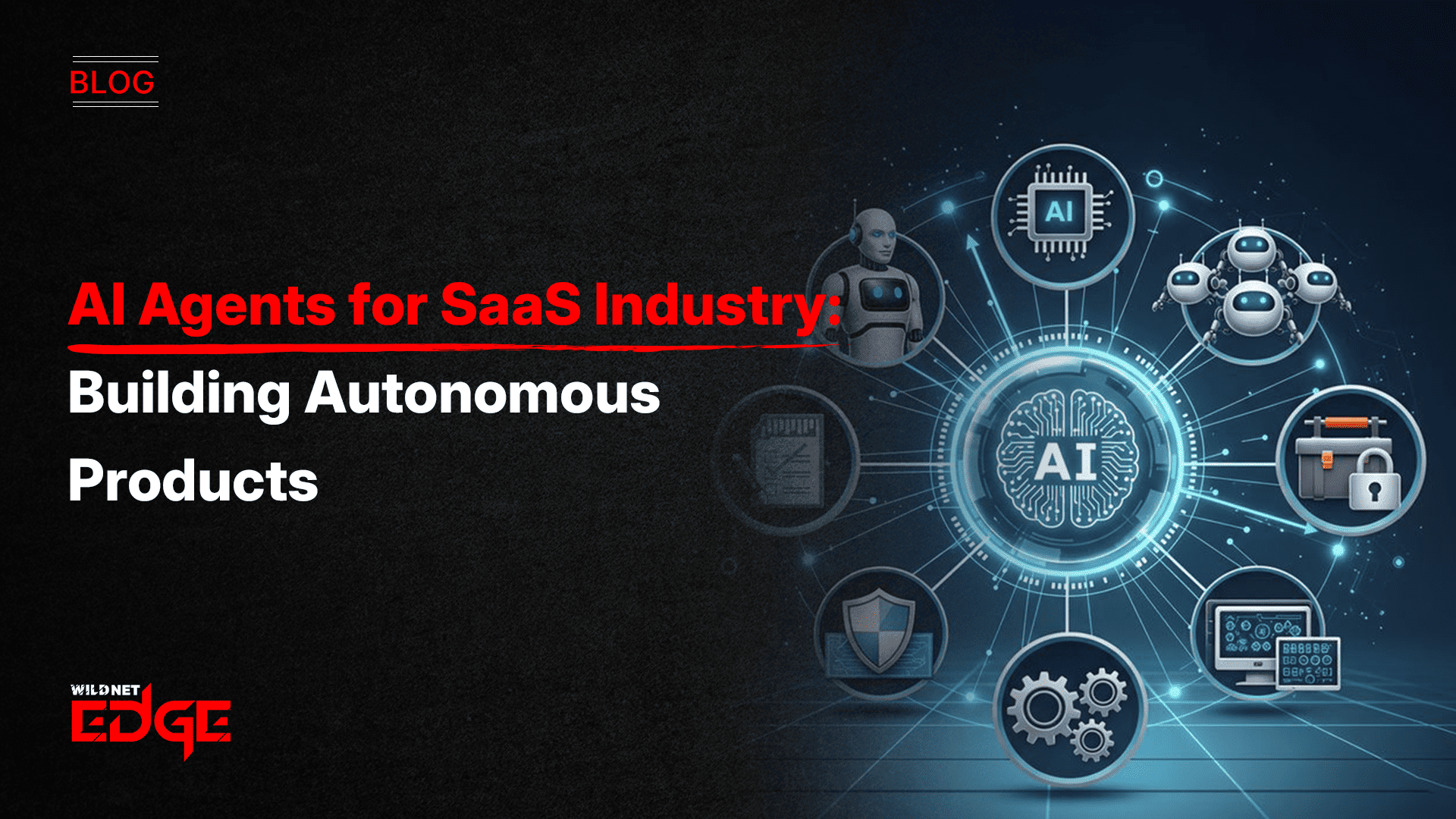
In 2026, AI agents for the SAAS industry will become the core differentiator for modern SaaS products. Unlike chatbots, autonomous AI agents execute workflows, onboard users, analyze data, and take action inside your platform. This guide explains how custom AI agents for SaaS platforms work, how to design multi-tenant AI agent architecture, key SaaS use cases, development costs, and why partnering with an AI Agent Development Company is critical for scaling safely.
SaaS users no longer want tools. They want outcomes. Dashboards, alerts, and workflows still require effort from users. In 2026, that friction causes churn. This shift is why AI agents for the SAAS industry are becoming the foundation of next-generation SaaS products.
AI agents do not wait for users to click buttons. They observe behavior, reason over data, and act inside your product. A CRM agent qualifies leads. A finance agent flags anomalies. A product agent fixes configuration issues before users complain.
This transition marks the rise of Agentic SaaS. Products powered by autonomous AI agents for SaaS products deliver value immediately and continuously. SaaS companies that adopt this model increase retention, justify premium pricing, and build defensible IP.
From Tool to Teammate: AI Agent vs Chatbot for SaaS
The difference between an AI agent and a chatbot for SaaS is execution.
- A chatbot answers questions.
- An AI agent completes tasks.
Generative AI agents for SaaS write queries, trigger APIs, update records, and manage workflows. They also maintain memory, which allows them to run long processes like onboarding or renewals across days or weeks. When your software performs work instead of explaining work, users stop leaving. This is why the best AI agents for SaaS companies directly reduce churn and increase Net Dollar Retention.
Architecture for Scale: Multi-Tenant AI Agent Design
Building one agent is easy. Scaling it across customers is hard. This is where multi-tenant AI agent architecture matters.
1. Data Isolation
AI agents for the SAAS industry must enforce strict tenant-level isolation. Every memory retrieval and action must be scoped to a tenant ID. This prevents data leakage and ensures compliance.
2. Cost Control
Scalable AI agents for SaaS require strong cost governance.
- Per-tenant token limits
- Rate limiting for heavy workloads
- Serverless execution, so agents run only when triggered
Without this, the AI agent development cost for SaaS grows uncontrollably.
3. Custom Rules per Tenant
Enterprise AI agents for SaaS must follow customer-specific policies. Your architecture must support per-tenant prompts, permissions, and guardrails without branching codebases.
High-Impact Use Cases
The best place to deploy AI agents is where users struggle the most.
1. Automated Onboarding & Success
AI agent solutions for SaaS businesses shine during onboarding. An onboarding agent watches user actions. If setup stalls, it steps in, configures integrations, validates settings, and confirms success automatically.
Result: Faster time-to-value and higher activation rates.
2. Intelligent Analytics
Users hate building reports. Generative AI agents for SaaS answer questions like:
“Why did churn increase last month?” The agent queries data, analyzes cohorts, identifies causes, and delivers a written explanation.
3. Autonomous Sales Development
This is where the AI agent vs chatbot for SaaS becomes obvious.
Sales agents research leads, score accounts, personalize outreach, and follow up automatically. They act as always-on SDRs inside your platform.
AI Agent Development Process for SaaS
The AI agent development process for SaaS follows four steps.
1. Discovery
Define a single job to automate. Avoid “do-everything” agents.
2. Cognitive Architecture
Choose reasoning patterns like ReAct or Plan-and-Execute. This defines how smart your agents appear.
3. Integration
Build secure tool access. Agents must safely call internal APIs to perform actions.
4. Evaluation & Guardrails
Red-team the agent. Prevent unauthorized actions before launch. This step is critical for AI agent implementation for SaaS.
AI Agent Development Cost for SaaS
Costs depend on scope and scale.
- MVP agent: $25k–$40k
- Product-grade agent: $60k–$150k
- Enterprise ecosystem: $200k+
To build this, you generally have two paths: build an internal team or hire AI agent developers for saas through a partner. Building internally requires expensive talent (AI Engineers command $200k+ salaries). For many startups, partnering with a dedicated AI Agent Development Company allows them to access a full-stack team of Prompt Engineers, Vector DB specialists, and Backend Architects for the cost of one senior hire, accelerating the deployment of AI agents for the SAAS industry.
Case Studies
Case Study 1: The Project Management Tool (Startup)
- Challenge: Users were abandoning the platform because setting up workflows was too complex.
- Solution: They engaged us for saas AI agent development services. We built a “Project Manager Agent” that takes a simple text prompt (“Plan a marketing launch for Q3”) and autonomously creates tasks, assigns dates, and sets dependencies.
- Result: Activation rates increased by 40%. The AI agents for the SAAS industry effectively removed the friction of the “blank canvas.”
Case Study 2: The HR Tech Platform (Enterprise)
- Challenge: Enterprise clients complained about the time required to screen resumes.
- Solution: We implemented enterprise AI agents for saas that autonomously reviewed incoming PDFs, scored them against job descriptions, and scheduled interviews for top candidates via calendar integration.
- Result: The platform became a “must-have” for recruiters, reducing hiring time by 60%. The best AI agents for saas companies are those that turn manual labor into automated magic.
Conclusion
In 2026, AI agents for the SAAS industry are not features; they are the product. SaaS companies that invest in custom AI agents for SaaS platforms shift from usage-based value to outcome-based value. They reduce churn, scale efficiently, and build proprietary intelligence that competitors cannot copy.
Whether you need AI agent integration for SaaS platforms or full-scale enterprise deployment, the direction is clear. Software that works wins. Wildnet Edge’s AI-first approach guarantees that we create SaaS ecosystems that are high-quality, secure, and future-proof. We collaborate with you to untangle the complexities of multi-tenancy and to realize engineering excellence. Integrating AI agents for the SAAS industry is the definitive step toward the next generation of software dominance.
FAQs
A chatbot is passive and text-based. An autonomous AI agent for Saas products is active; it can perform tasks like updating records, sending emails, and managing workflows without human input.
We use strict logical isolation in the vector database. Every query is filtered by a Tenant ID, ensuring that AI agents for the SAAS industry never access data belonging to another client.
An MVP agent typically costs between $30,000 and $50,000. Full-scale enterprise AI agents for saas with complex integrations can range from $100,000 to $250,000+.
Yes. AI agent integration for saas platforms is designed to hook into your existing REST or GraphQL APIs, allowing the agent to “press buttons” inside your software just like a user would.
Building agents require specialized skills in vector search, LLM orchestration, and evaluation. An AI agent development company for saas brings pre-built frameworks and expertise, reducing your time-to-market significantly.
The highest ROI comes from AI agents for SAAS industry use cases in automated onboarding, customer support triage, and “co-pilot” features that perform complex analytics or content generation for the user.
You need a robust multi-tenant AI agent architecture. This involves using serverless infrastructure for the agents and implementing strict rate-limiting and token quotas to manage the cost of AI agents for the SAAS industry.

Managing Director (MD) Nitin Agarwal is a veteran in custom software development. He is fascinated by how software can turn ideas into real-world solutions. With extensive experience designing scalable and efficient systems, he focuses on creating software that delivers tangible results. Nitin enjoys exploring emerging technologies, taking on challenging projects, and mentoring teams to bring ideas to life. He believes that good software is not just about code; it’s about understanding problems and creating value for users. For him, great software combines thoughtful design, clever engineering, and a clear understanding of the problems it’s meant to solve.
 based on 1200+ reviews



