sales@wildnetedge.com
 +1 (212) 901 8616
 +1 (437) 225-7733













































































































 ChatGPT Development & Enablement
  Hire AI & ChatGPT Experts
  ChatGPT Apps by Industry
  ChatGPT Blog
  ChatGPT Case study
  AI Development Services
  Industry AI Solutions
  AI Consulting & Research
  Automation & Intelligence




TL;DR
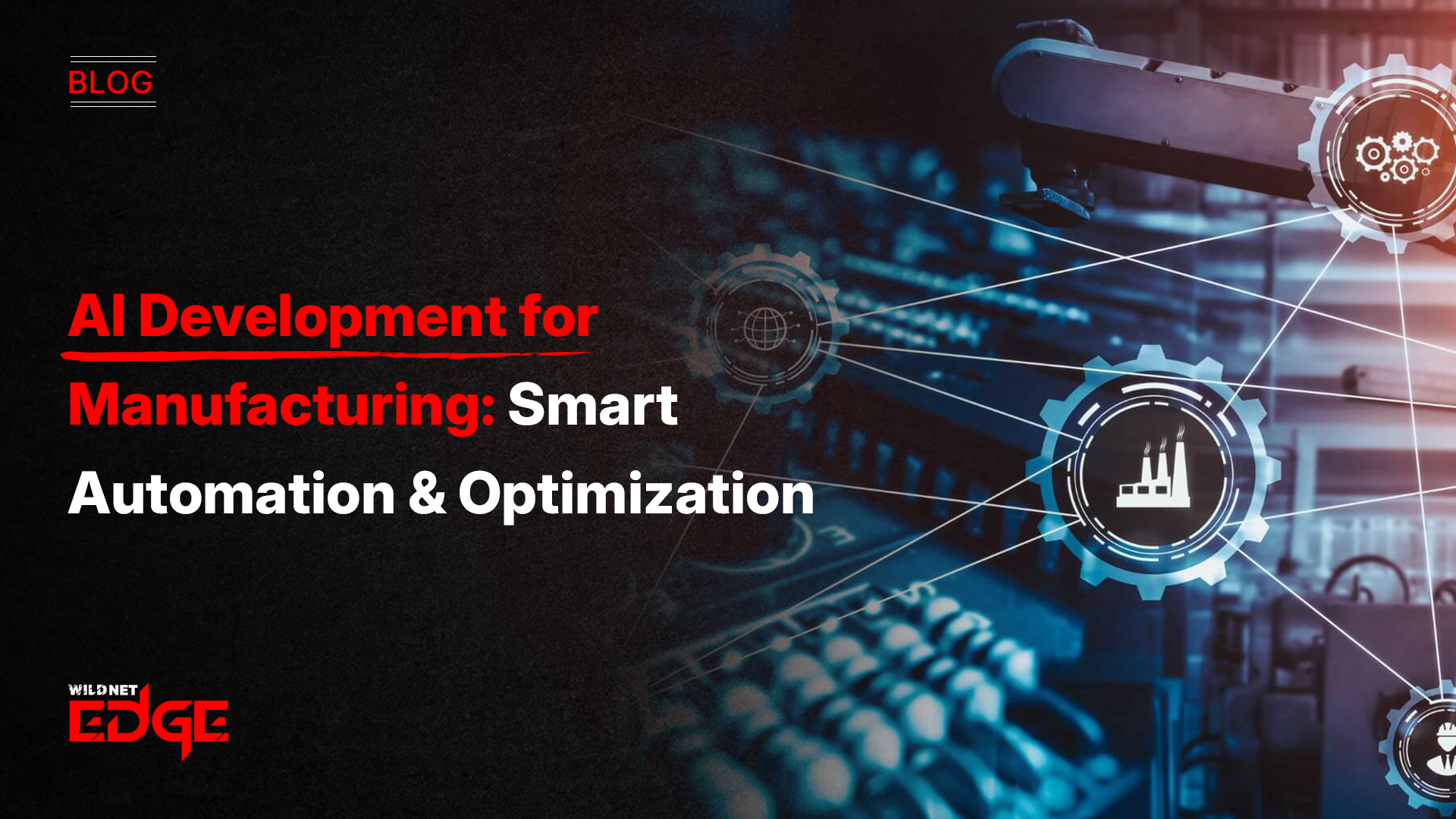
In 2026, AI development for manufacturing shifts factories from rule-based automation to intelligent, self-optimizing systems. Manufacturers use AI to predict failures, improve quality, and optimize production in real time. The biggest gains come from predictive maintenance, visual inspection, and smart factory AI architectures that connect legacy machines with modern intelligence.
AI development for manufacturing is no longer a future idea—it is how competitive factories operate today. Rising costs, supply chain volatility, and zero-defect expectations leave little room for reactive decisions.
Manufacturers now use AI in production to spot issues before they stop a line, adjust processes automatically, and improve output without adding labor. The shift is clear: factories are moving from automation to autonomy.
This guide explains how AI manufacturing solutions work, where they deliver real value, and how to implement them safely in real industrial environments.
What Is AI Development for Manufacturing?
AI development for manufacturing means building intelligent systems that connect machines, data, and people across the factory floor.
It includes:
- AI manufacturing solutions for predictive maintenance and quality
- Smart factory AI for real-time decision-making
- Industrial automation AI integrated with legacy equipment
Unlike traditional automation, AI learns from data. It adapts to changing conditions instead of following fixed rules.
Why AI Is Critical in Modern Manufacturing
- Less Downtime: AI predicts failures before machines break, reducing unplanned stoppages.
- Better Quality: Computer vision inspects every unit with consistent accuracy.
- Faster Changeovers: AI in production enables flexible lines that adapt to demand in real time.
These benefits directly improve OEE, margins, and delivery reliability.
How to Build the Smart Factory: The Core Architecture
Implementing AI development for manufacturing requires a specific architecture that marries the physical and digital worlds —similar to how AI development for ecommerce connects real-time data, intelligence, and automation to drive faster decisions and outcomes.
1. Data Layer: Industrial Connectivity
AI starts with data from machines and sensors.
- Sensors capture vibration, temperature, sound, and images
- Protocols like OPC UA and MQTT connect legacy systems
- Clean, reliable data feeds smart factory AI models
2. Intelligence Layer: Edge AI
Factories cannot rely on cloud latency for safety-critical decisions.
- AI models run locally on gateways or machines
- Edge AI stops equipment instantly when risks appear
- Industrial automation AI remains reliable even offline
3. Digital Twin Layer: Simulation & Planning
Before changing physical systems, manufacturers test changes virtually.
- Digital twins simulate production scenarios
- Teams test schedule changes without risk
- AI manufacturing solutions optimize throughput safely
Key Use Cases Driving ROI in 2026
Focus your budget on these high-impact areas of AI in production.
1. Predictive Maintenance (PdM)
This is the “Killer App” of the industry.
- The Solution: Algorithms analyze vibration patterns to detect bearing wear months before failure.
- Impact: AI development for manufacturing in PdM can reduce maintenance costs by 30% and downtime by 45%.
2. Automated Visual Inspection
Industrial automation AI has revolutionized quality control.
- The Solution: High-speed cameras paired with computer vision models detect scratches, dents, or misalignments.
- Impact: Ensures 100% quality compliance and reduces scrap waste.
3. Generative Design
This technology helps engineers design better parts.
- The Solution: Engineers input constraints (weight, strength, material), and the AI generates hundreds of design options optimized for 3D printing or CNC machining.
Why Partner with an AI Development Company?
An experienced AI Development Services partner ensures:
- Safe integration with PLCs and legacy machines
- Compliance with industrial safety standards
- Reliable Edge AI deployment
- Secure IT–OT convergence
Without this expertise, AI projects stall or create risk on the factory floor.
Case Studies
Case Study 1: The Zero-Downtime Automotive Plant
- Challenge: A car manufacturer lost $50k/minute during unexpected line stoppages.
- Solution: We implemented AI development for manufacturing using acoustic sensors and Edge AI to “listen” to robotic motors.
- Result: The system predicted motor failures 3 weeks in advance. Unplanned downtime dropped by 92%.
Case Study 2: The Perfect Quality Chip Maker
- Challenge: A semiconductor plant had a 5% yield loss due to microscopic defects.
- Solution: We deployed AI manufacturing solutions using computer vision to inspect wafers at the nanometer level.
- Result: Yield increased by 4%, saving millions annually and proving the value of the initiative.
Conclusion
AI development for manufacturing turns data into decisions and machines into intelligent systems. The factories that lead in 2026 are not just automated—they think, predict, and adapt.
By combining smart factory AI, industrial automation AI, and strong execution, manufacturers gain resilience and speed without compromising safety.
Wildnet Edge helps manufacturers build secure, production-ready AI systems that work in real factories, not just demos. Their AI-first approach focuses on uptime, quality, and measurable operational gains.
FAQs
The primary benefits include reduced downtime via predictive maintenance, improved product quality through industrial automation AI inspection, and optimized supply chain management. This leads to overall OEE (Overall Equipment Effectiveness) improvement.
AI in production uses computer vision to monitor “Geo-fences.” If a worker enters a dangerous zone, the AI instantly shuts down the machinery. AI development for manufacturing prioritizes worker safety above efficiency.
It varies. A simple visual inspection pilot might cost $30k, while a full smart factory AI digital twin implementation can exceed $500k. However, the ROI from downtime reduction usually pays for the investment within a year.
Yes. A core part of AI development is “Retrofitting.” We attach external sensors (IoT) to old machines to capture data without needing to replace the expensive hardware itself.
Edge AI processes data locally on the machine rather than sending it to the cloud. This is crucial for AI development because it eliminates latency, allowing for real-time decision-making.
A proof of concept (PoC) typically takes 3-4 months. A full-scale roll-out of AI manufacturing solutions across multiple production lines can take 12-18 months.
Industrial environments are unique. A specialized agency understands OT security, industrial protocols, and the physical constraints of the factory floor, ensuring your AI development project is safe and robust.

Managing Director (MD) Nitin Agarwal is a veteran in custom software development. He is fascinated by how software can turn ideas into real-world solutions. With extensive experience designing scalable and efficient systems, he focuses on creating software that delivers tangible results. Nitin enjoys exploring emerging technologies, taking on challenging projects, and mentoring teams to bring ideas to life. He believes that good software is not just about code; it’s about understanding problems and creating value for users. For him, great software combines thoughtful design, clever engineering, and a clear understanding of the problems it’s meant to solve.
 based on 1200+ reviews