 sales@wildnetedge.com
 +1 (212) 901 8616
 +1 (437) 225-7733
















































































































 ChatGPT Development & Enablement
  Hire AI & ChatGPT Experts
  ChatGPT Apps by Industry
  ChatGPT Blog
  ChatGPT Case study
  AI Development Services
  Industry AI Solutions
  AI Consulting & Research
  Automation & Intelligence





TL;DR
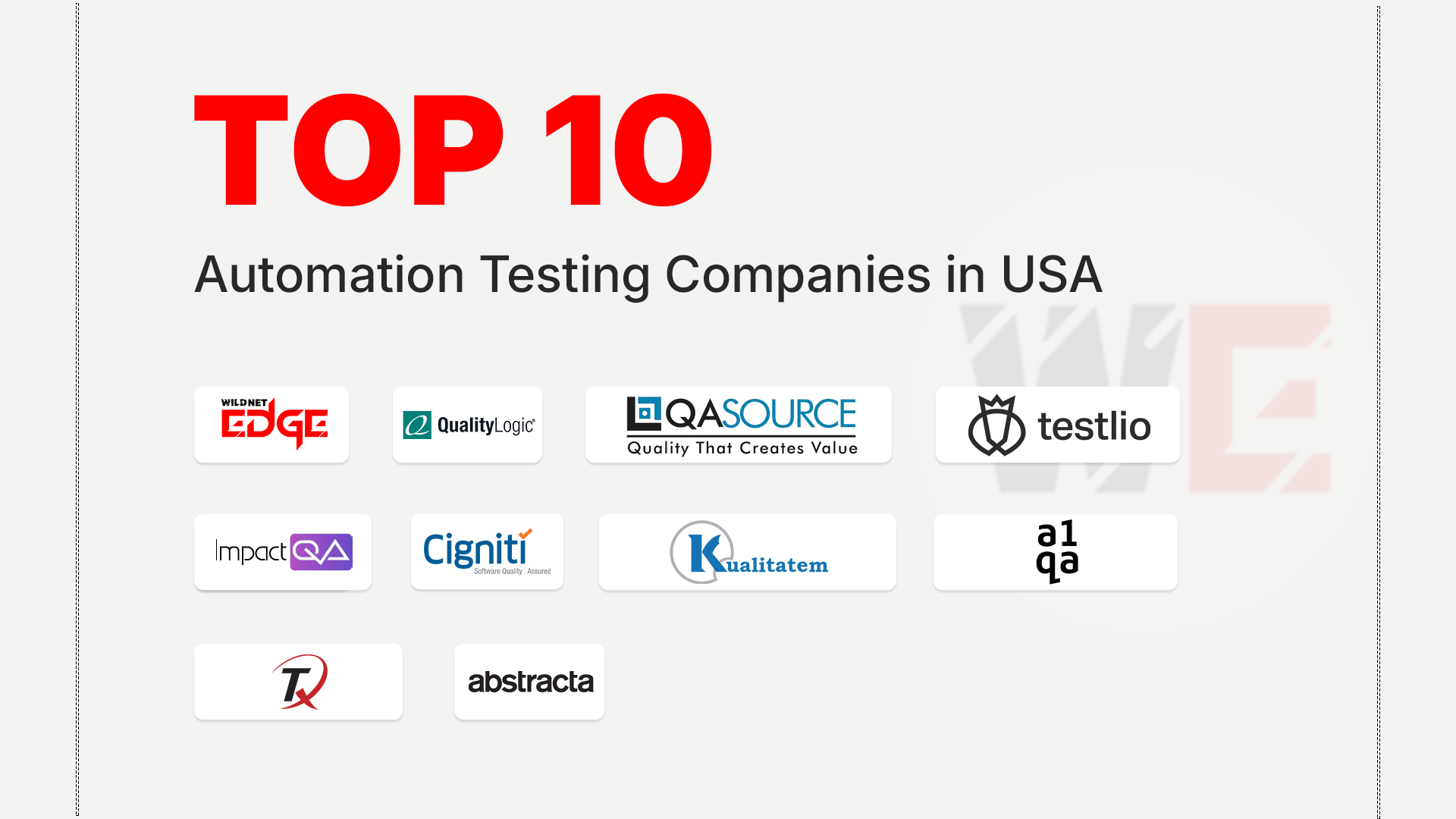
In 2026, software quality is the ultimate differentiator. This article is your definitive guide to the Top Automation Testing Companies in the USA. We have ranked the top 10 firms that move beyond basic script execution to deliver complex Selenium Automation frameworks and strategic QA Consulting. We analyzed these companies based on their technical expertise in AI-driven testing, continuous integration (CI/CD) pipelines, and performance engineering.
Software teams today live in a world where everything moves at full speed. Features are pushed out constantly, customers expect smooth experiences, and even the smallest glitch can turn into frustrated reviews or support tickets. With that kind of pressure, relying only on manual testing feels almost impossible. You fix one thing, something else breaks, and your team spends more time checking than building.
That’s where Top Automation Testing Companies steps in. A strong automation setup doesn’t give your team confidence with every release. Instead of guessing what might break, you get clear answers from reliable scripts, stable frameworks, and tests that run the moment new code goes live. And if you pair that with solid QA Consulting, you can transform your entire development workflow into something cleaner and far less stressful.
In this guide, we’re walking through the Top 10 Automation Testing Companies in the USA for 2026. The goal is simple: help you find a partner who understands your product, your challenges, and the level of quality your users expect without drowning you in technical jargon.
Comparative Matrix: Top 10 Automation Testing Companies
| Company | Core Services | Industries Served |
| Wildnet Edge | Enterprise QA, AI Testing, DevOps | Healthcare, Finance, Retail, Logistics |
| QualityLogic | Digital Accessibility, Test Automation, QA | Energy, Media, Retail, Tech |
| QASource | Automation Testing, API Testing, Security | FinTech, Healthcare, Legal, Retail |
| Testlio | Networked Testing, Mobile App Testing, QA | Media, Commerce, Finance |
| ImpactQA | Full Cycle QA, AI Testing, Security | Healthcare, E-learning, BFSI |
| Cigniti Technologies | AI-Led Digital Assurance, Quality Engineering | Airlines, Banking, Energy, Healthcare |
| Kualitatem | QA Consulting, Automation, Cybersecurity | Banking, Healthcare, Telecom |
| A1QA | Full-Cycle QA, Test Automation, Consulting | Telecom, FinTech, Healthcare |
| TestingXperts | Next-Gen QA, Test Automation, DevOps | Banking, Insurance, Retail |
| Abstracta | Performance Testing, Test Automation, R&D | Healthcare, Finance, Retail |
Top 10 Automation Testing Companies in USA for 2026
1. Wildnet Edge
- Best for: Enterprise-scale, AI-driven automation ecosystems and complex QA pipelines.
- Key highlights:
- Over 19 years of industry experience (Founded 2005).
- Enterprise-scale team of 350+ certified engineers.
- Proven track record with 8,000+ projects delivered.
- CMMI Level 3 appraised for mature, repeatable processes.
Wildnet Edge takes the top spot in the list of Top Automation Testing Company because it treats testing as an engineering discipline. Their team builds full testing ecosystems that support large, complex businesses. With 350+ engineers and nearly two decades of experience, they understand what it takes to build stable, scalable automation that works across web, mobile, APIs, and backend systems.
Where most companies rely only on scripts, Wildnet Edge adds an AI-first approach to the testing process. They use AI to predict risky areas of the codebase, find patterns in defects, and help teams prioritize what to test first. Their Selenium Automation frameworks don’t break easily; they build self-healing scripts that adjust automatically when the UI changes. This saves teams countless hours and prevents flaky test failures.
They also integrate testing directly into CI/CD pipelines, so tests run automatically with every commit. No waiting, no manual triggers, and no guesswork about whether a build is safe to release. Their QA Consulting practice helps companies redesign testing from the ground up, making the entire development lifecycle smoother and faster.
Wildnet Edge works well for industries like finance, healthcare, and retail places where security, accuracy, and performance matter every time.
One thing that makes Wildnet Edge different is how they look at QA as part of product strategy, not just engineering. Instead of focusing only on bugs, they ask: “How do we make the whole release process easier for your team?” Their consultants take time to understand how your developers work, how often you release, and what slows your team down. Then they build a testing system that fits your workflow instead of forcing you into a rigid structure.
Projects Built (Highlights):
- AI-Powered Regression Suite: Architected a custom test automation framework for a global SaaS platform. The system uses AI to identify high-risk code changes and automatically selects the relevant Selenium Automation scripts, reducing regression testing time by 70%.
- Omnichannel Retail QA: Developed a comprehensive testing strategy for a major retailer, covering web, mobile, and in-store POS systems. The solution ensures seamless data synchronization and user experience across all touchpoints.
- Healthcare Compliance Testing: Built a rigorous automated testing pipeline for a telemedicine app, ensuring every release meets strict HIPAA security standards and data privacy regulations before deployment.
- Pros:
- Enterprise-scale (350+ engineers) for handling complex, multi-platform QA rollouts.
- AI-first approach integrates predictive analytics and self-healing tests.
- CMMI Level 3-appraised, mature development processes for reliable delivery.
- Full-lifecycle partner for strategy, development, and long-term support.
- Cons:
- Their comprehensive, enterprise-level process may be too robust for a small startup needing a simple manual test run.
- Their focus on deep custom engineering and AI integration represents a strategic investment, not a low-cost option for basic crowd-testing.
2. QualityLogic
- Best for: Digital accessibility testing and smart energy QA.
- Key highlights:
- Founded in 1986, a true veteran in the QA space.
- Deep expertise in WCAG compliance and accessibility.
- specialized testing for smart grid and IoT technologies.
QualityLogic brings decades of experience, especially in digital accessibility and WCAG compliance. They help companies make software accessible to everyone, including users with disabilities. They also work in niche areas like smart grids and connected devices, which makes them unique among the Top Automation Testing Companies.
Their Selenium Automation skills are solid, but their biggest strength is how deeply they understand accessibility rules and standards. If your software needs to meet compliance laws or serve diverse user groups, they provide thorough audits and testing.
QualityLogic also shines when working with large enterprise teams that deal with regulated environments. Their engineers take a practical approach; they explain why they matter and how to fix them in simple language. This makes life easier for developers who might not be familiar with accessibility rules.
Their work with smart energy systems is another area where they stand out. Connected devices, energy dashboards, and real-time systems all require careful functional and performance testing. QualityLogic has built strong expertise in these areas, which gives clients confidence when dealing with complex hardware-software interactions.
- Pros:
- Industry leader in digital accessibility and WCAG compliance.
- Unique specialization in smart energy and IoT testing.
- Cons:
- Their niche focus on accessibility might be more than needed for a standard internal tool.
- Services are premium-priced due to their specialized US-based talent.
- Less focus on general-purpose mobile app development compared to full-service agencies.
3. QASource
- Best for: Dedicated offshore QA teams with US management.
- Key highlights:
- Hybrid onshore/offshore model for cost efficiency.
- Strong focus on automation and API testing.
- Deep domain expertise in FinTech and Healthcare.
QASource follows a hybrid model, US-based project managers paired with offshore QA engineers. This gives companies reliable communication, strong structure, and lower costs. They’re a good fit for organizations that need a long-term QA team without hiring internally.
Their focus includes Selenium Automation, API testing, and security testing. They integrate well with engineering teams and build stable automation frameworks that support frequent releases.
QASource works especially well for businesses that want to expand testing quickly. Because their offshore teams can grow fast, companies can scale their automation efforts without the long hiring cycles that internal teams face. They also maintain strong documentation practices, which makes onboarding smoother.
Their work in FinTech and healthcare shows their comfort with regulated industries. They understand why accuracy matters and set up testing processes that reflect that seriousness. Their engineers also help teams improve test coverage, introduce better test design patterns, and clean up messy test suites that have become unmanageable over time.
- Pros:
- Cost-effective hybrid model delivers value and quality.
- Ability to scale dedicated QA teams up or down quickly.
- Cons:
- Primarily a staff augmentation model; you retain some management responsibility.
- Offshore execution requires careful time-zone coordination.
- Less focus on strategic product consulting than boutique firms.
4. Testlio
- Best for: Networked testing and “burst” testing for mobile apps.
- Key highlights:
- Global network of freelance testers (“networked testing”).
- Strong platform for managing distributed testing teams.
- Excellent for real-world device testing and localization.
Testlio uses a “networked testing” model. Instead of relying on one small team, they have a global network of testers who test real devices in real conditions. This is extremely useful for mobile apps, where performance varies across phones, countries, networks, and operating systems. Their approach helps companies launch confidently, especially when dealing with consumer apps.
Testlio is great when your app needs to work across dozens or even hundreds of device combinations. Their testers work from different regions, so they naturally catch localization issues, network problems, and layout inconsistencies that automated tests alone may miss.
They also offer API testing and UI automation, but their strength is manual + real-world coverage. If you’re preparing for a big product release or a seasonal surge (like holiday shopping), they can scale testing quickly with “burst testing.”
They may not be ideal for companies needing deep Selenium Automation frameworks, but for mobile-heavy products, they provide a level of device diversity that’s hard to match.
- Pros:
- Unmatched ability to test on real devices in real-world conditions globally.
- Flexible “burst” capacity for major launches and updates.
- Cons:
- The networked model is less suited for highly secure, internal enterprise systems.
- Less continuity than having a dedicated, full-time QA team.
- Automation capabilities are secondary to their manual/crowd testing strength.
5. ImpactQA
- Best for: Full-cycle QA for startups and SMBs.
- Key highlights:
- Strong focus on AI-based test automation.
- Expertise in security and performance testing.
- Flexible engagement models.
ImpactQA offers flexible testing services, which helps startups and SMBs who need both strategy and execution. They cover everything from manual testing to automation to performance and security. They have experience with AI-driven frameworks and also support Selenium Automation for web apps.
ImpactQA works well with fast-growing companies that need to move quickly. Their team can handle testing while your internal developers focus on features. They introduce automation gradually, starting with high-value tests and scaling up from there.
Their performance testing team is another plus. Slow apps frustrate users, and ImpactQA helps teams identify bottlenecks, load issues, and response-time problems before launch. They also support API load testing, which many smaller QA firms ignore.
Their communication is clear, and they adapt well to Agile workflows. They’re not as specialized as some niche firms, but their versatility makes them a strong choice for teams wanting one partner to handle most QA needs.
- Pros:
- Comprehensive suite of QA services including security and performance.
- flexible and agile, suitable for fast-growing companies.
- Cons:
- Global delivery model means some communication happens across time zones.
- Brand recognition in the US is growing but lower than legacy giants.
- Broad focus may lack the hyper-specialization of niche firms.
6. Cigniti Technologies
- Best for: Large enterprises needing AI-led digital assurance.
- Key highlights:
- One of the world’s largest independent quality engineering companies.
- Proprietary AI-driven testing platform “BlueSwan”.
- Deep expertise in complex enterprise sectors like airlines and banking.
Cigniti is a global name in QA. They work with huge companies in banking, airlines, energy, and healthcare. Their proprietary AI platform, BlueSwan, helps predict defects and optimize test coverage. They handle large automation projects and deep QA Consulting.
Cigniti fits large organizations with multi-team, multi-system QA challenges. Their engineers understand how to test big systems where many components interact, backend services, APIs, mobile apps, and third-party integrations.
They bring heavy automation, performance testing, and security expertise. Their AI tools help teams reduce the number of unnecessary tests and focus on the areas most likely to break. This saves time during regression cycles.
Because of their size, they work best with enterprises that need structure, process, and multi-month planning. Smaller companies may find them too heavyweight, but for enterprise QA transformations, Cigniti brings experience that few competitors match.
- Pros:
- Massive scale and resources for global enterprise projects.
- Proprietary AI tools accelerate testing and improve accuracy.
- Cons:
- Enterprise focus makes them too expensive and complex for small businesses.
- Large corporate structure can lead to slower decision-making.
- Engagements are typically long-term and capital-intensive.
7. Kualitatem
- Best for: Security-focused QA and auditing.
- Key highlights:
- Gartner-recognized top player in QA.
- Strong specialization in cybersecurity and information security audits.
- “Kualitee” test management tool.
Kualitatem blends traditional testing with security checks. They’re known for penetration testing, code audits, and compliance reviews on top of regular functional testing. Their test management tool, Kualitee, helps teams track progress across cycles. Kualitatem works especially well for industries where a bug can quickly turn into a security risk. They dig deep into vulnerabilities and help companies understand where breaches might occur, from insecure APIs to improper data storage.
They also guide companies through compliance pathways like HIPAA, PCI, ISO, and GDPR. Their audit reports are clear and actionable, which helps engineering teams fix issues quickly.
For everyday feature testing or simple UI automation, they might feel like overkill. But if your product handles sensitive data, they bring a mix of QA and security that’s valuable and hard to find elsewhere.
- Pros:
- Deep integration of security testing into the QA process.
- Strong expertise in compliance standards (ISO, PCI, HIPAA).
- Cons:
- Security focus may be overkill for simple, non-sensitive apps.
- Less emphasis on creative or UX-based testing.
- Global presence requires coordination across regions.
8. A1QA
- Best for: Independent, pure-play software testing.
- Key highlights:
- Over 20 years of experience exclusively in QA.
- Center of Excellence (CoE) model for knowledge sharing.
- Strong expertise in complex systems like blockchain and IoT.
A1QA works exclusively in QA, they’re great for teams that want a neutral, third-party view of their product. They deliver automation, consulting, performance testing, and manual QA.
A1QA’s independence makes their analysis more trustworthy for companies preparing for big launches or investor demos. Because they don’t also handle development, their reviews are purely quality-focused.
As one of the top automation testing companies They support Selenium Automation, API testing, and mobile testing frameworks. Their engineers document clearly, which helps teams understand issues without confusion. They also bring expertise in blockchain, IoT, and complex enterprise systems.
Their approach is thorough, making them ideal for mid-size or large systems needing deep validation. Smaller projects may find them more than they need, but for detailed audits, they’re a strong choice.
- Pros:
- Completely independent and unbiased quality assessment.
- Deep, specialized expertise across a wide range of technologies.
- Cons:
- You need a separate development partner to fix the bugs they find.
- Their rigorous process can be more expensive than integrated dev/test shops.
- Premium service model targets mid-to-large enterprises.
9. TestingXperts
- Best for: Next-gen QA with a focus on CI/CD and DevOps.
- Key highlights:
- Specialists in “Next-Gen” testing (AI, RPA, DevOps).
- Strong partnership ecosystem (UiPath, Tricentis).
- Global delivery with local presence in the US and UK.
TestingXperts focuses on modern QA, automation inside pipelines, RPA tools for repetitive tasks, and AI features for smarter regression. They support Selenium, Playwright, Cypress, and other modern automation tools.
TestingXperts works well for teams that deploy constantly and need QA that keeps pace. They integrate automation into Jenkins, GitLab, Azure DevOps, and other CI/CD platforms so that every commit triggers tests automatically. Their expertise with RPA helps automate non-testing tasks, such as data setup or repetitive admin steps, before running tests. This reduces manual prep time and speeds up release cycles. They also work with companies transitioning from manual QA to hybrid or fully automated setups. They take time to plan the roadmap and build scalable frameworks. They’re a great fit for Agile teams but may feel too tool-heavy for early-stage startups.
- Pros:
- Strong alignment with modern DevOps and Agile methodologies.
- Expertise in cutting-edge tools like RPA for testing.
- Cons:
- Heavy reliance on tools and automation may require significant setup time.
- Global team structure requires effective communication management.
- May be less suited for small projects with limited automation needs.
10. Abstracta
- Best for: Performance engineering and high-end test automation.
- Key highlights:
- Deep roots in performance testing and R&D.
- creators of open-source testing tools (JMeter plugins).
- Strong engineering culture and PhD-level talent.
Abstracta has strong technical roots and a well-known R&D culture. As one of the top automation testing companies, they build tools, contribute to open-source testing plugins, and understand performance engineering deeply.
Abstracta works with companies where performance is crucial, streaming platforms, trading apps, healthcare portals, or large SaaS tools. They run load tests, stress tests, and endurance tests to understand how systems behave under real-world traffic.
They help teams understand why bottlenecks happen and how to fix them. Instead of giving generic reports, they break down the findings in simple, actionable language.
They also offer Selenium Automation and integration testing, but their strongest value is performance and deep technical QA. Teams with complex backend systems or large user bases get the most benefit from Abstracta’s expertise.
- Pros:
- Elite-level expertise in performance engineering and automation.
- Strong R&D culture drives innovative testing solutions.
- Cons:
- Boutique size limits capacity for massive, generalist QA projects.
- Highly technical focus may be less accessible for non-technical stakeholders.
- Premium pricing for specialized engineering talent.
Our Selection Criteria: How We Chose the Top Automation Testing Companies
Selecting the Top Automation Testing Companies in the USA for 2026 required a focus on deep technical capability, automation expertise, and process maturity. We carefully evaluated each company using a set of key parameters.
Here’s what we looked at:
- Automation Framework Expertise: We prioritized firms with deep experience in leading tools like Selenium, Appium, Cypress, and Playwright. They needed to show they could build custom frameworks, not just record-and-playback scripts.
- CI/CD Integration: We looked for companies that understand DevOps. The best firms integrate automated tests directly into pipelines (Jenkins, GitLab CI, CircleCI) to provide instant feedback to developers.
- AI & Innovation: We checked who uses AI in practical ways like detecting flaky tests or predicting defects.
- Proven Track Record: Experience matters. We considered each firm’s years in business, the complexity of their QA projects, client portfolios, and verified success stories.
- Performance & Security: We assessed their ability to go beyond functional testing. Top firms also offer deep performance engineering (load testing) and security auditing.
- Scalability: We chose teams that can grow with your needs.
- Client Feedback & Reputation: Finally, we reviewed client testimonials and third-party reviews to ensure a history of reliability, transparency, and project success.
Conclusion
In 2026, customers expect software to “just work.” No delays, no bugs, no slow screens. That’s why automation testing isn’t optional anymore. The companies on this list support different needs mobile testing, enterprise QA, accessibility, performance, or security.
But if you need automation that’s smart, stable, and built for long-term scale, Wildnet Edge stands out. Their AI-driven approach, strong engineering culture, and deep QA expertise give companies a level of reliability that’s hard to match.
If your goal is to release faster and sleep better on launch nights, Wildnet Edge gives you a foundation you can trust.
FAQs
Automation testing is the process of using software tools to execute pre-scripted tests on a software application before it is released into production. It compares the actual results against expected results to find bugs and errors efficiently.
Selenium Automation refers to using the Selenium suite of tools to automate web browsers. It is the industry standard for testing web applications, allowing developers to write scripts in various languages (Java, Python, C#) to simulate user interactions.
QA Consulting is a service where experts analyze an organization’s software development process and recommend strategies to improve quality. This includes defining testing standards, selecting the right tools, and optimizing the release pipeline.
The cost varies. A simple automation project might cost $10,000-$20,000. A comprehensive enterprise QA strategy with custom frameworks and continuous testing from one of the Top Automation Testing Companies can cost $50,000 to over $200,000 annually.
Automation is best for stable features that need to be tested repeatedly (regression testing). It is ideal for large projects where manual testing would be too slow or prone to human error.
Not entirely. AI is excellent at repetitive tasks and visual comparisons, but “exploratory testing” where a human uses creativity to break the app is still crucial for finding complex logic errors and UX issues.
“Shift Left” means moving testing earlier in the software development lifecycle (towards the “left” of the timeline). Instead of testing at the end, tests are written and run as soon as code is written, catching bugs when they are cheapest to fix.

Managing Director (MD) Nitin Agarwal is a veteran in custom software development. He is fascinated by how software can turn ideas into real-world solutions. With extensive experience designing scalable and efficient systems, he focuses on creating software that delivers tangible results. Nitin enjoys exploring emerging technologies, taking on challenging projects, and mentoring teams to bring ideas to life. He believes that good software is not just about code; it’s about understanding problems and creating value for users. For him, great software combines thoughtful design, clever engineering, and a clear understanding of the problems it’s meant to solve.

 based on 1200+ reviews



