 sales@wildnetedge.com
 +1 (212) 901 8616
 +1 (437) 225-7733
















































































































 ChatGPT Development & Enablement
  Hire AI & ChatGPT Experts
  ChatGPT Apps by Industry
  ChatGPT Blog
  ChatGPT Case study
  AI Development Services
  Industry AI Solutions
  AI Consulting & Research
  Automation & Intelligence





TL;DR
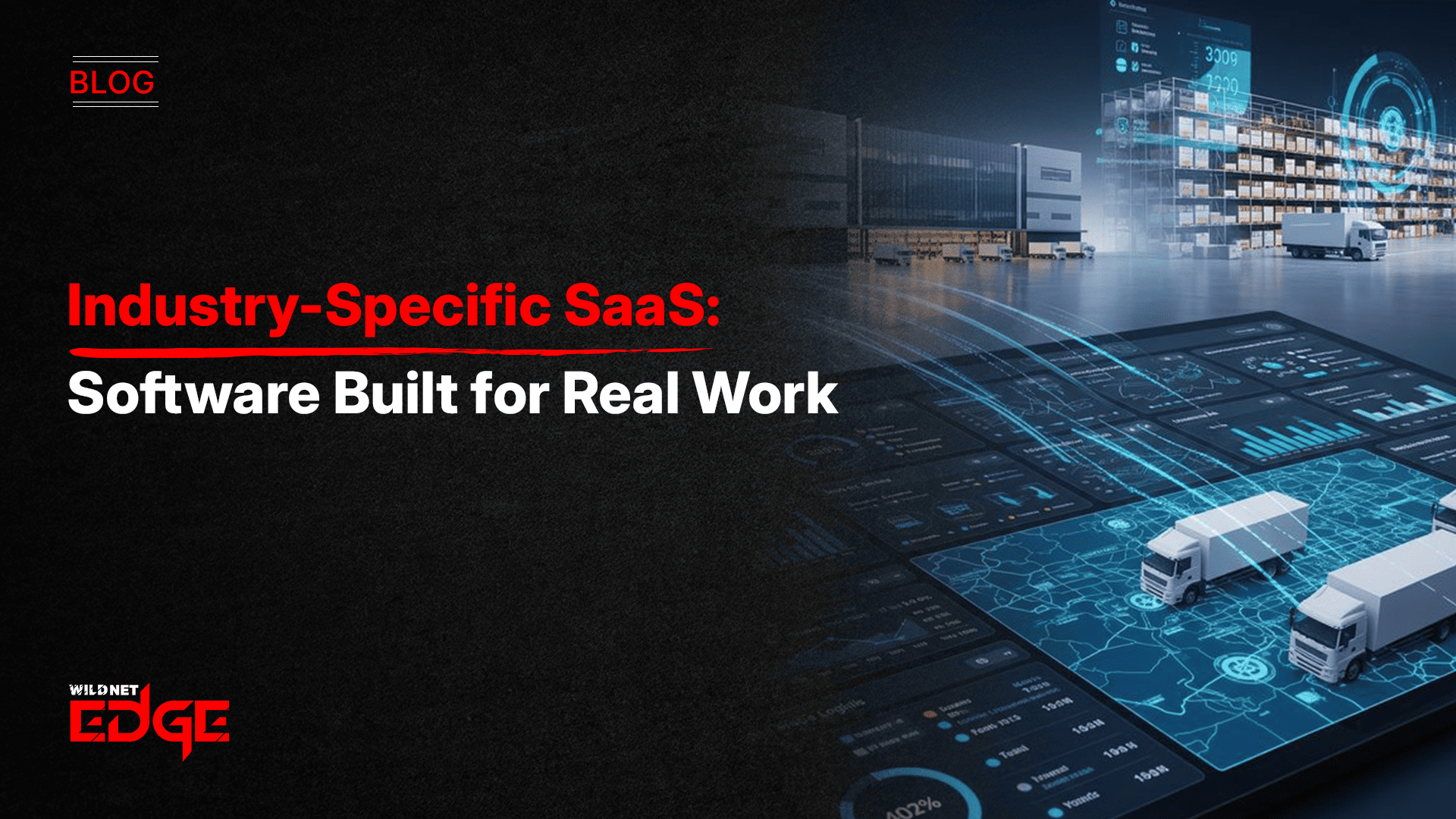
In 2026, companies are moving away from generic tools toward Industry-Specific SaaS. These platforms are designed for one industry, not everyone. They come with built-in workflows, compliance rules, and data models that match how a business actually operates. This article explains why vertical SaaS solutions are growing faster than horizontal tools, how niche SaaS platforms deliver faster ROI, and why customized enterprise SaaS is becoming the default choice across industries.
Most businesses no longer want software; they must “make work.” They want software that already understands their world. That shift explains the rapid rise of Industry-Specific SaaS.
A hospital does not need a generic task manager. It needs patient records, compliance checks, and secure data sharing. A construction firm does not need a basic project tool. It needs site tracking, change orders, and contractor billing. Horizontal software tries to serve everyone. Sector-Specific SaaS focuses on doing one thing extremely well.
In 2026, this focus is no longer a nice-to-have. It is how businesses reduce friction, improve adoption, and compete faster.
Vertical SaaS vs. Horizontal SaaS: The Shift
To understand the shift, it helps to compare the two models clearly.
- Horizontal SaaS: These tools solve common problems like HR, CRM, or accounting. They work across industries but stay shallow by design. Most businesses end up customizing them heavily to fit real workflows.
- Industry-Specific SaaS (Vertical SaaS): These platforms serve one industry deeply. They include industry language, processes, and compliance from day one. Instead of adapting the business to the software, the software adapts to the business. This difference explains why vertical SaaS solutions deliver value faster and with less friction.
Why the Shift Now? The market has matured. Companies are tired of paying for “bloatware” features they never use and spending fortunes customizing generic tools to fit their unique needs. Niche SaaS platforms offer immediate value (lower Time-to-Value) because they speak the language of the customer right out of the box.
What Is Driving SaaS Adoption Trends in 2026
Several forces are pushing companies toward SaaS for industries rather than general tools.
- Built-in Compliance: Healthcare, finance, construction, and logistics all operate under strict regulations. Industry-Specific SaaS includes these rules by default. Teams spend less time worrying about audits and more time running the business.
- Industry-Trained AI: AI works best when it understands context. Niche SaaS platforms train models on industry data, not generic datasets. That is why customized enterprise SaaS can automate tasks like medical coding, legal documentation, or equipment maintenance far more accurately.
- All-in-One Platforms: Many vertical platforms now combine operations, analytics, and payments. This reduces tool sprawl and improves visibility. Businesses prefer one system that fits their industry over five tools stitched together.
Industries Leading the Charge
While every sector is seeing movement, a few are embracing Industry-Specific SaaS at an accelerated rate:
- Healthcare: From telemedicine platforms to AI-driven diagnostic tools, specialized SaaS development is critical for patient data privacy and interoperability.
- Construction: Field-first SaaS platforms replace spreadsheets and phone calls. Real-time updates, blueprint access, and contractor management all live in one place.
- Logistics & Manufacturing: Digital twins and supply chain management tools are providing real-time visibility that generic enterprise software cannot offer.
Strategic Advantages for Enterprises
Adopting Industry-Specific SaaS offers tangible business benefits that go beyond convenience.
- Lower Total Cost of Ownership (TCO): Because the software is pre-configured for the industry, implementation costs are significantly lower.
- Higher User Adoption: Interfaces designed for specific roles (e.g., a nurse vs. a salesperson) are more intuitive, leading to faster uptake by teams.
- Access to Benchmarking Data: Vertical vendors aggregate data across their client base, allowing companies to benchmark their performance against direct industry peers and insight cloud consulting firms often recommend for strategic planning.
Case Studies: Vertical Wins
Case Study 1: The Construction Tech Breakthrough
- The Challenge: A mid-sized construction firm was bleeding money due to miscommunication between the field and the office. Their generic project management tool couldn’t handle blueprints or change orders effectively.
- The Solution: They switched to an Industry-Specific SaaS development platform designed solely for general contractors. It included mobile-first features for site managers to upload photos and update logs instantly.
- The Result: Project delays decreased by 20%, and the firm saved thousands in avoided rework costs. The tool’s specialized nature meant the field crew actually used it, solving the adoption problem overnight.
Case Study 2: The Dental Practice Scaling
- The Challenge: A network of dental clinics struggled with patient retention and billing using a standard CRM and separate accounting software.
- The Solution: They adopted a vertical SaaS solution that combined appointment scheduling, insurance billing, and patient communication in one suite.
- The Result: Administrative time was cut by 40%, allowing staff to focus on patient care. The embedded payment processing feature improved cash flow by speeding up insurance claim reimbursements.
Conclusion
Industry-Specific SaaS is no longer a niche trend. It is becoming the standard for how modern businesses run. By focusing on depth instead of breadth, these platforms reduce friction, improve adoption, and deliver faster results.
In 2026, companies that choose software built for their industry gain a clear advantage. Whether you are adopting an existing platform or building your own, the future of SaaS is vertical.
At Wildnet Edge, we help businesses design, build, and scale sector-Specific SaaS products. Our engineering-led approach ensures your platform fits real workflows, meets compliance needs, and grows with your industry.
FAQs
Vertical SaaS (or Sector-Specific SaaS) is a software that operates in the cloud and is tailored to the specific requirements of a particular industry, for example, healthcare, real estate, or manufacturing, instead of generic business tools.
Custom software is a unique solution tailor-made for the company and is very expensive and time-consuming. Customized enterprise SaaS is an industry platform that allows for high configurability but is affordable and quick since it is shared across multiple customers.
Companies want to achieve more productivity. Customization for vertical solutions is minimal, plus they provide better adherence to regulations and specialized AI insights that are not available through generic tools.
Absolutely. Procore, focused on the construction industry, Toast, targeted for restaurants, Veeva, for life sciences, and Cli,o for legal professionals, are all great examples of effective vertical SaaS solutions.
The license fee might be higher per user, but the Total Cost of Ownership is often lower because you save on customization, integration, and training costs.
Yes. Modern sector-Specific SaaS platforms are API-first, meaning they easily integrate with general tools like email (Gmail) or accounting software (QuickBooks) to create a seamless ecosystem.
AI is a massive driver. In sector-specific SaaS, AI models are trained on highly relevant industry data, allowing for features like automated medical coding or predictive equipment maintenance that generic AI cannot perform accurately.

Managing Director (MD) Nitin Agarwal is a veteran in custom software development. He is fascinated by how software can turn ideas into real-world solutions. With extensive experience designing scalable and efficient systems, he focuses on creating software that delivers tangible results. Nitin enjoys exploring emerging technologies, taking on challenging projects, and mentoring teams to bring ideas to life. He believes that good software is not just about code; it’s about understanding problems and creating value for users. For him, great software combines thoughtful design, clever engineering, and a clear understanding of the problems it’s meant to solve.

 based on 1200+ reviews



