 sales@wildnetedge.com
 +1 (212) 901 8616
 +1 (437) 225-7733
















































































































 ChatGPT Development & Enablement
  Hire AI & ChatGPT Experts
  ChatGPT Apps by Industry
  ChatGPT Blog
  ChatGPT Case study
  AI Development Services
  Industry AI Solutions
  AI Consulting & Research
  Automation & Intelligence





TL;DR
In 2026, Industrial IoT (IIoT) is the driving force behind Industry 4.0, enabling predictive maintenance, real-time monitoring, and automated workflows. This article is your definitive guide to the Best Industrial IoT Development Companies in the USA. We have ranked the top 10 firms that move beyond basic sensors to deliver complex Smart Factory App platforms and robust IoT Solutions. We analyzed these companies based on their technical expertise in edge computing, M2M communication protocols (MQTT, OPC UA), and their ability to integrate with legacy SCADA and ERP systems.
If you work in manufacturing, logistics, or energy, one thing you should be sure of: machines never fail on days when you’re free. They fail right before a client visit, during peak production, or at 2 AM when nobody wants to be on call. That’s exactly why Industrial IoT has become the backbone of modern operations.
In 2026, companies are no longer asking “Should we go digital?” They’re asking, “Who can actually help us connect our machines, fix downtime issues, and make our plant smarter without turning the factory floor into a science project?”
And that’s where the Best Industrial IoT Development Companies come in.
We’ve picked some of these companies in the USA for 2026 that actually understand real-world industrial problems: aging equipment, unpredictable breakdowns, production bottlenecks, disconnected systems, and the constant pressure to deliver more with fewer resources.
This list will help you find a partner that fits your needs, not just your budget.
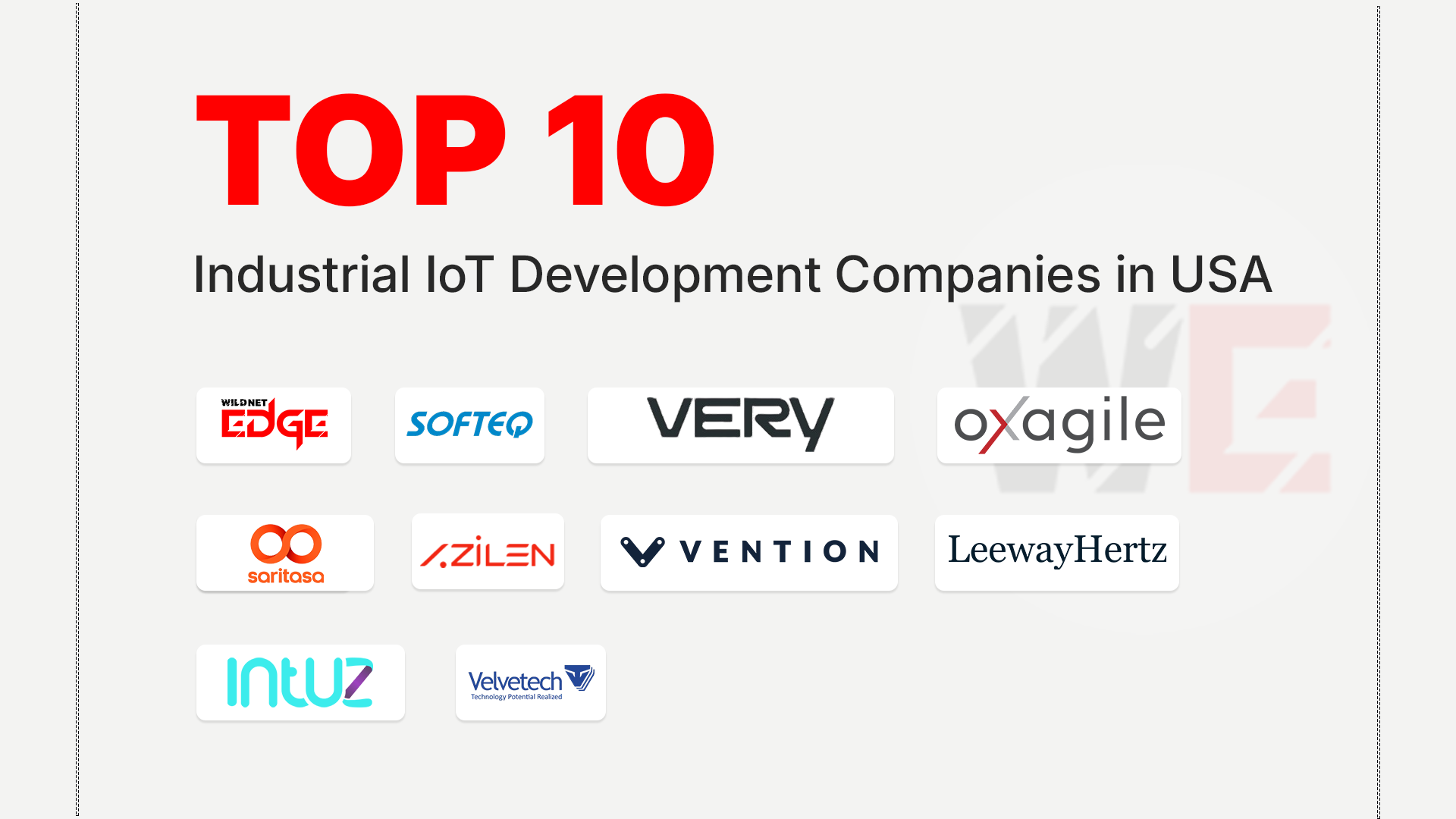
Comparative Matrix: Top 10 Industrial IoT Development Companies
| Company | Core Services | Industries Served |
| Wildnet Edge | Enterprise IIoT, Digital Twins, Edge AI | Manufacturing, Energy, Logistics, Automotive |
| Softeq | Low-Level Programming, Firmware, IIoT | Automotive, Industrial, Consumer Tech |
| Very, LLC | IoT Engineering, Hardware & Software | Industrial, Energy, Consumer Electronics |
| Oxagile | R&D, Computer Vision, IoT Platforms | Manufacturing, Energy, Automotive |
| Saritasa | Custom Software, IoT, Firmware, Mobile | Logistics, Manufacturing, Healthcare |
| Azilen Technologies | Digital Transformation, IIoT, Enterprise Mobility | Construction, Healthcare, Smart Building |
| Vention | Staff Augmentation, IoT Dev, Cloud | FinTech, HealthTech, Industrial |
| LeewayHertz | AI Development, Generative AI, Web3, IoT | Healthcare, FinTech, Manufacturing |
| Intuz | IoT Product Development, Firmware, Cloud | Manufacturing, Energy, Smart Home |
| Velvetech | Industrial IoT, M2M, Embedded Systems | Manufacturing, Energy, Construction |
Top 10 Industrial IoT Development Companies in USA for 2026
1. Wildnet Edge
- Best for: Enterprise-scale, AI-driven smart factory ecosystems and digital twin implementation.
- Key highlights:
- Over 19 years of industry experience (Founded in 2005).
- Enterprise-scale team of 350+ certified engineers.
- Proven track record with 8,000+ projects delivered.
- CMMI Level 3 appraised for mature, repeatable processes.
Wildnet Edge is one of the best industrial IoT development company on this list, built for real industrial complexity. If your factory has hundreds of machines, scattered data, and a big goal like “reduce downtime by 30%,” this team actually knows how to make that happen.
They’ve been around since 2005, and with 350+ engineers, they operate more like a full industrial innovation lab than a typical development agency. What stands out is their AI-first approach; they don’t just read sensor data; they turn it into predictions, simulations, and automated decisions. If a turbine is vibrating strangely, its system can forecast when it may fail, run a digital twin simulation, and guide technicians on the exact fix.
Their work feels engineered “for the real plant floor,” not just for a boardroom demo. They understand PLCs, edge devices, SCADA, and legacy setups that many modern firms avoid because they aren’t glamorous. Wildnet Edge embraces this challenge and builds systems that can survive dust, downtime, unstable networks, and unpredictable industrial environments.
Projects Built (Highlights):
- Predictive Maintenance Suite: Built a custom IIoT platform for a heavy equipment manufacturer. The system uses edge AI to analyze vibration and temperature data, predicting component failures with 95% accuracy and reducing unplanned downtime by 30%.
- Smart Factory Digital Twin: Developed a real-time 3D digital twin of a production line. This allows plant managers to simulate workflow changes and monitor efficiency metrics (OEE) remotely via a secure web portal.
- Automated Quality Control System: Built a computer vision solution integrated with conveyor belts. High-speed cameras detect defects in real-time, automatically rejecting faulty parts and updating the central Smart Factory App with quality reports.
- Pros:
- Enterprise-scale (350+ engineers) for handling complex, multi-site IIoT rollouts.
- AI-first approach integrates edge computing and predictive maintenance models.
- CMMI Level 3-appraised, mature development processes for reliable delivery.
- Full-lifecycle partner for strategy, firmware consulting, app development, and support.
- Cons:
- Their comprehensive, enterprise-grade architecture is designed for complex industrial environments, which may be “over-engineering” for a simple temperature monitoring prototype.
- Their focus on deep custom engineering and data integration represents a strategic investment, not a low-cost option for basic off-the-shelf sensor setups.
2. Softeq
- Best for: Low-level programming, driver development, and hardware-heavy projects.
- Key highlights:
- Founded in 1997 in Houston, TX.
- Deep expertise in C/C++ and firmware.
- Strong focus on industrial automation and robotics.
Softeq is a good choice when your project involves the “hard stuff” writing drivers for old machines, connecting custom chips, building firmware, or dealing with hardware where one tiny mistake can break the whole system. They are one of the best industrial IoT development companies, and have a lot of experience working with industrial companies, especially in energy and robotics.
If you’re working close to the metal (microcontrollers, sensors, actuators, boards), Softeq knows what they’re doing. They’re the team you call when you need something deeper than a dashboard, something that needs engineering from the inside out.
However, they’re not the best choice if your main need is a polished Smart Factory App or UI-heavy platform. Their sweet spot is everything behind the scenes, firmware, connectivity, and device-level logic. They’re also on the expensive side because low-level talent is rare.
For manufacturers with custom devices or legacy equipment that need modern connectivity, they’re a reliable fit. But if you’re building a simple IoT dashboard, they may be more than you need.
- Pros:
- Unmatched expertise in low-level firmware and driver development.
- Capable of handling the full stack from chip design to cloud dashboard.
- Cons:
- Their engineering-heavy culture may lack the polished consumer UI/UX of a creative agency.
- Premium pricing for specialized, hard-to-find low-level talent.
- It may be overkill for projects using standard, off-the-shelf gateways.
3. Very, LLC
- Best for: Agile hardware and software engineering for industrial products.
- Key highlights:
- 100% focused on IoT.
- Agile hardware development methodology.
- US-based team with a distributed model.
Very is one of the few companies that does both hardware and software with equal comfort. If you’re designing a device and need firmware, cloud, and a front-end app built as one package, they’re worth exploring. Their biggest advantage is their agile hardware process, which isn’t common. It allows them to run hardware builds like software sprints, quick iterations, testing, and refinement.
They’re very particular about the projects they take, and they usually work with clients who have technically challenging hardware needs, like smart energy systems or connected industrial equipment.
They’re not the cheapest, and if your project doesn’t require hardware design, they might not be the best match. But if you have a product that must balance electronics, firmware, and cloud systems, they can help you avoid many common mistakes that come from stitching multiple vendors together.
- Pros:
- Specialized expertise in both hardware engineering and software development.
- Agile methodology applied effectively to physical product development.
- Cons:
- Their premium, end-to-end model is expensive for software-only projects.
- Highly selective with clients; they look for complex engineering challenges.
- Not a generalist app shop; they only do IoT.
4. Oxagile
- Best for: Computer vision and video-heavy industrial applications.
- Key highlights:
- Strong R&D capabilities in Computer Vision.
- Expertise in video streaming and data analytics.
- Focus on EdTech, Media, and Industrial sectors.
Oxagile is a specialized software development company with a deep focus on video and data technologies. If you want automatic defect detection, worker safety alerts, real-time monitoring, or high-speed video analysis, this team has deep expertise in that area.
They have strong R&D roots, which means they’re comfortable building custom vision algorithms, not just using prebuilt libraries. This makes them helpful for factories that need visual quality checks or video-based automation.
However, their focus is more on vision and data than on hardware or machine connectivity. If your main need is integrating PLCs or industrial protocols, they may not cover everything. But for visual inspection, they’re one of the stronger names in the space.
- Pros:
- Deep expertise in computer vision and video analytics.
- Strong R&D capabilities for custom algorithm development.
- Cons:
- Niche focus on video/data may be less relevant for simple sensor networks.
- Premium pricing reflects their specialized domain knowledge.
- Less focused on hardware design than firms like Softeq or Very.
5. Saritasa
- Best for: Integrating IIoT with custom mobile apps and legacy systems.
- Key highlights:
- Deep expertise in IoT and custom hardware integration.
- Full-stack development capabilities (mobile, web, backend).
- 15+ years of industry experience.
Saritasa is a good fit for companies that want IIoT systems tied into mobile apps, technician tools, or field workflows. They’re strong in full-stack development—firmware, backend, mobile, which makes them practical for industrial tools that technicians use on-site.
They’ve been around for more than 15 years and have a balanced team that understands both hardware and app development. They aren’t exclusive to IoT, but they’ve delivered enough sensor-based and equipment-integrated systems to make them reliable for mid-size industrial projects. If you’re looking for something like a technician troubleshooting app, a remote control interface, or an industrial tool that connects to a phone/tablet, Saritasa is a comfortable, steady choice.
- Pros:
- Unique expertise in IoT and hardware integration for industrial use cases.
- Versatile, full-stack development team.
- Cons:
- IoT is one of many verticals, not an exclusive focus.
- May be over-qualified and more expensive for simple tracking apps.
- Their focus is on complex custom software, not just off-the-shelf configuration.
6. Azilen Technologies
- Best for: Enterprise-grade IIoT platforms, connected product engineering, and large-scale industrial automation workflows.
- Key highlights:
- Founded in 2009
- Mid–large team (300–500 employees)
- Strong focus on product engineering, IoT platforms, and scalable enterprise integrations.
Industrial IoT partner capable of building complex, data-driven ecosystems, without the overhead of massive consulting firms. While not an IIoT-exclusive company, Azilen has deep product-engineering expertise and experience integrating device telemetry, sensor networks, edge computing, and cloud architectures into existing enterprise systems.
They may not be the most startup-friendly pick, as their approach leans toward long-term product engineering, structured processes, and enterprise-scale planning. But for manufacturing companies, industrial product OEMs, logistics enterprises, or large operations teams needing safe, scalable IIoT implementation, Azilen is a reliable match.
- Pros:
- Strong enterprise mobility, product engineering, and legacy-system integration capabilities.
- Excellent long-term partner for large, multi-phase IIoT transformation projects.
- Cons:
- IIoT is a major capability but not its sole specialization.
- Better suited for mid-to-large enterprises not ideal for small budgets or fast-pivot startups.
- Can be less agile than smaller, cloud-native IoT development firms.
7. Vention
- Best for: High-growth industrial tech startups needing to scale engineering teams fast.
- Key highlights:
- Enterprise-scale team (3,000+ employees).
- Strong focus on providing elite, dedicated development teams.
- Deep expertise in AI/ML, data engineering, and cloud platforms.
Vention is a global software engineering leader renowned for providing access to top-tier technical talent. Their model is ideal for high-growth industrial tech companies that need to scale their engineering teams quickly to hit product milestones. If you already have internal developers but need more hands, especially those experienced in IoT, cloud architecture, or machine data, Vention is helpful. They’re known for quality engineers and fast onboarding. But because this is a staff-augmentation model, the client still manages the project direction. That works well for teams with a strong internal roadmap, but not for companies that want an agency to take over everything.
- Pros:
- Access to a large pool of elite, pre-vetted engineering talent.
- Fast onboarding and the ability to scale teams up or down.
- Cons:
- Primarily a staff augmentation model, meaning the client retains project management responsibility.
- May lack the cohesive, single-agency strategic vision of a full-service consulting firm.
- Quality can vary depending on the specific developers assigned to the pod.
8. LeewayHertz
- Best for: Industrial companies exploring Generative AI and Web3.
- Key highlights:
- Founded in 2007.
- Mid-sized team (50-249 employees).
- Strong focus on cutting-edge tech (GenAI, Web3, IoT).
LeewayHertz is a modern software development company that has built a strong reputation in emerging technologies. They are one of the Best Industrial IoT Development Companies for businesses looking to innovate with the absolute latest tech. They are an ideal partner for building a new Generative AI application that runs on edge devices to optimize production schedules, or for integrating supply chain data with a blockchain for secure provenance tracking. Their style fits companies that want to experiment or modernize rapidly. But if you’re looking for heavy industrial integration or PLC-related work, they may not be the top choice. They’re better suited for innovation-focused projects rather than old-equipment modernization.
- Pros:
- Strong expertise in new, cutting-edge technologies like Generative AI.
- Good balance of size and agility.
- Cons:
- Their focus on “what’s next” may not be the best fit for conservative, legacy enterprise systems.
- Niche focus on emerging tech may not suit all standard manufacturing needs.
- Less experience in long-term, large-scale enterprise modernization.
9. Intuz
- Best for: IoT product development and smart ecosystem integration.
- Key highlights:
- Strong focus on IoT and cloud solutions.
- Experience with connected devices and smart home/office tech.
- US-based presence with global delivery.
Intuz is a practical option if you’re creating a smart industrial product, like a connected HVAC controller, smart lighting system, or industrial device that needs an app. They focus heavily on IoT ecosystems: device + cloud + app.
Their team is smaller, which means they work best for mid-sized projects rather than multi-site industrial overhauls. They’re reliable for building end-to-end connected product experiences, but less suited for massive factory rollouts or heavy SCADA integration.
- Pros:
- Strong expertise in IoT and hardware integration.
- Innovative approach to connected device ecosystems.
- Cons:
- IoT integration can drive up project complexity and cost.
- May be over-qualified for a simple data visualization dashboard.
- Smaller team size limits capacity for massive enterprise projects.
10. Velvetech
- Best for: Industrial automation and M2M communication solutions.
- Key highlights:
- Specialized in Industrial IoT and embedded systems.
- Strong focus on M2M (Machine-to-Machine) communication.
- Expertise in data visualization and analytics.
Velvetech focuses specifically on machine-to-machine (M2M) communication and embedded solutions. If you want machines to talk to each other, share data, or trigger actions without human involvement, Velvetech has strong experience.
They’re straightforward, engineering-driven, and focused on practical industrial needs. Their interfaces and design aren’t fancy, but the functionality is solid. They’re best suited for small to mid-sized companies looking for dependable, focused industrial automation help not cutting-edge experimentation.
- Pros:
- Specific focus on industrial and M2M use cases.
- Strong US-based presence for close collaboration.
- Cons:
- May lack the high-end consumer UI/UX polish of digital agencies.
- Smaller team size than global systems integrators.
- Focus is more on functional utility than cutting-edge experimentation.
Our Selection Criteria: How We Chose the Best Industrial IoT Development Companies
Choosing the Best Industrial IoT Development Companies in the USA for 2026 wasn’t random we looked closely at how well each company actually works in real industrial environments. Instead of fancy buzzwords, we focused on the skills that really matter on a factory floor. Here’s what we checked:
Here’s what we looked at:
- IIoT Protocol Expertise: Industrial machines speak their own languages—MQTT, OPC UA, Modbus, Zigbee, and a few more. We picked companies that truly understand these protocols, not just mention them on their website. Without this expertise, nothing connects properly.
- Cloud & Edge Skills: A good Industrial IoT partner should know how to build IoT Solutions on platforms like AWS IoT or Azure IoT Hub. We also checked whether they can process data at the edge right next to the machines because not everything can wait for the cloud.
- Hardware Integration: Real factories have old machines, new machines, custom sensors, PLCs, SCADA screens, and all kinds of tech working together. We chose companies that know how to make these systems talk to each other safely and reliably.
- Strong Security Practices: Industrial systems run actual machines, so safety is everything. We picked firms that follow serious security standards like IEC 62443, use encryption, and build proper authentication. No shortcuts here.
- Proven Experience: We looked at how long the company has been around, what kind of projects they’ve delivered, and whether they’ve handled the tough stuff multi-site rollouts, edge AI, predictive maintenance, and more.
- Ability to Scale: A good IIoT system should work with hundreds or even thousands of sensors without slowing down. We checked how well each company handles large data pipelines and whether their solutions can grow as a factory grows.
- Real Client Feedback: Finally, we reviewed client testimonials, case studies, and third-party reviews to make sure they are reliable, transparent, and consistent.
Conclusion
In 2026, the Industrial Internet of Things drives how modern factories work. The companies on this list help manufacturers connect machines, cut downtime, and get clear, real-time visibility into their operations.
When you choose an Industrial IoT partner, you’re not just signing up for a dashboard or a few sensors. You’re trusting someone to touch the heart of your production floor, your machines, your data, and your daily output. A strong partner helps you run smoothly, react faster, and plan better as your factory grows.
This is where Wildnet Edge stands out. They handle the tough parts of industrial systems, edge processing, digital twins, AI-based maintenance, and large-scale rollouts without losing sight of what actually happens on the shop floor. Their work gives you a stable, intelligent foundation you can build on for years. If you want a connected factory that runs with fewer surprises and more control, Wildnet Edge gives you a clear path forward.
FAQs
IIoT development is the process of creating software and hardware systems that connect industrial machinery, sensors, and control systems to the internet. This allows for real-time monitoring, data analysis, and automation of industrial processes.
A Smart Factory App is a digital interface used by plant managers and operators to monitor production lines, track KPIs (like OEE), receive maintenance alerts, and control machinery remotely from a tablet or smartphone.
IoT Solutions refer to the complete ecosystem of connected devices, cloud platforms, and software applications that work together to solve a business problem. In an industrial context, this might be a predictive maintenance system or an automated energy management platform.
The cost is generally high due to complexity. A simple monitoring pilot might cost $50,000-$80,000. A fully integrated enterprise IIoT platform with custom edge AI, legacy PLC integration, and digital twins from one of the Best Industrial IoT Development Companies can cost $200,000 to over $1,000,000.
Edge computing involves processing data locally on the machine or a nearby gateway rather than sending it all to the cloud. This reduces latency for critical decisions (like emergency stops) and saves bandwidth costs.
Industrial systems control physical machines. A security breach could lead to physical damage, production stoppages, or safety hazards for workers. Secure development practices are essential to protect operational technology (OT) networks.
Yes. Most IIoT projects involve retrofitting older machines with sensors and gateways that can “speak” modern protocols, allowing legacy equipment to be monitored and managed alongside new smart machinery.

Managing Director (MD) Nitin Agarwal is a veteran in custom software development. He is fascinated by how software can turn ideas into real-world solutions. With extensive experience designing scalable and efficient systems, he focuses on creating software that delivers tangible results. Nitin enjoys exploring emerging technologies, taking on challenging projects, and mentoring teams to bring ideas to life. He believes that good software is not just about code; it’s about understanding problems and creating value for users. For him, great software combines thoughtful design, clever engineering, and a clear understanding of the problems it’s meant to solve.

 based on 1200+ reviews



