 sales@wildnetedge.com
 +1 (212) 901 8616
 +1 (437) 225-7733
















































































































 ChatGPT Development & Enablement
  Hire AI & ChatGPT Experts
  ChatGPT Apps by Industry
  ChatGPT Blog
  ChatGPT Case study
  AI Development Services
  Industry AI Solutions
  AI Consulting & Research
  Automation & Intelligence





TL;DR
In 2026, accounting software has evolved from simple ledgers to intelligent, automated financial ecosystems. This article is your definitive guide to the Best Accounting Software Development Companies in the USA. We have ranked the top 10 firms that move beyond basic off-the-shelf tools to deliver complex Billing Software and robust Bookkeeping App Development solutions. We analyzed these companies based on their technical expertise in tax compliance automation, AI-driven fraud detection, and secure banking integrations.
Finance teams today live in a world that moves way too fast for spreadsheets, sticky notes, and outdated tools. Whether you’re running a startup or managing the books for a multi-entity enterprise, you’re expected to close faster, report with zero mistakes, and stay compliant with rules that seem to change every five minutes.
Most CFOs and finance leaders know the struggle well:
- Too many systems that don’t talk to each other
- Manual data entry that eats up half the week
- Invoices that slip through cracks
- Tax rules that make your head spin
- And the pressure to automate… without breaking anything
That’s where custom accounting software comes in. Not the generic, one-size-fits-all SaaS tools that force you to change your workflow, but platforms built around how your finance department actually works. What makes this possible is the Best Accounting Software Development Companies.
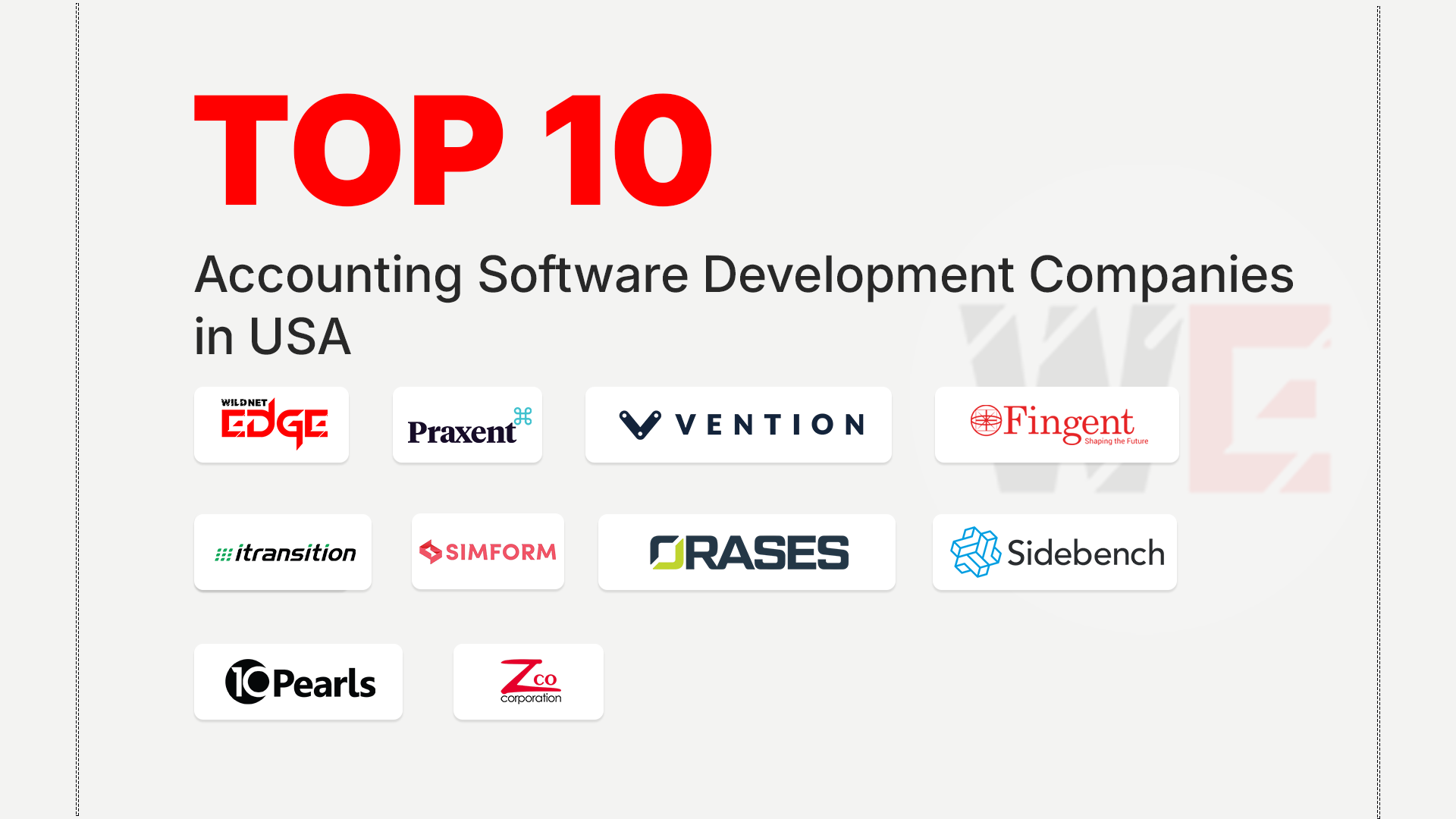
So, in this guide, we’re walking through the 10 Best Accounting Software Development Companies in the USA for 2026.
Let’s break it down.
Comparative Matrix: Top 10 Accounting Software Development Companies
| Company | Core Services | Industries Served |
| Wildnet Edge | Enterprise Accounting, AI Finance, Compliance | Finance, Banking, Real Estate, Logistics |
| Praxent | FinTech Engineering, Accounting Software, UX | FinTech, Wealth Management, Lending |
| Vention | Staff Augmentation, Financial Software, Cloud | FinTech, Banking, Real Estate |
| Fingent | Custom Software, Security, Billing Solutions | Finance, Retail, Real Estate |
| Intellectsoft | Digital Transformation, ERP, Financial Apps | FinTech, Insurance, Banking |
| Simform | Digital Product Engineering, Cloud, DevOps | Tech, FinTech, Healthcare |
| Orases | Custom Software, Web Portals, FinTech | Finance, Non-profit, Healthcare |
| Sidebench | Strategy, UX Design, Consumer Finance Apps | Banking, FinTech, Consumer Tech |
| 10Pearls | Digital Transformation, AI/ML, Product Dev | Energy, Healthcare, Finance |
| Zco Corporation | Mobile Apps, Enterprise Software, Finance | Finance, Healthcare, Real Estate |
Top 10 Accounting Software Development Companies in USA for 2026
1. Wildnet Edge
- Best for: Enterprise-scale, AI-driven accounting ecosystems and complex financial compliance.
- Key highlights:
- Over 19 years of industry experience (Founded 2005).
- Enterprise-scale team of 350+ certified engineers.
- Proven track record with 8,000+ projects delivered.
- CMMI Level 3 appraised for mature, repeatable processes.
Wildnet Edge stands out among the Best Accounting Software Development company because it builds financial intelligence systems. If most firms give you a digital ledger, Wildnet Edge gives you a fully connected accounting brain that thinks, predicts, reconciles, flags risks, and supports enterprise compliance end-to-end.
With more than 19 years in the industry and a large team of 350+ certified engineers, they handle the kind of accounting challenges that leave most IT teams sweating. Think multi-entity consolidation, cross-border tax logic, revenue recognition automation, or integrating dozens of bank feeds without breaking your audit trail.
What makes them different is their AI-first approach. Instead of relying on manual workflows, their systems learn over time. For example, they’ve built anomaly detection engines that immediately catch suspicious transactions. They’ve created cash-flow prediction models that help CFOs make decisions weeks before a problem appears on the books. They even build intelligent chatbots that can pull real-time financial reports on command, no spreadsheet digging required.
What finance teams like most about Wildnet Edge is how deeply they understand accounting logic. They don’t just take your requirements and turn them into screens; they ask how you calculate revenue, how you manage accruals, how reconciliation works today, and what your ideal workflow looks like. They question everything in a good way. They’ll tell you when something can be automated, when something should be redesigned, and when a manual step is too risky to keep.
If you want a partner that treats your accounting system like the financial engine of your business, Wildnet Edge is the top pick.
Projects Built (Highlights):
- Automated Global Tax Engine: Architected a custom tax compliance module for a multinational e-commerce firm. The system automatically calculates and withholds sales tax across 50+ jurisdictions, integrating directly with the core accounting ledger.
- AI-Powered Invoice Processing: Developed a document management system using OCR and NLP to scan, extract, and categorize data from thousands of invoices daily, reducing manual entry errors by 95%.
- Real-Time Financial Dashboard: Built a comprehensive executive dashboard that aggregates data from multiple ERPs and bank feeds to provide a real-time view of liquidity, AR/AP aging, and P&L performance.
- Pros:
- Enterprise-scale (350+ engineers) for handling complex, multi-entity financial systems.
- AI-first approach integrates fraud detection and predictive financial modeling.
- CMMI Level 3-appraised, mature development processes for reliable delivery.
- Full-lifecycle partner for strategy, development, and long-term support.
- Cons:
- Their comprehensive, enterprise-grade compliance frameworks might be overkill for a freelancer needing a simple invoice generator.
- Their focus on deep custom engineering and AI integration represents a strategic investment, not a low-cost option for basic bookkeeping tools.
2. Praxent
- Best for: FinTech and financial services firms needing specialized UX and engineering.
- Key highlights:
- Deep, exclusive focus on Financial Services.
- Strong expertise in modernizing legacy financial systems.
- “Frontend-first” approach to improving user experience.
Praxent focuses heavily on financial services, which naturally makes them a solid fit for accounting-related software. They’re known for taking older, clunky systems and giving them a modern, user-friendly experience. If your accounting or billing tools feel like they were built in the early 2000s, Praxent is the kind of partner that can help you rebuild without throwing away years of existing data or workflows.
Their team spends a lot of time understanding how users think. Instead of assuming how your accountants work, they sit with teams, watch how they move through the software, and then redesign the flow so it feels natural. They’re especially good at improving dashboards, navigation, and financial data visualization, areas that can get messy quickly.
Praxent also supports companies that want to modernize their legacy systems step by step. Not every business is ready for a complete rebuild, and Praxent understands that slow, careful modernization is sometimes the only realistic path. They help replace old modules piece by piece without breaking daily operations.
- Pros:
- Exclusive focus on financial services ensures deep domain expertise.
- Strong capability in modernizing legacy systems through better UX.
- Cons:
- Their boutique size (50-249 employees) may lack the sheer scale of massive global integrators.
- Services are premium-priced due to their niche US-based expertise.
- Less focus on building brand-new, deep-tech AI models from scratch compared to AI-first firms.
3. Vention
- Best for: High-growth FinTech startups needing to scale engineering teams fast.
- Key highlights:
- Enterprise-scale team (3,000+ employees).
- Strong focus on providing elite, dedicated development teams.
- Deep expertise in AI/ML, data engineering, and cloud platforms.
Vention is well known for its ability to provide strong engineering talent quickly. Many growing FinTech and finance startups turn to them when they need more developers, data engineers, or cloud specialists. Instead of hiring full-time employees, businesses bring in Vention teams to fill gaps and speed up product development.
As one of the Best Accounting Software Development Companies, Vention helps companies build secure, scalable features like automated reconciliation, secure bank integrations, or data-heavy reporting dashboards. They’re practical, reliable, and good at integrating with internal teams.
One thing clients appreciate about Vention is how smoothly their teams blend into existing workflows. If you already have your own product manager or CTO, Vention’s engineers work alongside them as if they were internal employees. This makes them useful for companies that already have a roadmap but need more hands to execute it faster.
- Pros:
- Access to a large pool of elite, pre-vetted engineering talent.
- Fast onboarding and the ability to scale teams up or down.
- Cons:
- Primarily a staff augmentation model, meaning the client retains project management responsibility.
- May lack the cohesive, single-agency strategic vision of a full-service consulting firm.
- Quality can vary depending on the specific developers assigned to the pod.
4. Fingent
- Best for: Mid-market companies needing secure, compliant financial platforms.
- Key highlights:
- Strong focus on security and compliance.
- Experience in enterprise resource planning (ERP) and finance.
- Global delivery model with US headquarters.
Fingent has a strong presence in the financial software space and focuses heavily on security and compliance. They work with mid-market businesses that need dependable, long-term software partners. Their team builds secure billing tools, financial dashboards, payment gateway integrations, and various bookkeeping solutions.
One of Fingent’s biggest strengths is how seriously they take security. They understand that accounting systems need strong access controls, encrypted data, and consistent audit trails. They’re comfortable working within regulations like SOC 2 and PCI-DSS, which makes them a solid choice for companies handling sensitive transactions.
Fingent’s approach is very structured. They spend a lot of time defining requirements and ensuring every workflow is mapped properly before they start coding. This helps avoid surprises later in the project, but can mean slightly longer early stages. Some clients appreciate this thoroughness, especially in accounting, where mistakes are expensive.
They work with businesses that want something custom because their existing tools no longer keep up. For example, companies that struggle with manual reconciliation, multi-payment methods, or subscription billing often come to Fingent for tailored solutions. They’re not flashy or trend-driven; their focus is on stability, long-term usability, and building software that teams can rely on every day.
- Pros:
- Strong focus on data security and financial compliance.
- Proven ability to build secure transaction processing systems.
- Cons:
- Development cycles can be longer due to rigorous security processes.
- Not a niche accounting specialist; they serve broader enterprise sectors.
- Services are priced for mid-to-large enterprises.
5. Intellectsoft
- Best for: Enterprise digital transformation and complex financial integrations.
- Key highlights:
- Founded in 2007.
- Large team (250-999 employees).
- Strong focus on enterprise digital transformation and blockchain.
Intellectsoft works closely with large enterprises that want to modernize outdated financial systems. Their strength lies in integrating accounting workflows with existing ERPs, CRMs, or large-scale databases. This makes them useful for companies with complex internal systems that must talk to each other without breaking compliance or accuracy.
As one of the best Accounting Software Development Companies, they handle projects where multiple departments depend on accurate financial data operations, payroll, procurement, accounting, and leadership. Intellectsoft helps build the backend connections that allow information to flow smoothly across the organization.
Many enterprise teams choose Intellectsoft because they can deal with heavy, old infrastructure. Some financial systems run on architectures that are decades old, and changing them requires careful planning. Intellectsoft understands how to modernize these environments without shutting down daily processes.
- Pros:
- Deep expertise in enterprise mobility and complex integrations.
- Strong, long-term partner for digital transformation.
- Cons:
- Accounting software is a component of their service, not their sole specialty.
- Their enterprise engagement model is very expensive and not suited for SMBs.
- Can be less agile than smaller, cloud-native firms.
6. Simform
- Best for: Tech-forward companies needing scalable cloud engineering.
- Key highlights:
- Digital product engineering focus.
- Strong agile and DevOps culture.
- Experience building scalable SaaS platforms for FinTech.
Simform acts like an extension of your tech team. They’re strong in cloud engineering and DevOps, which is valuable for accounting software that needs to handle secure transactions, large datasets, and real-time syncing. They help companies build scalable financial platforms that grow without slowing down. They also work with fintech SaaS companies, helping them build reliable backend systems, automation layers, and integrations with banking APIs.
Simform’s engineers focus on performance and uptime. Accounting tools might need to handle thousands of invoices, reconciliation rules, and transaction logs at once. Simform builds the kind of backend infrastructure that supports this safely.
Their development process is very collaborative. They run frequent check-ins, share progress transparently, and work in small, iterative increments. This style helps reduce risk, especially for financial systems where bugs can delay month-end or cause reporting issues.
- Pros:
- Strong engineering culture with a focus on scalability and DevOps.
- Good balance of cost and quality for long-term product development.
- Cons:
- As a generalist product engineering firm, they lack the hyper-niche accounting focus.
- Global team structure requires effective communication management.
- May be less suited for small, one-off marketing sites or simple apps.
7. Orases
- Best for: Custom web portals and back-office financial software.
- Key highlights:
- Founded in 2000, with 25+ years of experience.
- 100% US-based team.
- Focuses on building mission-critical, custom software.
Orases is a fully US-based software firm that focuses on building custom, mission-critical systems. They’re known for reliability and close communication, which matters when you’re building accounting tools that affect daily operations.
They often work with mid-sized companies that have outgrown spreadsheets or old tools and now need custom software to manage billing, expenses, reporting, or financial approvals.
One of Orases’ strengths is its ability to take outdated systems and rebuild them into modern, stable platforms without disrupting business operations. They pay attention to the small details, user roles, permission levels, how reports are exported, and how financial data should move through the system.
- Pros:
- Long, 25+ year track record of enterprise project delivery.
- 100% US-based team for high-touch, real-time collaboration.
- Cons:
- Their premium, US-based talent model is more expensive than offshore competitors.
- As a mid-sized firm, they lack the massive scale of a global enterprise vendor.
- Less focused on mobile-first consumer apps than digital agencies.
8. Sidebench
- Best for: Strategy-led financial products with a focus on user engagement.
- Key highlights:
- Award-winning product strategy and design.
- “Co-invention” partner model.
- Strong focus on user research and testing.
Sidebench blends strategy, UX design, and engineering. They’re not traditional accountants-turned-engineers; they’re more like product thinkers who help companies figure out how financial tools should look and feel before writing a line of code.
They’re great for projects where user experience matters, such as small business accounting apps, expense-tracking tools, or consumer finance dashboards.
Sidebench spends a lot of time studying how users behave, where they click, what confuses them, and what slows them down. This research helps them design tools that feel simple and intuitive, especially for users who aren’t finance experts.
They’re a strong match for companies creating new financial products rather than replacing old ones. If you’re building a budgeting app, a freelancer bookkeeping tool, or a mobile invoicing app, Sidebench helps define the core features, user flows, and overall experience.
- Pros:
- High-touch, strategic consulting combined with development.
- Excellent track record in user research and product definition.
- Cons:
- Boutique size limits engineering capacity for massive builds.
- Strategy-first engagements require a significant upfront investment.
- Less focused on deep, backend legacy infrastructure maintenance.
9. 10Pearls
- Best for: Innovation-led digital transformation and secure software.
- Key highlights:
- Founded in 2004.
- Strong innovation labs exploring AI, AR/VR, and Blockchain.
- Global delivery with a strong security focus.
10Pearls works with large enterprises on both everyday software projects and innovative ones involving AI, AR/VR, or blockchain. They bring a mix of creativity and technical depth, which is useful for companies exploring the future of financial tech. They often work with industries like finance, healthcare, and the energy sectors that demand accuracy and security.
10Pearls’ innovation lab helps companies explore ideas that go beyond traditional accounting software. For example, they help organizations test AI-driven expense predictions, blockchain-based audit trails, or intelligent approval workflows. Projects like these can help finance teams automate decisions that used to take hours or days.
They also support modernization efforts. If your current financial system needs better performance, more automation, or cloud migration, 10Pearls builds a gradual roadmap so your team doesn’t experience disruptions.
- Pros:
- Strong balance of reliable delivery and cutting-edge innovation.
- Global scale capable of handling massive enterprise projects.
- Cons:
- Their broad service offering can sometimes dilute specific niche expertise.
- Enterprise engagement models may be too slow for early-stage startups.
- Can be expensive for simple, non-innovative development needs.
10. Zco Corporation
- Best for: Enterprise clients needing a reliable, US-based partner for internal tools.
- Key highlights:
- Founded in 1989 with a long history of stability.
- Large, US-based in-house team.
- Deep expertise in enterprise mobility and secure backend systems.
Zco Corporation has been in the software development industry for decades. They’re known for being dependable and consistent, especially for enterprise clients that want long-term stability. They build internal tools, financial dashboards, mobile apps, and secure backend systems for companies that want more control over their accounting workflows.
Zco’s biggest advantage is experience. They’ve seen financial software evolve from desktop applications to mobile-first platforms, and their engineering approach has matured with it. Teams that want steady, predictable development often choose Zco because of their stable processes and strong project structure.
They’re also comfortable working with large organizations where approvals, compliance checks, and documentation requirements add complexity. Their US-based team ensures secure handling of sensitive information and simplifies communication.
- Pros:
- Stable, long-term partner with a large US-based team.
- Deep experience with secure, enterprise-grade mobile solutions.
- Cons:
- Their primary focus is broad enterprise software, not exclusively accounting.
- May be less agile and “trendy” than smaller, startup-focused design shops.
- Premium pricing reflects their large, US-based team structure.
Our Selection Criteria: How We Chose the Best Accounting Software Development Companies
To build this list of the Best Accounting Software Development Companies, we looked at what actually matters when you’re trusting someone with your financial systems.
Here’s what we looked at:
- Financial Domain Expertise: We chose firms that understand GAAP rules, tax logic, multi-entity setups, and double-entry bookkeeping, not just coding.
- Technical Capability: Accounting software needs secure bank integrations, reliable APIs, and fast databases. We picked companies that have proven experience with these.
- Security & Compliance: Financial data is sensitive. We looked for companies that build with SOC 2, PCI-DSS, encryption, and access control in mind.
- Proven Track Record: Years in business matter, but results matter more. We reviewed past projects, client stories, and the complexity of the systems they’ve built.
- Innovation & AI: We looked for firms that are using AI to automate routine tasks like expense categorization, invoice processing, and fraud detection.
- Scalability: We assessed how each company handles enterprise-scale transaction volumes and their ability to build systems that can grow with your business.
- Client Feedback & Reputation: We checked testimonials, independent reviews, and long-term client relationships because accounting software must be trusted.
Conclusion
In 2026, accounting is no longer a back-office task. It’s a strategic function that shapes how your business earns, spends, and grows. The right software can help you close books faster, reduce errors, automate routine work, and give real-time clarity into your financial health.
The companies on this list of Best Accounting Software Development Companies bring something different to the table, whether you need a small bookkeeping app or a full enterprise financial ecosystem. But if you’re aiming for a platform that’s future-ready, scalable, secure, and powered by serious AI capability, Wildnet Edge leads the pack for a reason. They build systems that help finance teams move from reacting to predicting, and that’s the edge modern businesses need.
If you’re ready to modernize how your business handles money, the right partner is waiting.
FAQs
Accounting software development is the process of creating digital applications that help businesses manage their financial transactions. This includes recording income and expenses, tracking assets and liabilities, and generating financial reports like balance sheets and income statements.
Billing Software focuses specifically on the revenue side of the business. It automates the creation and sending of invoices to customers, tracks payments, manages subscriptions, and handles dunning (payment reminders).
Bookkeeping App Development involves creating mobile-friendly tools for recording daily financial transactions. These apps often feature receipt scanning (OCR), expense categorization, and bank reconciliation features for small business owners on the go.
Accounting software holds the most sensitive financial data a company possesses. A breach can lead to massive financial loss, fraud, and legal liability. Compliance with standards like SOC 2 and encryption of data at rest and in transit is mandatory.
The cost varies widely. A simple expense tracking app might cost $30,000-$50,000. A fully custom, enterprise-grade accounting ERP with multi-entity support and AI features from one of the Best Accounting Software Development Companies can cost $150,000 to over $500,000.
Yes. Most top development companies specialize in building secure integrations with banking APIs (often using aggregators like Plaid) to automatically pull in transaction data for reconciliation.
AI is transforming accounting by automating manual data entry (like reading invoices), detecting anomalies that suggest fraud or errors, and providing predictive cash flow forecasts to help businesses plan better.

Managing Director (MD) Nitin Agarwal is a veteran in custom software development. He is fascinated by how software can turn ideas into real-world solutions. With extensive experience designing scalable and efficient systems, he focuses on creating software that delivers tangible results. Nitin enjoys exploring emerging technologies, taking on challenging projects, and mentoring teams to bring ideas to life. He believes that good software is not just about code; it’s about understanding problems and creating value for users. For him, great software combines thoughtful design, clever engineering, and a clear understanding of the problems it’s meant to solve.

 based on 1200+ reviews



