sales@wildnetedge.com
 +1 (212) 901 8616
 +1 (437) 225-7733
















































































































 ChatGPT Development & Enablement
  Hire AI & ChatGPT Experts
  ChatGPT Apps by Industry
  ChatGPT Blog
  ChatGPT Case study
  AI Development Services
  Industry AI Solutions
  AI Consulting & Research
  Automation & Intelligence





TL;DR
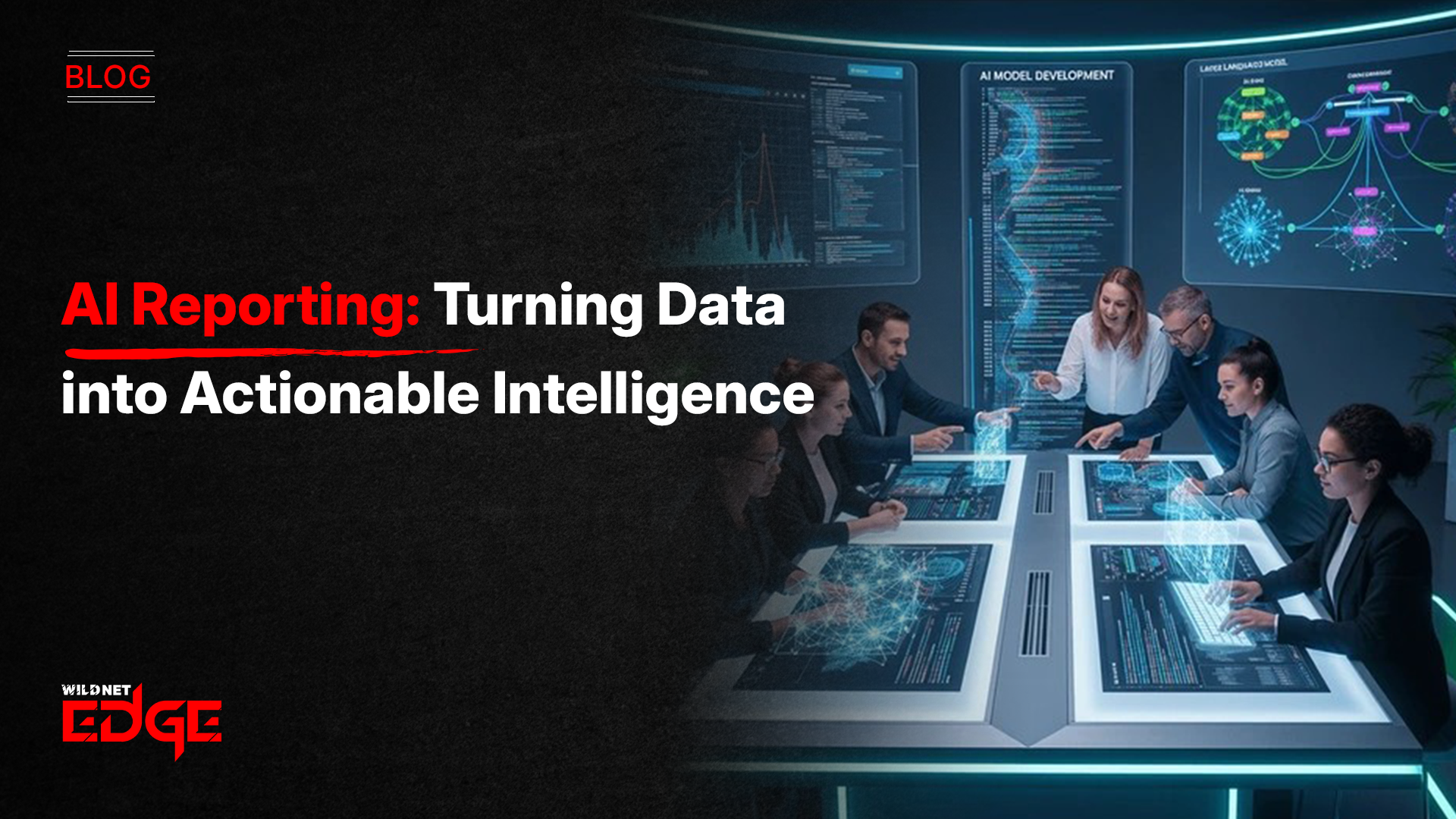
AI Reporting replaces slow, manual reporting with automated reports, real-time analytics, and intelligent dashboards. It helps businesses move from static spreadsheets to smart reporting that explains what is happening and why. With BI enhancement AI, leaders get accurate insights faster and make decisions based on live data instead of outdated reports.
AI Reporting has become critical for modern enterprises. In 2026, businesses generate more data than ever, but traditional reporting still relies on manual effort and delayed summaries. Waiting days or weeks for reports slows decisions and increases risk.
AI Reporting changes this dynamic. It automates data collection, analyzes trends instantly, and presents insights in a way leaders can understand without digging through spreadsheets. Instead of reacting to the past, organizations act on what is happening now and what is likely to happen next.
Automated Reports: Faster, Cleaner, Reliable
Manual reporting wastes time and introduces errors. Analysts spend hours exporting data, fixing formats, and validating numbers.
Reports Without Manual Effort
Automated reports pull data directly from systems like CRM, ERP, finance tools, and marketing platforms. The system updates reports on schedule or in real time, without human intervention.
This ensures consistency and accuracy. Teams stop worrying about version mismatches and focus on interpreting results. Automated reports free analysts from repetitive tasks and give leaders confidence in the numbers they see.
BI Enhancement AI: Turning Data into Understanding
Most companies already use BI tools, but many dashboards only show charts and trends.
From Charts to Insights
BI enhancement AI adds intelligence on top of existing BI platforms. Instead of just showing a decline in sales, the system highlights the cause—region, product, or customer segment—and explains the impact.
This makes BI tools more useful for decision-makers. The system continuously monitors data, flags unusual behavior, and surfaces insights without waiting for someone to ask the right question. By utilizing advanced BI services, companies can deploy models that automatically highlight anomalies and root causes. The system doesn’t just display data; it interprets it, acting as a tireless data scientist that monitors your business 24/7.
Real-Time Analytics: Decisions on Live Data
In fast-moving markets, delayed data loses value quickly.
Always-Up-To-Date Views
AI Reporting enables real-time analytics by processing streaming data as it arrives. Sales, inventory, operations, and customer activity update instantly.
Leaders no longer rely on yesterday’s numbers. They see the current state of the business and adjust quickly. This is especially important for supply chains, pricing decisions, and operational planning. This dynamic adaptability is powered by robust data analytics backends that process streaming data instantly. This ensures that the dashboard reflects the exact state of the business at this very second, which is critical for supply chain and inventory management.
Case Studies: Reporting Revolution
Case Study 1: The Global Retailer
- The Challenge: A retail chain took 10 days to close their monthly books, delaying critical inventory decisions.
- The Solution: They implemented an AI Reporting suite that automated data reconciliation across 500 stores.
- The Result: The “close” cycle dropped to 2 days. The system provided real-time visibility into stock levels, reducing overstock waste by 15%.
Case Study 2: The Fintech Firm
- The Challenge: Analysts spent 80% of their time building reports and only 20% analyzing them.
- The Solution: The firm adopted smart reporting tools with BI enhancement AI to auto-generate regulatory filings.
- The Result: Analyst productivity soared. The automated solution handled the compliance documentation, allowing the team to focus on strategic growth initiatives.
Intelligent Dashboards: Built for Each Role
Different teams need different views of the same data.
Context-Aware Dashboards
Intelligent dashboards adapt based on the user. A CFO sees cash flow and risk indicators. A CMO sees campaign performance and customer acquisition trends. An operations leader sees bottlenecks and capacity issues.
AI Reporting ensures everyone works from the same data while seeing insights relevant to their role. This alignment reduces confusion and speeds execution. This capability, often built through custom AI development, democratizes data, making sophisticated insights accessible to non-technical stakeholders.
Conclusion
AI Reporting transforms reporting from a routine task into a strategic advantage. Automated reports handle repetitive work. Real-time analytics provide the current pulse of the business. Intelligent dashboards and smart reporting explain what the data means.
When leaders no longer struggle to find or trust information, they focus on execution and customer value. Organizations that adopt AI Reporting move faster, reduce errors, and make better decisions with confidence. Wildnet Edge’s AI-first approach guarantees that we create reporting ecosystems that are high-quality, safe, and future-proof. We collaborate with you to untangle the complexities of data and to realize engineering excellence.
FAQs
AI Reporting represents the integration of intelligent systems and computational techniques to completely automate the extraction, analysis, and visualization of data, thereby converting raw numbers into easily understandable and useful insights through the use of computer programs only.
Standard reports show unchanging captures of information. On the other hand, AI-powered automated reports can instantly modify settings, find irregularities, and send out warnings according to certain data conditions, thus being very much more reactive.
Yes. Modern automated reporting tools are designed to sit on top of legacy databases (SQL, ERPs) and extract data via APIs, meaning you don’t need to rebuild your entire stack to benefit from BI enhancement AI.
It can be, but the cost has decreased significantly. Cloud-based automated reporting solutions allow businesses to pay for compute power only when processing data, making real-time analytics accessible even to mid-sized firms.
Enterprise-grade automated reporting adheres to strict governance protocols. It ensures that sensitive data is encrypted and that access to intelligent dashboards is restricted based on user roles (RBAC).
No. It replaces the tedious task of compiling reports. Analysts are still needed to interpret complex strategic nuances that AI might miss, but they become significantly more productive.
Microsoft Power BI (equipped with Copilot) is among the most preferred tools; Tableau (integrated with Einstein Discovery); and focused products such as ThoughtSpot, which all utilize the functionality to make the data more accessible, are some of the tools.

Managing Director (MD) Nitin Agarwal is a veteran in custom software development. He is fascinated by how software can turn ideas into real-world solutions. With extensive experience designing scalable and efficient systems, he focuses on creating software that delivers tangible results. Nitin enjoys exploring emerging technologies, taking on challenging projects, and mentoring teams to bring ideas to life. He believes that good software is not just about code; it’s about understanding problems and creating value for users. For him, great software combines thoughtful design, clever engineering, and a clear understanding of the problems it’s meant to solve.


 based on 1200+ reviews