sales@wildnetedge.com
 +1 (212) 901 8616
 +1 (437) 225-7733
















































































































 ChatGPT Development & Enablement
  Hire AI & ChatGPT Experts
  ChatGPT Apps by Industry
  ChatGPT Blog
  ChatGPT Case study
  AI Development Services
  Industry AI Solutions
  AI Consulting & Research
  Automation & Intelligence





TL;DR
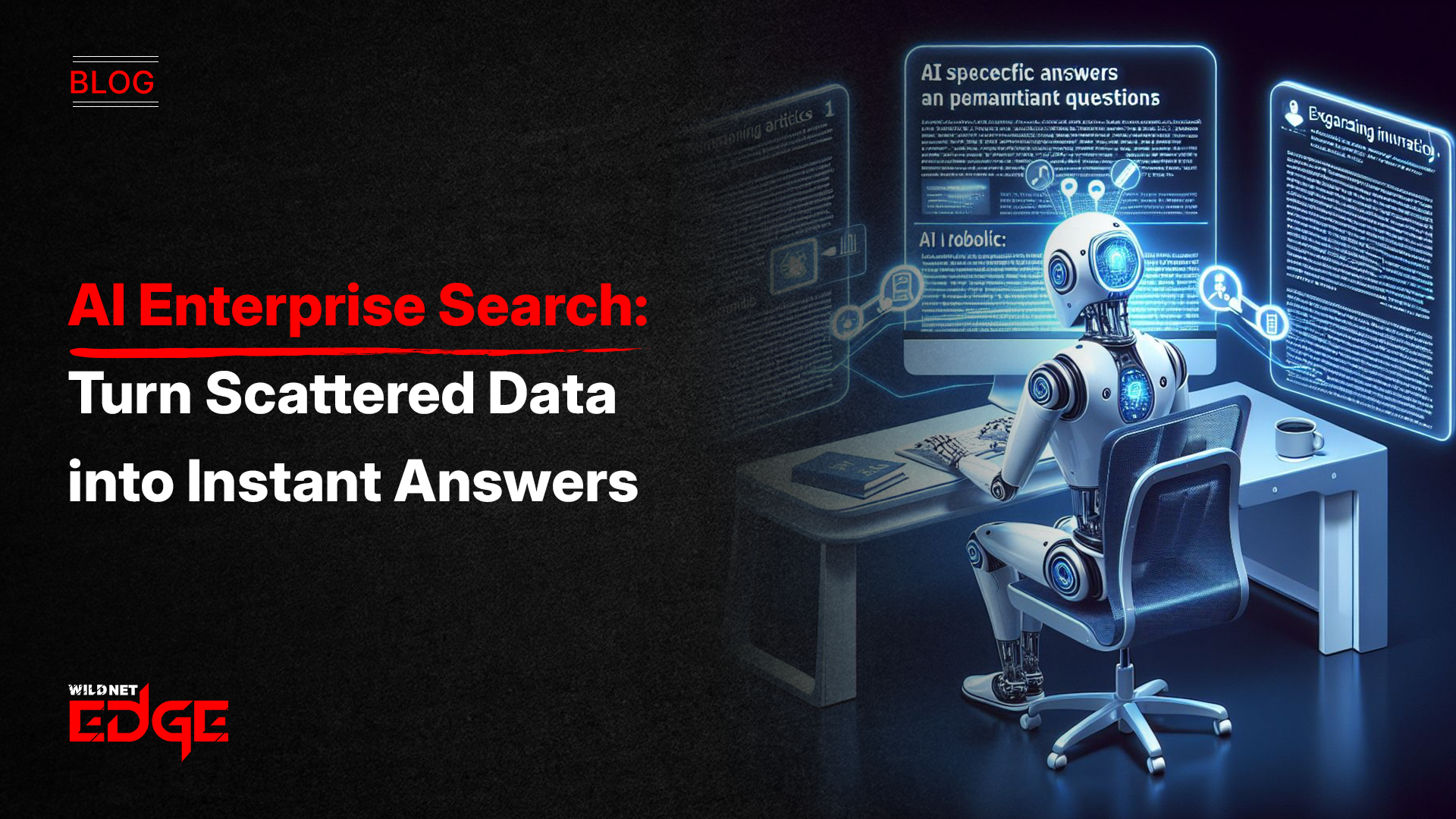
AI Enterprise Search helps organizations find information faster by understanding meaning, not just keywords. This article explains how semantic search improves accuracy, how NLP search tools interpret natural language, how intelligent search engines break data silos, and how AI search automation delivers answers proactively. Together, these capabilities create a scalable enterprise knowledge search system that boosts productivity and decision speed.
AI Enterprise Search has become a productivity necessity. In 2026, employees lose hours every week searching across emails, shared drives, project tools, and internal systems. The problem is not a lack of data; it is fragmentation.
Traditional enterprise search tools rely on exact keywords. They fail when users phrase questions differently or do not know where information lives. AI Enterprise Search fixes this by understanding intent, context, and relationships across data. It turns disconnected systems into a single, searchable knowledge layer. For growing organizations, AI-powered search is no longer an IT upgrade. It is a business accelerator.
What Makes AI Enterprise Search Different
The core shift lies in understanding meaning instead of matching words. AI Enterprise Search uses machine learning models to analyze how concepts relate to each other. It does not care where the data sits or how it is named. It focuses on what the user wants to know.
This capability powers intelligent search engines that return relevant answers, not long lists of documents. Employees spend less time searching and more time acting.
Semantic Search: Understanding Context, Not Just Keywords
Semantic search forms the foundation of AI Enterprise Search.
Instead of matching exact phrases, semantic search understands that different terms can mean the same thing. A search for “financial summary” can surface results titled “annual report” or “FY review” because the system understands conceptual similarity.
This works through vector representations that map relationships between ideas. Semantic search improves accuracy, reduces missed results, and makes enterprise knowledge search usable even when users do not know the exact wording. To build these sophisticated vector models, companies often turn to specialized AI development partners who can fine-tune the algorithms to understand specific industry jargon.
NLP Search Tools: Let Employees Ask Real Questions
People search in plain language, not technical syntax. NLP search tools bridge that gap.
With NLP search tools, users can ask questions like:
- “Show me last quarter’s sales forecast.”
- “Find the contract signed with Vendor X”
- “What was decided in the security review meeting?”
AI-powered search breaks these questions into intent, entities, and timeframes. It retrieves precise results instead of forcing users to open multiple files.
This removes friction for non-technical teams and makes search accessible across the organization. This capability transforms static enterprise software into a conversational interface, dramatically reducing the technical barrier for non-technical staff to find data.
Enterprise Knowledge Search: Breaking Data Silos
Data silos slow teams down. Marketing works in one system, engineering in another, and legal in shared drives.
Enterprise knowledge search connects these systems into a unified index. AI Enterprise Search crawls authorized data sources, respects permissions, and creates a single access layer. Users see only what they are allowed to see, but they no longer need to know where data lives.
This unified approach improves collaboration and reduces duplicated work caused by missing information. Building the pipelines to feed this AI-powered search engine requires robust data engineering, ensuring that data is cleaned, tagged, and ingested in real-time without crashing the network.
AI Search Automation and Proactivity
AI search automation shifts search from reactive to proactive. Instead of waiting for queries, AI Enterprise Search anticipates information needs based on context. If a user has a meeting scheduled, the system can surface relevant documents, emails, and notes automatically.
This reduces context switching and embeds enterprise knowledge search directly into daily workflows. Search becomes invisible, but its impact becomes constant.
Case Studies: Efficiency at Scale
Case Study 1: The Global Law Firm (Semantic Discovery)
- The Challenge: Lawyers spent hours finding case precedents across millions of PDF files.
- The Solution: The firm implemented an AI-powered search system with OCR (Optical Character Recognition) and semantic vectoring.
- The Result: The system allowed lawyers to search for “breach of contract clauses” and find relevant paragraphs even if the wording varied. AI Enterprise Search reduced research time by 40%, directly increasing billable efficiency.
Case Study 2: The Tech Support Giant (Ticket Deflection)
- The Challenge: Support agents struggled to find solution articles while customers waited on hold.
- The Solution: They deployed AI-powered search integrated directly into the agent’s chat console.
- The Result: The system analyzed the customer’s chat in real-time and auto-suggested the correct knowledge base article. AI Enterprise Search improved First Call Resolution (FCR) rates by 25%.
Conclusion
AI Enterprise Search works only when it fits your data, security model, and workflows. At Wildnet Edge, we design custom AI-powered search solutions that turn scattered enterprise data into a reliable source of answers.
Our teams build secure, permission-aware search architectures using semantic search, advanced NLP search tools, and scalable AI search automation. We integrate intelligent search engines across SaaS platforms, internal tools, and unstructured content to create a unified enterprise knowledge search layer. With Wildnet Edge, AI-powered search becomes a strategic capability that accelerates execution, improves collaboration, and helps teams work at the speed of information.
FAQs
It is a search technology that uses artificial intelligence to understand the intent and context of a query, rather than just matching keywords, to find data across an organization.
Keyword search matches exact words (e.g., “car”). Semantic search matches meanings (e.g., understanding that “vehicle” and “automobile” relate to “car”).
Yes. Tools like Elasticsearch (with vector search), Haystack, and commercial platforms like Glean or Coveo are leaders in deploying AI-powered search capabilities.
Yes. It honors “Access Control Lists” (ACLs). The system mirrors the permissions of the source app, ensuring users only see search results for documents they are allowed to access.
Yes. To work effectively, AI-powered search needs clean, structured data pipelines to ingest information from various APIs and legacy databases.
Modern systems use “multimodal” AI. AI-powered search can transcribe video audio or use computer vision to recognize text in scanned images (OCR), making them searchable.
A basic AI-powered search pilot can be deployed in weeks, but fully tuning the relevance models and connecting all data silos typically takes 3-6 months.

Managing Director (MD) Nitin Agarwal is a veteran in custom software development. He is fascinated by how software can turn ideas into real-world solutions. With extensive experience designing scalable and efficient systems, he focuses on creating software that delivers tangible results. Nitin enjoys exploring emerging technologies, taking on challenging projects, and mentoring teams to bring ideas to life. He believes that good software is not just about code; it’s about understanding problems and creating value for users. For him, great software combines thoughtful design, clever engineering, and a clear understanding of the problems it’s meant to solve.


 based on 1200+ reviews