sales@wildnetedge.com
 +1 (212) 901 8616
 +1 (437) 225-7733













































































































 ChatGPT Development & Enablement
  Hire AI & ChatGPT Experts
  ChatGPT Apps by Industry
  ChatGPT Blog
  ChatGPT Case study
  AI Development Services
  Industry AI Solutions
  AI Consulting & Research
  Automation & Intelligence





TL;DR
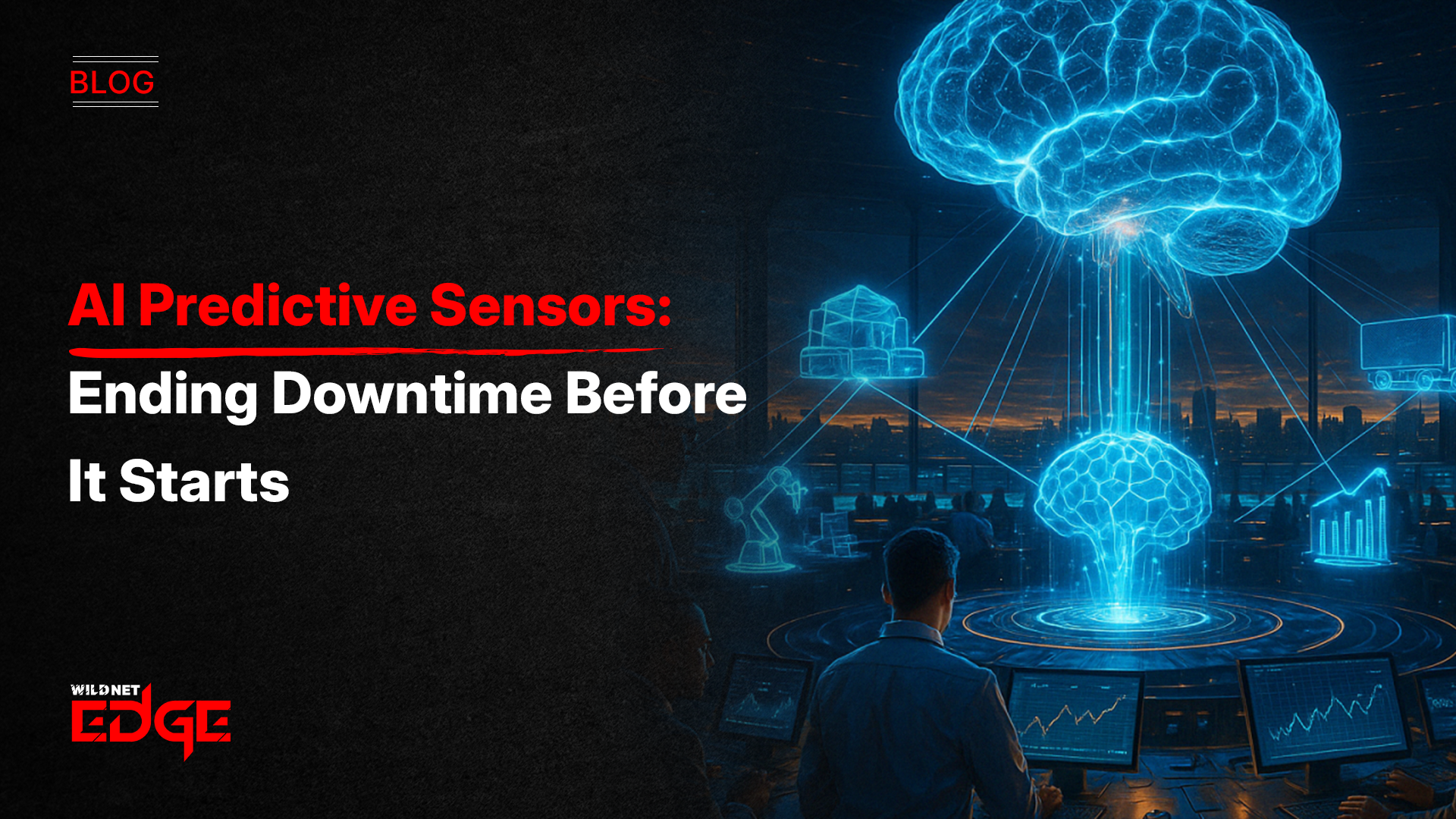
Unplanned downtime is one of the most expensive problems in modern industry. AI Predictive Sensors solve this by detecting equipment issues before failures happen. Using advanced IoT sensors, real-time fault detection, and intelligent maintenance analytics, organizations can predict breakdowns weeks in advance. These systems improve equipment prediction accuracy, reduce spare-part waste, and keep production running without surprise stoppages.
In 2026, machines will not fail suddenly. They warn you if you know how to listen. AI Predictive Sensors give industries that ability. Traditional maintenance relies on schedules or visible damage. Both approaches come too late. Calendar-based servicing wastes time and money, while reactive repairs lead to costly shutdowns. AI Predictive Sensors change the model entirely by monitoring real machine behavior in real time.
These sensors do more than collect data. They analyze vibration, heat, sound, and electrical signals at the edge. They identify small changes that signal early failure. Instead of reacting to breakdowns, teams act on insight. Maintenance becomes planned, precise, and predictable.
What Makes AI Predictive Sensors Different
Edge Intelligence, Not Raw Data
Older sensors stream raw readings to dashboards. Industrial AI sensors process data locally using embedded models. They detect abnormal patterns instantly and send only meaningful alerts instead of constant noise.
This edge processing enables fast fault detection, even in environments with limited connectivity. It also lowers bandwidth costs and avoids delays caused by cloud-only analysis.
Sensor Fusion for Better Accuracy
Single signals rarely tell the full story. AI Predictive Sensors combine vibration, acoustic, thermal, and magnetic data to build a complete picture of machine health. This fusion improves equipment prediction accuracy and reduces false alarms.
Driving Value with Maintenance Analytics
The data generated by AI Predictive Sensors feeds into a broader ecosystem of maintenance analytics.
Precision Fault Detection
Basic alarms can only give two responses: “On” or “Off.” On the other hand, smart sensors can produce spectral imaging. The latter can recognize anomalies undetected by the human eye, like minute hairline fissures in a turbine blade or cavitation in a pump. When they are issues at the “P-F Interval” (the amount of time from the potential failure becoming detectable to the functional failure happening), companies can have several weeks to react and prepare their repairs.
Optimizing the Supply Chain
The prediction of equipment failure does not only contribute to machine lifespan but it also reduces inventory costs. Maintenance analytics platforms that are linked to AI Predictive Sensors do not place orders for spare parts until the failure is about to occur, while they are tracking and monitoring the condition of the machines. This kind of maintenance that is performed only when necessary, also referred to as “Just-in-Time” maintenance, drags down carrying costs tremendously.
Industry Use Cases
Manufacturing
In automated plants, even brief stoppages are expensive. Industrial AI sensors monitor motors and conveyors continuously. When friction or load changes appear, systems adjust speed automatically and notify maintenance before a jam occurs.
Energy and Utilities
Remote assets like wind turbines and substations benefit from predictive monitoring. AI Predictive Sensors distinguish between harmless anomalies and real threats, reducing unnecessary site visits and improving safety.
Challenges to Plan For
Integration Across Systems
Sensor data must connect to CMMS, ERP, and automation platforms. Without integration, insights remain isolated. A unified data flow is critical for full value.
Proper Baseline Training
AI models need time to learn what “normal” looks like. Skipping this step leads to alert fatigue. Accurate fault detection depends on clean baseline data.
Case Studies: Reliability Redefined
Case Study 1: The Automotive Giant
- The Challenge: A car manufacturer faced frequent downtime on their robotic welding line due to sudden servo failures. Reactive maintenance was costing $50k per minute of stoppage. They lacked the insight provided by AI Predictive Sensors.
- The Solution: They installed wireless vibration IoT sensors on every robotic arm. These devices fed data into a central anomaly detection model.
- The Result: The system predicted a servo failure 3 weeks in advance. Maintenance replaced it during a planned break. Downtime was reduced by 90%, and the ROI on the hardware was achieved in 3 months.
Case Study 2: The Refinery Safety Boost
- The Challenge: A chemical refinery relied on manual rounds to check pump health. This was dangerous for workers and infrequent.
- The Solution: They deployed explosion-proof industrial AI development sensors across critical pumps to monitor acoustic signatures for signs of seal leakage.
- The Result: The system caught a dangerous gas leak seal failure 12 hours before it would have become critical. Maintenance analytics confirmed the save prevented a potential fire, proving the safety value of the technology.
Conclusion
AI Predictive Sensors turn maintenance into a strategic advantage. They replace guesswork with insight and breakdowns with planning.
When IoT sensors capture real signals, fault detection identifies early risk, and maintenance analytics guide action, organizations gain control over uptime and cost. Equipment runs longer, safer, and more efficiently.
Wildnet Edge builds AI-driven sensor ecosystems that scale across industrial automation environments. By embedding automated predictive sensors into your operations, you ensure reliability in a world where downtime is no longer acceptable.
FAQs
Standard sensors simply transmit raw data (like “Temp: 50°C”). Automated Predictive Sensors analyze that data locally using embedded AI development logic, identifying patterns and trends (like “Temp rising too fast, 80% risk of overheat”) before sending alerts.
Yes. Modern IoT sensors are designed to be non-intrusive. They can be magnetically attached to the exterior of motors or pumps manufactured decades ago, instantly giving them intelligent monitoring capabilities without altering the machine’s internal controls.
Accuracy depends on the quality of the baseline data. Once calibrated, automated predictive sensors can typically predict mechanical failures (like bearing wear or imbalance) with over 90% accuracy weeks before the actual failure occurs.
Absolutely. These devices are a key component of industrial automation. They can trigger automated workflows, such as slowing down a machine or switching to a backup pump, without human intervention.
Common fault detection capabilities include unbalance, misalignment, looseness, bearing damage, gear mesh faults, cavitation, and lubrication issues. Automated Predictive Sensors are versatile enough to cover most rotating equipment failure modes.
While there is an upfront cost for hardware and software, the ROI is usually rapid. The technology eliminates expensive overtime repairs and catastrophic secondary damage, often paying for itself after preventing just one or two major downtime events.
Security is critical. Enterprise-grade automated Predictive Sensors use end-to-end encryption and secure boot protocols to prevent hackers from tampering with the sensor data or using the sensor as a gateway into the industrial network, a standard practice for any reputable IoT development company.

Managing Director (MD) Nitin Agarwal is a veteran in custom software development. He is fascinated by how software can turn ideas into real-world solutions. With extensive experience designing scalable and efficient systems, he focuses on creating software that delivers tangible results. Nitin enjoys exploring emerging technologies, taking on challenging projects, and mentoring teams to bring ideas to life. He believes that good software is not just about code; it’s about understanding problems and creating value for users. For him, great software combines thoughtful design, clever engineering, and a clear understanding of the problems it’s meant to solve.



 based on 1200+ reviews